High Impact Polystyrene Hips Film and Sheet Market Size and Growth
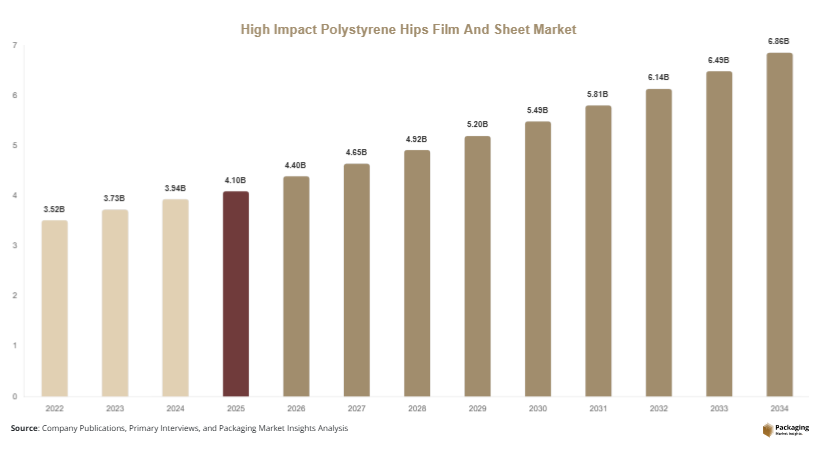
The global high impact polystyrene hips film And sheet market size was valued at approximately USD 4.1 billion in 2025 and is projected to reach around USD 4.4 billion in 2026. Over the forecast period, the market is expected to grow steadily and reach nearly USD 7.2 billion by 2034, registering a compound annual growth rate (CAGR) of 5.7% between 2025 and 2034. Increasing adoption of lightweight packaging materials and rising demand for cost-efficient plastic sheets are supporting this market expansion.
The high impact polystyrene hips film And sheet market has experienced stable growth due to increasing demand from packaging, electronics, and consumer goods industries. High Impact Polystyrene (HIPS) film and sheet products are widely used because of their balance of rigidity, impact resistance, thermoformability, and cost efficiency. These materials are commonly applied in food packaging trays, refrigerator liners, display packaging, signage boards, and protective industrial sheets. Growing urbanization and rising consumption of packaged products are supporting consistent demand across several end-use sectors.
Key Highlights
- The high impact polystyrene hips film And sheet market reached USD 4.1 billion in 2025 and is estimated to grow to USD 4.4 billion in 2026.
- The market is forecast to reach USD 7.2 billion by 2034, expanding at a CAGR of 5.7% during 2025–2034.
- Growth is mainly driven by rising demand from packaging and consumer goods industries worldwide.
Explore more data points, trends and opportunities Download Free Sample Report
Market Trends
Increasing Adoption of Thermoformed Packaging
Thermoforming has become a widely used manufacturing method for plastic packaging, and this trend is significantly influencing the high impact polystyrene hips film And sheet market. HIPS films and sheets offer excellent thermoforming properties, allowing manufacturers to produce lightweight packaging trays, containers, and clamshell packs efficiently. Food manufacturers and retailers prefer thermoformed packaging due to its ability to maintain product integrity while reducing material usage and transportation costs. As the global food supply chain expands and demand for ready-to-eat meals grows, thermoformed packaging solutions are gaining traction. This trend is encouraging packaging companies to increase production of HIPS sheets and films with improved thickness control, surface quality, and impact resistance.
Development of Recyclable and Sustainable HIPS Materials
Sustainability concerns are shaping innovation within the high impact polystyrene hips film And sheet market. Manufacturers are developing recyclable HIPS materials and integrating recycled polystyrene into production processes. Governments and regulatory authorities across several regions are encouraging plastic recycling and circular economy practices, which has pushed manufacturers to design films and sheets that meet recyclability standards. Many companies are investing in mechanical recycling technologies to recover polystyrene waste and convert it into new HIPS sheets. These developments allow manufacturers to maintain performance characteristics while reducing environmental impact. As sustainable packaging becomes a priority for consumer goods companies, demand for recyclable HIPS film and sheet solutions is expected to rise steadily.
Market Drivers
Growth of the Global Packaging Industry
The rapid expansion of the global packaging sector is a primary driver of the high impact polystyrene hips film And sheet market. Packaging manufacturers prefer HIPS materials because they offer a balance between strength, flexibility, and affordability. HIPS sheets are widely used in food packaging trays, dairy containers, and disposable cups. These products require materials that are durable yet easy to mold into complex shapes. Rising consumption of packaged food, beverages, and takeaway products is increasing the demand for reliable packaging solutions. In addition, e-commerce growth has created demand for protective packaging materials that can safeguard products during shipping. As packaging companies continue to scale production, the demand for HIPS films and sheets is expected to grow steadily.
Expanding Consumer Electronics and Appliance Production
The increasing production of consumer electronics and household appliances is also supporting market growth. HIPS sheets are commonly used for refrigerator liners, air conditioner components, television housings, and protective interior panels. These applications require materials with good impact resistance and smooth surface finish. HIPS offers both qualities at a relatively low cost compared with other engineering plastics. Rapid urbanization and rising disposable incomes in developing economies have boosted demand for household appliances such as refrigerators, washing machines, and microwaves. As electronics manufacturers expand production capacity to meet global demand, the need for durable plastic sheets continues to rise, driving growth in the high impact polystyrene hips film And sheet market.
Market Restraint
Environmental Concerns Related to Plastic Waste
Environmental concerns related to plastic waste represent a major restraint for the high impact polystyrene hips film And sheet market. Governments around the world are implementing stricter regulations on single-use plastics and non-recyclable materials. Although HIPS can be recycled, its recycling rate remains relatively low in many regions due to limitations in collection infrastructure and sorting technologies. This challenge has led to increasing scrutiny from environmental organizations and regulatory bodies.
For example, several countries in Europe and parts of North America are promoting the use of biodegradable or compostable materials in food packaging applications. These policies may limit the use of traditional polystyrene products in certain segments. Additionally, consumer awareness about plastic pollution is influencing purchasing decisions. Many brands are therefore shifting toward alternative materials such as paper-based packaging or bio-plastics.
The impact of this restraint varies by region. Developed markets with strict environmental policies are experiencing higher pressure to adopt recyclable materials and circular production models. As a result, manufacturers in the HIPS film and sheet industry must invest in recycling technologies, sustainable product designs, and improved waste management systems. While these measures help address environmental concerns, they can also increase production costs and affect profit margins for market participants.
Market Opportunities
Expansion of Food Service Packaging
The growth of the food service industry presents a major opportunity for the high impact polystyrene hips film And sheet market. Restaurants, quick-service chains, and food delivery platforms rely heavily on disposable packaging materials to maintain food quality and hygiene. HIPS sheets are widely used to produce trays, containers, lids, and portion packs. These products provide structural stability and protection during transportation. As online food delivery platforms expand globally, the demand for durable yet lightweight packaging materials is rising. Manufacturers can benefit from this trend by producing customized HIPS sheets designed specifically for thermoforming food containers.
Emerging Demand from Developing Economies
Emerging economies in Asia, Latin America, and parts of Africa are creating new growth opportunities for HIPS film and sheet manufacturers. Rapid urbanization, industrial development, and expanding retail sectors are increasing the demand for packaged consumer products. In many developing countries, modern retail infrastructure and supermarkets are growing rapidly, which leads to higher demand for packaged foods and consumer goods. HIPS materials provide a cost-effective solution for packaging and product display applications. As manufacturing industries expand in these regions, local demand for plastic films and sheets is expected to increase significantly, creating opportunities for global and regional producers.
Report Scope
| Report Metric | Details |
|---|---|
| Market Size in 2025 | USD 4.1 Billion |
| Market Size in 2026 | USD 4.4 Billion |
| Market Size in 2034 | USD 7.2 Billion |
| CAGR | 5.7% (2026-2034) |
| Base Year for Estimation | 2025 |
| Historical Data | 2022-2024 |
| Forecast Period | 2026-2034 |
| Report Coverage | Revenue Forecast, Competitive Landscape, Supply Chain Disruption, Growth Factors, Environment & Regulatory Landscape and Trends |
| Geographies Covered | North America, Europe, APAC, Middle East and Africa, LATAM |
| Countries Covered | U.S., Canada, U.K., Germany, France, Spain, Italy, Russia, Nordic, Benelux, Rest of Europe, China, South Korea, Japan, India, Australia, Singapore, Taiwan, South East Asia, Rest of Asia-Pacific, UAE, Turky, Saudi Arabia, South Africa, Egypt, Nigeria, Rest of MEA, Brazil, Mexico, Argentina, Chile, Colombia, Rest of LATAM |
Explore more data points, trends and opportunities Download Free Sample Report
Segmental Analysis
By Type
The HIPS film segment held the largest share of the high impact polystyrene hips film And sheet market in 2024, accounting for nearly 58% of total revenue. HIPS films are widely used in packaging applications because they offer good clarity, flexibility, and impact resistance. Food manufacturers commonly use these films for thermoformed trays, dairy containers, and protective packaging layers. The ability of HIPS films to maintain product structure during transportation makes them suitable for large-scale packaging operations. In addition, these films provide a smooth surface that supports printing and labeling, which is important for branding and product identification. The growing demand for packaged food products and consumer goods continues to support the dominance of the HIPS film segment.
The HIPS sheet segment is expected to be the fastest-growing type during the forecast period, registering a CAGR of about 6.2%. HIPS sheets are widely used in industrial applications, appliance manufacturing, and signage boards. These sheets provide higher structural strength compared with films and are commonly used in thermoforming processes to produce thicker components. The growing demand for durable plastic materials in refrigerator liners, appliance housings, and retail display boards is driving the expansion of this segment. As industries continue to adopt lightweight and cost-effective materials for manufacturing components, demand for HIPS sheets is expected to increase.
By Application
The packaging segment dominated the high impact polystyrene hips film And sheet market in 2024, accounting for approximately 46% of total market share. Packaging companies rely heavily on HIPS materials due to their ease of thermoforming and cost efficiency. Food packaging trays, yogurt containers, and disposable cups are common applications. These products require materials that provide structural stability and protect contents during storage and transportation. Rising consumption of packaged foods and beverages continues to increase demand for reliable packaging materials. In addition, retail companies prefer packaging materials that can be easily printed and customized for branding, which further strengthens the position of the packaging segment.
The advertising and display segment is expected to register the fastest growth, with a CAGR of nearly 6.5% during the forecast period. HIPS sheets are commonly used for point-of-sale displays, signage boards, and promotional stands. These materials provide a smooth surface suitable for printing and graphic applications. Retail stores and shopping malls frequently use HIPS boards to create promotional displays because they are lightweight and easy to shape. As global retail infrastructure expands and marketing strategies increasingly rely on in-store displays, the demand for HIPS sheets used in advertising applications is expected to rise steadily.
By End-Use Industry
The food and beverage industry accounted for the largest share of the high impact polystyrene hips film And sheet market in 2024, contributing around 42% of total demand. This sector requires reliable packaging materials that can protect food products while maintaining hygiene standards. HIPS films and sheets are widely used in packaging dairy products, ready-to-eat meals, and bakery items. The material’s durability and thermoforming capabilities allow manufacturers to produce various container shapes efficiently. As urban lifestyles continue to encourage the consumption of packaged and convenience foods, demand from the food and beverage industry remains strong.
The consumer electronics and appliances industry is expected to grow at the fastest rate, with a CAGR of approximately 6.3% through 2034. Manufacturers of refrigerators, televisions, and air conditioners frequently use HIPS sheets to produce interior components and protective housings. These materials provide impact resistance while maintaining a smooth finish suitable for aesthetic designs. Rapid growth in consumer electronics production, particularly in Asia Pacific, is expected to increase demand for durable plastic sheets used in appliance manufacturing.
High Impact Polystyrene Hips Film And Sheet Market Segmentations
Type
- HIPS Film
- HIPS Sheet
Application
- Packaging
- Advertising and Display
- Industrial Components
- Consumer Products
End-Use Industry
- Food and Beverage
- Consumer Electronics
- Appliances
- Retail and Advertising
Regional Analysis
North America
North America held a significant share of the high impact polystyrene hips film And sheet market in 2025, accounting for approximately 28% of global revenue. The region is projected to expand at a CAGR of about 4.8% during the forecast period. Stable demand from packaging and consumer electronics industries continues to support market growth. Manufacturers in the region are also investing in advanced thermoforming technologies to improve product efficiency and reduce material waste.
The United States remains the dominant country in the North American market. One key growth factor is the strong presence of food processing and packaged food industries. Large-scale food manufacturers require consistent supplies of thermoformable plastic sheets for packaging applications. The growing adoption of sustainable packaging solutions is also encouraging companies to develop recyclable HIPS sheets that meet regulatory requirements.
Europe
Europe accounted for nearly 24% of the high impact polystyrene hips film And sheet market share in 2025. The market in this region is expected to grow at a CAGR of approximately 4.5% through 2034. Demand is primarily supported by packaging, advertising displays, and appliance manufacturing sectors. European manufacturers are focusing on producing high-quality plastic sheets with improved recyclability.
Germany is a dominant country within the European market due to its strong manufacturing base. The country has a large automotive, electronics, and appliance industry that requires durable plastic components. A key growth factor in Germany is the increasing adoption of sustainable plastic processing technologies. Companies are investing in recycling infrastructure to recover polystyrene waste and convert it into new HIPS materials.
Asia Pacific
Asia Pacific represented the largest regional share of around 34% in 2025 and is expected to register the fastest CAGR of approximately 6.8% during the forecast period. Rapid industrialization, population growth, and increasing consumption of packaged goods are key drivers in this region. Many global plastic manufacturers are expanding production facilities in Asia Pacific to meet rising demand.
China is the leading country in the Asia Pacific high impact polystyrene hips film And sheet market. The country has a large manufacturing sector that includes electronics, appliances, and consumer goods. A major growth factor is the rapid expansion of the packaging industry, driven by growing e-commerce and food delivery markets. This trend continues to increase demand for thermoformable plastic sheets.
Middle East & Africa
The Middle East & Africa region accounted for about 7% of the global market in 2025. The region is projected to grow at a CAGR of around 5.2% during the forecast period. Increasing investment in manufacturing and packaging industries is supporting demand for plastic sheets and films. Several countries are developing new industrial zones to attract plastic processing companies.
The United Arab Emirates is one of the leading markets in the region. A key growth factor is the expansion of the retail and hospitality sectors. Shopping malls, restaurants, and food service businesses require reliable packaging materials and promotional display boards. This demand is encouraging local distributors to increase imports of HIPS sheets.
Latin America
Latin America held nearly 7% share of the high impact polystyrene hips film And sheet market in 2025. The market is expected to grow at a CAGR of approximately 5.4% between 2025 and 2034. Demand in the region is primarily driven by packaging applications in food and beverage industries. Growth in retail chains and supermarkets is also contributing to market expansion.
Brazil remains the dominant country in the Latin American market. The country has a large food processing industry that requires efficient packaging materials. One key growth factor is the expansion of modern retail infrastructure, which increases demand for packaged products and display packaging solutions.
Competitive Landscape
The high impact polystyrene hips film And sheet market is moderately competitive, with several global and regional manufacturers operating across multiple production facilities. Companies focus on expanding production capacity, improving material performance, and strengthening distribution networks to maintain their market presence. Many manufacturers are also investing in recyclable polystyrene technologies to align with environmental regulations and customer preferences.
One of the leading players in the market is TotalEnergies, which has a strong presence in the global polystyrene industry. The company supplies HIPS materials used in packaging and appliance manufacturing applications. Its extensive distribution network and product portfolio allow it to serve customers across several regions.
Other key companies include Trinseo, INEOS Styrolution, BASF, and SABIC. These companies are focusing on research and development to produce advanced HIPS materials with improved impact resistance and recyclability.
A notable recent development in the industry involves several companies introducing recycled polystyrene products designed for packaging applications. This initiative supports sustainability goals while maintaining material performance standards.
Overall, competition in the market is driven by product innovation, cost efficiency, and partnerships with packaging manufacturers.
Key Players List
- TotalEnergies
- INEOS Styrolution
- Trinseo
- BASF
- SABIC
- LG Chem
- Chi Mei Corporation
- Formosa Chemicals & Fibre Corporation
- Supreme Petrochem
- PS Japan Corporation
- Kumho Petrochemical
- Americas Styrenics
- Toray Industries
- Samsung SDI Chemicals
- Versalis S.p.A.