High Barrier Packaging Films For Pharmaceuticals Market Size
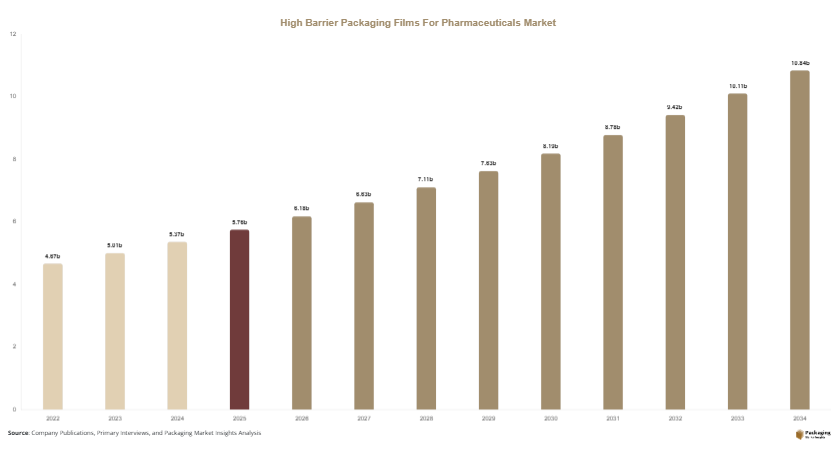
High Barrier Packaging Films For Pharmaceuticals market size is projected at USD 6.18 billion in 2026 and is expected to hit USD 10.84 billion by 2034 with a CAGR of 7.28%. The market is supported by rising pharmaceutical production, expanding sterile drug packaging requirements, and increasing investments in advanced barrier materials. The report provides detailed segmentation analysis, competitive landscape evaluation, pricing analysis, production assessment, and regional performance across major pharmaceutical manufacturing hubs.
The High Barrier Packaging Films For Pharmaceuticals Market consists of specialized multilayer flexible films designed to provide superior protection against oxygen, moisture, light, and contaminants for pharmaceutical products including tablets, capsules, injectable drugs, transdermal patches, and diagnostic devices. Global pharmaceutical packaging film production exceeded 3.8 million metric tons in 2025, while high-barrier variants accounted for nearly 41% of premium pharmaceutical flexible packaging consumption. Multilayer film adoption surpassed 68%, and recyclable high-barrier structures represented approximately 19% of newly introduced pharmaceutical packaging materials. Growing biologics manufacturing, stringent regulatory compliance, and increasing pharmaceutical exports continue to reinforce the High Barrier Packaging Films For Pharmaceuticals Market.
Explore more data points, trends and opportunities Download Free Sample Report
High Barrier Packaging Films For Pharmaceuticals Market Trends
Increasing Adoption of Sustainable High-Barrier Structures
Pharmaceutical manufacturers are increasingly replacing conventional foil-based laminates with recyclable and mono-material high-barrier films. Sustainable pharmaceutical film production exceeded 820 thousand metric tons during 2025, while recyclable barrier film adoption increased by 24% year-over-year. Investments exceeding USD 780 million were directed toward sustainable barrier film technologies, supporting pharmaceutical packaging modernization and reinforcing the High Barrier Packaging Films For Pharmaceuticals Market.
Digital coating technologies, plasma surface treatments, and advanced EVOH barrier layers are improving shelf-life performance while reducing material thickness by nearly 15%. Smart manufacturing facilities achieved production efficiency improvements of 18%, with defect rates falling below 1.8%. Demand from biologics, vaccines, and specialty drugs continues to expand rapidly, strengthening the High Barrier Packaging Films For Pharmaceuticals Market.
High Barrier Packaging Films For Pharmaceuticals Drivers
Growing Global Pharmaceutical Manufacturing Drives Demand
Global pharmaceutical manufacturing surpassed USD 1.7 trillion in output during 2025, creating substantial demand for advanced protective packaging. Prescription medicine production increased by 8.4%, while sterile injectable manufacturing expanded by 11.2%. High-performance barrier films reduce oxygen transmission below 0.1 cc/m²/day and moisture transmission below 0.05 g/m²/day, making them essential for sensitive formulations. Continuous pharmaceutical capacity expansion supports High Barrier Packaging Films For Pharmaceuticals Market demand.
High Barrier Packaging Films For Pharmaceuticals Restraints
High Production Costs and Complex Recycling
Multilayer pharmaceutical films involve sophisticated coextrusion and lamination technologies requiring capital investments exceeding USD 45 million for large production facilities. Premium raw materials contribute nearly 35% of manufacturing costs, while recycling rates for complex multilayer pharmaceutical films remain below 22% globally. Regulatory validation processes extending 12–24 months further increase commercialization costs, affecting market expansion.
High Barrier Packaging Films For Pharmaceuticals Opportunities
Expansion of Biologics and Personalized Medicine
Biologics production is projected to increase by over 10% annually, while personalized medicine packaging demand is forecast to exceed USD 45 billion by 2034. More than 65% of biologic products require ultra-high barrier packaging for stability. Investments in advanced pharmaceutical manufacturing and cold-chain infrastructure continue creating significant opportunities for barrier film producers.
Challenges in High Barrier Packaging Films For Pharmaceuticals
Balancing Performance with Sustainability
Manufacturers face increasing pressure to reduce plastic usage while maintaining barrier performance. Material qualification costs increased by nearly 17% during the past three years, while regulatory documentation requirements expanded significantly. Developing recyclable films with equivalent barrier protection remains technically demanding, requiring continuous innovation across the High Barrier Packaging Films For Pharmaceuticals Market.
Report Scope
| Report Metric | Details |
|---|---|
| Market Size in 2025 | USD 5.76 billion |
| Market Size in 2026 | USD 6.18 billion |
| Market Size in 2034 | USD 10.84 billion |
| CAGR | 7.28% (2026-2034) |
| Base Year for Estimation | 2025 |
| Historical Data | 2022-2024 |
| Forecast Period | 2026-2034 |
| Report Coverage | Revenue Forecast, Competitive Landscape, Supply Chain Disruption, Growth Factors, Environment & Regulatory Landscape and Trends |
| Geographies Covered | North America, Europe, APAC, Middle East and Africa, LATAM |
| Countries Covered | U.S., Canada, U.K., Germany, France, Spain, Italy, Russia, Nordic, Benelux, Rest of Europe, China, South Korea, Japan, India, Australia, Singapore, Taiwan, South East Asia, Rest of Asia-Pacific, UAE, Turky, Saudi Arabia, South Africa, Egypt, Nigeria, Rest of MEA, Brazil, Mexico, Argentina, Chile, Colombia, Rest of LATAM |
Explore more data points, trends and opportunities Download Free Sample Report
High Barrier Packaging Films For Pharmaceuticals Market Segmentation
The market is segmented according to material and film type. Polyethylene-based structures accounted for approximately 39% of total production, while multilayer films represented nearly 52% of global pharmaceutical barrier film consumption due to superior protection and mechanical strength.
By Material
Polyethylene
Polyethylene films contribute around 39% of production, exceeding 1.4 million metric tons annually. Their flexibility, moisture resistance, and sealability make them widely used in pharmaceutical blister lidding and pouch applications.
Polypropylene
Polypropylene accounts for approximately 34% of market volume with production surpassing 1.1 million metric tons. High clarity, chemical resistance, and sterilization compatibility support pharmaceutical packaging applications.
Polyamide
Polyamide represents nearly 27% of demand. Oxygen barrier performance, puncture resistance, and mechanical durability enable packaging for moisture-sensitive medicines, injectable products, and medical devices.
By Film Type
Multilayer Films
Multilayer films hold nearly 52% of market volume with production exceeding 2 million metric tons. Combining multiple polymers enhances barrier properties, extending pharmaceutical shelf life while improving package integrity.
Coextruded Films
Coextruded films account for approximately 28% of consumption. Advanced multi-layer extrusion provides excellent barrier performance with reduced material thickness and improved manufacturing efficiency.
Laminated Films
Laminated films contribute nearly 20% of global production. These structures combine aluminum foil and polymer layers to deliver exceptional moisture and oxygen protection for high-value pharmaceutical products.
High Barrier Packaging Films For Pharmaceuticals Market Segmentations
Material
- Polyethylene
- Polypropylene
- Polyamide
Film Type
- Multilayer Films
- Coextruded Films
- Laminated Films
Application
- Blister Packaging
- Sachet & Pouch Packaging
- Medical Device Packaging
- Injectable Drug Packaging
- Transdermal Patch Packaging
High Barrier Packaging Films For Pharmaceuticals Regional Outlook
North America
North America accounted for nearly 34% of global revenue in 2025. The United States generated over 78% of regional pharmaceutical packaging production, while Canada expanded pharmaceutical exports by 9%. Regional film production exceeded 980 thousand metric tons.
Europe
Europe represented approximately 29% of global demand. Germany, Switzerland, France, and Italy collectively contributed more than 67% of regional pharmaceutical packaging output. Sustainability initiatives accelerated recyclable barrier film adoption by 21%.
Asia-Pacific
Asia-Pacific held nearly 30% market share with China, India, Japan, and South Korea leading production. Regional pharmaceutical manufacturing expanded by 10.8%, while barrier film production surpassed 1.4 million metric tons.
Latin America
Latin America contributed around 4% of global revenue. Brazil and Mexico accounted for more than 70% of regional pharmaceutical packaging demand, supported by increasing domestic medicine manufacturing.
Middle East & Africa
The Middle East & Africa represented approximately 3% of market value. Saudi Arabia, UAE, and South Africa are investing in pharmaceutical manufacturing facilities, increasing demand for advanced barrier packaging solutions.
Top players in High Barrier Packaging Films For Pharmaceuticals
- Amcor plc
- Berry Global Inc.
- Sealed Air Corporation
- Mondi plc
- Winpak Ltd.
- Constantia Flexibles
- Huhtamaki Oyj
- UFlex Ltd.
- Toray Industries Inc.
- Coveris Holdings S.A.
- Schur Flexibles Group
- Cosmo Films Ltd.
- Kureha Corporation
- Toppan Holdings Inc.
- TekniPlex Healthcare
Amcor plc
-
Estimated market share of approximately 14% globally.
-
Strong leadership in pharmaceutical flexible packaging with extensive multilayer barrier film technologies.
-
Operates advanced manufacturing facilities across North America, Europe, and Asia-Pacific.
-
Significant investments in recyclable pharmaceutical packaging and high-performance sustainable barrier films support long-term competitive positioning.
Berry Global Inc.
-
Estimated market share of approximately 10% worldwide.
-
Broad portfolio of pharmaceutical packaging films, healthcare packaging solutions, and specialty barrier materials.
-
Focuses on lightweight structures, improved recyclability, and advanced polymer technologies.
-
Strong manufacturing footprint and long-term partnerships with pharmaceutical companies strengthen its position across regulated healthcare packaging markets.