Heavy Industry Packaging Market Size and Growth
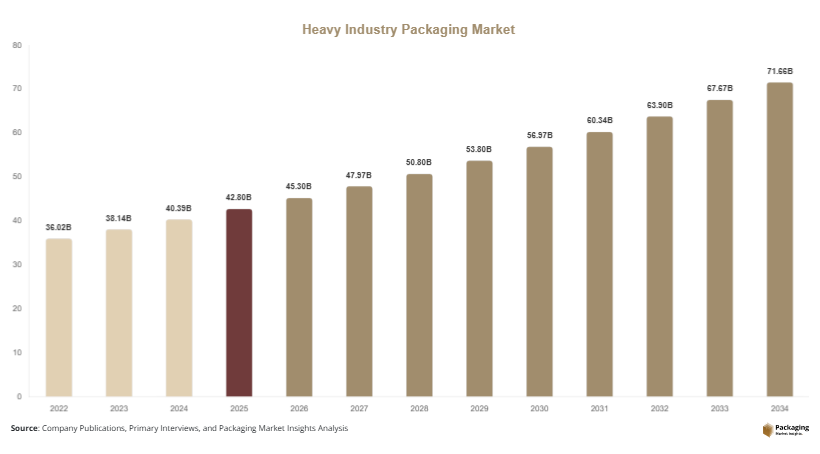
The global heavy industry packaging market size was estimated at USD 42.8 billion in 2025 and is projected to reach USD 45.3 billion in 2026, with expectations to grow to approximately USD 71.6 billion by 2034, registering a compound annual growth rate (CAGR) of 5.9% from 2025 to 2034. Heavy industry packaging plays a vital role in protecting large-scale industrial goods such as machinery, fabricated metals, chemicals, and construction materials during handling, storage, and transportation. The heavy industry packaging market is expanding steadily as global industrial production, infrastructure development, and international trade activities continue to accelerate.
A major factor supporting market growth is the rapid expansion of construction and infrastructure projects across emerging economies. Governments are investing heavily in transportation networks, urban development, and industrial facilities, which require durable and reliable packaging solutions for heavy materials. This has led to increased demand for pallets, crates, and bulk containers designed to withstand harsh environmental conditions and long transit durations.
Key Highlights:
- Asia Pacific dominated the market with a 38.6% share in 2025, while Latin America is projected to grow at the fastest CAGR of 6.3%.
- Bulk containers led the type segment with a 31.8% share, while protective films are expected to grow at a CAGR of 6.1%.
- Plastic packaging dominated with a 49.7% share, while paper-based packaging is forecasted to grow at a CAGR of 5.8%.
- Construction applications led the segment with 36.9% share, while energy sector applications are expected to grow at a CAGR of 6.4%.
- China remained the dominant country with a market size of USD 9.8 billion in 2025 and USD 10.4 billion in 2026.
Explore more data points, trends and opportunities Download Free Sample Report
Market Trends
Growing Adoption of Sustainable and Reusable Packaging Solutions
Sustainability has become a central focus in the heavy industry packaging market as companies aim to reduce environmental impact and comply with evolving regulations. Manufacturers are increasingly adopting recyclable materials such as corrugated fiberboard and reusable metal containers to minimize waste. This shift is particularly evident in developed regions where environmental compliance standards are more stringent. Reusable packaging solutions also help industries lower long-term operational costs by reducing the need for frequent replacements. Additionally, businesses are focusing on lifecycle analysis to ensure that packaging materials can be reused or recycled efficiently. This growing emphasis on sustainability is expected to influence product development strategies and drive innovation across the market.
Integration of Advanced Protective and Smart Packaging Technologies
Technological advancements are reshaping the design and functionality of heavy industry packaging. Modern packaging solutions are incorporating features such as shock absorption, moisture resistance, and anti-corrosion properties to enhance product protection. These innovations are critical for safeguarding high-value equipment during transportation and storage. Smart packaging technologies, including sensors and tracking systems, are also gaining traction as they enable real-time monitoring of environmental conditions. This helps companies reduce losses caused by damage and improve supply chain efficiency. As industries continue to adopt digital technologies, the integration of smart features in packaging solutions is expected to expand significantly.
Market Drivers
Expansion of Infrastructure and Construction Activities
The growth of infrastructure and construction projects worldwide is a major factor driving the heavy industry packaging market. Governments and private organizations are investing in transportation systems, energy facilities, and urban infrastructure, which require the movement of heavy materials and equipment. Packaging solutions such as crates, pallets, and bulk containers are essential for ensuring safe handling and transportation. As construction activities increase, the demand for durable and efficient packaging systems continues to rise. This trend is particularly strong in emerging economies where rapid urbanization is driving large-scale infrastructure development.
Increasing Global Trade and Industrial Exports
The expansion of global trade has significantly increased the need for reliable packaging solutions that can protect goods during long-distance transportation. Heavy industrial products, including machinery and components, are frequently shipped across international markets. This requires packaging systems that offer durability and resistance to environmental factors such as moisture and temperature variations. The growth of logistics networks and international trade agreements is further supporting this trend. Companies are focusing on improving packaging efficiency to reduce costs and enhance product safety, which is driving demand for advanced packaging solutions.
Market Restraint
High Cost of Raw Materials and Complex Logistics Requirements
The heavy industry packaging market faces challenges related to the high cost of raw materials such as wood, metal, and high-grade plastics. These materials are essential for producing durable packaging solutions but can significantly increase overall production costs. In addition, the logistics involved in handling and transporting heavy packaging materials are complex and require specialized equipment and infrastructure. For instance, large wooden crates used for shipping industrial machinery must be handled carefully to prevent damage, which increases operational expenses. These factors can limit the adoption of advanced packaging solutions, particularly among small and medium-sized enterprises operating with budget constraints.
Market Opportunities
Rising Demand from Renewable Energy Sector
The increasing focus on renewable energy projects is creating new growth opportunities for the heavy industry packaging market. The transportation of large components such as wind turbine blades and solar panels requires specialized packaging solutions that ensure safety and stability. As countries invest in clean energy initiatives, the demand for heavy-duty packaging systems is expected to increase. This trend is particularly prominent in regions where renewable energy projects are expanding rapidly, providing significant opportunities for packaging manufacturers.
Development of Customized and Application-Specific Packaging Solutions
The demand for customized packaging solutions is growing as industries seek packaging systems tailored to their specific requirements. Customized solutions allow companies to optimize packaging design based on product dimensions, weight, and transportation conditions. This not only improves efficiency but also reduces material waste and costs. Manufacturers are increasingly offering application-specific packaging solutions to meet the diverse needs of industries such as construction, chemicals, and energy. This trend is expected to create new avenues for market growth as industries continue to evolve.
Report Scope
| Report Metric | Details |
|---|---|
| Market Size in 2025 | USD 42.8 Billion |
| Market Size in 2026 | USD 45.3 Billion |
| Market Size in 2034 | USD 71.6 Billion |
| CAGR | 5.9% (2026-2034) |
| Base Year for Estimation | 2025 |
| Historical Data | 2022-2024 |
| Forecast Period | 2026-2034 |
| Report Coverage | Revenue Forecast, Competitive Landscape, Supply Chain Disruption, Growth Factors, Environment & Regulatory Landscape and Trends |
| Geographies Covered | North America, Europe, APAC, Middle East and Africa, LATAM |
| Countries Covered | U.S., Canada, U.K., Germany, France, Spain, Italy, Russia, Nordic, Benelux, Rest of Europe, China, South Korea, Japan, India, Australia, Singapore, Taiwan, South East Asia, Rest of Asia-Pacific, UAE, Turky, Saudi Arabia, South Africa, Egypt, Nigeria, Rest of MEA, Brazil, Mexico, Argentina, Chile, Colombia, Rest of LATAM |
Explore more data points, trends and opportunities Download Free Sample Report
Segmental Analysis
By Type
Bulk containers accounted for the largest share of the heavy industry packaging market in 2024, holding approximately 31.8% of the total market. These containers are widely used for transporting large volumes of materials such as chemicals, agricultural products, and industrial components. Their durability, strength, and ability to handle heavy loads make them a preferred choice for industries that require efficient logistics solutions. The increasing demand for bulk transportation and storage is supporting the dominance of this segment. Additionally, advancements in container design are improving their performance and usability across various industrial applications.
Protective films are expected to register the fastest growth, with a projected CAGR of 6.1% during the forecast period. These films provide an additional layer of protection against environmental factors such as moisture, dust, and corrosion. Their versatility and ease of application make them suitable for a wide range of industries. The growing need for enhanced product protection during transportation is driving the adoption of protective films. As industries continue to prioritize product safety, the demand for these solutions is expected to increase.
By Material
Plastic packaging held the largest market share in 2024, accounting for approximately 49.7%. Plastic materials are widely used due to their durability, flexibility, and cost-effectiveness. They are commonly used in the production of containers, wraps, and protective films, making them a key component of heavy industry packaging solutions. The widespread availability and versatility of plastic materials contribute to their dominance in the market.
Paper-based packaging is projected to grow at the fastest CAGR of 5.8% during the forecast period. The increasing focus on sustainability and environmental regulations is driving the adoption of paper-based materials. These materials are recyclable and biodegradable, making them an attractive option for industries seeking eco-friendly packaging solutions. As environmental concerns continue to rise, the demand for paper-based packaging is expected to grow steadily.
By Application
Construction applications dominated the heavy industry packaging market in 2024 with a share of approximately 36.9%. The need to transport heavy building materials and equipment is driving demand for durable packaging solutions in this segment. The growth of infrastructure projects worldwide is further supporting this trend, as construction activities require efficient and reliable packaging systems.
The energy sector is expected to grow at the fastest CAGR of 6.4% during the forecast period. The increasing investment in renewable energy projects is driving demand for specialized packaging solutions. These solutions are required to transport large and sensitive components safely. As the energy sector continues to expand, the demand for heavy industry packaging is expected to increase.
Heavy Industry Packaging Market Segmentations
By Type
- Bulk Containers
- Crates
- Drums
- Protective Films
By Material
- Plastic
- Metal
- Wood
- Paper & Paperboard
By Application
- Construction
- Oil & Gas
- Chemicals
- Energy
Regional Analysis
North America
North America accounted for approximately 23.9% of the global heavy industry packaging market share in 2025 and is projected to grow at a CAGR of 5.6% during the forecast period. The region benefits from a strong industrial base and advanced logistics infrastructure, which support the adoption of high-performance packaging solutions. Industries such as construction, oil & gas, and manufacturing are major contributors to market demand, as they require reliable packaging systems for heavy materials and equipment.
The United States dominates the regional market due to its large-scale industrial operations and significant export activities. A key growth factor in this region is the increasing adoption of automation in packaging processes, which enhances efficiency and reduces labor costs. This trend is encouraging companies to invest in advanced packaging technologies, thereby driving market growth.
Europe
Europe held a market share of around 21.7% in 2025 and is expected to grow at a CAGR of 5.5%. The region is characterized by strict environmental regulations and a strong focus on sustainability. These factors are encouraging the adoption of recyclable and reusable packaging materials across industries, supporting the growth of the market.
Germany leads the European market due to its strong industrial and manufacturing sectors. A unique growth factor in this region is the emphasis on eco-friendly packaging solutions, which is driving innovation in material selection and packaging design. This focus on sustainability is expected to continue influencing market dynamics.
Asia Pacific
Asia Pacific dominated the market with a 38.6% share in 2025 and is expected to grow at the highest CAGR of 6.2%. Rapid industrialization, urbanization, and expanding infrastructure projects are key factors driving market growth in this region. The presence of a large manufacturing base further supports demand for heavy industry packaging solutions.
China is the leading country in the region, supported by its strong industrial output and export-oriented economy. A unique growth factor is the rapid expansion of construction and infrastructure projects, which significantly increases the demand for durable packaging solutions for heavy materials and equipment.
Middle East & Africa
The Middle East & Africa region accounted for approximately 7.4% of the market share in 2025 and is projected to grow at a CAGR of 5.7%. The growth is supported by increasing investments in infrastructure and energy projects, which require specialized packaging solutions for heavy equipment.
Saudi Arabia is a key contributor to the regional market, driven by its focus on economic diversification and industrial development. A unique growth factor is the expansion of oil & gas projects, which increases the demand for heavy-duty packaging solutions that can handle large and complex equipment.
Latin America
Latin America held a market share of around 8.4% in 2025 and is expected to grow at the fastest CAGR of 6.3%. The region is witnessing growth in industrial and construction activities, which is driving demand for heavy industry packaging solutions.
Brazil dominates the regional market due to its expanding industrial sector and increasing export activities. A unique growth factor is the focus on export-oriented manufacturing, which requires reliable packaging solutions to ensure product safety during transportation.
Competitive Landscape
The heavy industry packaging market is moderately fragmented, with several global and regional players competing based on product quality, innovation, and pricing strategies. Companies are focusing on expanding their product portfolios and investing in advanced technologies to meet the evolving needs of industrial sectors. The competitive environment is shaped by the increasing demand for sustainable packaging solutions and the need for improved product protection.
Smurfit Kappa Group is recognized as a leading company in this market due to its strong presence in sustainable packaging solutions and extensive product portfolio. The company recently introduced a new range of heavy-duty corrugated packaging designed for industrial applications, reflecting its focus on innovation and environmental responsibility. Other major players are also investing in research and development to enhance their offerings and strengthen their market position. Strategic partnerships, acquisitions, and geographic expansion remain key strategies adopted by companies to gain a competitive advantage.
Key Players List
- Smurfit Kappa Group
- DS Smith Plc
- International Paper Company
- WestRock Company
- Greif Inc.
- Mondi Group
- Orora Limited
- Sealed Air Corporation
- Sonoco Products Company
- UFP Industries Inc.
- Mauser Packaging Solutions
- Berry Global Inc.
- Nefab Group
- Packaging Corporation of America
- Rengo Co., Ltd.