Heat Sensitive Cups Size
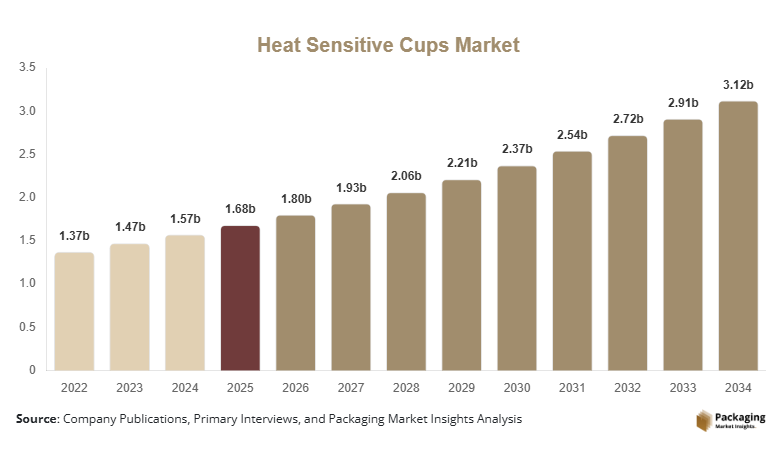
Heat Sensitive Cups market size is projected at USD 1.8 billion in 2026 and is expected to hit USD 3.1 billion by 2034 with a CAGR of 7.1%.”
The Heat Sensitive Cups Market includes cups manufactured using temperature-responsive coatings, inks, pigments, and specialty materials that display color changes when exposed to heat or cold. Global production of heat sensitive cups exceeded 2.5 billion units in 2025, supported by rising demand from coffee shops, quick-service restaurants, and branded beverage companies. Thermochromic technology accounts for nearly 55% of market applications, while disposable heat sensitive cups represent approximately 65% of total consumption. North America and Asia-Pacific collectively contribute more than 60% of global demand due to increasing café culture and customized packaging adoption. Growing consumer interaction requirements and innovative beverage packaging solutions are strengthening Heat Sensitive Cups Market growth.
Explore more data points, trends and opportunities Download Free Sample Report
Heat Sensitive Cups Market Trends
Increasing Adoption of Interactive and Smart Beverage Packaging
The Heat Sensitive Cups Market is experiencing strong adoption of interactive packaging technologies, with thermochromic-coated cups accounting for approximately 55% market penetration in 2026. Global production volumes surpassed 2.5 billion units annually, with more than 35% of manufacturers integrating temperature-responsive printing technologies. Beverage brands are increasingly using color-changing cups for customer engagement, marketing campaigns, and premium product differentiation. The adoption of digital printing and advanced coating technologies has improved durability by nearly 25%, supporting Heat Sensitive Cups Market trends.
Rising Demand from Coffee Shops and Premium Beverage Segments
The expanding café and specialty beverage industry is driving demand for heat sensitive cups, with global coffee consumption exceeding 10 billion kilograms annually and supporting higher packaging requirements. More than 40% of premium beverage brands have introduced customized temperature-responsive cups to improve customer experience. Sustainable materials, recyclable coatings, and biodegradable cup structures are gaining adoption rates of nearly 30% among manufacturers. These developments are accelerating Heat Sensitive Cups Market demand.
Heat Sensitive Cups Drivers
Growing Demand for Customized and Experiential Beverage Packaging
Increasing consumer preference for unique packaging experiences is a major driver for the Heat Sensitive Cups Market. More than 60% of beverage brands are investing in customized packaging formats, while global demand for specialty cups is growing above 7% annually. Approximately 2 billion disposable beverage cups are consumed daily worldwide, creating opportunities for innovative temperature-responsive designs. The ability to combine branding, functionality, and consumer interaction is supporting Heat Sensitive Cups Market growth.
Heat Sensitive Cups Restraints
Higher Manufacturing Costs and Limited Material Compatibility
The Heat Sensitive Cups Market faces challenges due to higher production costs associated with thermochromic coatings and specialty materials. Manufacturing costs are approximately 15–25% higher compared with conventional paper cups. Around 30% of small-scale producers experience difficulties adopting advanced temperature-sensitive printing technologies due to investment requirements. Material compatibility issues, recycling limitations, and coating durability concerns continue to restrict Heat Sensitive Cups Market expansion.
Heat Sensitive Cups Opportunities
Expansion of Sustainable and Smart Packaging Applications
The increasing focus on sustainable packaging creates new opportunities for the Heat Sensitive Cups Market. Nearly 45% of beverage packaging companies are investing in recyclable paper-based cup solutions integrated with smart coatings. Demand for eco-friendly temperature-sensitive cups is expected to grow above 8% annually through 2034. Growing adoption in events, restaurants, and promotional campaigns is creating additional opportunities for manufacturers operating in the Heat Sensitive Cups Market.
Challenges in Heat Sensitive Cups Market
Maintaining Performance While Improving Sustainability
A major challenge in the Heat Sensitive Cups Market is maintaining thermochromic performance while meeting sustainability requirements. Approximately 35% of manufacturers face difficulties balancing coating durability, recyclability, and cost efficiency. Temperature-sensitive materials must maintain accuracy within a range of 35°C–70°C while ensuring food-contact safety standards. These technical challenges influence product development strategies across the Heat Sensitive Cups Market.
Report Scope
| Report Metric | Details |
|---|---|
| Market Size in 2025 | USD 1.68 billion |
| Market Size in 2026 | USD 1.8 billion |
| Market Size in 2034 | USD 3.1 billion |
| CAGR | 7.1% (2026-2034) |
| Base Year for Estimation | 2025 |
| Historical Data | 2022-2024 |
| Forecast Period | 2026-2034 |
| Report Coverage | Revenue Forecast, Competitive Landscape, Supply Chain Disruption, Growth Factors, Environment & Regulatory Landscape and Trends |
| Geographies Covered | North America, Europe, APAC, Middle East and Africa, LATAM |
| Countries Covered | U.S., Canada, U.K., Germany, France, Spain, Italy, Russia, Nordic, Benelux, Rest of Europe, China, South Korea, Japan, India, Australia, Singapore, Taiwan, South East Asia, Rest of Asia-Pacific, UAE, Turky, Saudi Arabia, South Africa, Egypt, Nigeria, Rest of MEA, Brazil, Mexico, Argentina, Chile, Colombia, Rest of LATAM |
Explore more data points, trends and opportunities Download Free Sample Report
Heat Sensitive Cups Market Segmentation
The Heat Sensitive Cups Market segmentation is categorized by type and application. Color-changing cups dominate the market with nearly 45% share due to widespread use in promotional beverages and cafés. Food service applications contribute approximately 50% of demand, supported by increasing adoption of customized beverage packaging solutions.
By Type
Color Changing Cups
Color changing cups represent approximately 45% of the Heat Sensitive Cups Market share and are widely used for consumer engagement applications. Global production exceeds 1 billion units annually, with thermochromic ink layers ranging from 5–20 microns thickness. These cups provide visual temperature indication and are mainly adopted by coffee shops, restaurants, and beverage brands for marketing purposes.
Temperature Indicator Cups
Temperature indicator cups account for nearly 30% market share and are designed for functional temperature monitoring. More than 700 million units are produced annually using advanced heat-responsive materials. These cups are increasingly used in premium beverage services where consumers require visual confirmation of beverage temperature.
Thermochromic Cups
Thermochromic cups contribute approximately 25% market share and utilize specialized pigments that react between specific temperature ranges. Production volumes exceed 600 million units annually, with applications expanding in promotional campaigns and specialty beverage packaging. Improved coating technologies have increased product lifespan by nearly 20%.
By Application
Food Service
Food service applications dominate with nearly 50% market share due to increasing adoption in cafés, restaurants, and quick-service chains. More than 1.2 billion heat sensitive cups are consumed annually in food service environments. These cups improve customer experience by providing interactive packaging features while supporting brand recognition.
Beverage Industry
The beverage industry contributes around 35% share, driven by coffee, tea, and specialty drink manufacturers. More than 900 million units are supplied annually to beverage companies globally. Temperature indication technology supports product differentiation, premium branding, and consumer engagement strategies.
Promotional Products
Promotional products account for nearly 15% market share and are increasingly used for corporate campaigns, events, and brand activations. Approximately 400 million customized heat sensitive cups are produced annually for promotional purposes. Companies utilize these cups to enhance visibility and create interactive marketing experiences.
Heat Sensitive Cups Market Segmentations
Type
- Color Changing Cups
- Temperature Indicator Cups
- Thermochromic Cups
Application
- Food Service
- Beverage Industry
- Promotional Products
Heat Sensitive Cups Regional Outlook
North America
North America holds approximately 38% share of the Heat Sensitive Cups Market due to strong café culture and high adoption of customized beverage packaging. The United States contributes nearly 30% of global specialty cup demand, supported by coffee chains and food service businesses. More than 900 million units are consumed annually across restaurants, cafés, and promotional applications.
Europe
Europe accounts for around 28% market share, driven by premium beverage consumption and sustainable packaging initiatives. Germany, the United Kingdom, and France collectively contribute over 65% of regional demand. Approximately 700 million heat sensitive cups are produced annually across European packaging facilities.
Asia-Pacific
Asia-Pacific represents nearly 25% share and is projected to record the fastest growth through 2034. China, Japan, and India contribute more than 70% of regional consumption due to expanding beverage markets and increasing disposable packaging demand. Regional production exceeds 600 million units annually.
Latin America and Middle East & Africa
These regions collectively account for approximately 9% market share. Brazil, Mexico, UAE, and South Africa are increasing adoption through food service expansion and promotional packaging activities. Demand is growing at nearly 6% annually across emerging markets.
Top players in Heat Sensitive Cups Market
- Huhtamaki Oyj
- Dart Container Corporation
- Graphic Packaging International LLC
- International Paper Company
- WestRock Company
- Amcor plc
- Berry Global Inc.
- Solo Cup Company
- Georgia-Pacific LLC
- Smart Packaging Solutions
Huhtamaki Oyj
-
Holds a strong position with an estimated 8–10% share in specialty beverage packaging.
-
Focuses on sustainable cup solutions and advanced printing technologies.
-
Supplies food service and beverage companies across multiple global markets.
-
Invests in recyclable materials and innovative packaging designs to improve consumer engagement.
Dart Container Corporation
-
Maintains approximately 7–9% share through extensive disposable cup manufacturing capabilities.
-
Provides customized beverage packaging solutions for restaurants, cafés, and promotional applications.
-
Operates large-scale production facilities supporting millions of cups annually.
-
Focuses on lightweight materials and functional packaging innovations.