Healthcare And Laboratory Labels Market Size
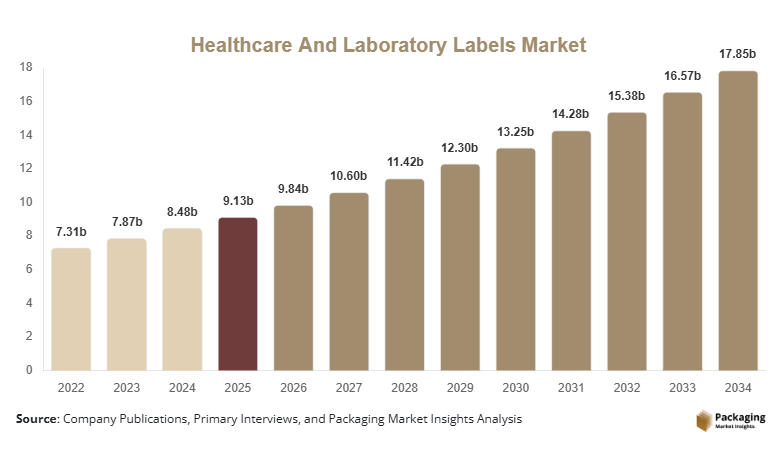
Healthcare And Laboratory Labels market size is projected at USD 9.84 billion in 2026 and is expected to hit USD 17.86 billion by 2034 with a CAGR of 7.73%. Rising demand for specimen identification, patient safety, pharmaceutical traceability, and laboratory automation continues to support market expansion. The report provides comprehensive quantitative analysis covering production volumes, segmentation, technological innovations, regional performance, and competitive landscape across the forecast period.
The healthcare and laboratory labels market comprises specialized labels designed for medical devices, pharmaceutical packaging, blood bags, laboratory specimens, diagnostic containers, and patient identification. Global production exceeded 82 billion labels during 2025, while pressure-sensitive labels accounted for approximately 56% of total output. Hospitals represented nearly 45% of market consumption, and barcode-enabled labeling adoption surpassed 78% among healthcare facilities. Increasing regulatory compliance continues driving the healthcare and laboratory labels market.
Explore more data points, trends and opportunities Download Free Sample Report
Healthcare And Laboratory Labels Market Trends
Growing Adoption of Smart Identification Technologies
Healthcare providers and laboratories continue implementing barcode and RFID labeling systems to improve patient safety and specimen tracking. More than 47 billion barcode labels were produced during 2025, while RFID label adoption increased by approximately 21% year-over-year. Automated printing technologies improved labeling accuracy by nearly 25%, supporting expansion across the healthcare and laboratory labels market.
Manufacturers are introducing chemical-resistant adhesives, cryogenic labels, and high-durability synthetic materials for demanding healthcare environments. Production exceeded 82 billion labels, while digital label printing adoption increased beyond 63% among healthcare packaging manufacturers. Technological innovation continues strengthening the healthcare and laboratory labels market.
Healthcare And Laboratory Labels Drivers
Increasing Demand for Patient Safety and Regulatory Compliance
Growing healthcare digitization and stringent labeling regulations are driving adoption of advanced identification solutions. More than 76% of hospitals utilize barcode-based patient identification systems, while laboratory automation increased by nearly 18% during 2025. Demand for accurate specimen traceability and medication labeling continues accelerating healthcare and laboratory labels market growth.
Healthcare And Laboratory Labels Restraints
High Cost of Advanced Labeling Technologies
RFID labels, specialized adhesives, and durable synthetic substrates increase manufacturing costs compared to conventional labels. RFID-enabled labels cost approximately 20–35% more than barcode alternatives, while raw material prices increased by nearly 12% during 2025. Cost-sensitive healthcare facilities may delay technology upgrades, affecting the healthcare and laboratory labels market.
Healthcare And Laboratory Labels Opportunities
Expansion of Laboratory Automation and Digital Healthcare
Healthcare digital transformation and automation create significant opportunities for advanced labeling solutions. Automated laboratory installations increased by approximately 19%, while demand for RFID-enabled sample tracking expanded by nearly 23%. Investments in precision diagnostics and electronic healthcare records continue generating opportunities across the healthcare and laboratory labels market.
Challenges in Healthcare And Laboratory Labels Market
Maintaining Label Durability Under Extreme Conditions
Healthcare labels must withstand sterilization, cryogenic storage, chemical exposure, and high humidity without losing readability. Specialized materials improve durability by approximately 28%, while production costs increase by nearly 15%. Achieving long-term adhesion and regulatory compliance remains a significant operational challenge for the healthcare and laboratory labels market.
Report Scope
| Report Metric | Details |
|---|---|
| Market Size in 2025 | USD 9.13 billion |
| Market Size in 2026 | USD 9.84 billion |
| Market Size in 2034 | USD 17.86 billion |
| CAGR | 7.73% (2026-2034) |
| Base Year for Estimation | 2025 |
| Historical Data | 2022-2024 |
| Forecast Period | 2026-2034 |
| Report Coverage | Revenue Forecast, Competitive Landscape, Supply Chain Disruption, Growth Factors, Environment & Regulatory Landscape and Trends |
| Geographies Covered | North America, Europe, APAC, Middle East and Africa, LATAM |
| Countries Covered | U.S., Canada, U.K., Germany, France, Spain, Italy, Russia, Nordic, Benelux, Rest of Europe, China, South Korea, Japan, India, Australia, Singapore, Taiwan, South East Asia, Rest of Asia-Pacific, UAE, Turky, Saudi Arabia, South Africa, Egypt, Nigeria, Rest of MEA, Brazil, Mexico, Argentina, Chile, Colombia, Rest of LATAM |
Explore more data points, trends and opportunities Download Free Sample Report
Healthcare And Laboratory Labels Market Segmentation
The market is segmented by type and application, with pressure-sensitive labels accounting for approximately 56% of total demand due to their versatility and ease of application. Hospitals contribute nearly 45% of overall consumption because of increasing patient admissions and medication labeling requirements.
By Type
Pressure-Sensitive Labels
Pressure-sensitive labels dominate the market with approximately 56% share and production exceeding 46 billion units annually. These labels provide excellent adhesion, chemical resistance, and compatibility with automated labeling systems used across hospitals and laboratories.
RFID Labels
RFID labels represent approximately 18% of market demand, with production exceeding 15 billion units annually. They enable real-time asset tracking, specimen identification, inventory management, and enhanced patient safety throughout healthcare operations.
Barcode Labels
Barcode labels account for nearly 26% of total production, exceeding 21 billion units annually. They improve identification accuracy, reduce manual errors, and facilitate laboratory workflow automation while supporting regulatory compliance.
By Application
Hospitals
Hospitals account for approximately 45% of total market demand and consume over 37 billion labels annually. Applications include patient wristbands, medication labeling, specimen tracking, blood bags, and surgical equipment identification.
Diagnostic Laboratories
Diagnostic laboratories contribute nearly 33% of market consumption with annual demand exceeding 27 billion labels. Cryogenic labels, chemical-resistant materials, and barcode technologies improve specimen management and laboratory efficiency.
Pharmaceutical Laboratories
Pharmaceutical laboratories represent approximately 22% of market demand, consuming more than 18 billion labels annually. Labels support drug development, clinical research, sample traceability, and regulatory documentation.
Healthcare And Laboratory Labels Market Segmentations
Type
- Pressure-Sensitive Labels
- RFID Labels
- Barcode Labels
Application
- Hospitals
- Diagnostic Laboratories
- Pharmaceutical Laboratories
Healthcare And Laboratory Labels Regional Outlook
North America
North America accounted for approximately 36% of global demand during 2025. The United States contributed nearly 84% of regional production, supported by advanced healthcare infrastructure and pharmaceutical manufacturing, producing over 29 billion labels annually.
Europe
Europe represented approximately 28% of total market demand. Germany, France, the United Kingdom, Italy, and Switzerland collectively produced more than 23 billion labels, driven by stringent medical labeling regulations and laboratory modernization.
Asia-Pacific
Asia-Pacific held approximately 29% market share and remained the fastest-growing regional market. China, Japan, India, South Korea, and Singapore produced over 24 billion labels, supported by expanding healthcare investments and pharmaceutical production.
Latin America, Middle East & Africa
These regions collectively accounted for approximately 7% of global demand. Brazil, Mexico, UAE, Saudi Arabia, and South Africa produced more than 6 billion labels, driven by healthcare infrastructure development and laboratory expansion.
Top players in Healthcare And Laboratory Labels Market
- CCL Industries Inc.
- Avery Dennison Corporation
- Brady Corporation
- 3M Company
- UPM Raflatac
- Multi-Color Corporation
- SATO Holdings Corporation
- Zebra Technologies Corporation
- Brother Industries, Ltd.
- Schreiner Group GmbH & Co. KG
- GA International Inc.
- Weber Packaging Solutions
- Label-Aire Inc.
- Resource Label Group LLC
- Fuji Seal International, Inc.
CCL Industries Inc.
-
Estimated global market share of approximately 14%.
-
Strong leadership in healthcare and pharmaceutical labeling solutions.
-
Extensive manufacturing network across North America, Europe, and Asia-Pacific.
-
Continuous investments in RFID technologies, durable healthcare labels, digital printing, and sustainable materials strengthen its position in pharmaceutical packaging, laboratory identification, and patient safety applications while supporting global regulatory compliance.
Avery Dennison Corporation
-
Estimated global market share of approximately 12%.
-
Broad portfolio of pressure-sensitive, RFID, and barcode labeling solutions.
-
Strong partnerships with healthcare providers and pharmaceutical manufacturers.
-
Ongoing investments in intelligent labeling technologies, automation, sustainable adhesives, and advanced printing solutions enhance competitiveness across hospitals, laboratories, and medical device packaging worldwide.