Healthcare And Laboratory Label Market Size and Growth
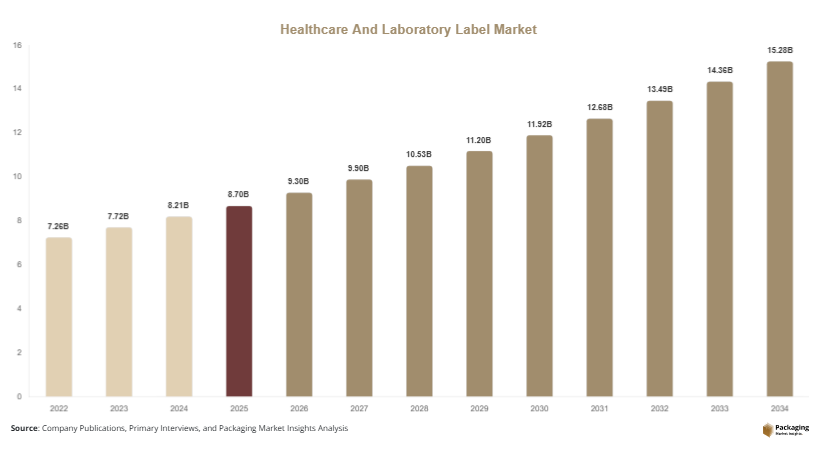
The global healthcare and laboratory label market size was valued at approximately USD 8.7 billion in 2025 and is expected to reach around USD 9.3 billion in 2026. Over the forecast period from 2025 to 2034, the market is projected to grow at a CAGR of 6.4%, reaching an estimated value of USD 16.2 billion by 2034. The growth trajectory reflects rising demand for labeling solutions that support patient safety, sample tracking, and inventory management across hospitals, diagnostic labs, and pharmaceutical companies. The healthcare and laboratory label market is witnessing steady expansion driven by the increasing need for accurate identification, traceability, and regulatory compliance across healthcare facilities and research laboratories.
One of the key growth factors includes the increasing adoption of digital healthcare systems and laboratory automation. As healthcare providers integrate electronic medical records and automated workflows, the need for high-performance labels with barcode and RFID capabilities is expanding. Another factor contributing to market growth is the rising volume of diagnostic testing and clinical research activities, particularly in emerging economies. This trend is driving demand for durable and chemical-resistant labels that can withstand harsh laboratory conditions.
Key Highlights:
- Asia Pacific dominated the market with a 38.1% share in 2025, while Latin America is projected to grow at the fastest CAGR of 6.9%.
- Pressure-sensitive labels led the type segment with a 31.4% share, while RFID labels are expected to grow at a CAGR of 7.2%.
- Plastic-based labels dominated with a 54.7% share, while paper-based labels are forecasted to grow at a CAGR of 5.8%.
- Laboratory applications led the segment with 45.6% share, while pharmaceutical labeling is expected to grow at a CAGR of 6.7%.
- The U.S. remained the dominant country with a market size of USD 2.4 billion in 2025 and USD 2.6 billion in 2026.
Explore more data points, trends and opportunities Download Free Sample Report
Market Trends
Increasing Adoption of Smart and RFID-Enabled Labels
The market is experiencing a shift toward smart labeling technologies, including RFID and barcode-integrated labels. These solutions enable real-time tracking of medical samples, pharmaceuticals, and equipment, improving operational efficiency and reducing human error. Healthcare institutions are increasingly adopting RFID-enabled labels to enhance patient identification and inventory management systems. The ability to store and retrieve data electronically supports better workflow integration and reduces the risk of mislabeling, which is critical in clinical environments. This trend is further supported by advancements in IoT and digital healthcare infrastructure, allowing seamless connectivity between labeling systems and healthcare databases.
Growing Demand for Durable and Specialized Label Materials
There is rising demand for labels that can withstand extreme environmental conditions such as low temperatures, moisture, and exposure to chemicals. Laboratories and healthcare facilities require labels that remain intact and readable during sterilization, freezing, and transportation processes. Manufacturers are focusing on developing high-performance materials such as synthetic films and advanced adhesives to meet these requirements. The increasing use of cryogenic storage and cold chain logistics in pharmaceutical and biotechnology sectors is further driving demand for specialized labels. This trend reflects the need for reliability and durability in labeling solutions to ensure accurate identification throughout the product lifecycle.
Market Drivers
Rising Demand for Accurate Identification and Patient Safety
The increasing emphasis on patient safety and error reduction is a major driver for the healthcare and laboratory label market. Accurate labeling of patient samples, medications, and medical devices is essential to prevent misdiagnosis and treatment errors. Healthcare providers are investing in advanced labeling systems that integrate with digital records and scanning technologies to ensure precision and traceability. The growing adoption of barcode and RFID systems enhances data accuracy and minimizes manual errors. As healthcare systems expand and patient volumes increase, the need for reliable labeling solutions continues to rise, supporting market growth.
Expansion of Pharmaceutical and Diagnostic Industries
The rapid growth of pharmaceutical manufacturing and diagnostic testing is significantly contributing to market expansion. The increasing production of drugs, vaccines, and biologics requires efficient labeling solutions to ensure compliance with regulatory standards and maintain product integrity. Similarly, the rise in diagnostic procedures and laboratory testing is driving demand for labels that can withstand rigorous handling and storage conditions. The expansion of research and development activities in biotechnology further supports the adoption of advanced labeling technologies. This driver highlights the critical role of labeling in ensuring quality control and traceability across healthcare operations.
Market Restraints
High Cost of Advanced Labeling Technologies and Integration
The adoption of advanced labeling technologies such as RFID and smart labels involves significant investment in equipment, software, and infrastructure. Small and medium-sized healthcare facilities and laboratories may face challenges in implementing these systems due to budget constraints. The cost of integrating labeling solutions with existing digital systems and training staff also adds to the overall expenditure. Additionally, maintaining and upgrading these technologies can be resource-intensive, limiting their adoption in cost-sensitive markets. For example, smaller diagnostic labs may rely on traditional labeling methods due to financial limitations, which can impact efficiency and accuracy. This restraint highlights the need for cost-effective solutions to support broader adoption across the industry.
Market Opportunities
Growth in Emerging Markets and Healthcare Infrastructure Development
Emerging economies are investing heavily in healthcare infrastructure, creating significant opportunities for the healthcare and laboratory label market. Countries in Asia Pacific, Latin America, and the Middle East are expanding their healthcare facilities and laboratory capabilities to meet growing population needs. This expansion is driving demand for labeling solutions that support efficient operations and compliance with international standards. The increasing adoption of modern healthcare technologies in these regions further enhances the demand for advanced labeling systems. Companies can capitalize on this opportunity by offering cost-effective and scalable solutions tailored to the needs of developing markets.
Advancements in Sustainable and Eco-Friendly Label Solutions
The growing focus on sustainability is creating opportunities for the development of eco-friendly labeling solutions. Manufacturers are exploring biodegradable materials, recyclable substrates, and environmentally friendly adhesives to reduce the environmental impact of labeling products. Healthcare institutions are increasingly adopting sustainable practices, including the use of green packaging and labeling solutions. This trend is encouraging innovation in label design and material selection, offering opportunities for companies to differentiate their products. The integration of sustainability with performance requirements is expected to drive future growth in the market.
Report Scope
| Report Metric | Details |
|---|---|
| Market Size in 2025 | USD 8.7 Billion |
| Market Size in 2026 | USD 9.3 Billion |
| Market Size in 2034 | USD 16.2 Billion |
| CAGR | 6.4% (2026-2034) |
| Base Year for Estimation | 2025 |
| Historical Data | 2022-2024 |
| Forecast Period | 2026-2034 |
| Report Coverage | Revenue Forecast, Competitive Landscape, Supply Chain Disruption, Growth Factors, Environment & Regulatory Landscape and Trends |
| Geographies Covered | North America, Europe, APAC, Middle East and Africa, LATAM |
| Countries Covered | U.S., Canada, U.K., Germany, France, Spain, Italy, Russia, Nordic, Benelux, Rest of Europe, China, South Korea, Japan, India, Australia, Singapore, Taiwan, South East Asia, Rest of Asia-Pacific, UAE, Turky, Saudi Arabia, South Africa, Egypt, Nigeria, Rest of MEA, Brazil, Mexico, Argentina, Chile, Colombia, Rest of LATAM |
Explore more data points, trends and opportunities Download Free Sample Report
Segmental Analysis
Type
Pressure-sensitive labels dominated the healthcare and laboratory label market in 2024, accounting for approximately 31.4% of the market share. These labels are widely used due to their ease of application, strong adhesion, and compatibility with various surfaces. They are commonly used in hospitals and laboratories for labeling patient samples, medical devices, and pharmaceutical products. The versatility and cost-effectiveness of pressure-sensitive labels make them a preferred choice across multiple applications. Their ability to support barcode printing and scanning further enhances their utility in healthcare settings.
RFID labels are expected to be the fastest-growing segment, with a projected CAGR of 7.2% during the forecast period. The growth is driven by the increasing adoption of smart labeling technologies in healthcare and laboratory environments. RFID labels enable real-time tracking and data management, improving efficiency and reducing errors. The integration of RFID systems with digital healthcare infrastructure supports seamless data exchange and enhances operational performance. This segment is gaining traction as healthcare providers focus on automation and advanced tracking solutions.
Material
Plastic-based labels held the largest share of around 54.7% in 2024, driven by their durability and resistance to environmental factors. These labels are widely used in applications that require high performance under challenging conditions, such as exposure to moisture, chemicals, and temperature variations. Plastic materials such as polyethylene and polypropylene offer flexibility and strength, making them suitable for a wide range of healthcare and laboratory applications. Their compatibility with advanced printing technologies further supports their dominance in the market.
Paper-based labels are expected to grow at a CAGR of 5.8% during the forecast period, driven by increasing demand for sustainable and eco-friendly solutions. These labels are commonly used in applications where environmental impact is a concern. Advances in paper coating and adhesive technologies are improving the performance of paper-based labels, making them more durable and versatile. The growing focus on sustainability in healthcare practices is supporting the adoption of these labels, creating opportunities for market growth.
Application
Laboratory applications accounted for the largest share of 45.6% in 2024, reflecting the critical role of labeling in sample identification and tracking. Laboratories require labels that can withstand harsh conditions such as freezing, sterilization, and chemical exposure. The increasing volume of diagnostic testing and research activities is driving demand for reliable labeling solutions. The integration of labeling systems with laboratory information management systems further enhances efficiency and accuracy, supporting market growth.
Pharmaceutical labeling is expected to grow at a CAGR of 6.7% during the forecast period. The growth is driven by the expanding pharmaceutical industry and increasing regulatory requirements. Labels play a crucial role in ensuring product safety, traceability, and compliance with regulations. The adoption of advanced labeling technologies such as RFID and smart labels is enhancing the efficiency of pharmaceutical operations. This segment is expected to witness steady growth as the demand for safe and compliant pharmaceutical products continues to rise.
Healthcare And Laboratory Label Market Segmentations
By Label Type
- Pressure-Sensitive Labels
- Shrink Sleeve Labels
- In-Mold Labels
- Glue-Applied Labels
By Material Type
- Paper Labels
- Plastic Labels
- Metalized Labels
- Eco-Friendly Labels
By Application
- Pharmaceutical Labeling
- Laboratory Sample Identification
- Diagnostic Equipment Labeling
- Hospital Asset Tracking
Regional Analysis
North America
North America accounted for approximately 32.5% of the healthcare and laboratory label market share in 2025 and is expected to grow at a CAGR of 5.9% during the forecast period. The region benefits from advanced healthcare infrastructure, high adoption of digital technologies, and strong regulatory frameworks. The presence of leading pharmaceutical companies and research institutions further supports market growth. Continuous investments in healthcare IT systems and automation are driving the demand for advanced labeling solutions.
The United States dominates the regional market due to its well-established healthcare system and high expenditure on medical services. A key growth factor is the increasing adoption of electronic health records and automated laboratory systems. These technologies require reliable labeling solutions to ensure accurate data management and traceability. The focus on patient safety and compliance with regulatory standards continues to drive demand in the country.
Europe
Europe held a market share of around 26.8% in 2025 and is projected to grow at a CAGR of 6.1% through 2034. The region’s growth is driven by stringent regulatory requirements and increasing healthcare investments. Countries such as Germany, the UK, and France are focusing on improving healthcare quality and efficiency, which supports the adoption of advanced labeling solutions. The expansion of pharmaceutical manufacturing and research activities also contributes to market growth.
Germany is the dominant country in the European market, supported by its strong pharmaceutical and biotechnology sectors. A unique growth factor is the emphasis on sustainability and eco-friendly labeling solutions. European regulations encourage the use of recyclable materials and environmentally responsible practices, driving innovation in label production. This focus on sustainability is shaping market dynamics in the region.
Asia Pacific
Asia Pacific led the global market with a share of 38.1% in 2025 and is expected to grow at a CAGR of 7.2% during the forecast period. Rapid urbanization, increasing healthcare expenditure, and expanding pharmaceutical industries are key factors driving growth. The region is witnessing significant investments in healthcare infrastructure and laboratory facilities, creating strong demand for labeling solutions.
China dominates the Asia Pacific market due to its large population and growing healthcare sector. A unique growth factor is the rapid expansion of diagnostic laboratories and biopharmaceutical production. Government initiatives to improve healthcare access and quality are further supporting market growth. The increasing adoption of digital technologies in healthcare is also contributing to the demand for advanced labeling solutions.
Middle East & Africa
The Middle East & Africa region accounted for approximately 6.7% of the market share in 2025 and is projected to grow at a CAGR of 6.5%. The region is experiencing gradual growth driven by investments in healthcare infrastructure and increasing awareness of patient safety. Governments are focusing on improving healthcare services, which supports the adoption of labeling solutions.
Saudi Arabia is a key market in the region, driven by government initiatives to modernize healthcare systems. A unique growth factor is the development of advanced medical facilities and research centers. These developments require efficient labeling systems to ensure accurate identification and compliance with international standards. The growing focus on healthcare quality is expected to drive market growth.
Latin America
Latin America held a market share of around 5.9% in 2025 and is expected to grow at a CAGR of 6.9%, making it one of the fastest-growing regions. The growth is driven by improving healthcare infrastructure and increasing demand for diagnostic services. Countries such as Brazil and Mexico are investing in healthcare modernization, which supports the adoption of labeling solutions.
Brazil dominates the regional market due to its large healthcare system and expanding pharmaceutical industry. A unique growth factor is the increasing focus on regulatory compliance and quality assurance. Healthcare providers are adopting advanced labeling systems to meet international standards and improve operational efficiency. This trend is expected to drive market growth in the region.
Competitive Landscape
The healthcare and laboratory label market is characterized by the presence of several global and regional players focusing on product innovation, strategic partnerships, and expansion initiatives. Companies are investing in advanced materials and technologies to enhance label performance and meet evolving industry requirements. The market is moderately consolidated, with key players competing on the basis of quality, customization, and technological capabilities.
Avery Dennison Corporation is considered a leading player in the market, known for its extensive product portfolio and strong global presence. The company has recently introduced advanced RFID labeling solutions designed for healthcare applications, enhancing tracking and data management capabilities. Other major players are focusing on expanding their production capacities and developing sustainable labeling solutions to meet growing demand. The competitive landscape reflects ongoing innovation and strategic developments aimed at strengthening market positions.
Key Players List
- Avery Dennison Corporation
- CCL Industries Inc.
- 3M Company
- Brady Corporation
- Zebra Technologies Corporation
- UPM Raflatac
- Multi-Color Corporation
- SATO Holdings Corporation
- Schreiner Group GmbH & Co. KG
- Henkel AG & Co. KGaA
- DuraFast Label Company
- Resource Label Group LLC
- Fuji Seal International, Inc.
- Label Technology, Inc.
- WS Packaging