Hazardous Label Market Size and Growth
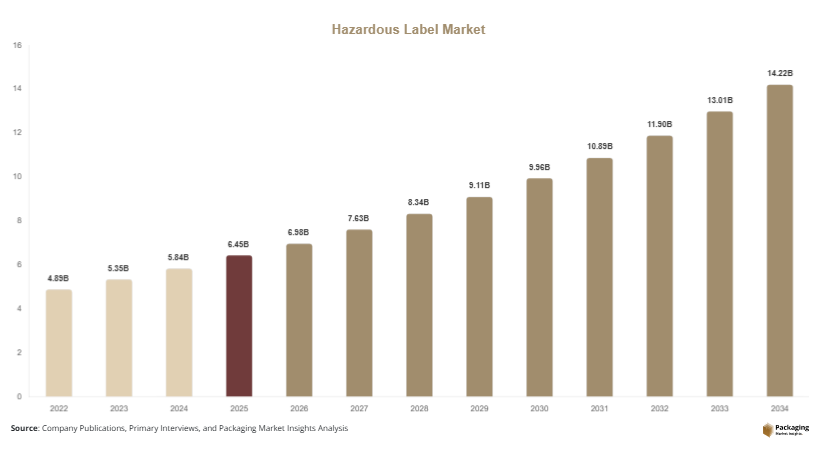
The global Hazardous Label Market size is estimated at approximately USD 6.45 billion in 2025, which is expected to reach around USD 6.98 billion in 2026. By 2034, the market is projected to attain nearly USD 14.2 billion, expanding at a CAGR of 9.3% during 2025–2034. The hazardous label market is witnessing steady expansion driven by increasing global safety regulations, rising industrial chemical usage, and strict compliance requirements across transportation and manufacturing sectors.
Growth in this market is primarily supported by the increasing need for standardized labeling of hazardous materials across logistics, chemicals, pharmaceuticals, and oil & gas industries. Regulatory frameworks such as OSHA, GHS (Globally Harmonized System), and DOT regulations are mandating clear and durable hazard communication labels, which is significantly boosting market demand. These labels ensure safe handling, storage, and transportation of dangerous substances, reducing workplace accidents and environmental risks.
Key Highlights
- Asia Pacific dominated the market with a 37.6% share in 2025.
- North America is projected to grow at the fastest CAGR of 6.8% during 2025–2034.
- GHS-Compliant Labels led the product type segment with a 44.2% share in 2025.
- Chemicals industry dominated the end-use segment with a 49.5% share in 2025.
- Polyethylene (PE) labels accounted for a 46.1% market share in 2025.
- The U.S. remained the dominant country with a market size of USD 512.4 million in 2025 and USD 548.7 million in 2026.
Explore more data points, trends and opportunities Download Free Sample Report
Market Trends
Shift Toward High-Durability and Chemical-Resistant Label Materials
A major trend shaping the hazardous label market is the growing demand for high-durability and chemically resistant label materials. Traditional paper-based labels are being replaced by synthetic materials such as polyester, polypropylene, and vinyl, which can withstand extreme temperatures, chemical exposure, and outdoor storage conditions. Industries such as chemicals, oil & gas, and pharmaceuticals require labels that remain intact and legible throughout the product lifecycle, including transportation and long-term storage. Manufacturers are also incorporating advanced adhesives that maintain bonding strength on irregular or low-energy surfaces. This shift is driven by regulatory requirements that mandate long-lasting hazard communication, ensuring safety compliance even under harsh industrial environments.
Integration of Smart and Digital Labeling Technologies
Another key trend is the integration of smart labeling technologies, including QR codes, RFID tags, and digital tracking systems into hazardous labels. These technologies enhance traceability, allowing real-time access to safety data sheets and handling instructions. Smart labels improve supply chain visibility and reduce human error during handling and transportation of hazardous materials. Digital printing advancements are enabling on-demand label customization, improving operational efficiency for manufacturers. This trend is particularly strong in logistics-heavy industries where tracking hazardous materials across multiple locations is critical for compliance and safety management.
Market Drivers
Stringent Global Safety and Environmental Regulations
One of the primary drivers of the hazardous label market is the increasing enforcement of global safety regulations. Organizations such as OSHA, EPA, and the European Chemicals Agency mandate strict labeling requirements for hazardous substances. The Globally Harmonized System (GHS) has standardized classification and labeling rules across countries, significantly boosting global adoption. These regulations require clear hazard identification, pictograms, and warning statements on chemical containers and transport packaging. Industries that fail to comply face heavy penalties and legal consequences, encouraging widespread adoption of compliant labeling solutions. As industrial safety standards continue to tighten, demand for durable and standardized hazard labels is expected to rise significantly.
Expansion of Chemical, Pharmaceutical, and Industrial Manufacturing
Another major driver is the expansion of chemical manufacturing, pharmaceuticals, and industrial production activities worldwide. The increasing production and transportation of hazardous materials require proper labeling to ensure safe handling across the supply chain. Pharmaceutical companies rely heavily on hazard labels for chemical intermediates and biohazard materials, while the oil & gas sector uses them for flammable and toxic substances. Growth in industrial exports from emerging economies is further contributing to demand. As global production scales increase, the need for efficient hazard communication systems becomes more critical.
Market Restraint
High Cost of Advanced Label Materials and Compliance Systems
A key restraint in the hazardous label market is the relatively high cost associated with advanced labeling materials and compliance systems. Durable synthetic labels, chemical-resistant adhesives, and smart labeling technologies are significantly more expensive than traditional labeling solutions. Small and medium-sized enterprises often struggle to adopt these high-cost solutions, particularly in price-sensitive markets. Additionally, frequent regulatory updates require companies to continuously modify label designs, increasing operational costs. The integration of digital tracking technologies such as RFID further adds to production expenses. In developing regions, limited awareness and budget constraints also restrict the adoption of advanced hazardous labeling systems, slowing overall market penetration.
Market Opportunities
Growth in Smart Logistics and Supply Chain Digitization
The expansion of smart logistics and digital supply chain systems presents a significant opportunity for the hazardous label market. Increasing adoption of automated tracking, IoT-enabled logistics, and warehouse digitization is driving demand for intelligent labeling solutions. Hazardous labels integrated with QR codes and RFID systems allow real-time monitoring of chemical shipments and improve safety compliance. These technologies help companies reduce human errors, improve traceability, and ensure regulatory compliance across global supply chains. As logistics networks become more complex, demand for digitally enabled hazardous labeling systems is expected to grow significantly.
Rising Demand in Emerging Economies
Emerging economies in Asia Pacific, Latin America, and Africa present strong growth opportunities for hazardous label manufacturers. Rapid industrialization, expansion of chemical manufacturing, and increasing export activities are driving demand for safety-compliant labeling systems. Governments in these regions are gradually adopting international safety standards such as GHS, encouraging industries to upgrade labeling practices. Additionally, foreign investments in manufacturing sectors are introducing advanced labeling technologies to local markets. As industrial safety awareness increases, demand for cost-effective yet compliant hazardous labeling solutions is expected to rise steadily.
Report Scope
| Report Metric | Details |
|---|---|
| Market Size in 2025 | USD 6.45 Billion |
| Market Size in 2026 | USD 6.98 Billion |
| Market Size in 2034 | USD 14.2 Billion |
| CAGR | 9.3% (2026-2034) |
| Base Year for Estimation | 2025 |
| Historical Data | 2022-2024 |
| Forecast Period | 2026-2034 |
| Report Coverage | Revenue Forecast, Competitive Landscape, Supply Chain Disruption, Growth Factors, Environment & Regulatory Landscape and Trends |
| Geographies Covered | North America, Europe, APAC, Middle East and Africa, LATAM |
| Countries Covered | U.S., Canada, U.K., Germany, France, Spain, Italy, Russia, Nordic, Benelux, Rest of Europe, China, South Korea, Japan, India, Australia, Singapore, Taiwan, South East Asia, Rest of Asia-Pacific, UAE, Turky, Saudi Arabia, South Africa, Egypt, Nigeria, Rest of MEA, Brazil, Mexico, Argentina, Chile, Colombia, Rest of LATAM |
Explore more data points, trends and opportunities Download Free Sample Report
Segmental Analysis
Product Type
The Product Type segment plays a crucial role in shaping the hazardous label market, with GHS-Compliant Labels dominating the market with around 44.2% share in 2025. These labels are widely adopted across chemical, pharmaceutical, and industrial sectors due to mandatory global safety regulations. Their standardized symbols, color coding, and universal compliance structure make them essential for hazard communication in global trade. The increasing movement of hazardous materials across borders further strengthens demand for standardized labeling systems that reduce risk and improve safety communication.
Chemical Hazard Labels and Flammable Material Labels also hold significant shares, driven by their widespread usage in oil & gas, manufacturing, and logistics industries. However, the fastest-growing subsegment is Biohazard Labels, projected to grow at a CAGR of 7.6% during 2025–2034. This growth is driven by rising pharmaceutical R&D activities, vaccine production, and expansion of biotechnology and healthcare infrastructure. Increasing laboratory safety requirements and strict handling regulations for biological substances are further accelerating adoption of advanced hazard labeling solutions in medical and research environments.
Material Type
The Material Type segment is led by Polyethylene (PE) labels, accounting for approximately 46.1% share in 2025. PE labels are widely used due to their excellent chemical resistance, durability, and cost-effectiveness. These properties make them suitable for harsh industrial environments where exposure to chemicals, moisture, and temperature variations is common. Their compatibility with various printing technologies also enhances their usage in industrial packaging and logistics operations. As industries continue to expand globally, PE labels remain the preferred choice for cost-efficient hazard communication.
The fastest-growing subsegment in this category is Polyester (PET) labels, expected to expand at a CAGR of 7.2% during 2025–2034. PET labels are gaining traction due to their superior heat resistance, tear strength, and long-term durability under extreme conditions. These properties make them ideal for aerospace, pharmaceutical, and high-value chemical storage applications. Additionally, increasing demand for recyclable and environmentally friendly labeling materials is supporting PET adoption across developed markets, where sustainability regulations are becoming stricter.
End-Use Industry
The End-Use Industry segment is dominated by the Chemicals industry, which accounted for approximately 49.5% share in 2025. This dominance is driven by strict regulatory requirements for safe handling, storage, and transportation of hazardous materials. Chemical manufacturers rely heavily on standardized hazard labels to ensure compliance with global safety frameworks such as GHS. Increasing global chemical production and cross-border trade have significantly boosted the need for reliable labeling systems that ensure worker safety and regulatory compliance.
Pharmaceuticals and Oil & Gas industries also contribute significantly to market demand. However, the fastest-growing subsegment is Pharmaceuticals, projected to grow at a CAGR of 7.8% during 2025–2034. This growth is driven by increasing vaccine production, biotechnology advancements, and expansion of clinical research activities. Strict labeling requirements for biological substances, controlled drugs, and chemical compounds are further accelerating adoption. Additionally, rising healthcare infrastructure investments in emerging economies are expanding demand for advanced hazard labeling systems.
Logistics & Transportation is another rapidly expanding application area due to the global movement of hazardous goods. The need for compliance, tracking, and safety documentation is pushing adoption of smart labeling technologies such as barcode and RFID-based systems. Manufacturing and healthcare sectors also maintain steady demand due to workplace safety regulations and material handling requirements.
Hazardous Label Market Segmentations
By Product Type
- GHS-Compliant Labels
- Chemical Hazard Labels
- Flammable & Explosive Labels
- Biohazard Labels
- Radiation Warning Labels
By Material Type
- Polyethylene (PE)
- Polyester (PET)
- Vinyl Labels
- Paper-Based Labels
By End-Use Industry
- Chemicals
- Pharmaceuticals
- Oil & Gas
- Logistics & Transportation
- Manufacturing
- Healthcare
Regional Analysis
North America
North America held around 28.4% share of the hazardous label market in 2025 and is projected to grow at a CAGR of 6.8% during 2025–2034. The region’s strong position is supported by well-established chemical, pharmaceutical, oil & gas, and logistics industries that require strict compliance with safety labeling standards. Regulatory bodies such as OSHA, EPA, and DOT enforce mandatory hazardous communication rules, which significantly increases the adoption of standardized and durable labeling solutions across industrial operations. The presence of advanced manufacturing infrastructure and high workplace safety awareness further strengthens demand.
The United States dominates the North American market with a market size of USD 512.4 million in 2025 and USD 548.7 million in 2026. A key growth factor in the country is the rapid adoption of smart labeling systems, including barcode and RFID-enabled hazardous labels, which enhance traceability and safety compliance in supply chains. Canada is also expanding steadily due to growth in mining, energy production, and chemical exports. Increasing digital transformation in industrial safety management is further supporting long-term market growth across the region.
Europe
Europe accounted for approximately 26.1% share of the global hazardous label market in 2025 and is expected to grow at a CAGR of 6.5% through 2034. The region’s demand is primarily driven by strict regulatory frameworks such as REACH and CLP regulations, which enforce standardized hazard communication across chemical and industrial sectors. Europe also places strong emphasis on environmental sustainability and worker protection, which increases the adoption of compliant and eco-friendly labeling materials. The region’s mature industrial base ensures stable demand from pharmaceuticals, chemicals, and manufacturing sectors.
Germany is the leading country in Europe due to its strong chemical manufacturing and export-oriented industrial ecosystem. A key growth factor is the integration of automated labeling systems within Industry 4.0 smart factories, improving efficiency and compliance. The United Kingdom and France also contribute significantly, supported by expanding pharmaceutical production and logistics modernization. Increasing use of recyclable labeling materials is further shaping sustainable growth across European markets.
Asia Pacific
Asia Pacific dominated the global market with a 37.6% share in 2025 and is projected to expand at the fastest CAGR of 7.4% during 2025–2034. The region’s dominance is driven by rapid industrialization, large-scale chemical production, and growing export-oriented manufacturing activities. Rising safety awareness and increasing enforcement of workplace safety regulations are boosting adoption of hazardous labeling systems across industries. Expansion of pharmaceutical, chemical, and manufacturing sectors further strengthens regional demand.
China leads the Asia Pacific market due to its massive chemical production base and strong logistics infrastructure. A major growth factor is the implementation of stricter national safety labeling standards aligned with global GHS compliance. India is also experiencing strong growth due to pharmaceutical manufacturing expansion and rising industrial safety regulations. Japan and South Korea contribute through advanced manufacturing sectors where precision labeling and compliance-driven safety systems are highly important.
Middle East & Africa
The Middle East & Africa accounted for approximately 9.8% share of the hazardous label market in 2025 and is projected to grow at a CAGR of 6.2% through 2034. Growth in this region is primarily driven by expansion in oil & gas, petrochemical, and industrial infrastructure projects. Hazardous labeling is essential for safe handling, storage, and transportation of chemicals and petroleum products. Increasing investments in industrial zones and refining capacities further support demand.
Saudi Arabia dominates the regional market due to its large-scale oil production and refining activities. A key growth factor is the adoption of international safety compliance standards as part of national economic diversification strategies. The UAE is also expanding due to logistics and chemical import growth, while South Africa is witnessing gradual adoption in mining and manufacturing sectors. Increasing industrial safety awareness is expected to further support market expansion.
Latin America
Latin America held around 8.1% share of the hazardous label market in 2025 and is projected to grow at a CAGR of 6.4% during 2025–2034. The region is witnessing steady growth due to expanding chemical processing, agriculture, and manufacturing industries. Increasing implementation of workplace safety regulations and modernization of logistics infrastructure are driving adoption of standardized hazardous labeling systems. Growing export activities are also increasing demand for compliant labeling across supply chains.
Brazil is the leading country in Latin America due to its strong chemical, agricultural, and biofuel industries. A key growth factor is rising enforcement of occupational safety regulations in industrial operations. Mexico is also expanding due to manufacturing and export-oriented growth, while Argentina contributes through pharmaceutical and food processing industries. Gradual industrial modernization is expected to further support hazardous label adoption across the region.
Competitive Landscape
The hazardous label market is moderately fragmented with strong competition among global packaging and labeling solution providers. Key players include Avery Dennison Corporation, 3M Company, Brady Corporation, CCL Industries, and Labelmaster. Avery Dennison leads the market due to its extensive product portfolio and strong global distribution network. The company continues to invest in smart labeling technologies and durable materials designed for industrial applications.
Competitors are focusing on innovation in chemical-resistant adhesives, digital labeling solutions, and compliance-driven product designs. Strategic acquisitions and partnerships are also common, allowing companies to expand geographic reach and technological capabilities. The increasing demand for smart labeling systems is pushing manufacturers toward integrating RFID and QR-enabled solutions into hazardous labels.
Key Players List
- Avery Dennison Corporation
- 3M Company
- Brady Corporation
- CCL Industries
- Labelmaster
- Tesa SE
- Zebra Technologies
- Sato Holdings
- UPM Raflatac
- Coveris Holdings
- HERMA GmbH
- Flexcon Company Inc.
- Resource Label Group
- Dunmore Corporation
- Intermec Inc.