Hazardous Goods Packaging Market Size and Growth
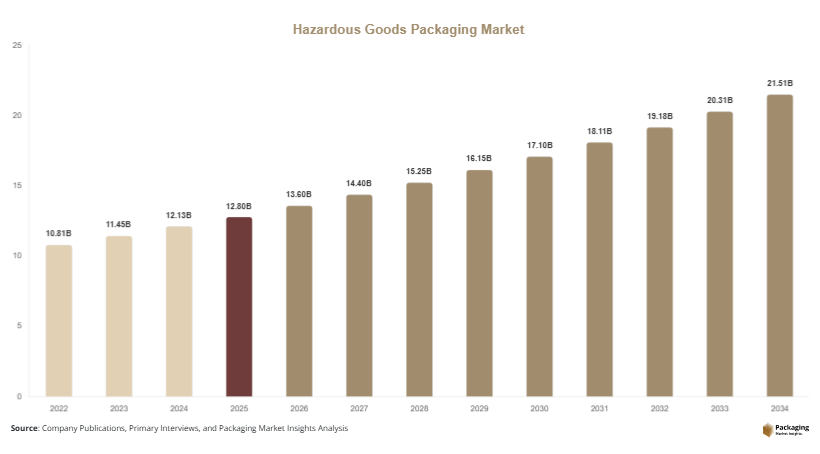
The global hazardous goods packaging market size is estimated at USD 12.8 billion in 2025, which is expected to reach approximately USD 13.6 billion in 2026. Over the forecast period from 2025 to 2034, the market is projected to reach USD 22.9 billion by 2034, growing at a CAGR of 5.9%. The hazardous goods packaging market is expanding steadily as industries handling chemicals, pharmaceuticals, oil & gas, and industrial materials require compliant and secure packaging solutions. Hazardous goods packaging is specifically designed to safely transport dangerous substances, including flammable liquids, corrosive chemicals, and toxic materials, while meeting international safety standards such as UN certification.
The market growth is closely tied to the increasing production and transportation of hazardous materials across global supply chains. As industrialization continues, the need for reliable packaging solutions that prevent leakage, contamination, and accidents becomes more critical. Hazardous goods packaging includes drums, intermediate bulk containers (IBCs), corrugated boxes with protective liners, and specialized containers designed to withstand extreme conditions.
Key Market Insights:
- Asia Pacific dominated the market with a 38.5% share in 2025.
- Latin America is projected to grow at the fastest CAGR of 6.3%.
- Drums led the type segment with a 35.2% share.
- Plastic packaging dominated with a 51.7% share.
- Chemicals applications led the segment with 46.8% share.
- China remained the dominant country with a market size of USD 2.9 billion in 2025 and USD 3.1 billion in 2026.
Explore more data points, trends and opportunities Download Free Sample Report
Market Trends
Growing adoption of sustainable and recyclable hazardous packaging solutions
Sustainability is becoming a defining trend in the hazardous goods packaging market. Manufacturers are increasingly focusing on developing recyclable, reusable, and eco-friendly packaging solutions that meet safety regulations while reducing environmental impact. For example, companies are adopting reconditioned steel drums and recyclable plastic containers for transporting hazardous materials. This reduces waste generation and supports circular economy practices.
The trend is expected to gain momentum as governments introduce stricter environmental regulations. In the future, innovations in biodegradable barrier materials and reusable packaging systems will further enhance sustainability. This shift will also influence procurement strategies across industries, encouraging long-term adoption of eco-friendly packaging solutions.
Integration of advanced safety and tracking technologies
The integration of advanced technologies is transforming hazardous goods packaging. Smart packaging solutions equipped with RFID tags, sensors, and GPS tracking systems are being used to monitor shipments in real time. These technologies help ensure compliance with safety standards and reduce risks associated with transportation.
For instance, chemical companies are using sensor-enabled containers to monitor temperature and pressure during transit. This prevents accidents and improves supply chain visibility. In the future, advancements in IoT and data analytics will enable predictive monitoring, enhancing safety and efficiency. This trend is expected to drive innovation and improve operational performance across the market.
Market Drivers
Expansion of chemical and pharmaceutical industries
The growth of chemical and pharmaceutical industries is a major factor driving the hazardous goods packaging market. These industries handle large volumes of hazardous materials that require secure and compliant packaging solutions. For example, pharmaceutical companies use specialized containers to transport sensitive and potentially dangerous substances, ensuring product integrity and safety.
As global demand for chemicals and pharmaceuticals increases, the need for reliable packaging solutions will continue to grow. This trend is particularly evident in emerging markets, where industrialization is accelerating. The expansion of these industries will remain a key driver of market growth.
Increasing regulatory compliance requirements
Stringent regulations governing the transportation of hazardous materials are another key driver of the market. Governments and international organizations have established strict guidelines to ensure the safe handling and transport of dangerous goods. Compliance with these regulations requires the use of certified packaging solutions.
For instance, companies exporting hazardous materials must use UN-approved packaging that meets specific safety standards. Failure to comply can result in penalties and operational disruptions. As regulatory frameworks become more stringent, the demand for compliant packaging solutions is expected to increase.
Market Restraint
High cost of compliant packaging solutions
The high cost associated with hazardous goods packaging is a significant challenge for the market. Packaging solutions designed to meet stringent safety standards often require advanced materials and manufacturing processes, increasing production costs. This can be a barrier for small and medium-sized enterprises.
For example, UN-certified containers and drums are more expensive than standard packaging solutions. Additionally, the need for regular testing and certification adds to the overall cost. These factors can limit adoption, particularly in cost-sensitive markets. Addressing this challenge requires cost optimization strategies and innovation in material design.
Market Opportunities
Growth in international trade of hazardous materials
The expansion of global trade presents significant opportunities for the hazardous goods packaging market. Increasing cross-border shipments of chemicals, pharmaceuticals, and industrial materials require reliable packaging solutions that comply with international standards.
For instance, exporters of industrial chemicals rely on certified packaging to ensure safe transportation. As global trade continues to grow, the demand for hazardous goods packaging will increase. Companies can capitalize on this opportunity by expanding their product offerings and improving supply chain capabilities.
Development of lightweight and high-performance packaging materials
Technological advancements in materials are creating new opportunities for the market. Manufacturers are developing lightweight packaging solutions that offer high strength and durability. These innovations reduce transportation costs and improve efficiency.
For example, advanced plastic composites are being used to create durable containers that are easier to handle and transport. In the future, the development of smart materials with enhanced barrier properties will further expand market potential. These advancements will support long-term growth and innovation.
Report Scope
| Report Metric | Details |
|---|---|
| Market Size in 2025 | USD 12.8 Billion |
| Market Size in 2026 | USD 13.6 Billion |
| Market Size in 2034 | USD 22.9 Billion |
| CAGR | 5.9% (2026-2034) |
| Base Year for Estimation | 2025 |
| Historical Data | 2022-2024 |
| Forecast Period | 2026-2034 |
| Report Coverage | Revenue Forecast, Competitive Landscape, Supply Chain Disruption, Growth Factors, Environment & Regulatory Landscape and Trends |
| Geographies Covered | North America, Europe, APAC, Middle East and Africa, LATAM |
| Countries Covered | U.S., Canada, U.K., Germany, France, Spain, Italy, Russia, Nordic, Benelux, Rest of Europe, China, South Korea, Japan, India, Australia, Singapore, Taiwan, South East Asia, Rest of Asia-Pacific, UAE, Turky, Saudi Arabia, South Africa, Egypt, Nigeria, Rest of MEA, Brazil, Mexico, Argentina, Chile, Colombia, Rest of LATAM |
Explore more data points, trends and opportunities Download Free Sample Report
Segmental Analysis
By Type
Drums dominated the market in 2024 with a 35.2% share, driven by their widespread use in transporting liquids and semi-solids. These containers are commonly used in industries such as chemicals and oil & gas due to their durability and compliance with safety standards. For example, steel and plastic drums are used to store hazardous liquids, ensuring safe transportation. The versatility and cost-effectiveness of drums make them a preferred choice for many applications.
Intermediate bulk containers (IBCs) are the fastest-growing segment, with a projected CAGR of 6.4%. These containers offer higher capacity and improved efficiency compared to traditional drums. The growth is driven by increasing demand for bulk transportation solutions. Future advancements in material design are expected to enhance performance and expand applications.
By Material
Plastic packaging dominated the market with a 51.7% share in 2024, driven by its lightweight nature and resistance to corrosion. Plastic containers are widely used in industries such as chemicals and pharmaceuticals. For instance, manufacturers use plastic packaging to transport hazardous liquids due to its durability and cost efficiency.
Metal packaging is the fastest-growing segment, with a CAGR of 5.8%. This growth is driven by the need for high-strength packaging solutions in demanding applications. Industries such as oil & gas rely on metal containers for transporting hazardous materials. Future advancements in coating technologies are expected to improve performance and extend product life.
By End-Use
Chemicals accounted for the largest share of 46.8% in 2024, driven by the need for safe and reliable packaging solutions. Hazardous goods packaging is widely used for storing and transporting chemical products. For example, manufacturers use certified containers to transport hazardous liquids across global markets.
Pharmaceuticals are the fastest-growing end-use segment, with a CAGR of 6.5%. The need for safe transportation of sensitive materials is driving demand. Hazardous goods packaging provides protection and compliance, making it suitable for pharmaceutical applications. As the healthcare industry expands, demand for advanced packaging solutions will increase.
Hazardous Goods Packaging Market Segmentations
By Product Type
- Drums
- Intermediate Bulk Containers
- Corrugated Boxes
- Specialty Containers
By Material
- Plastic Packaging
- Metal Packaging
- Paper & Paperboard Packaging
By End-User
- Chemicals
- Pharmaceuticals
- Oil & Gas
- Industrial Goods
Regional Analysis
North America
North America accounted for approximately 25.4% of the global market share in 2025 and is projected to grow at a CAGR of 5.3% through 2034. The region benefits from a well-established industrial base and strict regulatory frameworks governing hazardous materials. The presence of large chemical and pharmaceutical companies drives consistent demand for compliant packaging solutions. Additionally, advanced logistics infrastructure supports efficient transportation of hazardous goods. Sustainability initiatives are also influencing market trends, with companies focusing on recyclable and reusable packaging solutions.
The United States dominates the regional market due to its strong industrial output and regulatory compliance requirements. A unique growth driver is the increasing demand for specialty chemicals used in advanced manufacturing. For example, companies are adopting high-performance packaging solutions to transport sensitive materials safely. The integration of smart tracking technologies is also gaining traction, improving supply chain visibility and safety.
Europe
Europe held a 22.8% market share in 2025 and is expected to grow at a CAGR of 5.1% during the forecast period. The region’s strict environmental and safety regulations are shaping the market. Countries such as Germany, France, and the UK are leading the adoption of eco-friendly and compliant packaging solutions. The demand for recyclable hazardous goods packaging is increasing as companies aim to meet regulatory requirements.
Germany is the dominant country in the region, driven by its strong chemical industry. A unique growth driver is the emphasis on circular economy practices, which encourage the reuse and recycling of packaging materials. For instance, German companies are investing in advanced recycling technologies to improve sustainability. This trend is expected to support market growth in Europe.
Asia Pacific
Asia Pacific emerged as the largest regional market with a 38.5% share in 2025 and is projected to grow at a CAGR of 6.2%. Rapid industrialization, expanding manufacturing sectors, and increasing exports are key factors driving growth in the region. Countries such as China, India, and Japan are major contributors to market expansion. The growing demand for chemicals and pharmaceuticals is boosting the need for hazardous goods packaging.
China dominates the Asia Pacific market due to its large manufacturing base and export activities. A significant growth driver is the expansion of the chemical industry, which requires secure packaging solutions. For example, Chinese manufacturers use certified containers to transport hazardous materials globally. Government initiatives to improve industrial safety standards are also supporting market growth.
Middle East & Africa
The Middle East & Africa region accounted for 7.6% of the market share in 2025 and is expected to grow at a CAGR of 5.8%. The region’s growth is driven by increasing investments in oil and gas and infrastructure development. Countries such as the UAE and South Africa are focusing on improving logistics capabilities, boosting demand for hazardous goods packaging.
Saudi Arabia is a key market in the region, supported by its oil and gas sector. A unique growth driver is the expansion of petrochemical projects, which require durable and compliant packaging solutions. For example, companies are using specialized containers to transport hazardous liquids safely. The region is expected to witness steady growth due to ongoing industrialization.
Latin America
Latin America held a 5.7% market share in 2025 and is projected to grow at the fastest CAGR of 6.3%. The region is experiencing growth due to expanding manufacturing activities and increasing trade. Countries such as Brazil and Mexico are key contributors to market expansion. The rising demand for packaging in the chemical and pharmaceutical industries is driving growth.
Brazil dominates the regional market, supported by its large industrial base. A key growth driver is the expansion of agricultural chemicals production, which requires safe packaging solutions. For instance, companies are using certified containers to transport pesticides and fertilizers. The region’s focus on improving supply chain efficiency is expected to support market growth.
Competitive Landscape
The hazardous goods packaging market is moderately fragmented, with several global and regional players competing on innovation, compliance, and sustainability. Companies are focusing on expanding their product portfolios and investing in advanced materials to meet evolving industry requirements.
Mauser Packaging Solutions is identified as the market leader due to its extensive range of packaging solutions and strong global presence. The company has been investing in sustainable packaging and expanding its manufacturing capabilities. Other key players are adopting strategies such as mergers, acquisitions, and partnerships to strengthen their market position.
Recent developments include the introduction of lightweight containers, advancements in recycling technologies, and the integration of smart tracking systems. Companies are also focusing on digitalization to improve supply chain efficiency. These strategies are expected to drive competition and innovation in the market.
Key Players
- Mauser Packaging Solutions
- Greif, Inc.
- SCHÜTZ GmbH & Co. KGaA
- Berry Global Inc.
- Mondi Group
- International Paper Company
- DS Smith Plc
- WestRock Company
- Amcor Plc
- Hoover Ferguson Group
- Time Technoplast Ltd.
- Balmer Lawrie & Co. Ltd.
- Nefab Group
- Schutz Container Systems
- Thielmann AG