Market Overview
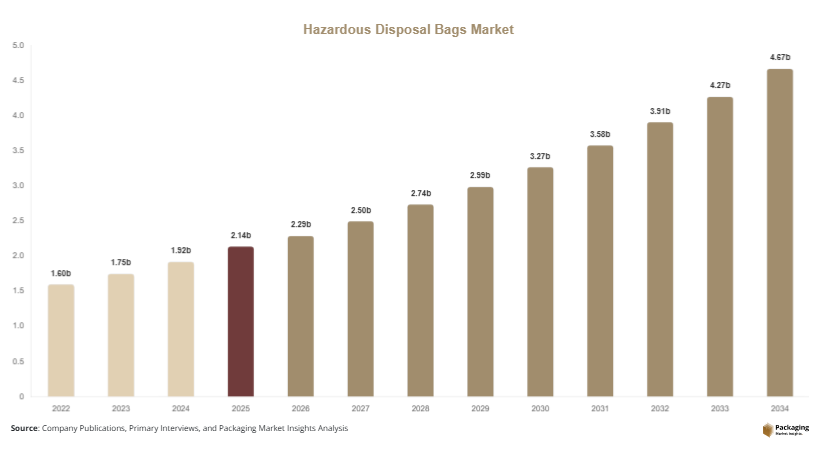
The global hazardous disposal bags market size was valued at USD 2.14 billion in 2025 and is estimated to reach USD 2.29 billion in 2026, reflecting steady industry insights into rising regulatory compliance across healthcare, industrial, and laboratory settings. The market is projected to grow from USD 2.29 billion in 2026 to USD 4.68 billion by 2034, registering a compound annual growth rate (CAGR) of 9.32% during the forecast period 2025–2034. Hazardous disposal bags, engineered from puncture-resistant, leak-proof, and often autoclavable materials, are widely used to contain biomedical waste, chemical residues, radioactive materials, and other regulated substances before treatment or final disposal.
Market growth is supported by several converging factors. First, tightening government regulations concerning biomedical and chemical waste handling are compelling hospitals, diagnostic laboratories, and pharmaceutical manufacturers to adopt certified disposal bag solutions rather than generic packaging. Second, the expansion of healthcare infrastructure in emerging economies, including new hospital construction and diagnostic center rollouts, is generating consistent downstream demand. Third, heightened awareness of occupational safety and environmental protection among industrial operators is accelerating the shift toward color-coded, standardized hazardous waste bags that reduce cross-contamination risk. Additionally, the proliferation of outpatient clinics and point-of-care testing is broadening the customer base beyond traditional hospital settings, while advances in biodegradable polymer films are opening new avenues for sustainable product innovation.
Key Highlights:
- North America dominated the hazardous disposal bags market with the largest share of 36.82% in 2025.
- Asia Pacific is expected to be the fastest-growing region in the hazardous disposal bags market during the forecast period at a CAGR of 11.47%.
- Based on material type, the low-density polyethylene (LDPE) segment dominated the market with a share of 42.65% in 2025.
- Based on bag type, biohazard bags dominated the market with a share of 38.91% in 2025.
- Based on end use, hospitals and clinics dominated the market with a share of 44.73% in 2025.
- Based on capacity, the medium-capacity bags segment (10–30 liters) dominated the market with 39.58% in 2025.
- The US hazardous disposal bags market size was valued at USD 0.71 billion in 2025 and is projected to reach USD 0.78 billion in 2026.
Explore more data points, trends and opportunities Download Free Sample Report
Market Trends
Rising Adoption of Color-Coded Segregation Systems
Healthcare facilities and industrial units are increasingly implementing standardized color-coded hazardous disposal bags to streamline waste segregation at the point of generation. Red, yellow, and black bags now correspond to specific waste categories such as infectious material, anatomical waste, and chemical residue, reducing manual sorting errors. This trend is reinforced by updated national biomedical waste management guidelines that mandate visual differentiation. Manufacturers are responding by expanding product lines with pre-printed biohazard symbols, tamper-evident seals, and multilingual labeling. This shift is improving compliance audit outcomes for hospitals while simplifying staff training, ultimately reducing the risk of workplace exposure incidents and regulatory penalties across both developed and developing healthcare markets.
Growing Demand for Biodegradable and Autoclavable Materials
Sustainability considerations are reshaping product development strategies within the hazardous disposal bags market. Manufacturers are investing in autoclavable polypropylene and biodegradable polymer blends that withstand high-temperature sterilization without compromising structural integrity. This trend addresses dual pressures: environmental regulations limiting landfill disposal of non-degradable plastics, and hospital sustainability commitments aimed at reducing overall waste footprints. Several regional health authorities are now favoring vendors offering eco-conscious packaging as part of green procurement policies. This transition is gradually increasing average selling prices but is also creating differentiated product tiers that allow manufacturers to capture premium positioning within institutional procurement contracts.
Market Drivers
Stringent Biomedical Waste Management Regulations
Government bodies across major economies have introduced increasingly rigorous frameworks governing the collection, segregation, and disposal of biomedical and hazardous waste. These regulations typically mandate the use of certified, leak-proof, and clearly labeled disposal bags at every stage of the waste management chain, from generation to final treatment. Non-compliance can result in substantial financial penalties, facility license suspensions, and reputational damage for healthcare providers. As enforcement mechanisms strengthen and inspection frequency increases, hospitals, diagnostic centers, and pharmaceutical manufacturers are prioritizing bulk procurement of standardized hazardous disposal bags, directly translating into sustained volume growth for manufacturers supplying compliant products across multiple jurisdictions.
Expansion of Healthcare Infrastructure and Diagnostic Services
The continuous expansion of hospital networks, ambulatory surgical centers, and diagnostic laboratories, particularly across Asia Pacific, Latin America, and the Middle East, is generating a proportional rise in medical waste volumes requiring safe containment. Rising incidence of chronic and infectious diseases has increased patient throughput, laboratory testing frequency, and surgical procedure counts, each contributing additional biomedical waste streams. Government investment in public health infrastructure, combined with private sector hospital chain expansion, is creating durable long-term demand for hazardous disposal bags. This infrastructure-led growth pattern provides manufacturers with predictable order volumes tied directly to regional healthcare capacity expansion timelines.
Market Restraint
The hazardous disposal bags market faces a notable restraint in the form of raw material price volatility affecting polymer-based products, particularly low-density polyethylene and polypropylene resins. These materials are petroleum derivatives, and their prices fluctuate in response to crude oil market movements, geopolitical supply disruptions, and regional trade policy changes. Manufacturers operating on thin margins within highly regulated, price-sensitive institutional procurement contracts often find it difficult to pass increased input costs directly to hospital or government buyers, many of whom operate under fixed annual procurement budgets or multi-year tender agreements. This dynamic compresses profitability, particularly for smaller regional manufacturers lacking the scale to hedge raw material purchases or negotiate favorable long-term supplier contracts. For example, sudden spikes in polyethylene resin pricing during periods of crude oil supply constraints have historically forced several mid-sized packaging producers to either absorb losses temporarily or renegotiate existing hospital supply contracts, creating friction in established buyer-supplier relationships. Additionally, the shift toward biodegradable alternatives, while environmentally favorable, often involves higher production costs and less mature supply chains, further complicating cost management for manufacturers attempting to balance sustainability goals with competitive pricing. This combination of input cost unpredictability and constrained pricing flexibility remains a persistent challenge across the industry.
Market Opportunities
Untapped Potential in Emerging Healthcare Markets
Developing economies across Southeast Asia, Africa, and Latin America are witnessing accelerated healthcare infrastructure investment, yet formal biomedical waste management practices remain inconsistently implemented in many secondary and tertiary cities. As governments in these regions gradually introduce enforceable waste management regulations modeled on international standards, a substantial addressable market is emerging for hazardous disposal bag manufacturers willing to establish local distribution partnerships. Companies that proactively engage with regional health ministries, offer training support for proper waste segregation practices, and provide cost-effective product tiers suited to public hospital budgets stand to capture early-mover advantages in markets that remain largely underpenetrated by established multinational suppliers.
Integration of Smart Tracking and Traceability Features
Growing institutional emphasis on chain-of-custody documentation for hazardous waste is creating opportunities for manufacturers to integrate QR codes, RFID tags, or barcode systems directly into disposal bag design. These features enable hospitals and waste management contractors to track waste from the point of generation through transportation and final treatment, supporting audit readiness and regulatory reporting requirements. Manufacturers that invest in smart traceability integration can differentiate their offerings within increasingly commoditized product categories, justify premium pricing, and build stickier relationships with large hospital networks and waste management service providers seeking comprehensive digital compliance solutions alongside physical containment products.
Report Scope
| Report Metric | Details |
|---|---|
| Market Size in 2025 | USD 2.14 billion |
| Market Size in 2026 | USD 2.29 billion |
| Market Size in 2034 | USD 4.68 billion |
| CAGR | 9.32% (2026-2034) |
| Base Year for Estimation | 2025 |
| Historical Data | 2022-2024 |
| Forecast Period | 2026-2034 |
| Report Coverage | Revenue Forecast, Competitive Landscape, Supply Chain Disruption, Growth Factors, Environment & Regulatory Landscape and Trends |
| Geographies Covered | North America, Europe, APAC, Middle East and Africa, LATAM |
| Countries Covered | U.S., Canada, U.K., Germany, France, Spain, Italy, Russia, Nordic, Benelux, Rest of Europe, China, South Korea, Japan, India, Australia, Singapore, Taiwan, South East Asia, Rest of Asia-Pacific, UAE, Turky, Saudi Arabia, South Africa, Egypt, Nigeria, Rest of MEA, Brazil, Mexico, Argentina, Chile, Colombia, Rest of LATAM |
Explore more data points, trends and opportunities Download Free Sample Report
Segmental Analysis
By Material Type
Low-density polyethylene (LDPE) dominated the hazardous disposal bags market by material type, accounting for approximately 42.65% share in 2025. LDPE's dominance stems from its favorable balance of flexibility, puncture resistance, and cost-effectiveness, making it the preferred choice for high-volume institutional procurement across hospitals, laboratories, and industrial facilities. The material's compatibility with heat-sealing processes and its ability to maintain structural integrity under moderate mechanical stress have made it the default specification within most national biomedical waste regulatory frameworks. Established manufacturing supply chains for LDPE resin further support consistent product availability and pricing stability, reinforcing its continued preference among cost-conscious public healthcare procurement systems, particularly across large hospital networks where bulk purchasing agreements prioritize proven material performance over premium specifications.
The biodegradable polymer segment is projected to be the fastest-growing material category, registering a CAGR of 12.85% through 2034. This accelerated growth is driven by intensifying environmental regulations restricting single-use plastic disposal in several countries, alongside hospital sustainability commitments aimed at reducing overall landfill contributions. Advances in polymer science have enabled biodegradable formulations to achieve puncture resistance and leak-proof performance comparable to conventional plastics, addressing earlier performance limitations that hindered institutional adoption. As procurement policies increasingly incorporate environmental criteria alongside safety compliance, biodegradable hazardous disposal bags are gaining traction among healthcare systems in Europe and parts of Asia Pacific actively pursuing carbon reduction targets.
By Bag Type
Biohazard bags represented the dominant bag type segment, capturing approximately 38.91% share of the hazardous disposal bags market in 2025. These bags, typically featuring the universal biohazard symbol, red or yellow coloration, and autoclave compatibility, are extensively used across hospitals, clinical laboratories, and blood banks for containing infectious waste materials. Their dominance is reinforced by near-universal regulatory mandates requiring visually distinct, clearly labeled containment for infectious medical waste across virtually all healthcare jurisdictions globally. High patient volumes across hospital emergency departments, surgical units, and diagnostic laboratories generate continuous demand for biohazard bags, positioning this segment as the foundational product category around which most manufacturers structure their broader hazardous disposal bag portfolios and regulatory certification efforts.
Chemical waste bags are emerging as the fastest-growing bag type segment, with a projected CAGR of 10.94% through the forecast period. This growth is attributed to expanding pharmaceutical manufacturing, industrial chemical processing, and research laboratory activity worldwide, each generating specialized chemical waste streams requiring containment materials resistant to corrosive substances and solvent permeation. Increasing regulatory scrutiny of industrial chemical disposal practices, combined with rising investment in pharmaceutical research and development facilities across emerging markets, is driving demand for chemically resistant disposal bags engineered with specialized barrier coatings. Manufacturers are responding with expanded product lines featuring enhanced chemical compatibility ratings and reinforced seam construction, supporting sustained growth momentum within this specialized segment as pharmaceutical and industrial buyers seek more resilient containment solutions.
By End Use
Hospitals and clinics constituted the dominant end-use segment, accounting for approximately 44.73% share of the hazardous disposal bags market in 2025. This dominance reflects the sheer scale of medical waste generation within hospital settings, encompassing surgical waste, sharps containers, pharmaceutical residues, and general infectious materials requiring continuous containment throughout daily operations. Hospitals typically operate under the strictest regulatory oversight among all end-use categories, necessitating consistent procurement of certified hazardous disposal bags across multiple departments simultaneously. The scale and complexity of hospital waste streams, combined with mandatory compliance audits, ensure this segment remains the largest and most stable demand source for manufacturers across virtually all global markets.
Diagnostic and pathology laboratories represent the fastest-growing end-use segment, projected to expand at a CAGR of 11.62% through 2034. This growth is fueled by rising diagnostic testing volumes worldwide, driven by increasing chronic disease prevalence, expanding preventive health screening programs, and growth in molecular and genomic testing services. Laboratories generate specialized waste streams, including biological specimens and chemical reagents, requiring dedicated containment solutions distinct from general hospital waste. The proliferation of standalone diagnostic chains and point-of-care testing centers, particularly across urbanizing regions in Asia Pacific and Latin America, is creating a rapidly expanding customer base that increasingly requires tailored hazardous disposal bag specifications suited to laboratory-specific waste characteristics.
Hazardous Disposal Bags Market Segmentations
Material Type
- Low-Density Polyethylene (LDPE)
- High-Density Polyethylene (HDPE)
- Polypropylene (PP)
- Biodegradable Polymers
Bag Type
- Biohazard Bags
- Sharps Disposal Bags
- Chemical Waste Bags
- Radioactive Waste Bags
- Autoclavable Bags
Capacity
- Small Capacity (Below 10 Liters)
- Medium Capacity (10–30 Liters)
- Large Capacity (Above 30 Liters)
End Use
- Hospitals and Clinics
- Diagnostic and Pathology Laboratories
- Pharmaceutical Manufacturing
- Industrial and Chemical Processing Units
- Research and Academic Institutions
Regional Analysis
North America
North America accounted for approximately 36.82% of the global hazardous disposal bags market share in 2025 and is projected to grow at a CAGR of 8.14% through 2034. The region's dominance is anchored in a mature healthcare infrastructure, well-established regulatory frameworks, and consistently high per-capita healthcare spending. Hospitals and diagnostic laboratories across the region maintain rigorous waste segregation protocols, sustaining steady demand for certified hazardous disposal bag products throughout the forecast period, while ongoing facility upgrades continue to reinforce baseline procurement volumes.
The United States remains the dominant country within the region, driven primarily by comprehensive federal and state-level biomedical waste regulations that mandate strict segregation and containment standards. A key unique growth factor is the region's extensive network of outpatient surgical centers and home healthcare providers, which has expanded the customer base for hazardous disposal bags beyond traditional hospital settings, creating diversified demand channels across ambulatory and residential care environments.
Europe
Europe held an estimated 27.36% share of the global hazardous disposal bags market in 2025, with the region expected to expand at a CAGR of 7.85% between 2025 and 2034. Demand across the region is reinforced by harmonized European Union waste directives that establish consistent labeling, containment, and disposal standards across member states, encouraging standardized procurement practices among hospitals, pharmaceutical manufacturers, and industrial waste generators operating across multiple national jurisdictions.
Germany leads the regional market, supported by its large hospital network and advanced pharmaceutical manufacturing base. A distinctive growth driver within the region is the strong regulatory push toward biodegradable and recyclable packaging materials, prompting German and broader Western European healthcare institutions to prioritize sustainable hazardous disposal bag suppliers over conventional plastic-based alternatives, thereby reshaping regional procurement preferences and vendor selection criteria across public tender processes.
Asia Pacific
Asia Pacific represented roughly 21.47% of the global hazardous disposal bags market in 2025 and is anticipated to register the fastest regional CAGR of 11.47% through 2034. This accelerated growth trajectory reflects rapid hospital construction, expanding diagnostic testing volumes, rising pharmaceutical manufacturing output, and increasing government attention toward formalizing biomedical waste management systems across both urban and semi-urban healthcare facilities.
China dominates the regional landscape, benefiting from large-scale public hospital expansion programs and growing pharmaceutical manufacturing output. A unique growth factor specific to the country is the government's ongoing rollout of centralized biomedical waste treatment facilities, which requires standardized, certified disposal bags at thousands of connected healthcare institutions, generating substantial bulk procurement opportunities for domestic and international suppliers alike.
Middle East & Africa
The Middle East & Africa region accounted for approximately 8.24% of the global hazardous disposal bags market in 2025, with projected growth at a CAGR of 9.63% through the forecast period. Market expansion is supported by increasing healthcare infrastructure investment in Gulf Cooperation Council countries alongside gradual regulatory formalization of medical waste handling practices across African healthcare systems and public hospital networks.
Saudi Arabia leads regional demand, driven by large-scale hospital modernization initiatives under national healthcare transformation programs. A distinct growth factor in this market is substantial government investment in specialized healthcare cities and medical tourism infrastructure, which requires internationally compliant waste containment systems and is driving premium hazardous disposal bag adoption well ahead of broader regional regulatory mandates and neighboring country timelines.
Latin America
Latin America held an estimated 6.11% share of the global hazardous disposal bags market in 2025 and is projected to grow at a CAGR of 8.72% between 2025 and 2034. Growth is supported by expanding private hospital networks, rising diagnostic testing volumes, and gradually strengthening national environmental and health regulatory bodies across the region's largest economies, which are progressively formalizing biomedical waste handling standards in line with international best practices.
Brazil represents the dominant country market, supported by its extensive hospital network and active pharmaceutical manufacturing sector. A unique regional growth factor is the increasing decentralization of healthcare services into secondary cities, which is extending demand for hazardous disposal bags beyond major metropolitan hospital systems into a broader base of regional clinics and diagnostic centers previously underserved by formal waste management suppliers and distribution networks.
Competitive Landscape
The hazardous disposal bags market features a moderately fragmented competitive landscape comprising global packaging manufacturers, specialized medical waste solution providers, and regional producers catering to localized regulatory requirements. Competition centers on product certification breadth, material innovation, pricing competitiveness, and distribution network strength across hospital and industrial procurement channels. Leading companies are increasingly investing in sustainable material research and expanding manufacturing capacity to meet growing institutional demand across emerging markets. Stericycle Inc. maintains a leading position within the market, supported by its extensive integrated waste management service network spanning collection, transportation, and disposal alongside its containment product offerings. The company recently expanded its biodegradable bag product line to align with tightening environmental procurement standards across North American and European healthcare systems. Other prominent participants, including Cardinal Health Inc., Thermo Fisher Scientific Inc., Berry Global Inc., and Daniels Health, continue strengthening regional manufacturing footprints and pursuing strategic partnerships with hospital group purchasing organizations to secure long-term supply agreements and expand certified product portfolios.
Key Players
- Stericycle Inc.
- Cardinal Health Inc.
- Thermo Fisher Scientific Inc.
- Berry Global Inc.
- Novolex Holdings
- Medline Industries LP
- Daniels Health
- Sharps Compliance Inc.
- Veolia Environmental Services
- Republic Services Inc.
- Clean Harbors Inc.
- International Plastics Inc.
- Poly-America LP
- Colonial Bag Corporation
- Superior Bag Manufacturing Corporation
- Inteplast Group
- Heritage Bag Company
- Terra Universal Inc.