Green Packaging Market Size and Growth
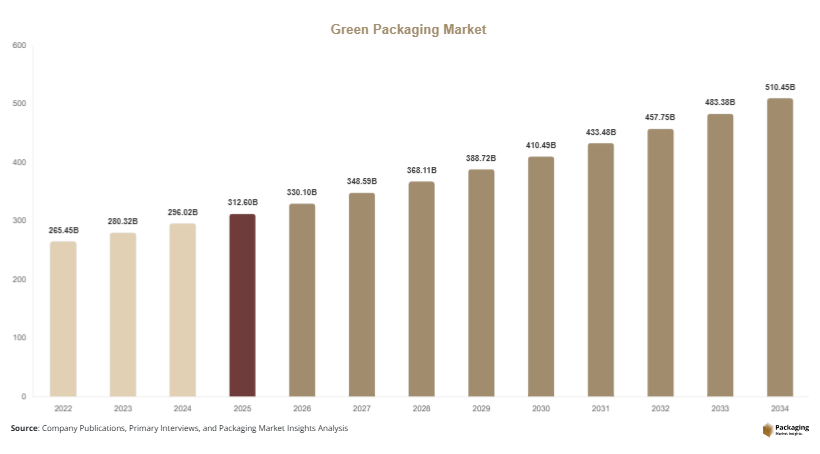
The green packaging market size was estimated at USD 312.6 billion in 2025 and is projected to reach USD 511.4 billion by 2034, expanding at a CAGR of 5.6% from 2025 to 2034. The market growth reflects increasing demand for environmentally responsible packaging solutions across food, beverage, personal care, healthcare, and e-commerce sectors. green packaging refers to packaging materials and systems designed to reduce environmental impact through recyclability, compostability, reusability, or reduced material usage.
A key global factor supporting green packaging market growth has been the increasing integration of circular economy principles into corporate supply chains. Companies across consumer goods industries have been redesigning packaging formats to reduce waste generation and carbon footprint while complying with evolving sustainability regulations. Governments and regulatory agencies have introduced stricter waste management frameworks, extended producer responsibility policies, and recycling mandates that encourage the adoption of sustainable packaging materials. In response, manufacturers have accelerated investments in recyclable plastics, molded fiber solutions, biodegradable films, and lightweight packaging formats.
Key Highlights
- Europe held the dominant regional share of 34.1% in 2025, while Asia Pacific is projected to grow at a CAGR of 6.8% during the forecast period.
- Within materials, recycled paper & paperboard accounted for 38.7% share in 2025, while biodegradable plastics are projected to grow at a CAGR of 7.4%.
- In applications, food & beverage packaging represented 46.2% of the market in 2025, while e-commerce packaging is expected to expand at a CAGR of 7.1%.
- The United States generated USD 67.3 billion in 2025 and is expected to reach USD 70.1 billion in 2026.
Explore more data points, trends and opportunities Download Free Sample Report
Market Trends
Expansion of Recyclable Paper-Based Packaging
The transition toward paper-based alternatives has become a defining trend in the green packaging market. Consumer goods companies have increasingly replaced multilayer plastics with recyclable paperboard and molded fiber packaging. Paper-based packaging offers advantages such as high recyclability, compatibility with existing recycling infrastructure, and lower carbon footprint compared with conventional plastic packaging. Packaging converters are developing water-resistant coatings and barrier technologies to improve the functionality of paper materials for food and beverage applications. As a result, paper packaging solutions are gaining adoption in takeaway food containers, beverage cartons, and retail packaging formats.
Development of Biodegradable and Compostable Materials
Another emerging trend shaping the green packaging market outlook is the commercialization of biodegradable materials derived from plant-based feedstocks. Packaging manufacturers are developing compostable films, starch-based polymers, and cellulose packaging designed to break down under industrial composting conditions. These materials are particularly attractive for single-use packaging formats in food delivery and fresh produce packaging. In addition, research initiatives are focusing on improving durability, moisture resistance, and shelf life performance. As regulatory pressure increases to reduce plastic waste, biodegradable packaging technologies are expected to influence product innovation strategies across multiple industries.
Market Drivers
Increasing Sustainability Regulations
Government policies aimed at reducing packaging waste have become a significant driver of the green packaging market. Regulatory frameworks focusing on plastic reduction, recycling targets, and landfill diversion have encouraged manufacturers to redesign packaging formats. Many jurisdictions have implemented extended producer responsibility programs requiring companies to manage post-consumer packaging waste. These regulatory initiatives have encouraged packaging manufacturers to adopt recyclable materials, lightweight packaging formats, and renewable resources.
In addition, restrictions on single-use plastics have accelerated demand for recyclable and compostable packaging solutions. Companies across retail and consumer goods sectors are responding by adopting sustainable packaging materials that meet regulatory requirements while maintaining product protection and supply chain efficiency.
Corporate Sustainability Commitments
Corporate sustainability targets established by multinational consumer goods companies have also supported green packaging market growth. Many global brands have announced commitments to achieve 100% recyclable, reusable, or compostable packaging within the next decade. These initiatives have created consistent demand for sustainable packaging solutions across multiple industries.
Companies are collaborating with packaging manufacturers to develop recyclable flexible packaging, lightweight bottles, and biodegradable containers. Sustainability reporting requirements and investor pressure have further encouraged organizations to transition toward environmentally responsible packaging systems.
Market Restraint
Higher Production Costs of Sustainable Materials
One significant challenge affecting the green packaging market is the relatively higher cost associated with sustainable packaging materials. Biodegradable polymers, compostable films, and specialized recyclable materials often require advanced manufacturing processes and raw materials that are more expensive than conventional plastics.
In addition, infrastructure limitations in recycling and composting systems create uncertainty regarding the large-scale adoption of some green packaging formats. Manufacturers must also invest in new production technologies, testing procedures, and supply chain adjustments to incorporate sustainable materials effectively.
Small and medium-sized packaging companies may face financial constraints when transitioning toward eco-friendly packaging systems. These cost barriers can slow the adoption of green packaging solutions in price-sensitive markets and industries. While technological advancements and economies of scale are expected to reduce costs gradually, price competitiveness remains an important factor influencing purchasing decisions.
Market Opportunities
Growth of Sustainable E-Commerce Packaging
The rapid expansion of e-commerce has created new opportunities for the green packaging market. Online retail generates significant packaging waste due to shipping materials, protective packaging, and delivery boxes. Retailers are increasingly seeking recyclable mailers, paper cushioning materials, and reusable packaging formats to reduce environmental impact.
Packaging companies are developing innovative designs such as lightweight corrugated boxes and recyclable protective fillers to meet sustainability targets. As global e-commerce volumes continue to expand, sustainable shipping packaging is expected to represent an important growth avenue for the market.
Advancements in Bio-Based Packaging Technologies
Research and development initiatives in bio-based materials present additional opportunities within the Green Packaging Market. Scientists and material engineers are developing polymers derived from agricultural feedstocks such as corn starch, sugarcane, and cellulose. These materials offer the potential to reduce reliance on fossil fuel-based plastics.
Bio-based packaging technologies also support circular economy models by enabling compostability and reduced carbon emissions. As material science innovations improve the performance of bio-based packaging, adoption across food packaging, cosmetics, and healthcare industries is expected to increase during the forecast period.
Report Scope
| Report Metric | Details |
|---|---|
| Market Size in 2025 | USD 312.6 Billion |
| Market Size in 2026 | USD 330.1 Billion |
| Market Size in 2034 | USD 511.4 Billion |
| CAGR | 5.6% (2026-2034) |
| Base Year for Estimation | 2025 |
| Historical Data | 2022-2024 |
| Forecast Period | 2026-2034 |
| Report Coverage | Revenue Forecast, Competitive Landscape, Supply Chain Disruption, Growth Factors, Environment & Regulatory Landscape and Trends |
| Geographies Covered | North America, Europe, APAC, Middle East and Africa, LATAM |
| Countries Covered | U.S., Canada, U.K., Germany, France, Spain, Italy, Russia, Nordic, Benelux, Rest of Europe, China, South Korea, Japan, India, Australia, Singapore, Taiwan, South East Asia, Rest of Asia-Pacific, UAE, Turky, Saudi Arabia, South Africa, Egypt, Nigeria, Rest of MEA, Brazil, Mexico, Argentina, Chile, Colombia, Rest of LATAM |
Explore more data points, trends and opportunities Download Free Sample Report
Segmental Analysis
By Material
Recycled paper & paperboard dominated the green packaging market in 2025, accounting for 38.7% of the total share. Paper-based materials have been widely used in packaging applications due to their recyclability and compatibility with existing recycling infrastructure. These materials are commonly used in food packaging, beverage cartons, and corrugated shipping boxes. Packaging manufacturers have also introduced improved coatings and barrier technologies to enhance the moisture resistance and durability of paper packaging.
Biodegradable plastics are projected to be the fastest-growing material segment with a CAGR of 7.4% during the forecast period. The growth of biodegradable plastics will be supported by increasing research into plant-based polymers derived from renewable resources such as starch and cellulose. These materials will gain adoption in applications where compostability is beneficial, including food packaging and disposable packaging formats.
By Packaging Type
Among packaging formats, recyclable packaging solutions held the dominant share of 41.5% in 2025 within the green packaging market. Recyclable packaging has gained widespread adoption due to regulatory pressure and increasing recycling infrastructure availability. Flexible packaging, bottles, and containers designed for recycling have been widely used across consumer goods industries.
Reusable packaging is expected to be the fastest-growing segment with a projected CAGR of 6.9%. The growth of reusable packaging will be supported by increasing interest in circular economy systems. Companies are developing refillable packaging formats and returnable packaging containers to reduce single-use packaging waste. Reusable packaging systems will gain adoption in sectors such as beverage distribution and retail product packaging.
By Application
The food & beverage segment dominated the green packaging market with a share of 46.2% in 2025. Sustainable packaging solutions have been widely used in food packaging applications including beverage containers, takeaway food packaging, and fresh produce packaging. The food industry has adopted recyclable paper packaging and biodegradable materials to reduce environmental impact while maintaining product safety and shelf life.
The e-commerce packaging segment will register the fastest growth with a CAGR of 7.1%. The expansion of online retail will drive demand for sustainable shipping packaging solutions such as recyclable corrugated boxes and paper cushioning materials. Companies will continue developing lightweight packaging formats to reduce transportation emissions and material usage.
By End-Use Industry
The consumer goods industry accounted for the dominant share of 32.4% in 2025 within the green packaging market. Consumer goods manufacturers have introduced sustainable packaging initiatives to reduce packaging waste and improve brand sustainability performance. Packaging solutions such as recyclable bottles, paperboard cartons, and biodegradable containers have gained adoption in personal care and household product packaging.
The healthcare sector will grow at a CAGR of 6.3% during the forecast period. Growth will be driven by the increasing adoption of environmentally responsible packaging in pharmaceutical and medical product distribution. Healthcare companies are exploring recyclable packaging materials that maintain strict product protection and sterility requirements.
Green Packaging Market Segmentations
Material
- Recycled Paper & Paperboard
- Biodegradable Plastics
- Recycled Plastics
- Glass
- Metal
Packaging Type
- Recyclable Packaging
- Reusable Packaging
- Biodegradable Packaging
Application
- Food & Beverage Packaging
- E-Commerce Packaging
- Personal Care Packaging
- Industrial Packaging
End-Use Industry
- Consumer Goods
- Food Industry
- Healthcare
- Retail
Regional Analysis
North America
North America accounted for 28.6% of the green packaging market share in 2025. The region demonstrated steady adoption of recyclable packaging formats across food, beverage, and consumer goods industries. The green packaging market in North America is projected to grow at a CAGR of 5.2% between 2025 and 2034. Increasing regulatory initiatives targeting plastic waste reduction and growing sustainability commitments among large corporations have supported regional demand for eco-friendly packaging solutions.
The United States represented the dominant country in the regional market. Growth in the country has been supported by increasing adoption of sustainable packaging in the food service and packaged food sectors. Major retail chains and consumer brands are transitioning toward recyclable packaging formats to meet sustainability goals. The expansion of sustainable packaging research programs and recycling infrastructure development has also supported market adoption.
Europe
Europe held 34.1% of the global green packaging market share in 2025, representing the largest regional market. The green packaging market in Europe will expand at a CAGR of 5.4% during the forecast period. The region’s growth has been influenced by strict environmental regulations and comprehensive waste management policies.
Germany emerged as the dominant country within the European market. The country has implemented extensive recycling systems and packaging waste reduction initiatives. Germany’s packaging legislation encourages companies to use recyclable materials and reduce packaging waste generation. As a result, packaging manufacturers in the region have invested in sustainable packaging materials including recycled paperboard, compostable plastics, and reusable packaging formats.
Asia Pacific
Asia Pacific represented 24.8% of the green packaging market in 2025. The region is expected to record the highest CAGR of 6.8% from 2025 to 2034. Rapid industrialization, urban population growth, and increasing environmental awareness have influenced the adoption of sustainable packaging solutions across the region.
China dominated the regional market due to its extensive manufacturing base and growing consumer goods industry. The country has introduced regulations focusing on reducing plastic waste and promoting recyclable packaging materials. Expansion of e-commerce and food delivery services has also created demand for sustainable packaging formats. As domestic packaging manufacturers invest in environmentally responsible materials, China is expected to remain a key contributor to regional market growth.
Middle East & Africa
The Middle East & Africa accounted for 6.3% of the green packaging market share in 2025. The market in this region will grow at a CAGR of 4.7% during the forecast period. Demand for sustainable packaging has been gradually increasing as governments and businesses focus on reducing environmental impact and improving waste management systems.
The United Arab Emirates represented the dominant country within the region. Government initiatives focusing on sustainability and environmental conservation have encouraged businesses to adopt eco-friendly packaging materials. The hospitality and food service industries in the country have increasingly introduced recyclable and biodegradable packaging formats to reduce plastic waste.
Latin America
Latin America captured 6.2% of the green packaging market share in 2025. The regional market is expected to grow at a CAGR of 5.1% from 2025 to 2034. Growing awareness regarding environmental sustainability and improving recycling initiatives have supported market expansion.
Brazil emerged as the dominant country in the region. The country’s large food and beverage industry has driven demand for sustainable packaging solutions. Brazilian packaging manufacturers have increasingly introduced recyclable paper packaging and biodegradable plastics to reduce environmental impact. In addition, government initiatives promoting recycling and waste reduction have encouraged companies to adopt eco-friendly packaging materials.
Competitive Landscape
The green packaging market features a mix of global packaging manufacturers and specialized sustainable packaging companies. Market participants are focusing on material innovation, partnerships, and capacity expansion to strengthen their market position.
Among the key players, Amcor plc has maintained a strong presence in the market through investments in recyclable and lightweight packaging technologies. The company recently introduced new recyclable flexible packaging solutions designed for food and beverage applications.
Other important companies operating in the green packaging market include Tetra Pak, Mondi Group, Smurfit Kappa Group, and Sealed Air Corporation. These companies focus on expanding sustainable material portfolios and collaborating with consumer brands to develop environmentally responsible packaging systems.
Industry competition is characterized by investments in recyclable materials, biodegradable packaging innovation, and circular packaging infrastructure.
Key Players
- Amcor plc
- Tetra Pak
- Mondi Group
- Smurfit Kappa Group
- Sealed Air Corporation
- DS Smith
- Berry Global Inc.
- International Paper
- WestRock Company
- Sonoco Products Company
- Huhtamaki Oyj
- Ball Corporation
- Ardagh Group
- Stora Enso
- Crown Holdings Inc.