Glass Prefilled Syringes And Glass Vials Packaging Equipment Market Size and Growth
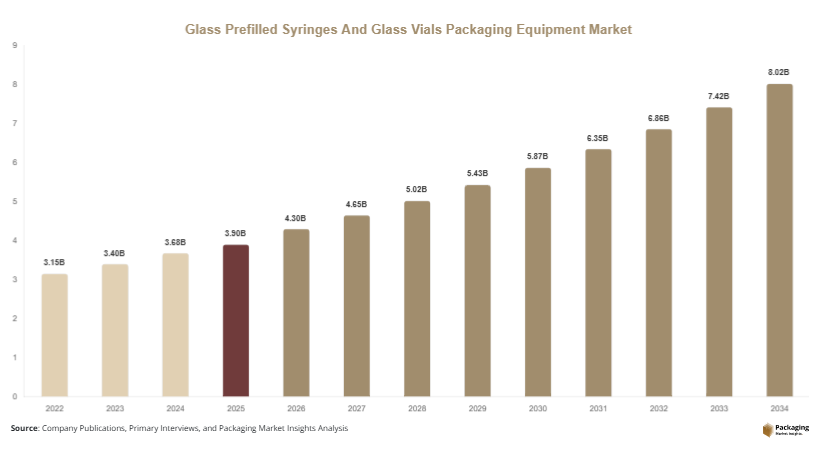
The global glass prefilled syringes and glass vials packaging equipment market is estimated at USD 3.9 billion in 2025, and it is projected to reach USD 4.3 billion in 2026. By 2034, the market is expected to reach approximately USD 8.2 billion, registering a CAGR of 8.1% (2025–2034). The expansion is driven by increasing biologics production, rising vaccine manufacturing capacity, and growing adoption of ready-to-use injectable drug delivery systems.
The glass prefilled syringes and glass vials packaging equipment market plays a critical role in the global pharmaceutical and biotechnology packaging ecosystem. This market includes advanced machinery used for washing, sterilizing, filling, sealing, and inspecting glass prefilled syringes and vials. These systems ensure sterility, accuracy, and compliance with stringent regulatory standards required for injectable drugs, vaccines, biologics, and sensitive pharmaceutical formulations. The growing demand for biologics and injectable therapies has significantly increased the need for high-precision packaging equipment capable of handling glass-based primary containers.
Key Highlights:
- Asia Pacific dominated the market with a 37.4% share in 2025.
- Latin America is projected to grow at the fastest CAGR of 6.2%.
- Aseptic filling machines led the type segment with a 34.1% share.
- Glass vials dominated with a 55.3% share.
- Pharmaceutical manufacturers led the segment with 48.6% share.
- The US remained the dominant country with a market size of USD 1.1 billion in 2025 and USD 1.3 billion in 2026.
Explore more data points, trends and opportunities Download Free Sample Report
Market Trends
Increasing Adoption of Fully Automated Aseptic Filling Lines
A major trend in the glass prefilled syringes and glass vials packaging equipment market is the rapid adoption of fully automated aseptic filling lines. Pharmaceutical manufacturers are shifting toward closed-system production environments to reduce human intervention and contamination risks. These systems integrate sterilization tunnels, robotic filling arms, and automated capping machines into a continuous production line. For example, leading vaccine manufacturers in Europe and the United States have deployed isolator-based filling systems for high-volume vaccine production. These systems ensure compliance with stringent GMP regulations while significantly improving production speed. In the future, automation will further expand through AI-driven process optimization and predictive maintenance technologies, reducing downtime and improving yield efficiency.
Rising Integration of Prefilled Syringe Technology in Biologics Delivery
Another key trend is the increasing adoption of prefilled syringe systems for biologics and injectable therapies. Prefilled syringes reduce dosage errors, improve patient convenience, and enhance drug stability. Pharmaceutical companies are increasingly investing in dedicated filling and packaging equipment designed specifically for syringe-based drug delivery systems. For instance, insulin manufacturers and oncology drug producers are adopting prefilled syringe formats to improve homecare treatment efficiency. This trend is expected to grow as self-administration of biologics becomes more common, supported by advancements in drug delivery devices and patient-centric healthcare models.
Market Drivers
Expansion of Biopharmaceutical Manufacturing
One of the primary drivers of the market is the rapid expansion of biopharmaceutical manufacturing globally. The increasing prevalence of chronic diseases such as cancer, diabetes, and autoimmune disorders has led to a surge in demand for biologic therapies. These therapies require highly controlled manufacturing environments and precision packaging systems for glass vials and syringes. For example, large-scale biologics production facilities in the United States and Switzerland are investing heavily in automated filling and sealing equipment. This expansion directly increases demand for high-performance packaging machinery capable of maintaining sterility and accuracy throughout the production process.
Growing Global Vaccine Production Capacity
Another significant driver is the expansion of global vaccine production capacity. Governments and pharmaceutical companies are investing in advanced manufacturing infrastructure to support routine immunization programs and emergency vaccine production. For example, vaccine production facilities in India and China have significantly increased their output capacity using high-speed vial filling and capping machines. These systems are essential for ensuring consistent vaccine dosage, sterility, and large-scale production efficiency. As global immunization programs expand, demand for advanced vial and syringe packaging equipment is expected to continue growing.
Market Restraint
High Cost and Complexity of Aseptic Packaging Equipment
One of the key restraints in the glass prefilled syringes and glass vials packaging equipment market is the high cost and operational complexity of aseptic packaging systems. These machines require advanced engineering, cleanroom integration, and strict regulatory compliance, significantly increasing capital investment requirements. Small and mid-sized pharmaceutical manufacturers often face financial constraints when adopting fully automated filling lines. Additionally, the need for continuous validation, maintenance, and skilled operators adds to operational costs. For example, setting up an isolator-based filling line can require substantial upfront investment, limiting adoption in cost-sensitive regions and smaller production facilities.
Market Opportunities
Expansion of Contract Manufacturing Organizations (CMOs)
The growing role of contract manufacturing organizations presents a significant opportunity for the market. Pharmaceutical companies are increasingly outsourcing drug production to CMOs to reduce costs and improve scalability. These organizations require advanced filling and packaging equipment to handle diverse drug formulations. For example, CMOs in Europe and Asia are investing in flexible aseptic filling lines capable of handling both vials and prefilled syringes. This trend is expected to continue as pharmaceutical companies focus more on core drug development while outsourcing manufacturing processes.
Adoption of Single-Use and Modular Filling Systems
Another major opportunity lies in the adoption of single-use and modular filling systems. These systems reduce cross-contamination risks, minimize cleaning requirements, and increase production flexibility. Pharmaceutical manufacturers are increasingly adopting modular equipment that can be quickly reconfigured for different drug types. For instance, modular vial filling systems are being used in clinical trial production facilities to handle small batch sizes efficiently. As personalized medicine and biologics expand, demand for flexible and scalable packaging equipment will increase significantly.
Report Scope
| Report Metric | Details |
|---|---|
| Market Size in 2025 | USD 3.9 Billion |
| Market Size in 2026 | USD 4.3 Billion |
| Market Size in 2034 | USD 8.2 Billion |
| CAGR | 8.1% (2026-2034) |
| Base Year for Estimation | 2025 |
| Historical Data | 2022-2024 |
| Forecast Period | 2026-2034 |
| Report Coverage | Revenue Forecast, Competitive Landscape, Supply Chain Disruption, Growth Factors, Environment & Regulatory Landscape and Trends |
| Geographies Covered | North America, Europe, APAC, Middle East and Africa, LATAM |
| Countries Covered | U.S., Canada, U.K., Germany, France, Spain, Italy, Russia, Nordic, Benelux, Rest of Europe, China, South Korea, Japan, India, Australia, Singapore, Taiwan, South East Asia, Rest of Asia-Pacific, UAE, Turky, Saudi Arabia, South Africa, Egypt, Nigeria, Rest of MEA, Brazil, Mexico, Argentina, Chile, Colombia, Rest of LATAM |
Explore more data points, trends and opportunities Download Free Sample Report
Segmental Analysis
By Type
Aseptic filling machines dominated with a 34.1% share in 2024, due to their critical role in maintaining sterility during vial and syringe filling. These machines are widely used in vaccine and biologics production facilities. Pharmaceutical companies rely on aseptic systems to ensure contamination-free drug packaging.
Automated inspection systems are the fastest-growing segment with a CAGR of 7.8%, driven by increasing quality control requirements. These systems use AI and machine vision to detect defects in glass containers and fill accuracy. Future adoption will increase as regulatory standards become more stringent.
By Material
Glass vials dominated with a 55.3% share in 2024, due to their chemical stability and compatibility with injectable drugs. They are widely used in vaccines and biologics packaging.
Prefilled syringe systems are the fastest-growing segment with a CAGR of 7.2%, driven by increasing demand for patient-friendly drug delivery systems and homecare treatments.
By End-Use
Pharmaceutical manufacturers dominated with a 48.6% share in 2024, due to large-scale biologics and vaccine production.
CMOs are the fastest-growing segment with a CAGR of 7.5%, driven by outsourcing trends in pharmaceutical production and demand for flexible manufacturing solutions.
Glass Prefilled Syringes And Glass Vials Packaging Equipment Market Segmentations
By Type
- Aseptic Filling Machines
- Capping & Sealing Machines
- Washing & Sterilization Systems
- Inspection Systems
- Labeling Equipment
By Material / Container Type
- Glass Vials
- Prefilled Syringes
- Ampoules
- Cartridge Systems
- Hybrid Glass-Plastic Systems
By End-Use
- Pharmaceutical Manufacturers
- Biotechnology Companies
- Contract Manufacturing Organizations (CMOs)
- Research & Clinical Laboratories
- Vaccine Production Facilities
Regional Analysis
North America
North America accounted for 29.1% market share in 2025, with a CAGR of 7.9%. The region is driven by strong pharmaceutical R&D activity, advanced biologics manufacturing, and high adoption of automation technologies. Demand is particularly strong in the United States due to its large-scale vaccine and biologics production infrastructure.
The United States dominates the region due to its extensive pharmaceutical manufacturing base. A key driver is the expansion of biologics production facilities in states like Massachusetts and California, where advanced aseptic filling systems are widely deployed for monoclonal antibody and vaccine production.
Europe
Europe held 26.4% market share in 2025, with a CAGR of 7.6%. The region benefits from strong regulatory frameworks, advanced pharmaceutical manufacturing, and high-quality production standards. Demand is driven by biologics and injectable drug production.
Germany leads the region due to its strong pharmaceutical engineering capabilities. A key driver is the widespread adoption of isolator-based aseptic filling systems in vaccine and oncology drug production facilities.
Asia Pacific
Asia Pacific dominated with 37.4% market share in 2025, and is projected to grow at a CAGR of 8.8%. Rapid expansion of pharmaceutical manufacturing, increasing vaccine production, and rising healthcare investments are key drivers.
China remains the dominant country due to its large-scale pharmaceutical production infrastructure. A key driver is the expansion of government-supported vaccine manufacturing facilities using high-speed vial filling and inspection systems.
Middle East & Africa
The region accounted for 4.8% market share in 2025, with a CAGR of 6.9%. Growth is driven by increasing healthcare investments, expansion of pharmaceutical distribution networks, and rising demand for injectable drugs.
The UAE dominates the region due to its growing pharmaceutical import and packaging infrastructure. A key driver is the development of regional vaccine filling and packaging hubs supporting healthcare supply chains.
Latin America
Latin America held 2.3% market share in 2025, with a CAGR of 6.2%, the fastest among emerging regions. Growth is driven by expanding pharmaceutical manufacturing and increasing healthcare infrastructure investments.
Brazil leads the region due to its strong pharmaceutical production base. A key driver is the rising adoption of injectable drug manufacturing supported by government healthcare expansion programs.
Competitive Landscape
The market is moderately consolidated, with key players focusing on automation, aseptic technology, and modular production systems. Major companies include Syntegon Technology GmbH, IMA Group, Bausch+Ströbel, Groninger GmbH, and Marchesini Group. Among these, Syntegon Technology GmbH leads due to its strong portfolio of aseptic filling and packaging systems.
Companies are investing in robotics integration, single-use technologies, and AI-based inspection systems. Strategic partnerships with pharmaceutical companies and CMOs are increasing to enhance production efficiency and compliance.
Key Players List
- Syntegon Technology GmbH
- IMA Group
- Bausch+Ströbel
- Groninger GmbH
- Marchesini Group
- Optima Packaging Group
- Romaco Group
- Uhlmann Group
- Bosch Packaging Technology
- Coesia Group
- Tofflon Science and Technology
- NJM Packaging
- Vanrx Pharmasystems
- SP Scientific
- Steriline S.r.l.