Glass Cosmetic Packaging Market Size and Growth
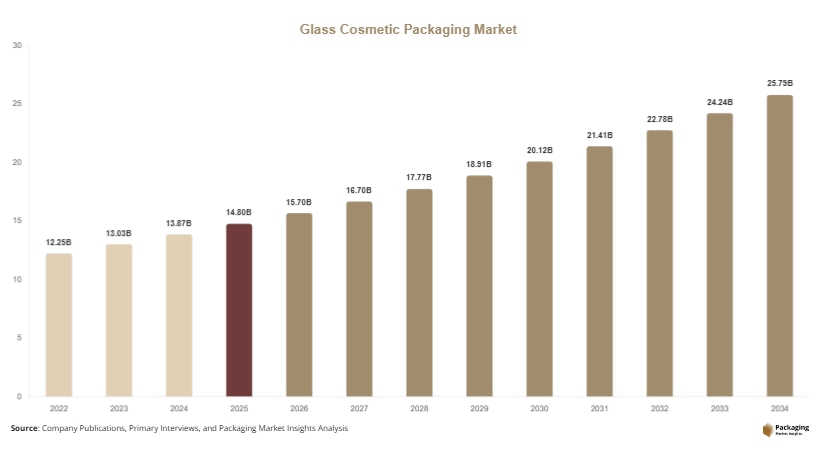
The global glass cosmetic packaging market size was valued at USD 14.8 billion in 2025 and is projected to reach USD 15.7 billion in 2026. The market is expected to attain approximately USD 25.9 billion by 2034, registering a CAGR of 6.4% during the forecast period (2025–2034). The increasing popularity of clean beauty products, luxury skincare brands, and refillable cosmetic packaging solutions continues to strengthen demand across developed and emerging economies.
The glass cosmetic packaging market is experiencing steady expansion as beauty and personal care brands increasingly adopt premium, sustainable, and recyclable packaging solutions. Glass packaging is widely preferred for perfumes, skincare serums, creams, essential oils, and luxury cosmetic products due to its aesthetic appeal, chemical stability, and ability to preserve product integrity. Growing consumer awareness regarding environmentally responsible packaging and the rising demand for premium beauty products are contributing to market growth globally.
Key Market Highlights
- Asia Pacific dominated the market with a 39.1% share in 2025.
- Latin America is projected to grow at the fastest CAGR of 7.2% through 2034.
- Bottles led the type segment with a 41.8% share.
- Soda-lime glass dominated the material segment with a 58.6% share.
- Skincare applications led the end-use segment with a 46.4% share.
- The US remained the dominant country with a market size of USD 2.8 billion in 2025 and USD 3.0 billion in 2026.
Explore more data points, trends and opportunities Download Free Sample Report
Market Trends
Rising Adoption of Refillable and Reusable Glass Packaging
The beauty industry is increasingly adopting refillable and reusable packaging formats as brands seek to reduce packaging waste and improve sustainability performance. Glass containers are emerging as a preferred choice because they can be reused multiple times while maintaining product quality and visual appeal. Luxury skincare and fragrance brands are launching refill systems that allow consumers to retain decorative glass containers and purchase replacement product cartridges. For example, several premium perfume brands have introduced refill stations and reusable bottle programs across retail stores. This trend is expected to gain momentum as environmental regulations tighten and consumers actively seek products aligned with sustainability values. Over the forecast period, refillable glass packaging is likely to become a standard offering within premium cosmetic product categories.
Premiumization and Decorative Packaging Innovation
Premiumization remains a significant trend influencing the glass cosmetic packaging market. Cosmetic manufacturers are investing in advanced decoration technologies such as frosting, metallization, engraving, digital printing, and embossing to differentiate products on retail shelves. Premium packaging helps brands communicate quality and exclusivity while enhancing customer experience. For instance, luxury skincare products increasingly use thick-walled glass jars with customized finishes to strengthen brand identity. Growing disposable income in emerging economies and rising demand for prestige beauty products continue to support this trend. Future developments are expected to include smart packaging elements, customized designs, and enhanced aesthetic features that further elevate the value proposition of glass cosmetic packaging solutions.
Market Drivers
Increasing Demand for Sustainable Beauty Packaging
The growing emphasis on sustainability across the cosmetics industry is a major driver of market growth. Consumers are becoming more aware of environmental concerns and are actively choosing brands that demonstrate responsible packaging practices. Glass packaging offers recyclability, durability, and reduced chemical interaction compared to certain plastic alternatives. As a result, cosmetic companies are replacing conventional plastic containers with glass bottles and jars. For example, several global skincare brands have announced targets to increase the share of recyclable packaging in their portfolios. This shift creates direct demand for glass cosmetic packaging manufacturers. The cause-and-effect relationship is clear: rising sustainability expectations encourage packaging transitions, which in turn stimulate market expansion and product innovation.
Growth of Premium Skincare and Fragrance Products
The expanding premium skincare and fragrance industry is another major growth driver. Consumers increasingly associate glass packaging with quality, luxury, and product authenticity. Premium serums, facial oils, perfumes, and anti-aging products are commonly packaged in glass containers because they enhance visual appeal while protecting sensitive formulations. For instance, luxury fragrance manufacturers continue to invest in customized glass bottle designs as part of brand differentiation strategies. As disposable incomes rise and beauty consumers prioritize product experience, demand for premium cosmetic packaging continues to increase. This trend is particularly evident in Asia Pacific and North America, where premium beauty categories are recording strong sales growth, supporting sustained demand for glass packaging solutions.
Market Restraint
High Manufacturing and Transportation Costs
One of the primary restraints affecting the glass cosmetic packaging market is the relatively high manufacturing and transportation cost associated with glass products. Glass production requires substantial energy consumption during melting and forming processes, increasing overall production expenses. In addition, glass packaging is heavier than plastic alternatives, resulting in higher logistics and transportation costs across supply chains. These factors can affect profit margins, particularly for small and medium-sized cosmetic brands operating in highly competitive markets. For example, emerging beauty companies often choose lightweight packaging materials to reduce shipping expenses in e-commerce channels. The challenge becomes more pronounced in long-distance international trade where freight costs significantly impact total product costs. Although technological advancements in lightweight glass manufacturing are helping address this issue, cost considerations remain a key barrier to wider market adoption, particularly within mass-market cosmetic segments where affordability remains a critical purchasing factor.
Market Opportunities
Expansion of Sustainable Packaging Regulations
The implementation of stricter environmental regulations worldwide presents significant opportunities for market participants. Governments across Europe, North America, and parts of Asia are introducing policies aimed at reducing plastic waste and increasing recycling rates. These initiatives encourage cosmetic manufacturers to adopt alternative packaging materials with stronger sustainability credentials. Glass packaging aligns well with these regulatory objectives due to its recyclability and long service life. Future opportunities are expected to emerge from mandatory recycled-content requirements and extended producer responsibility programs. Cosmetic companies investing in sustainable packaging portfolios are likely to increase procurement of glass containers, creating long-term demand growth for packaging suppliers and manufacturers operating within this market.
Growth of Premium Beauty Markets in Emerging Economies
Emerging economies are becoming attractive growth centers for premium beauty products, creating substantial opportunities for glass cosmetic packaging providers. Rising urbanization, increasing disposable incomes, and growing beauty awareness are encouraging consumers to purchase higher-value skincare and fragrance products. Countries such as India, Brazil, Indonesia, and Vietnam are witnessing increased demand for premium cosmetic brands that commonly utilize glass packaging. Future applications include luxury skincare collections, prestige fragrances, and premium wellness products. As international beauty companies expand their presence in these markets, demand for aesthetically appealing and durable packaging solutions is expected to rise. This opportunity provides manufacturers with potential for capacity expansion, product innovation, and strategic partnerships across fast-growing consumer markets.
Report Scope
| Report Metric | Details |
|---|---|
| Market Size in 2025 | USD 14.8 Billion |
| Market Size in 2026 | USD 15.7 Billion |
| Market Size in 2034 | USD 25.9 Billion |
| CAGR | 6.4% (2026-2034) |
| Base Year for Estimation | 2025 |
| Historical Data | 2022-2024 |
| Forecast Period | 2026-2034 |
| Report Coverage | Revenue Forecast, Competitive Landscape, Supply Chain Disruption, Growth Factors, Environment & Regulatory Landscape and Trends |
| Geographies Covered | North America, Europe, APAC, Middle East and Africa, LATAM |
| Countries Covered | U.S., Canada, U.K., Germany, France, Spain, Italy, Russia, Nordic, Benelux, Rest of Europe, China, South Korea, Japan, India, Australia, Singapore, Taiwan, South East Asia, Rest of Asia-Pacific, UAE, Turky, Saudi Arabia, South Africa, Egypt, Nigeria, Rest of MEA, Brazil, Mexico, Argentina, Chile, Colombia, Rest of LATAM |
Explore more data points, trends and opportunities Download Free Sample Report
Segmental Analysis
By Type
Bottles represented the largest subsegment in the glass cosmetic packaging market, accounting for approximately 41.8% of the global market share in 2024. Their dominance is primarily attributed to widespread usage across perfumes, facial serums, toners, essential oils, foundations, and liquid skincare products. Glass bottles offer excellent chemical resistance, ensuring that active cosmetic ingredients remain stable throughout the product lifecycle. In addition, brands favor glass bottles because they provide a premium appearance that aligns with consumer expectations in luxury beauty categories. Major fragrance manufacturers continue to rely on customized bottle designs, decorative caps, and premium finishing techniques to differentiate products. The rise of premium skincare formulations containing vitamins, peptides, and botanical extracts has further strengthened demand for glass bottles. Their compatibility with droppers, pumps, and spray mechanisms makes them versatile for multiple cosmetic applications. As premium beauty products gain popularity globally, glass bottles continue to maintain a leading position across the packaging landscape.
Glass jars are projected to register the fastest growth, expanding at a CAGR of 6.9% during 2025–2034. Demand is being driven by increasing consumption of face creams, anti-aging products, masks, balms, and luxury skincare formulations. Consumers often associate glass jars with product quality and authenticity, making them attractive for premium skincare brands. Manufacturers are introducing lightweight jar designs and refillable systems that support sustainability objectives while maintaining premium aesthetics. Several cosmetic companies have launched refillable skincare collections that utilize durable glass jars to reduce packaging waste. Growing demand for clean beauty products is also encouraging the adoption of glass jars because they provide excellent protection against contamination. Future growth is expected to be supported by innovations in decorative finishes, smart closures, and reusable packaging concepts. As skincare continues to outperform several cosmetic categories globally, glass jars are expected to capture a larger share of market revenue over the forecast period.
By Material
Soda-lime glass dominated the material segment and accounted for approximately 58.6% of the glass cosmetic packaging market in 2024. This material remains the industry standard due to its affordability, durability, transparency, and manufacturing efficiency. Cosmetic brands widely use soda-lime glass for bottles, jars, and containers because it offers a balance between performance and cost-effectiveness. The material supports various decorative processes including frosting, coating, silk-screen printing, and embossing, enabling manufacturers to create visually distinctive packaging. Leading skincare and fragrance brands frequently utilize soda-lime glass because it provides adequate protection while supporting premium product presentation. The availability of large-scale production infrastructure across Asia, Europe, and North America also contributes to its dominance. Additionally, improvements in lightweight manufacturing technologies have helped reduce transportation costs, making soda-lime glass an attractive option for both established and emerging cosmetic brands operating in competitive markets.
Recycled glass is anticipated to be the fastest-growing material category, recording a CAGR of 7.5% during the forecast period. Sustainability initiatives across the beauty industry are encouraging manufacturers to increase recycled content in packaging products. Cosmetic brands are actively promoting environmentally responsible packaging strategies, and recycled glass aligns with these objectives by reducing raw material consumption and lowering carbon emissions. Several global beauty companies have announced packaging targets that include increased use of post-consumer recycled glass. Growing consumer awareness regarding environmental issues has also strengthened demand for products packaged in sustainable materials. Future developments are expected to include higher recycled-content formulations without compromising clarity, strength, or aesthetic quality. Technological advancements in glass recycling processes are likely to improve efficiency and support broader market adoption. As environmental regulations become more stringent worldwide, recycled glass is expected to play an increasingly important role in cosmetic packaging supply chains.
By End-Use
The skincare segment dominated the market and held approximately 46.4% of total revenue in 2024. The segment's leadership is driven by increasing consumer spending on serums, moisturizers, facial oils, anti-aging treatments, and specialty skincare products. Many skincare formulations contain sensitive active ingredients that require stable packaging materials to maintain effectiveness. Glass packaging provides excellent barrier properties and minimizes interaction between packaging and product contents. Luxury skincare brands particularly favor glass containers because they enhance product perception and support premium positioning strategies. The growth of clean beauty, dermatological skincare, and personalized skincare solutions has further strengthened demand for glass packaging. Industry examples include premium serum manufacturers utilizing amber and frosted glass bottles to protect formulations from light exposure. As consumers continue prioritizing skincare routines, demand for high-quality glass packaging solutions within this segment is expected to remain strong throughout the forecast period.
Premium cosmetics are forecast to be the fastest-growing end-use category, registering a CAGR of 7.1% between 2025 and 2034. Rising disposable incomes, beauty-conscious consumers, and increased demand for prestige makeup products are driving segment growth. Glass packaging is increasingly used for premium foundations, liquid highlighters, primers, and specialty cosmetic products because it enhances brand image and consumer experience. Manufacturers are investing in innovative packaging formats featuring advanced dispensing systems, decorative elements, and customized designs. Sustainability concerns are also encouraging luxury cosmetic brands to adopt refillable glass containers that combine environmental responsibility with premium aesthetics. Future growth opportunities are expected to emerge from expanding beauty markets in Asia Pacific, Latin America, and the Middle East. As premium cosmetic brands continue to differentiate themselves through packaging innovation and sustainability initiatives, demand for glass cosmetic packaging solutions within this category is expected to accelerate significantly.
Glass Cosmetic Packaging Market Segmentations
By Type
- Bottles
- Jars
- Vials
- Ampoules
- Others
By Material
- Soda-Lime Glass
- Borosilicate Glass
- Recycled Glass
- Specialty Glass
By End-User
- Skincare
- Hair Care
- Fragrances
- Color Cosmetics
- Premium Cosmetics
- Personal Care Products
Regional Analysis
North America
North America accounted for approximately 27.8% of the global glass cosmetic packaging market share in 2025 and is expected to register a CAGR of 5.8% through 2034. The region benefits from strong consumer spending on premium beauty products, advanced packaging technologies, and established cosmetic manufacturing infrastructure. Demand remains particularly high for luxury skincare, fragrances, and organic beauty products. Sustainability initiatives among major cosmetic brands continue to encourage adoption of recyclable glass containers. Furthermore, growing consumer awareness regarding environmentally responsible packaging is supporting market expansion across the United States and Canada.
The United States dominates the regional market. A unique growth driver is the rapid expansion of prestige skincare brands emphasizing premium presentation and product preservation. Several luxury beauty companies are introducing refillable glass packaging systems to strengthen sustainability commitments. The increasing popularity of clean-label beauty products has also created demand for inert packaging materials capable of protecting active ingredients. Retail expansion across specialty beauty stores and online premium cosmetic channels further supports continued growth within the U.S. market.
Europe
Europe held approximately 25.4% market share in 2025 and is forecast to grow at a CAGR of 5.9% during the assessment period. The region benefits from stringent environmental regulations, high recycling rates, and strong demand for premium personal care products. Glass packaging adoption is increasing as cosmetic manufacturers seek alternatives to single-use plastics. The presence of leading luxury beauty brands and established glass manufacturing facilities contributes significantly to regional market development. Sustainable packaging targets established by major cosmetic companies continue to stimulate demand across European markets.
France remains the dominant country within Europe. A unique growth factor is the concentration of global fragrance and luxury cosmetic brands requiring sophisticated packaging designs. Decorative glass bottles remain an essential component of premium perfume branding strategies. For example, French fragrance manufacturers increasingly invest in customized bottle architecture and artistic packaging formats to enhance product differentiation. This trend continues to support demand for high-quality glass cosmetic packaging throughout the country.
Asia Pacific
Asia Pacific represented 39.1% of the global market share in 2025 and is projected to achieve a CAGR of 7.0% through 2034. Rapid urbanization, expanding middle-class populations, and increasing beauty product consumption are driving market growth across the region. The popularity of skincare products, serums, and beauty wellness solutions continues to increase demand for premium packaging formats. Growing investments in domestic cosmetic manufacturing and export activities further strengthen regional market expansion.
China leads the Asia Pacific market. A unique growth driver is the rapid growth of domestic premium beauty brands targeting younger consumers. Many Chinese skincare companies are adopting luxury-style glass packaging to compete with international brands. The increasing influence of social commerce platforms and live-streaming product sales has elevated the importance of visually attractive packaging. This market trend continues to encourage investment in innovative glass cosmetic containers and decorative packaging solutions.
Middle East & Africa
The Middle East & Africa accounted for approximately 4.6% market share in 2025 and is expected to register a CAGR of 6.1% through the forecast period. Rising consumer interest in premium beauty products, expanding retail networks, and increasing spending on personal care items are contributing to regional growth. Luxury fragrances remain a particularly important product category, creating sustained demand for decorative glass packaging. Economic diversification initiatives in several countries are also supporting cosmetic industry development.
The United Arab Emirates dominates the regional market. A unique growth factor is the strong demand for premium fragrances and luxury beauty products among affluent consumers. High-end perfume brands continue to launch visually distinctive glass bottles designed for premium retail positioning. Growth in tourism and luxury retail sectors has further strengthened demand for sophisticated cosmetic packaging formats, supporting ongoing market expansion within the UAE.
Latin America
Latin America held approximately 3.1% market share in 2025 and is forecast to expand at the fastest CAGR of 7.2% through 2034. Rising beauty consciousness, growing middle-income populations, and expanding access to international cosmetic brands are driving regional demand. Investments in local cosmetic production and increasing adoption of sustainable packaging solutions contribute to market development. Beauty and personal care products remain among the most dynamic consumer goods categories across several Latin American countries.
Brazil remains the dominant country in the region. A unique growth driver is the country's strong domestic beauty industry and growing preference for premium skincare products. Brazilian cosmetic companies are increasingly incorporating glass packaging into high-value product lines to improve brand perception and sustainability credentials. The continued expansion of specialty beauty retailers and online cosmetic sales channels is expected to further support market growth during the forecast period.
Competitive Landscape
The glass cosmetic packaging market is characterized by the presence of global packaging manufacturers, specialty glass producers, and regional suppliers competing through product innovation, sustainability initiatives, and strategic partnerships. Market participants are increasingly focusing on lightweight glass technologies, recycled content integration, and premium decorative solutions to strengthen their competitive positions.
Gerresheimer AG remains one of the leading companies in the market due to its extensive manufacturing footprint, advanced glass packaging capabilities, and strong relationships with cosmetic and personal care brands. The company has expanded its sustainable packaging portfolio through increased use of recycled glass and energy-efficient production processes.
Verescence continues to maintain a strong presence in luxury cosmetic and fragrance packaging. The company focuses on premium bottle manufacturing and has invested in low-carbon glass production technologies to meet sustainability requirements.
Pochet Group specializes in high-end fragrance and skincare packaging solutions. Its competitive strategy centers on design innovation, customization, and collaboration with luxury beauty brands. Recent developments include investments in decorative glass manufacturing capabilities.
Stoelzle Glass Group has strengthened its position through product diversification and increased production efficiency. The company serves multiple cosmetic categories including skincare, fragrance, and color cosmetics.
HEINZ-GLAS remains a significant player within the fragrance packaging segment. The company continues to introduce customized bottle designs and sustainable production methods to support evolving customer requirements.
Competition is expected to intensify as manufacturers expand recycling capabilities, develop refillable packaging solutions, and invest in advanced decorative technologies that enhance product differentiation for cosmetic brands.
Key Players List
- Gerresheimer AG
- Verescence
- Pochet Group
- HEINZ-GLAS GmbH & Co. KGaA
- Stoelzle Glass Group
- SGD Pharma
- Vitro Packaging
- Piramal Glass Limited
- Zignago Vetro S.p.A.
- Bormioli Luigi S.p.A.
- Ardagh Group S.A.
- Saverglass
- Pragati Glass Pvt. Ltd.
- HCP Packaging
- Quadpack Industries
- Baralan International S.p.A.
- FusionPKG
- APG Packaging