Glass Container Market Size and Growth
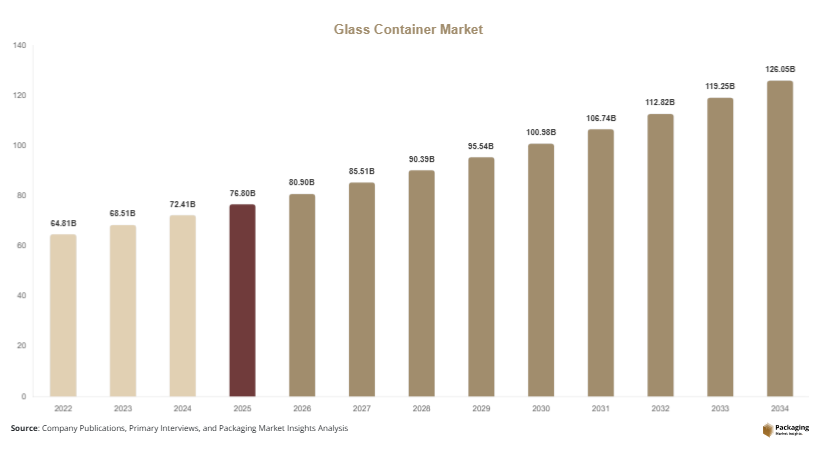
The global glass container market size was valued at approximately USD 76.8 billion in 2025 and is projected to reach USD 80.9 billion in 2026. Over the forecast period from 2025 to 2034, the market is expected to expand at a compound annual growth rate (CAGR) of 5.7%, reaching nearly USD 133.6 billion by 2034. The steady growth of the market is supported by rising demand from the food and beverage industry, increasing environmental awareness, and regulatory pressure to reduce plastic usage. The global glass container market is witnessing stable growth as industries increasingly prioritize sustainable and recyclable packaging solutions.
One of the primary growth factors is the increasing preference for sustainable packaging materials. Glass containers are fully recyclable and can be reused multiple times without compromising quality, making them an attractive option for environmentally conscious consumers and manufacturers. Secondly, the growing demand for premium and high-quality packaging in the beverage and cosmetics industries is driving the adoption of glass containers due to their aesthetic appeal and ability to preserve product integrity. Thirdly, stringent government regulations aimed at reducing plastic waste are encouraging companies to shift toward glass packaging solutions.
Key Market Insights
- Asia Pacific dominated the market with a 36.9% share in 2025, while Latin America is projected to grow at the fastest CAGR of 6.3%.
- Soda lime glass led the type segment with a 62.4% share, while borosilicate glass is expected to grow at a CAGR of 6.8%.
- Food & beverage applications dominated with 51.2% share, while pharmaceutical packaging is expected to grow at a CAGR of 6.5%.
- Bottles held a 58.7% share, while jars are forecasted to grow at a CAGR of 5.9%.
- China remained the dominant country with a market size of USD 16.3 billion in 2025 and USD 17.1 billion in 2026.
Explore more data points, trends and opportunities Download Free Sample Report
Market Trends
Increasing demand for sustainable and recyclable packaging solutions
The glass container market is influenced by the growing emphasis on sustainability and environmental responsibility. Consumers and businesses are actively seeking packaging solutions that minimize environmental impact, and glass containers are gaining traction due to their recyclability and reusability. Unlike plastic, glass does not degrade in quality during recycling, making it suitable for closed-loop systems. Governments are also supporting this trend through regulations and incentives that promote the use of eco-friendly materials. As a result, manufacturers are expanding their glass production capacities and investing in recycling infrastructure to meet the rising demand for sustainable packaging.
Rising preference for premium packaging in beverage and cosmetics industries
Another significant trend shaping the glass container market is the increasing demand for premium packaging. Glass containers are widely used in the beverage and cosmetics industries due to their ability to enhance product presentation and maintain quality. Premium alcoholic beverages, perfumes, and skincare products often use glass packaging to convey brand value and ensure product safety. The transparency and aesthetic appeal of glass also allow consumers to visually assess product quality. This trend is driving innovation in glass design, including unique shapes, colors, and finishes, which further contributes to market growth.
Market Drivers
Expansion of the global food and beverage industry
The growth of the food and beverage sector is a major factor driving the glass container market. Increasing consumption of packaged food and beverages, particularly in urban areas, is boosting demand for reliable and safe packaging solutions. Glass containers are widely used for packaging products such as sauces, beverages, and dairy items due to their non-reactive nature and ability to preserve flavor and freshness. The rising popularity of organic and natural food products is also supporting the use of glass packaging, as it aligns with consumer preferences for chemical-free storage.
Increasing regulatory focus on reducing plastic waste
Government regulations aimed at reducing plastic waste are significantly influencing the adoption of glass containers. Many countries are implementing bans on single-use plastics and promoting the use of recyclable materials. These policies are encouraging manufacturers to shift toward glass packaging solutions. Additionally, consumer awareness regarding environmental issues is increasing, leading to higher demand for sustainable packaging. Companies are responding by incorporating glass containers into their product lines to meet regulatory requirements and consumer expectations.
Market Restraint
High production and transportation costs
The glass container market faces challenges related to the high cost of production and transportation. Glass manufacturing requires significant energy consumption, which increases production costs compared to alternative materials such as plastic. Additionally, glass containers are heavier and more fragile, leading to higher transportation and handling costs. These factors can limit their adoption, particularly in cost-sensitive markets. For example, companies operating in regions with limited infrastructure may find it challenging to manage the logistics of glass packaging. Despite advancements in lightweight glass technology, cost considerations remain a key restraint affecting market growth.
Market Opportunities
Growth in pharmaceutical and healthcare packaging applications
The pharmaceutical sector presents significant opportunities for the glass container market. Glass is widely used for packaging medicines, vaccines, and injectable drugs due to its chemical stability and resistance to contamination. The increasing demand for healthcare products, driven by aging populations and rising healthcare expenditure, is boosting the need for reliable packaging solutions. Additionally, advancements in glass manufacturing are improving the strength and durability of containers, making them suitable for a wider range of medical applications.
Increasing adoption in emerging markets
Emerging economies offer substantial growth opportunities for the glass container market. Rising disposable incomes and changing consumer preferences are driving demand for premium and sustainable packaging solutions. The expansion of organized retail and e-commerce platforms is further supporting market growth in these regions. Governments in emerging markets are also implementing policies to promote sustainable packaging, creating favorable conditions for the adoption of glass containers. As infrastructure improves and awareness increases, these markets are expected to contribute significantly to global growth.
Report Scope
| Report Metric | Details |
|---|---|
| Market Size in 2025 | USD 76.8 Billion |
| Market Size in 2026 | USD 80.9 Billion |
| Market Size in 2034 | USD 133.6 Billion |
| CAGR | 5.7% (2026-2034) |
| Base Year for Estimation | 2025 |
| Historical Data | 2022-2024 |
| Forecast Period | 2026-2034 |
| Report Coverage | Revenue Forecast, Competitive Landscape, Supply Chain Disruption, Growth Factors, Environment & Regulatory Landscape and Trends |
| Geographies Covered | North America, Europe, APAC, Middle East and Africa, LATAM |
| Countries Covered | U.S., Canada, U.K., Germany, France, Spain, Italy, Russia, Nordic, Benelux, Rest of Europe, China, South Korea, Japan, India, Australia, Singapore, Taiwan, South East Asia, Rest of Asia-Pacific, UAE, Turky, Saudi Arabia, South Africa, Egypt, Nigeria, Rest of MEA, Brazil, Mexico, Argentina, Chile, Colombia, Rest of LATAM |
Explore more data points, trends and opportunities Download Free Sample Report
Segmental Analysis
By Glass Type
Soda lime glass remains the dominant subsegment, accounting for approximately 62.4% of the market share in 2024. This type of glass is widely used due to its cost-effectiveness, durability, and versatility in packaging applications. It is commonly used for bottles and jars in the food and beverage industry, as well as in household products. The availability of raw materials and established manufacturing processes further support its dominance in the market.
Borosilicate glass is expected to grow at a CAGR of 6.8% during the forecast period. This growth is driven by its superior thermal and chemical resistance, making it suitable for pharmaceutical and laboratory applications. Increasing demand for high-quality and durable packaging solutions is supporting the adoption of borosilicate glass across various industries.
By Application
The food and beverage segment dominated the market in 2024, holding a share of 51.2%. Glass containers are widely used for packaging beverages, sauces, and dairy products due to their ability to preserve taste and quality. The growing demand for organic and natural products is further supporting the use of glass packaging in this segment.
Pharmaceutical applications are expected to grow at a CAGR of 6.5%. The increasing demand for safe and reliable packaging for medicines and vaccines is driving the adoption of glass containers. Their non-reactive nature and ability to maintain product integrity make them suitable for healthcare applications.
By Product Type
Bottles held the largest market share of 58.7% in 2024, driven by their widespread use in beverage packaging. Glass bottles are preferred for alcoholic and non-alcoholic beverages due to their durability and ability to maintain product quality. The increasing demand for premium beverages is further supporting growth in this segment.
Jars are expected to grow at a CAGR of 5.9%, driven by their use in food and personal care packaging. Glass jars provide excellent storage conditions for products such as sauces, jams, and cosmetics. Their reusability and aesthetic appeal are contributing to their growing popularity.
Glass Container Market Segmentations
By Glass Type
- Soda Lime Glass
- Borosilicate Glass
- Others
By Application
- Food & Beverage
- Pharmaceutical
- Personal Care & Cosmetics
- Household Products
By Product Type
- Bottles
- Jars
- Others
Regional Analysis
North America
North America accounted for approximately 22.7% of the glass container market share in 2025 and is projected to grow at a CAGR of 5.2% during the forecast period. The region benefits from a well-established packaging industry and strong demand from food, beverage, and pharmaceutical sectors. Increasing focus on sustainability and recycling initiatives is also influencing market growth.
The United States dominates the regional market due to its large consumer base and advanced manufacturing capabilities. A key growth factor is the rising demand for premium beverages, including craft beer and specialty drinks, which rely heavily on glass packaging to maintain quality and brand image.
Europe
Europe held a market share of 27.1% in 2025 and is expected to grow at a CAGR of 5.4%. The region is characterized by strict environmental regulations and a strong emphasis on sustainability. Companies are increasingly adopting glass packaging to comply with regulatory requirements and meet consumer expectations.
Germany leads the European market, supported by its robust industrial base and focus on innovation. A unique growth factor is the widespread adoption of recycling systems, which ensures a steady supply of raw materials for glass production and supports sustainable practices.
Asia Pacific
Asia Pacific dominated the market with a 36.9% share in 2025 and is projected to grow at a CAGR of 6.2%. Rapid urbanization, population growth, and increasing disposable incomes are key factors driving market expansion in this region. The growing demand for packaged food and beverages further supports growth.
China is the dominant country, driven by its large manufacturing sector and strong domestic demand. A unique growth factor is the increasing adoption of sustainable packaging solutions, supported by government initiatives to reduce environmental impact and promote recycling.
Middle East & Africa
The Middle East & Africa region held a share of 6.8% in 2025 and is expected to grow at a CAGR of 5.0%. The market is gradually expanding due to increasing urbanization and rising demand for packaged goods. Improvements in infrastructure and retail sectors are also supporting growth.
The United Arab Emirates is a key market, supported by its growing hospitality and tourism industries. A unique growth factor is the increasing demand for premium beverages and luxury products, which require high-quality glass packaging solutions.
Latin America
Latin America accounted for 6.5% of the market share in 2025 and is projected to grow at the fastest CAGR of 6.3%. The region is experiencing rising demand for packaged food and beverages due to changing lifestyles and urbanization. Economic development is also contributing to increased consumption.
Brazil dominates the regional market, driven by its large population and expanding retail sector. A unique growth factor is the growing demand for alcoholic beverages, which is boosting the use of glass bottles for packaging and distribution.
Competitive Landscape
The glass container market is characterized by the presence of several global and regional players focusing on innovation, sustainability, and capacity expansion. Companies are investing in advanced manufacturing technologies and recycling initiatives to enhance their market position. Strategic collaborations and acquisitions are also common strategies to expand product portfolios and geographic reach.
Ardagh Group is recognized as a leading player in the market, known for its extensive product range and focus on sustainable packaging solutions. The company recently expanded its production capacity to meet increasing demand for glass containers. Other key players, including Owens-Illinois Inc., Verallia, Vidrala S.A., and Gerresheimer AG, are also активно investing in research and development to improve product performance and meet evolving industry requirements.
Key Players List
- Ardagh Group
- Owens-Illinois Inc.
- Verallia
- Vidrala S.A.
- Gerresheimer AG
- AGI Glaspac
- Hindustan National Glass & Industries Ltd.
- Piramal Glass Private Limited
- Beatson Clark
- Stölzle Glass Group
- Vetropack Holding Ltd.
- Bormioli Rocco
- HEINZ-GLAS GmbH
- Shandong Pharmaceutical Glass Co., Ltd.
- Wiegand-Glas GmbH