Gel Packs Market Size and Growth
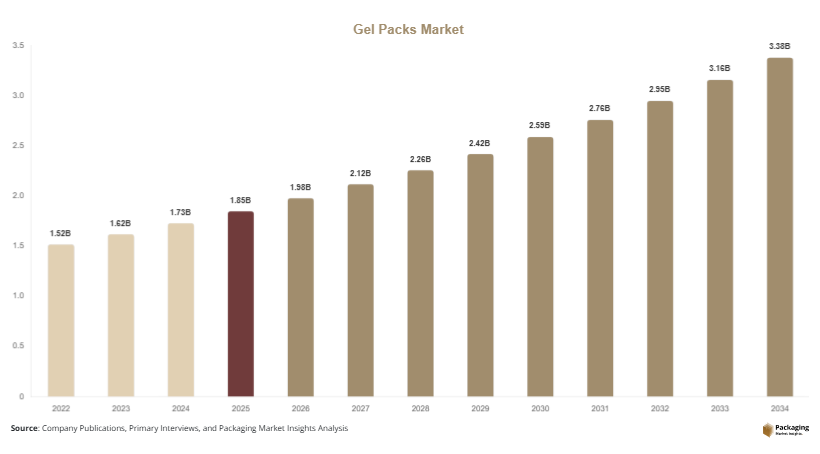
The global gel packs market size is estimated at USD 1.85 billion in 2025, and it is projected to reach USD 1.98 billion in 2026. By 2034, the market is expected to reach USD 3.45 billion, growing at a CAGR of 6.9% during 2025–2034. The gel packs market is witnessing steady expansion due to increasing demand across cold chain logistics, healthcare transport, food preservation, and industrial thermal management applications. Gel packs, commonly used as reusable or single-use cooling agents, play a critical role in maintaining temperature-sensitive goods during storage and transportation.
One of the primary growth factors is the rapid expansion of pharmaceutical and biotech logistics, where temperature-controlled packaging is essential for vaccines, biologics, and diagnostic samples. Gel packs are widely used in last-mile cold chain delivery systems due to their ability to maintain stable temperature ranges over extended periods. Another key driver is the expansion of the global food delivery and e-commerce grocery sector, which requires reliable cold packaging solutions to preserve perishable food quality during transit. Additionally, increasing awareness of sustainable packaging solutions has encouraged the development of reusable gel packs made from non-toxic and recyclable materials.
Key Highlights:
- Asia Pacific dominated the market with a 37.4% share in 2025.
- Latin America is projected to grow at the fastest CAGR of 6.2%.
- Water-based gel packs led the type segment with a 29.6% share.
- Plastic casing gel packs dominated with a 52.3% share.
- Healthcare applications led the segment with a 43.1% share.
- The US remained the dominant country with a market size of USD 0.62 billion in 2025 and USD 0.66 billion in 2026, driven by strong pharmaceutical logistics and e-commerce cold chain expansion.
Explore more data points, trends and opportunities Download Free Sample Report
Market Trends
Shift Toward Reusable and Eco-Friendly Gel Pack Solutions
A major trend in the gel packs market is the increasing adoption of reusable and environmentally friendly gel packs. Traditional single-use gel packs are gradually being replaced by recyclable and refillable alternatives, particularly in healthcare and food logistics. Companies are developing gel packs using non-toxic polymers and biodegradable outer materials to reduce environmental impact. For example, cold chain logistics providers in Europe are implementing returnable gel pack systems for pharmaceutical shipments. These reusable systems reduce packaging waste and operational costs over time. The trend is expected to grow further as regulatory pressure increases on single-use plastics and sustainability reporting becomes mandatory across logistics industries.
Integration of Advanced Phase-Change Gel Technology
Another significant trend is the adoption of phase-change material (PCM)-based gel packs, which provide improved thermal stability and longer cooling duration. These advanced gel packs maintain precise temperature ranges for extended periods, making them ideal for high-value pharmaceuticals and biotech products. For instance, vaccine distribution programs in Asia Pacific increasingly rely on PCM gel packs to maintain strict temperature thresholds during transport. The technology is also being integrated into smart packaging systems with digital temperature tracking. In the future, hybrid gel packs combining PCM technology with IoT-based monitoring systems are expected to transform cold chain logistics.
Market Drivers
Expansion of Pharmaceutical Cold Chain Logistics
The rapid growth of pharmaceutical and biotechnology industries is a key driver for the gel packs market. Vaccines, biologics, insulin, and diagnostic samples require strict temperature control during transportation and storage. Gel packs are widely used in insulated shipping containers to maintain required temperature ranges. For example, global vaccine distribution programs rely heavily on gel pack-based cold chain systems. Increasing investments in healthcare infrastructure, especially in emerging economies, are further boosting demand for reliable thermal packaging solutions.
Growth in E-commerce Grocery and Food Delivery Services
The expansion of online grocery delivery and food e-commerce platforms is significantly increasing demand for gel packs. Consumers expect fresh, temperature-controlled delivery of perishable food items such as dairy, seafood, and frozen meals. Gel packs are used in insulated delivery boxes to ensure product freshness during last-mile delivery. For example, online grocery platforms in North America and Europe use gel pack-based cooling systems for same-day delivery services. This trend is expected to continue as urbanization and digital food retail expand globally.
Market Restraint
High Disposal Costs and Environmental Concerns of Non-Biodegradable Gel Packs
One of the major restraints in the gel packs market is the environmental impact associated with traditional gel pack disposal. Many gel packs contain non-biodegradable plastic casings and synthetic gel materials, which create disposal challenges in large-scale logistics operations. Healthcare and food industries generate significant volumes of used gel packs, leading to increased waste management costs. For example, pharmaceutical logistics companies in the U.S. and Europe face regulatory pressure to adopt sustainable disposal practices. Although reusable gel packs exist, they require reverse logistics systems, which increase operational complexity. This environmental concern is pushing manufacturers to innovate biodegradable alternatives, but cost-effective scalability remains a challenge.
Market Opportunities
Expansion of Healthcare and Biopharmaceutical Logistics
The growing global healthcare sector presents a major opportunity for gel pack manufacturers. Increasing demand for vaccines, biologics, and personalized medicines requires advanced cold chain packaging solutions. Gel packs are essential for maintaining precise temperature control in medical transport. For example, biotech companies in Europe and North America are investing in high-performance gel packs for clinical trial sample transport. The future growth of cell and gene therapy will further expand demand for ultra-stable temperature-controlled packaging systems.
Growth in Smart Cold Chain Packaging Systems
The integration of digital technologies with gel pack systems presents a significant opportunity. Smart gel packs equipped with temperature sensors and RFID tracking are being developed to enhance logistics transparency. These systems allow real-time monitoring of shipment conditions, reducing product loss and improving compliance. For instance, logistics providers in Asia are adopting IoT-enabled cold chain systems for pharmaceutical exports. In the future, AI-based predictive temperature control systems integrated with gel packs will enhance efficiency in global cold chain networks.
Report Scope
| Report Metric | Details |
|---|---|
| Market Size in 2025 | USD 1.85 Billion |
| Market Size in 2026 | USD 1.98 Billion |
| Market Size in 2034 | USD 3.45 Billion |
| CAGR | 6.9% (2026-2034) |
| Base Year for Estimation | 2025 |
| Historical Data | 2022-2024 |
| Forecast Period | 2026-2034 |
| Report Coverage | Revenue Forecast, Competitive Landscape, Supply Chain Disruption, Growth Factors, Environment & Regulatory Landscape and Trends |
| Geographies Covered | North America, Europe, APAC, Middle East and Africa, LATAM |
| Countries Covered | U.S., Canada, U.K., Germany, France, Spain, Italy, Russia, Nordic, Benelux, Rest of Europe, China, South Korea, Japan, India, Australia, Singapore, Taiwan, South East Asia, Rest of Asia-Pacific, UAE, Turky, Saudi Arabia, South Africa, Egypt, Nigeria, Rest of MEA, Brazil, Mexico, Argentina, Chile, Colombia, Rest of LATAM |
Explore more data points, trends and opportunities Download Free Sample Report
Segmental Analysis
By Type
Water-based gel packs dominated the market in 2024 with a 42.1% share, due to their cost efficiency, non-toxic composition, and wide usage in healthcare and food logistics. These gel packs are widely used for short- to medium-duration cooling applications. For example, hospital laboratories use water-based gel packs for specimen transport.
Phase-change gel packs are the fastest-growing segment with a CAGR of 7.8%, driven by demand for longer thermal retention and precision cooling in pharmaceutical logistics.
By Material
Plastic-based gel packs dominated with a 55.4% share in 2024, due to durability and flexibility. They are widely used in bulk logistics and industrial applications.
Biodegradable gel packs are the fastest-growing segment with a CAGR of 7.6%, driven by environmental regulations and sustainability goals.
By End-Use
Healthcare applications led with a 44.8% share in 2024, driven by pharmaceutical logistics and vaccine distribution.
Food delivery applications are the fastest-growing segment with a CAGR of 8.1%, driven by rising online grocery and meal delivery services.
Gel Packs Market Segmentations
By Product Type
- Water-Based Gel Packs
- Phase-Change Gel Packs
- Reusable Gel Packs
- Disposable Gel Packs
By Material
- Plastic Casings
- Fabric-Based Covers
- Biodegradable Materials
- Hybrid Composite Materials
By End-User
- Healthcare & Pharmaceuticals
- Food & Beverage Logistics
- E-commerce & Grocery Delivery
- Industrial & Chemical Transport
By Distribution Channel
- B2B Direct Supply
- Cold Chain Logistics Providers
- Online Industrial Platforms
- Retail & Specialty Stores
Regional Analysis
North America
North America accounted for approximately 33.5% share in 2025, with a projected CAGR of 6.7% during 2025–2034. The region is a major hub for pharmaceutical logistics, food delivery services, and advanced cold chain infrastructure. High demand for temperature-sensitive drug transportation and strong regulatory standards are key drivers. Additionally, the expansion of e-commerce grocery services is increasing demand for gel-based cooling systems.
The United States dominates the regional market due to its advanced healthcare logistics network. A key growth driver is the increasing use of reusable gel packs in pharmaceutical shipments, particularly in vaccine distribution programs and hospital supply chains.
Europe
Europe held a 28.2% share in 2025, with a CAGR of 6.5%. Growth is driven by strict environmental regulations, strong pharmaceutical exports, and increasing adoption of sustainable packaging systems. Countries such as Germany, France, and the UK are leading users of gel pack-based cold chain logistics.
Germany dominates the region due to its strong pharmaceutical manufacturing base. A key driver is the adoption of reusable gel pack systems in cross-border drug transport across the EU.
Asia Pacific
Asia Pacific dominated the market with a 37.4% share in 2025, and is projected to grow at a CAGR of 7.4%. Rapid urbanization, expansion of healthcare infrastructure, and growing e-commerce food delivery are driving demand. Countries like China, India, Japan, and South Korea are major contributors.
China leads the region due to its large pharmaceutical export industry. A key driver is the expansion of vaccine distribution networks requiring temperature-controlled logistics.
Middle East & Africa
The region accounted for a 4.1% share in 2025, with a CAGR of 6.1%. Growth is supported by increasing healthcare investments and expansion of cold chain logistics for food imports. Urban retail growth is also contributing to demand.
The UAE dominates the region due to its advanced logistics infrastructure. A key driver is the rising import of temperature-sensitive pharmaceuticals and specialty foods.
Latin America
Latin America held a 3.2% share in 2025, with the fastest CAGR of 7.0%. Growth is driven by increasing pharmaceutical imports and expansion of online food delivery services in Brazil and Mexico.
Brazil dominates the region due to its expanding healthcare logistics sector. A key driver is increasing demand for cold chain packaging in vaccine distribution programs.
Competitive Landscape
The gel packs market is moderately fragmented, with key players focusing on sustainability, thermal performance innovation, and expansion of reusable product lines. Major companies include Pelton Shepherd Industries, Cold Chain Technologies, Sofrigam SA, Sonoco ThermoSafe, and Cryopak Industries. Among these, Sonoco ThermoSafe is a leading player due to its strong global cold chain packaging portfolio.
Companies are investing in biodegradable gel formulations, reusable systems, and smart temperature tracking technologies. Strategic partnerships with pharmaceutical companies are increasing for vaccine distribution solutions. Recent developments include expansion of PCM-based gel pack production and introduction of eco-friendly gel materials for food logistics applications.
Key Players List
- Pelton Shepherd Industries
- Sonoco ThermoSafe
- Cold Chain Technologies
- Sofrigam SA
- Cryopak Industries
- PackIt LLC
- Nordic Cold Chain Solutions
- Reusable Ice Packs Ltd.
- Davis Core & Pad Company
- TechniIce
- AcuTemp Packaging Systems
- Thermosafe Brands
- Icebox Gel Packs Inc.
- Delta T Solutions
- Insulated Products Corporation