Fragrance Packaging Market Size and Growth
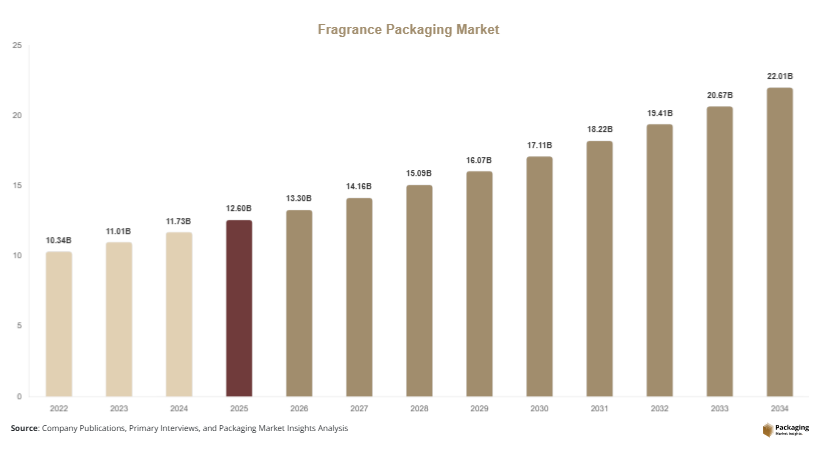
The global fragrance packaging market size was valued at approximately USD 12.6 billion in 2025 and is expected to reach USD 13.3 billion in 2026. By 2034, the market is projected to reach nearly USD 22.1 billion, expanding at a CAGR of 6.5% during 2025–2034. The fragrance packaging market is witnessing stable growth due to increasing demand for premium cosmetic products, rising consumer spending on personal grooming, and expanding fragrance product portfolios across luxury and mass-market brands. Fragrance packaging includes bottles, pumps, caps, cartons, labels, and decorative components designed to enhance product protection, branding, and consumer appeal. Packaging plays a critical role in the fragrance industry because visual aesthetics, material quality, and dispensing functionality strongly influence purchasing behavior.
One of the major growth factors driving the market is the increasing popularity of luxury and premium fragrances among urban consumers. Premium perfume brands are investing heavily in customized packaging designs, decorative glass bottles, and innovative dispensing mechanisms to strengthen brand identity and improve shelf appeal. Another important growth factor is the rising influence of e-commerce and digital beauty retail channels. Online fragrance sales require durable and visually attractive packaging capable of maintaining product safety during transportation while also supporting premium unboxing experiences. Additionally, growing demand for sustainable cosmetic packaging solutions is encouraging manufacturers to adopt recyclable glass bottles, refillable containers, and biodegradable packaging materials.
Key Highlights
- Europe dominated the market with a 34.2% share in 2025.
- Asia Pacific is projected to grow at the fastest CAGR of 7.1%.
- Glass packaging led the material segment with a 61.8% share.
- Bottles dominated the product type segment with a 48.7% share.
- Luxury fragrance applications led the segment with 45.6% share.
- The US remained the dominant country with a market size of USD 2.4 billion in 2025 and USD 2.5 billion in 2026.
Explore more data points, trends and opportunities Download Free Sample Report
Market Trends
Rising Adoption of Sustainable and Refillable Fragrance Packaging
Sustainability has become a major trend in the fragrance packaging market as cosmetic brands increasingly adopt recyclable and refillable packaging formats. Manufacturers are introducing glass bottles with reusable pump systems, refill cartridges, and paper-based outer cartons to reduce packaging waste and improve environmental performance. Luxury fragrance companies are also incorporating recycled glass and biodegradable decorative materials into premium packaging designs. Consumer awareness regarding sustainable consumption is encouraging fragrance brands to reduce plastic usage and support circular packaging models. In addition, refillable fragrance systems are helping companies strengthen customer retention while lowering long-term packaging costs. These developments are expected to accelerate the adoption of eco-friendly fragrance packaging solutions globally.
Increasing Demand for Personalized and Premium Packaging Designs
Premiumization and personalization are significantly influencing packaging innovation across the fragrance packaging market. Fragrance brands are investing in decorative bottle shapes, metallic finishes, embossing, and customized labeling to strengthen product differentiation and improve luxury appeal. Personalized packaging featuring engraved bottles, limited-edition artwork, and customized gift packaging is becoming increasingly popular among premium fragrance consumers. Manufacturers are also integrating advanced printing technologies and digital customization systems to support small-batch and seasonal packaging production. The growing popularity of luxury gifting and influencer-driven beauty marketing is encouraging companies to develop visually distinctive packaging formats that improve consumer engagement and brand recognition.
Market Drivers
Growth of the Global Beauty and Personal Care Industry
The expansion of the global beauty and personal care industry is one of the primary drivers supporting the fragrance packaging market. Increasing consumer spending on perfumes, body sprays, deodorants, and premium beauty products is creating higher demand for visually attractive and durable packaging solutions. Fragrance brands are investing in innovative packaging designs to strengthen shelf visibility and influence purchasing decisions. Urbanization, rising disposable incomes, and changing grooming habits are further supporting fragrance product consumption worldwide. In addition, the growing influence of social media beauty trends and celebrity-endorsed fragrances is increasing demand for premium packaging formats that improve product presentation and consumer perception.
Expansion of E-Commerce and Premium Retail Packaging
The rapid growth of e-commerce and online cosmetic retail channels is driving demand for secure and aesthetically appealing fragrance packaging. Online fragrance sales require packaging solutions capable of protecting delicate glass bottles during transportation while maintaining premium product presentation. Manufacturers are developing impact-resistant secondary packaging, decorative cartons, and tamper-evident closures to improve product safety and customer satisfaction. The rise of luxury subscription boxes and direct-to-consumer fragrance brands is also increasing demand for customized packaging formats. In addition, premium retail environments continue emphasizing visually attractive packaging to strengthen consumer engagement and in-store product differentiation.
Market Restraint
High Packaging Costs and Material Price Volatility
One of the major restraints affecting the fragrance packaging market is the high cost associated with premium packaging materials and decorative manufacturing processes. Luxury fragrance packaging often utilizes customized glass bottles, metallic finishes, embossing, and advanced printing technologies that increase production expenses. Small and medium-sized fragrance companies may face challenges in adopting high-end packaging solutions because of limited budgets and lower production volumes. In addition, fluctuations in raw material prices, especially glass, aluminum, and specialty paperboard, can affect profit margins and pricing strategies for packaging manufacturers. For example, rising energy costs can significantly increase glass bottle manufacturing expenses because glass production requires high-temperature processing. Sustainability initiatives also require additional investments in recyclable materials and eco-friendly manufacturing technologies. These factors can increase operational complexity and create pricing pressure throughout the fragrance packaging supply chain.
Market Opportunities
Expansion of Refillable and Smart Packaging Systems
The growing focus on sustainability and premium consumer experiences is creating opportunities for refillable and smart fragrance packaging solutions. Fragrance companies are increasingly introducing refill stations, reusable bottles, and refill cartridges to reduce packaging waste and strengthen customer loyalty. Smart packaging technologies such as QR codes, NFC-enabled labels, and digital authentication systems are also gaining attention in luxury fragrance packaging. These technologies help brands improve consumer engagement, support anti-counterfeit protection, and provide interactive product information. Growing investment in sustainable luxury branding is expected to support long-term opportunities for advanced refillable fragrance packaging systems.
Rising Demand from Emerging Markets
Emerging economies present significant growth opportunities for the fragrance packaging market due to increasing urbanization, rising disposable incomes, and expanding middle-class populations. Countries in Asia Pacific, Latin America, and the Middle East are witnessing strong growth in premium beauty and personal care product consumption. International fragrance brands are expanding retail presence in these markets while local cosmetic manufacturers are investing in improved packaging quality and branding strategies. The increasing popularity of affordable luxury fragrances and gift-oriented packaging is also supporting market expansion. Manufacturers capable of offering cost-effective yet visually appealing packaging solutions are expected to benefit from rising demand in emerging regions.
Report Scope
| Report Metric | Details |
|---|---|
| Market Size in 2025 | USD 12.6 Billion |
| Market Size in 2026 | USD 13.3 Billion |
| Market Size in 2034 | USD 22.1 Billion |
| CAGR | 6.5% (2026-2034) |
| Base Year for Estimation | 2025 |
| Historical Data | 2022-2024 |
| Forecast Period | 2026-2034 |
| Report Coverage | Revenue Forecast, Competitive Landscape, Supply Chain Disruption, Growth Factors, Environment & Regulatory Landscape and Trends |
| Geographies Covered | North America, Europe, APAC, Middle East and Africa, LATAM |
| Countries Covered | U.S., Canada, U.K., Germany, France, Spain, Italy, Russia, Nordic, Benelux, Rest of Europe, China, South Korea, Japan, India, Australia, Singapore, Taiwan, South East Asia, Rest of Asia-Pacific, UAE, Turky, Saudi Arabia, South Africa, Egypt, Nigeria, Rest of MEA, Brazil, Mexico, Argentina, Chile, Colombia, Rest of LATAM |
Explore more data points, trends and opportunities Download Free Sample Report
Segmental Analysis
By Material
Glass packaging dominated the fragrance packaging market in 2024, accounting for approximately 61.8% of total market revenue. Glass remains the preferred packaging material because of its premium appearance, chemical stability, and ability to preserve fragrance quality over long periods. Luxury perfume brands extensively use decorative glass bottles with customized shapes and embossing to strengthen product differentiation and enhance shelf appeal. Glass packaging also supports sustainability initiatives because it is recyclable and reusable. Advances in lightweight glass manufacturing technologies are helping reduce transportation costs while maintaining durability and visual appeal. These factors continue supporting strong demand for glass fragrance packaging globally.
Recyclable paperboard packaging is expected to witness the fastest growth, registering a CAGR of 7.3% during the forecast period. Sustainability concerns and increasing demand for environmentally responsible packaging are encouraging fragrance brands to adopt recyclable cartons and paper-based secondary packaging solutions. Paperboard packaging provides branding flexibility through high-quality printing, embossing, and decorative finishing options. Luxury brands are increasingly introducing FSC-certified paper cartons and biodegradable packaging inserts to reduce environmental impact. Rising regulatory emphasis on sustainable cosmetic packaging is expected to further support growth within this segment.
By Product Type
Bottles dominated the fragrance packaging market in 2024 with a revenue share of approximately 48.7%. Fragrance bottles serve as both protective containers and important branding elements within the cosmetics industry. Luxury perfume companies invest heavily in customized bottle designs featuring decorative glass, metallic finishes, and artistic shapes to improve consumer perception and brand identity. Bottles are also widely used across mass-market fragrance categories because they provide durability, portability, and controlled dispensing functionality. Increasing investment in premium beauty branding and decorative packaging innovation continues to support strong market demand for fragrance bottles.
Refillable fragrance packaging is projected to grow at the fastest CAGR of 7.4% during the forecast period. Consumer awareness regarding sustainability and packaging waste reduction is encouraging fragrance companies to introduce refillable perfume systems. Refillable packaging allows consumers to reuse decorative fragrance bottles while purchasing refill cartridges separately, reducing long-term packaging consumption. Luxury cosmetic brands are increasingly launching refill stations and reusable packaging programs to strengthen environmental commitments and customer loyalty. Growing adoption of sustainable beauty practices is expected to accelerate demand for refillable fragrance packaging solutions globally.
By Application
Luxury fragrance applications dominated the fragrance packaging market in 2024, accounting for approximately 45.6% of total market revenue. Premium perfume brands require highly decorative and customized packaging formats that enhance product aesthetics and strengthen luxury positioning. Glass bottles with embossing, metallic caps, and decorative cartons are commonly used in luxury fragrance packaging to improve consumer engagement and gifting appeal. The expansion of premium skincare and cosmetics industries is also supporting demand for luxury fragrance packaging solutions. Increasing disposable incomes and growth in prestige beauty retail channels continue driving this segment.
Mass-market fragrance packaging is expected to grow at the fastest CAGR of 6.9% during the forecast period. Affordable perfumes, body sprays, and deodorants are witnessing rising demand across emerging economies due to increasing urbanization and changing consumer lifestyles. Manufacturers are developing cost-effective packaging solutions that maintain visual appeal while supporting high-volume production requirements. Lightweight bottles, simplified decorative elements, and recyclable packaging materials are becoming increasingly common within mass-market fragrance packaging applications. The rapid growth of retail and e-commerce cosmetic distribution channels is expected to support continued expansion within this segment.
Fragrance Packaging Market Segmentations
By Material Type
- Glass Packaging
- Plastic Packaging
- Metal Packaging
- Recyclable Paperboard Packaging
ByProduct Type
- Bottles
- Caps & Closures
- Pumps & Sprayers
- Refillable Packaging Systems
By Application
- Luxury Fragrances
- Mass-Market Fragrances
- Body Sprays
- Deodorants
By Distribution Channel
- Online Retail
- Specialty Beauty Stores
- Department Stores
- Supermarkets & Hypermarkets
- Brand-Owned Retail Stores
Regional Analysis
North America
North America accounted for approximately 24.6% of the global fragrance packaging market share in 2025 and is projected to grow at a CAGR of 5.9% during the forecast period. Strong demand for luxury perfumes, celebrity fragrance brands, and premium personal care products is supporting regional market growth. Packaging manufacturers are increasingly focusing on recyclable glass bottles and decorative packaging innovations to meet sustainability targets. The region also benefits from advanced cosmetic packaging technologies and strong retail distribution networks.
The United States dominates the North American market because of its large beauty and cosmetics industry. One unique growth factor is the increasing popularity of direct-to-consumer fragrance brands using customized premium packaging to strengthen online customer engagement. Packaging companies are investing in lightweight protective packaging systems designed specifically for e-commerce fragrance shipping applications.
Europe
Europe held around 34.2% of the fragrance packaging market share in 2025 and is expected to grow at a CAGR of 6.1% through 2034. The region has a strong luxury perfume manufacturing base and significant demand for premium cosmetic packaging solutions. Sustainability regulations are encouraging fragrance brands to adopt refillable glass bottles, recyclable cartons, and biodegradable decorative materials. Manufacturers are also investing in advanced decorative printing and embossing technologies to support luxury fragrance branding strategies.
France remains the dominant country in the European market due to its established perfume industry and global luxury fragrance brands. One unique growth factor is the increasing demand for artisanal and niche perfumes packaged in customized decorative bottles. Luxury fragrance companies are introducing limited-edition packaging collections to strengthen premium consumer engagement.
Asia Pacific
Asia Pacific represented approximately 28.7% of the global fragrance packaging market share in 2025 and is projected to grow at the fastest CAGR of 7.1% during the forecast period. Rising disposable incomes, expanding beauty product consumption, and increasing urbanization are driving regional market growth. Fragrance companies are investing in localized packaging designs and premium branding strategies to attract younger consumers. Growth in online cosmetic retail channels is also supporting demand for protective and visually attractive fragrance packaging solutions.
China dominates the Asia Pacific market because of its rapidly expanding beauty and personal care sector. One unique growth factor is the increasing demand for luxury gifting products featuring premium decorative fragrance packaging. Domestic cosmetic brands are increasingly investing in customized packaging to compete with international fragrance manufacturers.
Middle East & Africa
The Middle East & Africa region accounted for nearly 5.9% of the global fragrance packaging market share in 2025 and is expected to grow at a CAGR of 6.0% during the forecast period. Growing demand for premium perfumes, oud-based fragrances, and luxury cosmetic products is supporting packaging demand across the region. Manufacturers are increasingly introducing decorative glass bottles and premium metallic closures tailored to regional consumer preferences.
The United Arab Emirates leads the regional market because of its strong luxury retail sector and high fragrance consumption levels. One unique growth factor is the rising popularity of customized gift-oriented fragrance packaging during festive and cultural celebrations. Regional brands are investing in premium packaging aesthetics to strengthen product differentiation in luxury retail channels.
Latin America
Latin America accounted for approximately 6.6% of the fragrance packaging market share in 2025 and is projected to grow at a CAGR of 6.4% through 2034. Increasing beauty product consumption and expansion of affordable luxury fragrance brands are supporting regional market growth. Packaging manufacturers are developing cost-efficient decorative packaging solutions that improve shelf visibility and consumer appeal. Growing retail expansion and rising online cosmetic sales are also contributing to demand for fragrance packaging products.
Brazil dominates the Latin American market because of its large cosmetics and personal care industry. One unique growth factor is the increasing consumption of body sprays and affordable perfumes packaged in lightweight decorative containers. Domestic manufacturers are focusing on visually attractive packaging designs to strengthen brand recognition among younger consumers.
Competitive Landscape
The fragrance packaging market is highly competitive, with companies focusing on sustainability, decorative innovation, and premium packaging customization to strengthen market presence. Leading manufacturers are investing in lightweight glass technologies, recyclable packaging materials, and advanced decorative printing solutions to meet changing consumer expectations and regulatory requirements. Strategic collaborations with luxury fragrance brands and cosmetic manufacturers are also supporting product innovation and regional expansion.
Gerresheimer AG remains one of the leading companies in the market because of its extensive glass fragrance bottle portfolio and strong global manufacturing capabilities. In 2024, the company introduced lightweight recyclable glass bottles designed specifically for premium fragrance applications. Other major companies operating in the market include AptarGroup, Inc., Albéa Group, SGD Pharma, and Quadpack Industries. These manufacturers continue investing in refillable packaging systems, decorative finishing technologies, and sustainable cosmetic packaging solutions to improve competitive positioning.
Key Players List
- Gerresheimer AG
- AptarGroup, Inc.
- Albéa Group
- SGD Pharma
- Quadpack Industries
- Silgan Holdings Inc.
- Verescence
- Amcor plc
- Berry Global Inc.
- HCP Packaging
- Saverglass Group
- Cosmopak Corporation
- Coverpla SA
- Piramal Glass Limited
- Fusion Packaging