Food Storage Containers Market Size and Growth
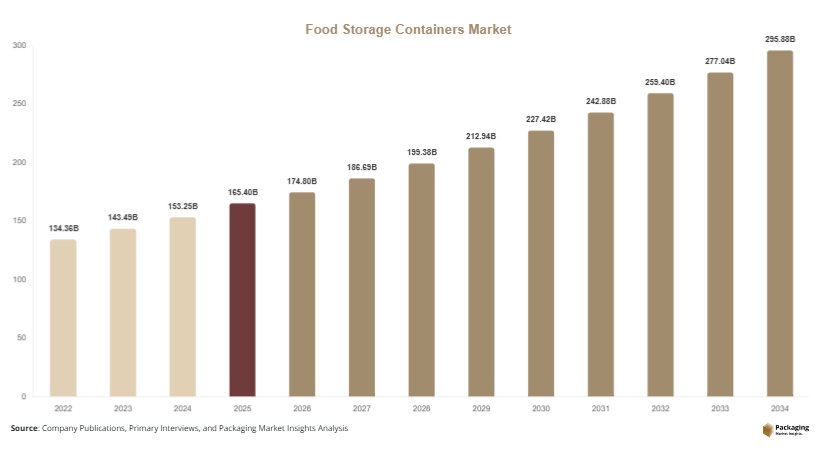
The food storage containers market is experiencing steady growth as consumer demand for safe, durable, and convenient food storage solutions continues to rise globally. In 2025, the market size is estimated at USD 165.4 billion, and it is expected to reach approximately USD 174.8 billion in 2026. Over the forecast period from 2025 to 2034, the market is projected to expand at a compound annual growth rate (CAGR) of 6.8%, reaching nearly USD 298.6 billion by 2034. This growth is supported by increasing awareness of food safety, waste reduction, and the need for efficient storage solutions across households and commercial sectors.
One of the key growth factors is the rising trend of home cooking and meal preparation, especially among urban populations. Consumers are increasingly adopting reusable containers to store leftovers and organize food, which drives consistent demand. Another important factor is the expansion of the food service and delivery industry, which relies heavily on durable and lightweight storage containers for packaging and transportation. Additionally, growing environmental awareness is encouraging the shift from single-use plastics to reusable and sustainable materials such as glass, stainless steel, and BPA-free plastics.
Key Highlights:
- Market size estimated at USD 165.4 billion in 2025
- Expected to reach USD 298.6 billion by 2034
- CAGR of 6.8% from 2025 to 2034
- Rising demand for reusable and sustainable containers
- Strong growth driven by food delivery and home cooking trends
Explore more data points, trends and opportunities Download Free Sample Report
Market Trends
Increasing Adoption of Sustainable and Eco-Friendly Materials
The food storage containers market is witnessing a notable shift toward sustainable and eco-friendly materials. Consumers are becoming more aware of the environmental impact of plastic waste, leading to increased demand for reusable and recyclable storage solutions. Manufacturers are responding by introducing containers made from glass, stainless steel, silicone, and biodegradable plastics. These materials offer durability and reduce environmental harm. In addition, regulatory policies aimed at reducing single-use plastics are encouraging companies to innovate in sustainable product design. Retailers are also promoting eco-friendly products, which is influencing purchasing decisions and driving long-term market growth.
Rising Demand for Smart and Functional Container Designs
Another key trend in the food storage containers market is the growing demand for smart and functional designs. Consumers are looking for products that offer convenience and enhance food storage efficiency. Features such as modular stacking systems, vacuum sealing, and portion control compartments are gaining popularity. Smart containers with temperature indicators and freshness tracking are also emerging in the market. These innovations are particularly relevant for urban consumers with busy lifestyles. The integration of modern design with functionality is helping manufacturers differentiate their products and meet evolving consumer preferences.
Market Drivers
Growth in Food Delivery and Takeaway Services
The rapid expansion of food delivery and takeaway services is a major driver of the food storage containers market. Restaurants and food service providers require reliable packaging solutions to maintain food quality during transportation. Food storage containers play a critical role in ensuring that meals remain fresh and secure. The increasing popularity of online food delivery platforms has significantly boosted demand for disposable and reusable containers. Additionally, the rise of cloud kitchens and quick-service restaurants is further contributing to market growth. As consumer reliance on delivery services continues to increase, the demand for efficient packaging solutions is expected to remain strong.
Increasing Awareness of Food Safety and Hygiene
Growing awareness of food safety and hygiene is another key driver of the food storage containers market. Consumers are becoming more conscious of proper food storage practices to prevent contamination and spoilage. This has led to increased adoption of high-quality containers with airtight and leak-proof features. Regulatory guidelines related to food safety are also encouraging the use of safe and durable storage solutions. In both residential and commercial settings, there is a growing emphasis on maintaining hygiene standards. This trend is driving demand for advanced food storage containers that ensure product safety and extend shelf life.
Market Restraint
Environmental Concerns Related to Plastic Usage
One of the major restraints in the food storage containers market is the environmental impact associated with plastic materials. Although plastic containers are widely used due to their affordability and versatility, they contribute significantly to environmental pollution. Many plastic containers are not biodegradable, leading to long-term waste management challenges. Governments and environmental organizations are imposing restrictions on single-use plastics, which can affect market growth. For example, several regions have introduced bans on certain types of plastic packaging, forcing manufacturers to shift toward alternative materials. This transition can increase production costs and create challenges for companies that rely heavily on plastic products. As a result, the need to balance cost efficiency with sustainability remains a key challenge for the industry.
Market Opportunities
Expansion in Emerging Markets
Emerging markets present significant opportunities for the food storage containers market. Rapid urbanization, rising incomes, and changing lifestyles are driving demand for modern kitchen solutions in regions such as Asia Pacific and Latin America. Consumers in these markets are increasingly adopting organized storage practices, which boosts the demand for food storage containers. The growth of retail infrastructure and e-commerce platforms is also improving product availability. Manufacturers are focusing on expanding their presence in these regions through strategic partnerships and local production facilities. This expansion is expected to create new revenue streams and support long-term market growth.
Innovation in Multi-Functional and Premium Products
Innovation in multi-functional and premium food storage containers is another key opportunity in the market. Consumers are willing to invest in products that offer added value, such as containers that can be used for cooking, storage, and serving. Features like microwave and oven compatibility, temperature resistance, and aesthetic design are gaining traction. Premium products made from high-quality materials are also becoming popular among health-conscious consumers. Manufacturers are leveraging advanced technologies to develop innovative solutions that meet diverse consumer needs. This focus on product differentiation is expected to drive growth and enhance market competitiveness.
Report Scope
| Report Metric | Details |
|---|---|
| Market Size in 2025 | USD 165.4 Billion |
| Market Size in 2026 | USD 174.8 Billion |
| Market Size in 2034 | USD 298.6 Billion |
| CAGR | 6.8% (2026-2034) |
| Base Year for Estimation | 2025 |
| Historical Data | 2022-2024 |
| Forecast Period | 2026-2034 |
| Report Coverage | Revenue Forecast, Competitive Landscape, Supply Chain Disruption, Growth Factors, Environment & Regulatory Landscape and Trends |
| Geographies Covered | North America, Europe, APAC, Middle East and Africa, LATAM |
| Countries Covered | U.S., Canada, U.K., Germany, France, Spain, Italy, Russia, Nordic, Benelux, Rest of Europe, China, South Korea, Japan, India, Australia, Singapore, Taiwan, South East Asia, Rest of Asia-Pacific, UAE, Turky, Saudi Arabia, South Africa, Egypt, Nigeria, Rest of MEA, Brazil, Mexico, Argentina, Chile, Colombia, Rest of LATAM |
Explore more data points, trends and opportunities Download Free Sample Report
Segmental Analysis
By Material Type
Plastic containers dominated the food storage containers market in 2024, accounting for approximately 52% of the market share. Their popularity is driven by affordability, lightweight design, and versatility. Plastic containers are widely used in both household and commercial applications due to their durability and ease of use. They are available in various shapes and sizes, making them suitable for different storage needs. Despite environmental concerns, innovations in BPA-free and recyclable plastics are supporting their continued use in the market.
Glass containers are the fastest-growing segment, with a projected CAGR of 7.5%. The growth is driven by increasing consumer preference for non-toxic and eco-friendly materials. Glass containers are durable, reusable, and resistant to stains and odors. They are also microwave and oven safe, which adds to their functionality. These advantages make glass containers an attractive option for health-conscious consumers.
By Product Type
Boxes and containers dominated the food storage containers market in 2024, accounting for around 48% of the market share. These products are widely used for storing a variety of food items, including leftovers and meal preparations. Their popularity is driven by their versatility and ease of storage. Manufacturers are offering products with advanced features such as airtight lids and stackable designs to enhance user convenience.
Bottles and jars are the fastest-growing segment, with a CAGR of 7.2%. The growth is driven by increasing demand for storing liquids and beverages. These products are widely used in households and commercial settings for storing sauces, juices, and other liquids. Innovations in design and materials are further supporting their adoption.
By End-Use
Households dominated the food storage containers market in 2024, accounting for approximately 55% of the market share. The segment’s growth is driven by increasing awareness of food storage and organization. Consumers are investing in high-quality containers to improve kitchen efficiency and reduce food waste. The rise of home cooking trends further supports this segment.
The commercial sector is the fastest-growing segment, with a CAGR of 7.6%. The growth is driven by the expansion of the food service industry and increasing demand for efficient storage solutions. Restaurants, hotels, and catering services require durable and reliable containers to store and transport food. This trend is expected to continue as the food service industry grows.
Food Storage Containers Market Segmentations
Material Type
- Plastic
- Glass
- Metal
- Silicone
Product Type
- Boxes & Containers
- Bottles & Jars
- Bags & Pouches
End-Use
- Household
- Commercial
Regional Analysis
North America
North America accounted for approximately 30% of the food storage containers market share in 2025 and is expected to grow at a CAGR of 6.2% during the forecast period. The region benefits from high consumer awareness regarding food safety and sustainability. The presence of established retail networks and strong demand for convenient storage solutions further supports market growth.
The United States dominates the North American market due to its large consumer base and advanced food service industry. A unique growth factor in this region is the increasing adoption of meal prep culture, which encourages the use of reusable and organized storage containers among households.
Europe
Europe held around 25% of the food storage containers market share in 2025 and is projected to grow at a CAGR of 6.5%. The region’s growth is driven by strict environmental regulations and a strong focus on sustainability. Consumers are increasingly shifting toward eco-friendly materials such as glass and stainless steel.
Germany is a leading market in Europe due to its strong manufacturing base and environmental awareness. A key growth factor is the widespread adoption of circular economy practices, which promote the use of recyclable and reusable products in everyday applications.
Asia Pacific
Asia Pacific is the fastest-growing region, accounting for approximately 28% of the food storage containers market in 2025 and expected to grow at a CAGR of 7.8%. Rapid urbanization and increasing disposable incomes are driving demand for modern kitchen solutions and packaged food storage.
China dominates the Asia Pacific market due to its large population and expanding retail sector. A unique growth factor is the rapid growth of e-commerce platforms, which provide easy access to a wide range of storage products.
Middle East & Africa
The Middle East & Africa region accounted for about 9% of the food storage containers market share in 2025 and is expected to grow at a CAGR of 6.7%. The market is driven by increasing urbanization and improving living standards, which boost demand for household storage solutions.
The United Arab Emirates leads the market in this region, supported by a growing expatriate population and modern retail infrastructure. A key growth factor is the rising demand for premium kitchen products among high-income consumers.
Latin America
Latin America held approximately 8% of the food storage containers market share in 2025 and is projected to grow at a CAGR of 6.9%. The region is experiencing growth due to changing consumer lifestyles and increasing demand for convenient storage solutions.
Brazil dominates the Latin American market due to its large population and growing middle class. A unique growth factor is the expansion of supermarket chains, which increases the availability of packaged food and storage products.
Competitive Landscape
The food storage containers market is highly competitive, with several global and regional players focusing on product innovation and brand differentiation. Companies are investing in research and development to introduce sustainable and functional products. Strategic collaborations and acquisitions are common strategies to expand market presence.
Tupperware Brands Corporation is a leading player in the market, known for its wide range of high-quality storage solutions. The company has recently introduced eco-friendly product lines to address sustainability concerns. Other key players such as Rubbermaid and LocknLock are also focusing on innovation and expanding their product portfolios to meet evolving consumer demands.
Key Players List
- Tupperware Brands Corporation
- Newell Brands (Rubbermaid)
- LocknLock Co., Ltd.
- Sistema Plastics
- OXO International Ltd.
- Thermos LLC
- Snapware Corporation
- Cambro Manufacturing Company
- Anchor Hocking Company
- Pyrex (Instant Brands)
- IKEA
- Hamilton Housewares Pvt. Ltd.
- Cello World Ltd.
- Borosil Ltd.
- Signoraware