Food Packaging Market Size and Growth
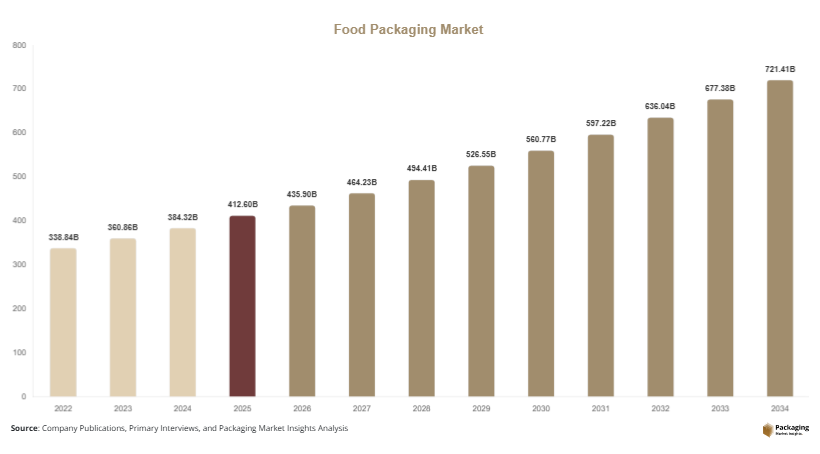
In 2025, the food packaging market size is estimated at USD 412.6 billion, and it is projected to reach approximately USD 435.9 billion in 2026. With expanding food consumption patterns and technological advancements, the market is forecast to grow to USD 768.4 billion by 2034, registering a CAGR of 6.5% during the forecast period (2025–2034). The food packaging market is witnessing steady growth driven by increasing demand for safe, durable, and efficient packaging solutions across the global food supply chain.
Food packaging plays a critical role in preserving product quality, extending shelf life, and ensuring safety during storage and transportation. The increasing consumption of processed and convenience foods is a major factor driving the demand for advanced packaging solutions. Changing lifestyles, urbanization, and the growing working population have led to a shift toward ready-to-eat and packaged food products, which require reliable packaging materials.
Key Highlights:
- The market size is projected to reach USD 768.4 billion by 2034, reflecting steady expansion across global food supply chains. Rising consumption of packaged and processed food products continues to support this growth.
- The market is expected to register a CAGR of 6.5% from 2025 to 2034, indicating consistent long-term development. Ongoing advancements in packaging materials and technologies are contributing to this growth rate.
- There is an increasing demand for convenience and packaged food products driven by changing lifestyles. Urbanization and busy consumer schedules are encouraging the adoption of ready-to-eat and easy-to-store food items.
- The growing focus on sustainable and eco-friendly packaging solutions is shaping market trends. Companies are investing in recyclable and biodegradable materials to meet regulatory standards and evolving consumer preferences.
Explore more data points, trends and opportunities Download Free Sample Report
Market Trends
Rising Adoption of Sustainable and Eco-Friendly Packaging
The food packaging market is experiencing a shift toward sustainable materials as environmental concerns continue to rise. Companies are increasingly using biodegradable plastics, paper-based packaging, and recyclable materials to reduce their environmental footprint. This trend is driven by regulatory requirements and consumer preference for environmentally responsible products. Manufacturers are investing in research and development to create packaging solutions that maintain performance while being eco-friendly. The adoption of sustainable packaging is becoming a key differentiator for brands, influencing purchasing decisions and enhancing brand reputation.
Growth of Smart and Active Packaging Technologies
Smart and active packaging technologies are gaining traction in the food packaging market. These solutions include features such as temperature indicators, freshness sensors, and antimicrobial coatings that help maintain food quality and safety. Smart packaging enables real-time monitoring of product conditions, providing valuable information to both manufacturers and consumers. Active packaging extends shelf life by controlling factors such as moisture and oxygen levels. The increasing demand for high-quality and safe food products is driving the adoption of these advanced technologies.
Market Drivers
Increasing Demand for Convenience and Ready-to-Eat Foods
The rising demand for convenience foods is a significant driver of the food packaging market. Busy lifestyles and changing consumer preferences are leading to increased consumption of ready-to-eat and packaged food products. These products require effective packaging solutions to ensure freshness, safety, and ease of use. Packaging also plays a crucial role in enhancing product appeal and providing information to consumers. The growth of urban populations and the expansion of retail networks are further supporting the demand for convenient food packaging solutions.
Expansion of E-Commerce and Food Delivery Services
The rapid growth of e-commerce and food delivery services is driving demand for food packaging solutions. Online grocery platforms and food delivery apps require packaging that can withstand transportation and maintain product quality. The increasing use of insulated packaging and tamper-evident solutions is enhancing food safety and consumer confidence. As digital platforms continue to expand, the demand for efficient and reliable packaging solutions is expected to increase significantly.
Market Restraint
Environmental Concerns and Regulatory Pressure
Environmental concerns related to packaging waste are a major restraint in the food packaging market. Governments are implementing strict regulations to reduce plastic usage and promote sustainable alternatives. These regulations are increasing compliance costs for manufacturers and limiting the use of certain materials. Additionally, consumer awareness about environmental issues is influencing purchasing decisions, leading to a preference for eco-friendly packaging. For example, bans on single-use plastics in several countries have forced companies to redesign their packaging solutions. This transition requires significant investment and can impact profitability, posing challenges for market growth.
Market Opportunities
Development of Biodegradable and Compostable Packaging
The growing focus on sustainability is creating opportunities for biodegradable and compostable packaging solutions. Companies are exploring alternative materials such as plant-based plastics and paper composites to reduce environmental impact. These solutions are gaining popularity in the food industry due to their ability to decompose naturally. The increasing demand for eco-friendly packaging is expected to drive innovation and create new growth opportunities in the market.
Technological Advancements in Packaging Design and Materials
Technological advancements are opening new opportunities in the food packaging market. Innovations such as smart packaging, nanotechnology, and advanced barrier materials are enhancing the functionality of packaging solutions. These technologies improve shelf life, reduce food waste, and ensure product safety. Companies investing in advanced packaging technologies are likely to gain a competitive advantage in the market.
Report Scope
| Report Metric | Details |
|---|---|
| Market Size in 2025 | USD 412.6 Billion |
| Market Size in 2026 | USD 435.9 Billion |
| Market Size in 2034 | USD 768.4 Billion |
| CAGR | 6.5% (2026-2034) |
| Base Year for Estimation | 2025 |
| Historical Data | 2022-2024 |
| Forecast Period | 2026-2034 |
| Report Coverage | Revenue Forecast, Competitive Landscape, Supply Chain Disruption, Growth Factors, Environment & Regulatory Landscape and Trends |
| Geographies Covered | North America, Europe, APAC, Middle East and Africa, LATAM |
| Countries Covered | U.S., Canada, U.K., Germany, France, Spain, Italy, Russia, Nordic, Benelux, Rest of Europe, China, South Korea, Japan, India, Australia, Singapore, Taiwan, South East Asia, Rest of Asia-Pacific, UAE, Turky, Saudi Arabia, South Africa, Egypt, Nigeria, Rest of MEA, Brazil, Mexico, Argentina, Chile, Colombia, Rest of LATAM |
Explore more data points, trends and opportunities Download Free Sample Report
Segmental Analysis
By Material Type
Plastic packaging dominated the food packaging market in 2024, accounting for approximately 52% of the total market share. Plastic materials such as polyethylene, polypropylene, and PET are widely used due to their durability, flexibility, and cost-effectiveness. These materials provide excellent barrier properties, protecting food from moisture, oxygen, and contaminants. The widespread use of plastic packaging in various applications, including flexible packaging and rigid containers, is contributing to its dominance. Despite environmental concerns, ongoing innovations in recyclable and biodegradable plastics are supporting the continued use of plastic packaging in the food industry.
Paper and paperboard packaging is expected to be the fastest-growing segment, with a CAGR of around 7.1% during the forecast period. The growth of this segment is driven by increasing demand for sustainable packaging solutions. Paper-based materials are biodegradable, recyclable, and widely accepted by consumers as environmentally friendly. The rise of eco-conscious consumers and regulatory pressure to reduce plastic usage are further supporting the growth of this segment.
By Packaging Type
Flexible packaging emerged as the dominant segment in 2024, holding nearly 58% of the market share. Flexible packaging solutions such as pouches, films, and wraps are widely used due to their lightweight nature and cost efficiency. These solutions offer convenience, extended shelf life, and reduced transportation costs. The increasing demand for on-the-go food products is driving the adoption of flexible packaging.
Rigid packaging is projected to be the fastest-growing segment, with a CAGR of 6.9%. This growth is driven by the increasing demand for durable and protective packaging solutions for products such as beverages and dairy items. Rigid packaging provides structural integrity and enhances product safety. The growing use of recyclable materials in rigid packaging is also contributing to its growth.
By End-Use
The food industry dominated the market in 2024, accounting for approximately 62% of total demand. Packaging solutions are widely used in various food segments, including processed foods, dairy products, and snacks. The increasing demand for packaged food products is driving the growth of this segment.
The beverage industry is expected to be the fastest-growing segment, with a CAGR of 7.0%. The growth is driven by the increasing consumption of packaged beverages such as soft drinks, juices, and bottled water. Packaging plays a crucial role in maintaining product quality and extending shelf life. The rising demand for convenient and portable packaging solutions is supporting the growth of this segment.
Food Packaging Market Segmentations
By Material Type
- Plastic
- Paper & Paperboard
- Glass
- Metal
By Packaging Type
- Flexible Packaging
- Rigid Packaging
By End-Use
- Food
- Beverage
Regional Analysis
North America
North America accounted for approximately 29% of the global food packaging market share in 2025 and is projected to grow at a CAGR of 5.8% during the forecast period. The region benefits from a well-established food processing industry and high demand for packaged food products. Technological advancements and strong distribution networks are supporting market growth.
The United States dominates the regional market due to its large consumer base and advanced retail infrastructure. A unique growth factor is the increasing demand for sustainable packaging solutions driven by consumer awareness and corporate sustainability initiatives. Companies are investing in eco-friendly materials to meet regulatory requirements and consumer expectations.
Europe
Europe held around 26% of the global market share in 2025 and is expected to grow at a CAGR of 5.6%. The region’s growth is influenced by strict environmental regulations and a strong focus on sustainability. The demand for innovative packaging solutions is driving market expansion.
Germany leads the European market due to its strong manufacturing sector and emphasis on technological innovation. A unique growth factor is the adoption of circular economy practices, which promote recycling and reuse of materials. This approach is driving the development of sustainable packaging solutions in the region.
Asia Pacific
Asia Pacific is the largest and fastest-growing region, accounting for approximately 32% of the market share in 2025 and expected to grow at a CAGR of 7.2%. Rapid urbanization and increasing disposable incomes are driving demand for packaged food products. The expansion of retail and e-commerce sectors is further supporting market growth.
China dominates the Asia Pacific market due to its large population and growing food industry. A unique growth factor is the increasing investment in modern packaging technologies to improve efficiency and reduce waste. This focus on innovation is driving the adoption of advanced packaging solutions.
Middle East & Africa
The Middle East & Africa region accounted for around 7% of the global market share in 2025 and is projected to grow at a CAGR of 6.0%. The market is driven by increasing demand for packaged food and beverages. Infrastructure development and urbanization are also supporting growth.
The United Arab Emirates is a key contributor to the regional market. A unique growth factor is the expansion of the hospitality and tourism sectors, which increases demand for packaged food products. This trend is driving the adoption of advanced packaging solutions in the region.
Latin America
Latin America held approximately 6% of the global market share in 2025 and is expected to grow at a CAGR of 6.3%. The region’s growth is supported by rising demand for packaged food products and improving economic conditions. The expansion of retail networks is also contributing to market growth.
Brazil leads the Latin American market due to its large population and growing food industry. A unique growth factor is the increasing adoption of flexible packaging solutions, which offer cost efficiency and convenience. This trend is supporting the growth of the market in the region.
Competitive Landscape
The food packaging market is highly competitive, with numerous global and regional players operating in the industry. Companies are focusing on innovation, sustainability, and strategic partnerships to strengthen their market position. The development of eco-friendly packaging solutions is a key focus area for many companies.
Amcor Plc is recognized as a leading player in the market due to its extensive product portfolio and global presence. The company recently introduced recyclable packaging solutions to meet sustainability goals. Other major players are also investing in research and development to enhance their offerings and gain a competitive edge.
Key Players List
- Amcor Plc
- Berry Global Inc.
- Sealed Air Corporation
- Mondi Group
- Tetra Pak International S.A.
- WestRock Company
- Smurfit Kappa Group
- Crown Holdings Inc.
- Ball Corporation
- DS Smith Plc
- Huhtamaki Oyj
- Sonoco Products Company
- Uflex Ltd.
- Constantia Flexibles
- Coveris Holdings S.A.