Food Packaging Equipment Market Size and Growth
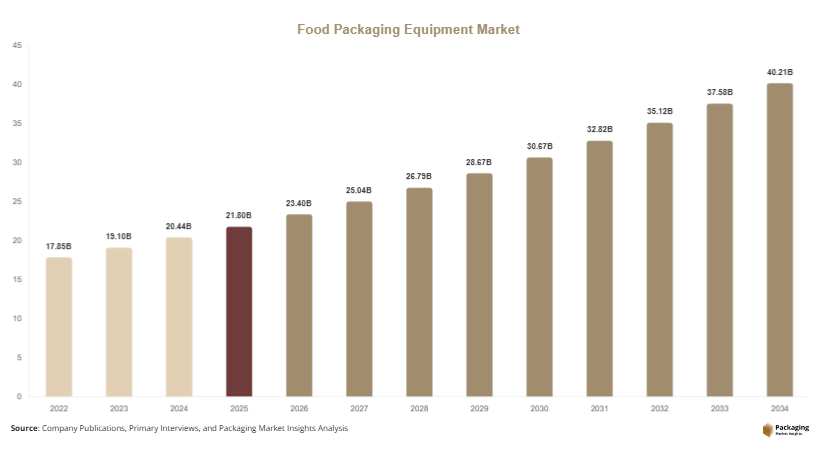
The global Food Packaging Equipment Market size was valued at approximately USD 21.8 billion in 2025 and is projected to reach USD 23.4 billion in 2026. Over the forecast period, the market is expected to reach USD 42.9 billion by 2034, registering a CAGR of 7.0% from 2025 to 2034. This growth is supported by rising consumption of convenience foods, expanding food processing industries, and technological advancements in packaging machinery.
One of the primary growth factors is the increasing demand for packaged food products. Changing consumer lifestyles, urbanization, and rising disposable incomes are driving the consumption of ready-to-eat and processed foods. This, in turn, is increasing the demand for efficient and high-speed packaging equipment to ensure product safety and quality.
Key Highlights:
- The market size reached USD 21.8 billion in 2025 and is projected to reach USD 42.9 billion by 2034, reflecting steady expansion across the food processing sector. This growth is supported by increasing demand for efficient and high-speed packaging solutions.
- The market is expected to grow at a CAGR of 7.0% from 2025 to 2034, driven by technological advancements and rising industrial automation. Continuous investments in packaging infrastructure are further supporting long-term growth.
- Rising demand for packaged and processed food products is a key factor driving market expansion. Changing consumer lifestyles and urbanization are increasing the need for convenient and ready-to-eat food options.
- Increasing adoption of automation and smart packaging technologies is enhancing operational efficiency. These technologies help reduce labor costs, improve accuracy, and enable real-time monitoring of packaging processes.
- Growing focus on food safety and hygiene standards is encouraging the use of advanced packaging equipment. Regulatory compliance and quality assurance requirements are pushing manufacturers to upgrade their systems.
Explore more data points, trends and opportunities Download Free Sample Report
Market Trends
Integration of Automation and Smart Technologies in Packaging Equipment
A key trend in the food packaging equipment market is the increasing integration of automation and smart technologies. Manufacturers are adopting advanced machinery equipped with sensors, artificial intelligence, and IoT capabilities to improve efficiency and reduce downtime. These smart systems enable real-time monitoring of packaging operations, predictive maintenance, and improved quality control. Automation also helps reduce reliance on manual labor, minimizing human error and increasing productivity. The demand for automated packaging lines is growing, especially among large-scale food manufacturers seeking to enhance operational efficiency and meet high production volumes.
Rising Demand for Flexible and Modular Packaging Equipment
Another significant trend is the growing demand for flexible and modular packaging equipment. Food manufacturers require equipment that can handle a variety of packaging formats and product types. Modular systems allow easy customization and scalability, enabling manufacturers to adapt to changing market demands. This trend is particularly relevant in industries with diverse product portfolios, such as snacks, beverages, and ready-to-eat meals. Flexible equipment also supports quick changeovers, reducing downtime and improving efficiency. As product diversification increases, the demand for versatile packaging equipment is expected to rise.
Market Drivers
Increasing Consumption of Packaged and Processed Foods
The rising consumption of packaged and processed foods is a major driver of the food packaging equipment market. Consumers are increasingly opting for convenient food options due to busy lifestyles and urbanization. This trend is driving demand for packaging solutions that can ensure product safety, freshness, and extended shelf life. Packaging equipment plays a critical role in maintaining product quality and meeting regulatory standards. The growth of supermarkets, convenience stores, and online food delivery platforms is further supporting the demand for packaged foods, thereby driving the need for advanced packaging equipment.
Expansion of Food Processing Industry and Industrial Automation
The expansion of the food processing industry is another key driver of market growth. As manufacturers increase production capacity, there is a growing need for efficient and high-speed packaging equipment. Automation is becoming an integral part of packaging operations, enabling companies to improve productivity and reduce costs. Advanced packaging equipment can handle complex tasks with precision, ensuring consistent product quality. The adoption of automated systems is particularly high in developed regions, where labor costs are high and efficiency is a priority.
Market Restraint
High Initial Investment and Maintenance Costs of Advanced Equipment
One of the key restraints in the food packaging equipment market is the high initial investment required for advanced packaging machinery. Automated and smart packaging systems involve significant capital expenditure, which can be a barrier for small and medium-sized enterprises. Additionally, the maintenance and operational costs of such equipment can be high, requiring skilled personnel and regular servicing. For example, small food processing companies may find it challenging to invest in high-end automated systems due to budget constraints. These factors can limit the adoption of advanced packaging equipment, particularly in developing regions.
Market Opportunities
Growth of Sustainable Packaging Solutions and Equipment
The increasing focus on sustainability presents significant opportunities for the food packaging equipment market. Manufacturers are investing in equipment that can handle eco-friendly packaging materials such as biodegradable films and recyclable materials. This trend is driven by regulatory requirements and consumer demand for sustainable products. Packaging equipment that supports sustainable materials is gaining popularity, creating opportunities for innovation and growth.
Expansion in Emerging Markets with Growing Food Industry
Emerging markets offer substantial growth opportunities for the food packaging equipment market. Rapid urbanization, increasing disposable incomes, and changing consumer preferences are driving the demand for packaged foods in these regions. The expansion of food processing industries is creating a need for advanced packaging equipment. Companies can capitalize on these opportunities by expanding their presence in emerging markets and offering cost-effective solutions tailored to local needs.
Report Scope
| Report Metric | Details |
|---|---|
| Market Size in 2025 | USD 21.8 Billion |
| Market Size in 2026 | USD 23.4 Billion |
| Market Size in 2034 | USD 42.9 Billion |
| CAGR | 7.0% (2026-2034) |
| Base Year for Estimation | 2025 |
| Historical Data | 2022-2024 |
| Forecast Period | 2026-2034 |
| Report Coverage | Revenue Forecast, Competitive Landscape, Supply Chain Disruption, Growth Factors, Environment & Regulatory Landscape and Trends |
| Geographies Covered | North America, Europe, APAC, Middle East and Africa, LATAM |
| Countries Covered | U.S., Canada, U.K., Germany, France, Spain, Italy, Russia, Nordic, Benelux, Rest of Europe, China, South Korea, Japan, India, Australia, Singapore, Taiwan, South East Asia, Rest of Asia-Pacific, UAE, Turky, Saudi Arabia, South Africa, Egypt, Nigeria, Rest of MEA, Brazil, Mexico, Argentina, Chile, Colombia, Rest of LATAM |
Explore more data points, trends and opportunities Download Free Sample Report
Segmental Analysis
By Equipment Type
Form-fill-seal machines dominated the market in 2024, accounting for approximately 46% of the total share. These machines are widely used for packaging food products due to their efficiency and versatility. They can perform multiple functions, including forming, filling, and sealing, in a single process. This reduces production time and costs, making them a preferred choice among manufacturers. The increasing demand for automated packaging solutions is driving the adoption of form-fill-seal machines.
Filling machines are the fastest-growing segment, with a CAGR of 7.8%. These machines are used for packaging liquid and semi-liquid products such as beverages, sauces, and dairy products. The growth of the beverage industry and increasing demand for packaged liquids are driving this segment. Additionally, advancements in filling technologies are improving accuracy and efficiency.
By Application
Food applications dominated the market in 2024, accounting for approximately 52% of the total share. The increasing demand for packaged food products is driving this segment. Packaging equipment ensures product safety, quality, and shelf life, making it essential for food manufacturers.
Beverage applications are the fastest-growing segment, with a CAGR of 7.6%. The growth of the beverage industry and increasing demand for packaged drinks are driving this segment. Packaging equipment plays a critical role in maintaining product quality and ensuring efficient production.
By End-Use
Food processing companies dominated the market in 2024, accounting for approximately 48% of the total share. These companies rely on packaging equipment to ensure efficient production and product quality.
E-commerce and retail companies are the fastest-growing segment, with a CAGR of 7.9%. The growth of online shopping and retail activities is driving demand for packaging equipment that can handle high volumes and ensure product safety.
Food Packaging Equipment Market Segmentations
By Equipment Type
- Form-Fill-Seal Machines
- Filling Machines
- Wrapping Machines
By Application
- Food
- Beverages
- Dairy
By End-Use
- Food Processing Companies
- Retail Sector
- E-Commerce
Regional Analysis
North America
North America accounted for approximately 31% of the global food packaging equipment market share in 2025 and is expected to grow at a CAGR of 6.8% during the forecast period. The region’s growth is driven by advanced food processing industries and high demand for packaged food products. Increasing adoption of automation is also contributing to market expansion.
The United States dominates the regional market due to its well-established food industry. A unique growth factor is the high adoption of automated packaging systems, which is driving demand for advanced equipment.
Europe
Europe held around 27% of the market share in 2025 and is projected to grow at a CAGR of 6.6%. The region is characterized by strict food safety regulations and a strong focus on sustainability. These factors are influencing the adoption of advanced packaging equipment.
Germany leads the European market due to its strong manufacturing base. A unique growth factor is the increasing demand for sustainable packaging solutions, which is driving innovation in packaging equipment.
Asia Pacific
Asia Pacific accounted for approximately 26% of the market share in 2025 and is expected to grow at a CAGR of 8.2%, making it the fastest-growing region. Rapid urbanization and increasing consumption of packaged foods are driving market growth.
China dominates the regional market due to its large population and expanding food processing industry. A unique growth factor is the growth of manufacturing industries, which is driving demand for packaging equipment.
Middle East & Africa
The Middle East & Africa region held around 8% of the market share in 2025 and is projected to grow at a CAGR of 7.1%. The growing food industry and increasing demand for packaged products are driving market growth.
Saudi Arabia is the dominant country in this region. A unique growth factor is the expansion of retail infrastructure, which is increasing demand for packaging equipment.
Latin America
Latin America accounted for approximately 8% of the market share in 2025 and is expected to grow at a CAGR of 7.3%. The region is experiencing steady growth due to increasing consumption of packaged foods.
Brazil leads the regional market due to its growing food industry. A unique growth factor is the rising demand for processed food products, which is driving market growth.
Competitive Landscape
The food packaging equipment market is moderately competitive, with several global players focusing on innovation and expansion. Companies are investing in advanced technologies to improve equipment performance and efficiency. Strategic partnerships and acquisitions are also common as companies aim to strengthen their market position.
Tetra Pak International S.A. is a leading player in the market, known for its advanced packaging solutions. The company recently introduced innovative packaging equipment designed for sustainable packaging materials. Other key players are also focusing on expanding their product portfolios and enhancing their global presence.
Key Players List
- Tetra Pak International S.A.
- Krones AG
- Bosch Packaging Technology
- MULTIVAC Group
- Coesia Group
- ProMach Inc.
- IMA Group
- GEA Group
- Barry-Wehmiller Companies
- Ishida Co., Ltd.
- ULMA Packaging
- Marchesini Group
- Syntegon Technology
- Duravant LLC
- Nichrome India Ltd.