Food Packaging Barrier Film Market Size and Growth
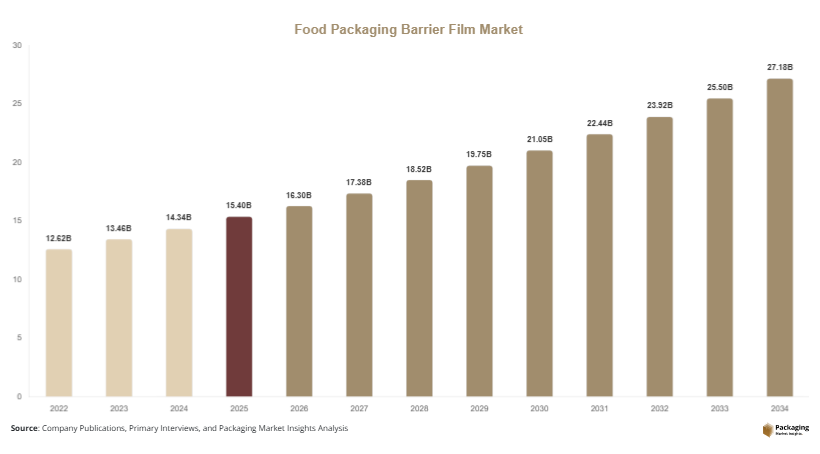
The global food packaging barrier film market was valued at approximately USD 15.4 billion in 2025 and is projected to reach nearly USD 16.3 billion in 2026. By 2034, the market is forecast to reach around USD 27.1 billion, expanding at a CAGR of 6.6% during 2025–2034. The food packaging barrier film market is experiencing stable growth due to increasing demand for extended shelf-life packaging solutions across the food and beverage industry. Barrier films are widely used to protect packaged food products from moisture, oxygen, light, aroma transfer, and microbial contamination. These films help preserve freshness, improve product safety, and reduce food waste during transportation and storage.
The growth of packaged and convenience food consumption is one of the major factors supporting market expansion. Consumers increasingly prefer ready-to-eat meals, frozen foods, snack products, and processed meat items that require durable and high-performance packaging materials. Barrier films help maintain product quality while extending shelf life, making them essential for modern food distribution systems. Another important growth factor is the increasing adoption of flexible packaging formats. Flexible packaging solutions offer lower transportation costs, reduced material usage, and improved product visibility compared to rigid alternatives. Barrier films are widely integrated into pouches, wraps, sachets, and vacuum packaging structures.
Key Highlights
- Asia Pacific dominated the market with a 43.6% share in 2025.
- Latin America is projected to grow at the fastest CAGR of 7.1%.
- High-barrier films led the product type segment with a 39.8% share.
- Flexible packaging dominated the packaging format segment with a 58.2% share.
- Polyethylene-based films led the material segment with a 35.7% share.
- The US remained the dominant country with a market size of USD 2.7 billion in 2025 and USD 2.9 billion in 2026.
Explore more data points, trends and opportunities Download Free Sample Report
Market Trends
Growing Adoption of Sustainable and Recyclable Barrier Films
The food packaging barrier film market is witnessing increasing adoption of sustainable and recyclable packaging solutions. Food manufacturers and retailers are focusing on reducing packaging waste and improving recyclability to comply with environmental regulations and consumer sustainability preferences. Barrier film producers are developing mono-material and recyclable multilayer structures that maintain oxygen and moisture barrier performance while supporting recycling compatibility. Polyethylene and polypropylene-based recyclable barrier films are gaining popularity in snack food, dairy, and frozen food applications. Packaging companies are also investing in downgauging technologies to reduce material consumption without compromising packaging strength and product protection.
Rising Demand for High-Barrier Packaging in Ready-to-Eat Foods
The demand for high-barrier packaging films is increasing due to the rapid growth of ready-to-eat meals and processed food products. Consumers are seeking convenient food options with longer shelf life and consistent product quality. High-barrier films protect food products from oxygen exposure, moisture transfer, and contamination, helping manufacturers maintain freshness and reduce spoilage. The expansion of online grocery delivery services is further supporting demand for durable barrier packaging materials. Food companies are increasingly adopting multilayer film structures with advanced sealing and puncture resistance properties to improve transportation safety and product stability.
Market Drivers
Expansion of the Global Packaged Food Industry
The rapid expansion of the global packaged food industry is a major driver supporting the food packaging barrier film market. Urbanization, rising disposable incomes, and changing consumer lifestyles are increasing demand for processed and packaged food products across developed and emerging economies. Barrier films help extend shelf life and maintain food quality during storage and transportation. Food manufacturers increasingly rely on advanced barrier packaging to reduce product spoilage and improve distribution efficiency. Snack foods, frozen products, meat packaging, and dairy applications are among the key segments driving demand for high-performance barrier film materials worldwide.
Increasing Focus on Food Safety and Shelf-Life Extension
Growing concerns regarding food safety and preservation are also driving market growth. Governments and regulatory authorities are implementing stricter food safety standards that require effective packaging solutions to minimize contamination risks. Barrier films provide strong protection against oxygen, moisture, bacteria, and external environmental conditions, helping maintain product freshness and nutritional value. Food exporters and cold chain operators increasingly use high-barrier packaging materials to ensure product integrity during long-distance transportation. Rising demand for vacuum-sealed and modified atmosphere packaging systems is further accelerating adoption of advanced barrier film technologies.
Market Restraint
Fluctuating Raw Material Costs and Recycling Challenges
One of the major restraints affecting the food packaging barrier film market is the fluctuation in raw material prices and the complexity of recycling multilayer packaging structures. Barrier films are often manufactured using combinations of polyethylene, polypropylene, EVOH, nylon, and metalized materials to achieve high-performance barrier properties. However, these multilayer combinations can create recycling difficulties because separating different material layers is technically challenging and costly. Environmental regulations targeting plastic packaging waste are increasing pressure on manufacturers to redesign traditional packaging structures. For example, several European retailers are reducing the use of non-recyclable multilayer plastic packaging to meet sustainability targets. Rising crude oil price volatility also impacts resin costs, affecting production expenses and profit margins for packaging manufacturers. Smaller companies may struggle to invest in advanced recyclable barrier technologies due to high capital requirements. These factors could slow market growth in regions with strict environmental regulations and limited recycling infrastructure.
Market Opportunities
Development of Mono-Material Barrier Packaging Solutions
The development of mono-material barrier packaging solutions presents a major opportunity for market participants. Packaging companies are increasingly focusing on recyclable packaging structures that simplify waste management and improve material recovery rates. Mono-material barrier films based on polyethylene or polypropylene can provide acceptable barrier properties while supporting recycling compatibility. Food manufacturers are adopting these solutions to meet sustainability commitments and comply with packaging regulations. Advancements in coating technologies and multilayer extrusion systems are enabling the production of recyclable barrier films with improved oxygen and moisture resistance, creating new growth opportunities for packaging suppliers.
Growth of E-Commerce Grocery and Cold Chain Distribution
The expansion of e-commerce grocery platforms and cold chain distribution systems is creating strong demand for durable food packaging barrier films. Online grocery delivery requires packaging materials capable of protecting products from temperature fluctuations, moisture exposure, and transportation damage. Barrier films help preserve food freshness during storage and transit, particularly for frozen meals, seafood, dairy products, and fresh produce. Rapid urbanization and increasing digital grocery adoption in emerging economies are expected to support demand for advanced food packaging solutions. Manufacturers are also developing puncture-resistant and lightweight barrier films optimized for e-commerce logistics applications.
Report Scope
| Report Metric | Details |
|---|---|
| Market Size in 2025 | USD 15.4 Billion |
| Market Size in 2026 | USD 16.3 Billion |
| Market Size in 2034 | USD 27.1 Billion |
| CAGR | 6.6% (2026-2034) |
| Base Year for Estimation | 2025 |
| Historical Data | 2022-2024 |
| Forecast Period | 2026-2034 |
| Report Coverage | Revenue Forecast, Competitive Landscape, Supply Chain Disruption, Growth Factors, Environment & Regulatory Landscape and Trends |
| Geographies Covered | North America, Europe, APAC, Middle East and Africa, LATAM |
| Countries Covered | U.S., Canada, U.K., Germany, France, Spain, Italy, Russia, Nordic, Benelux, Rest of Europe, China, South Korea, Japan, India, Australia, Singapore, Taiwan, South East Asia, Rest of Asia-Pacific, UAE, Turky, Saudi Arabia, South Africa, Egypt, Nigeria, Rest of MEA, Brazil, Mexico, Argentina, Chile, Colombia, Rest of LATAM |
Explore more data points, trends and opportunities Download Free Sample Report
Segmental Analysis
By Product Type
High-barrier films dominated the food packaging barrier film market in 2024, accounting for approximately 39.8% of the total market share. These films are widely used in meat packaging, dairy products, snack foods, and ready-to-eat meals because they provide excellent oxygen and moisture protection. High-barrier packaging helps extend shelf life and maintain food freshness during transportation and storage. Manufacturers increasingly prefer multilayer high-barrier films because they improve food safety and reduce product spoilage. Rising demand for processed foods and cold chain distribution systems continues to support strong adoption of high-barrier packaging materials globally.
Recyclable barrier films are expected to be the fastest-growing product type segment, registering a CAGR of 7.4% during the forecast period. Food companies are increasingly focusing on sustainable packaging strategies to reduce environmental impact and comply with packaging regulations. Recyclable barrier films based on mono-material polyethylene and polypropylene structures are gaining popularity across snack foods, bakery products, and frozen food packaging applications. Advances in coating technologies and resin formulations are improving barrier performance while maintaining recyclability. Growing consumer awareness regarding sustainable packaging is expected to accelerate segment growth over the coming years.
By Packaging Format
Flexible packaging dominated the food packaging barrier film market in 2024 with a market share of approximately 58.2%. Flexible packaging solutions offer lower transportation costs, reduced storage requirements, and improved product convenience compared to rigid packaging alternatives. Barrier films are widely used in pouches, sachets, wraps, and laminated packaging structures to protect packaged foods from moisture and oxygen exposure. Food manufacturers increasingly adopt flexible packaging because it improves shelf appeal and supports efficient distribution systems. Rising demand for packaged snacks, frozen foods, and convenience meals continues to drive segment growth globally.
Vacuum packaging is projected to be the fastest-growing packaging format segment, expanding at a CAGR of 6.9% during the forecast period. Vacuum packaging removes air from food packaging structures, helping extend product shelf life and reduce bacterial growth. Barrier films play an important role in maintaining vacuum integrity and protecting food products from external contamination. Meat, seafood, cheese, and processed food manufacturers increasingly use vacuum packaging systems to improve freshness and reduce waste. Growing investments in food preservation technologies and cold chain logistics are expected to support continued demand for vacuum packaging barrier films.
By Material
Polyethylene-based films accounted for the largest market share in 2024 at approximately 35.7%. These films are widely used because they offer flexibility, sealability, moisture resistance, and cost efficiency. Polyethylene barrier films are commonly integrated into multilayer food packaging structures for snack foods, frozen products, and bakery items. Packaging manufacturers increasingly use polyethylene materials in flexible packaging applications because they are compatible with recyclable mono-material packaging systems. Rising adoption of lightweight packaging and growing demand for cost-effective food preservation solutions continue to support strong market demand for polyethylene-based barrier films.
EVOH-based films are projected to be the fastest-growing material segment, with an expected CAGR of 7.2% during 2025–2034. EVOH materials provide strong oxygen barrier properties that help extend the shelf life of sensitive food products such as meat, dairy, sauces, and processed meals. Food manufacturers increasingly use EVOH barrier layers in multilayer packaging structures to improve food preservation and reduce spoilage risks. Technological advancements in multilayer extrusion and sustainable packaging development are further supporting segment growth. Increasing demand for premium packaged food products is expected to accelerate adoption of EVOH-based barrier films.
Food Packaging Barrier Film Market Segmentations
By Product Type
- High-Barrier Films
- Medium-Barrier Films
- Low-Barrier Films
- Recyclable Barrier Films
By Packaging Format
- Flexible Packaging
- Vacuum Packaging
- Modified Atmosphere Packaging
- Stand-Up Pouches
By Material
- Polyethylene-Based Films
- Polypropylene-Based Films
- EVOH-Based Films
- Polyamide-Based Films
Regional Analysis
North America
North America accounted for approximately 26.1% of the global food packaging barrier film market share in 2025 and is expected to grow at a CAGR of 6.2% during the forecast period. The region benefits from a strong packaged food industry, advanced cold chain infrastructure, and high adoption of flexible packaging technologies. Food manufacturers increasingly use barrier films for frozen foods, meat products, dairy packaging, and snack applications. Rising demand for sustainable food packaging is also encouraging innovation in recyclable barrier film materials.
The United States dominates the North American market because of its large food processing industry and extensive retail distribution network. One unique growth factor is the increasing expansion of online grocery delivery services requiring durable and temperature-resistant food packaging solutions.
Europe
Europe held nearly 24.4% of the global food packaging barrier film market share in 2025 and is projected to grow at a CAGR of 5.9% during the forecast period. The region is strongly influenced by sustainability regulations and circular economy initiatives targeting packaging waste reduction. Food manufacturers and retailers are increasingly adopting recyclable barrier film solutions to comply with regional environmental standards. Demand for vacuum packaging and modified atmosphere packaging is also supporting growth in meat and dairy applications.
Germany remains the dominant country in the European market due to its advanced food processing and packaging manufacturing industries. One unique growth factor is the rapid adoption of recyclable mono-material flexible packaging solutions across supermarket and private-label food brands.
Asia Pacific
Asia Pacific dominated the food packaging barrier film market with a 43.6% share in 2025 and is expected to grow at a CAGR of 7.0% through 2034. Rising urbanization, increasing disposable incomes, and expanding packaged food consumption are driving strong demand for barrier packaging materials across China, India, Japan, and Southeast Asia. Flexible packaging adoption is growing rapidly due to affordability, convenience, and transportation efficiency. Investments in food processing infrastructure and retail modernization are further supporting regional market expansion.
China dominates the Asia Pacific market because of its large-scale food manufacturing sector and rapidly growing packaged food industry. One unique growth factor is the increasing investment in domestic cold chain logistics infrastructure supporting demand for advanced food preservation packaging solutions.
Middle East & Africa
The Middle East & Africa market represented approximately 3.8% of the global food packaging barrier film market share in 2025 and is forecast to grow at a CAGR of 5.7% during the study period. Increasing packaged food imports, urban population growth, and retail sector expansion are supporting demand for barrier packaging materials. Flexible food packaging solutions are increasingly used across dairy, confectionery, and frozen food applications due to their lightweight structure and cost efficiency.
Saudi Arabia leads the regional market because of its expanding food processing and supermarket industries. One unique growth factor is the growing demand for temperature-resistant packaging materials suitable for hot climate food transportation and storage conditions.
Latin America
Latin America accounted for approximately 2.1% of the global food packaging barrier film market share in 2025 and is projected to grow at the fastest CAGR of 7.1% during the forecast period. Rising processed food consumption, retail modernization, and increasing food exports are driving demand for advanced packaging materials across the region. Flexible packaging adoption is increasing because of lower material costs and improved shelf-life performance.
Brazil dominates the Latin American market due to its large food and beverage manufacturing industry. One unique growth factor is the growing export of processed meat and agricultural food products requiring high-barrier packaging solutions for long-distance transportation.
Competitive Landscape
The food packaging barrier film market is highly competitive, with major companies focusing on sustainable packaging technologies, multilayer barrier innovation, and regional manufacturing expansion. Market participants are investing in recyclable barrier film solutions and advanced coating technologies to comply with changing environmental regulations and customer preferences. Strategic partnerships with food processing companies and retail brands remain important competitive strategies within the industry.
Amcor plc is one of the leading companies in the market due to its extensive flexible packaging portfolio and global manufacturing network. In 2024, the company introduced recyclable high-barrier packaging solutions designed for food and dairy applications. Other major companies include Sealed Air Corporation, Berry Global Inc., Mondi Group, and Winpak Ltd. These companies continue to invest in sustainable packaging materials, high-performance barrier technologies, and capacity expansion projects to strengthen their market position and support growing global demand.
Key Players List
- Amcor plc
- Sealed Air Corporation
- Berry Global Inc.
- Mondi Group
- Winpak Ltd.
- Coveris Holdings S.A.
- Constantia Flexibles
- Toray Industries Inc.
- Huhtamaki Oyj
- Sonoco Products Company
- Uflex Ltd.
- ProAmpac LLC
- Cosmo Films Ltd.
- Clondalkin Group
- Toppan Holdings Inc.