Food Labels Market Size and Growth
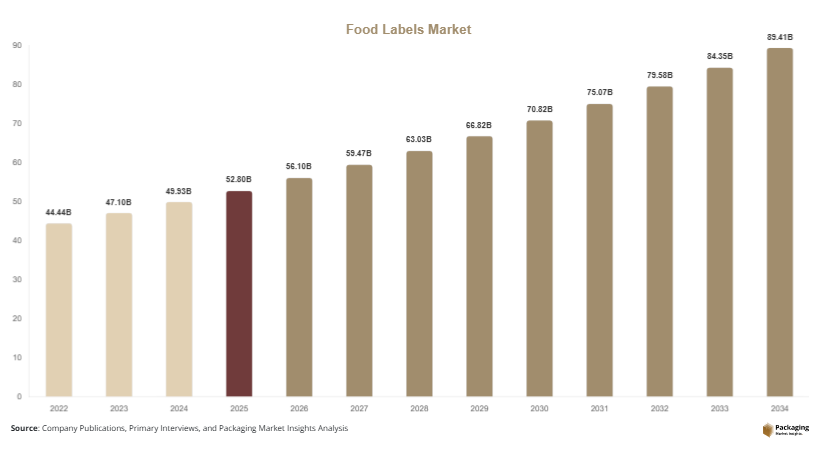
The global food labels market size was valued at approximately USD 52.8 billion in 2025 and is expected to reach USD 56.1 billion in 2026. Over the forecast period, the market is projected to reach USD 89.7 billion by 2034, registering a CAGR of 6.0% from 2025 to 2034.
One of the primary growth factors driving the market is the increasing focus on food safety and traceability. Governments and regulatory authorities across the globe are implementing strict labeling guidelines to ensure that consumers receive accurate information regarding ingredients, nutritional value, and allergens. This has led to a surge in demand for advanced labeling solutions.
Key Highlights:
- The food labels market is projected to reach USD 89.7 billion by 2034, reflecting strong growth driven by increasing demand across the global food industry. This expansion highlights the rising importance of labeling in ensuring product transparency and compliance.
- The market is expected to grow at a CAGR of 6.0% from 2025 to 2034, indicating steady and consistent development. This growth rate is supported by regulatory requirements and evolving consumer preferences.
- Rising demand for transparent and clean-label products is a key factor driving market expansion. Consumers are increasingly seeking clear ingredient information and natural product claims, influencing labeling practices.
- The growth of the packaged food and beverage industry is significantly boosting demand for food labels. Increasing consumption of ready-to-eat and processed foods is creating a need for informative and compliant labeling solutions.
- Advancements in digital and smart labeling technologies are enhancing the functionality of food labels. Innovations such as QR codes and RFID tags are improving traceability, consumer engagement, and supply chain efficiency.
Explore more data points, trends and opportunities Download Free Sample Report
Market Trends
Increasing Adoption of Smart and Digital Labels
The adoption of smart and digital labeling solutions is emerging as a significant trend in the food labels market. Manufacturers are integrating technologies such as QR codes, NFC tags, and RFID labels to provide consumers with detailed product information. These smart labels allow consumers to access information about ingredients, sourcing, nutritional content, and expiration dates through digital platforms.
This trend is particularly important in enhancing transparency and traceability within the food supply chain. Companies are using smart labels to improve inventory management, reduce counterfeiting, and ensure compliance with regulatory requirements. Additionally, digital labeling solutions enable real-time updates and customization, making them highly adaptable to changing market needs. As consumers continue to demand more information about food products, the adoption of smart labels is expected to grow steadily.
Growth of Clean-Label and Minimalist Packaging
The demand for clean-label and minimalist packaging is gaining momentum in the food labels market. Consumers are increasingly seeking products with simple and transparent ingredient lists, free from artificial additives and preservatives. This has led to a shift toward clean-label packaging that emphasizes clarity and simplicity.
Manufacturers are redesigning labels to highlight key information such as natural ingredients, organic certifications, and nutritional benefits. Minimalist designs with clear typography and reduced clutter are becoming more popular, enhancing product appeal and consumer trust. This trend is also aligned with sustainability goals, as companies are reducing the use of excessive materials and inks. As consumer preferences continue to evolve, clean-label packaging is expected to play a crucial role in shaping the future of the market.
Market Drivers
Stringent Government Regulations on Food Labeling
Government regulations play a critical role in driving the food labels market. Regulatory bodies across various countries have established strict guidelines to ensure that food products are labeled accurately and transparently. These regulations require manufacturers to provide detailed information about ingredients, nutritional content, allergens, and expiration dates.
Compliance with these regulations is mandatory for food manufacturers, leading to increased demand for labeling solutions. Companies are investing in advanced labeling technologies to meet regulatory requirements and avoid penalties. Additionally, regulatory frameworks are continuously evolving, requiring manufacturers to update their labeling practices. This ongoing need for compliance is driving growth in the food labels market.
Expansion of Packaged and Processed Food Industry
The rapid growth of the packaged and processed food industry is another key driver of the food labels market. Increasing urbanization, busy lifestyles, and rising disposable incomes are contributing to the demand for convenient food products. As the consumption of packaged foods increases, the need for labeling solutions also rises.
Food labels play a crucial role in providing essential information to consumers, ensuring product safety and quality. Manufacturers are focusing on creating visually appealing and informative labels to attract consumers and differentiate their products. The expansion of retail and e-commerce channels is further supporting the growth of the packaged food industry, driving demand for food labels.
Market Restraint
High Cost of Advanced Labeling Technologies
One of the key restraints in the food labels market is the high cost associated with advanced labeling technologies. Solutions such as smart labels, RFID tags, and digital printing systems require significant investment in equipment and infrastructure. This can be a barrier for small and medium-sized enterprises, limiting their ability to adopt advanced labeling solutions.
The high cost of implementation can also impact the overall pricing of food products, making them less competitive in price-sensitive markets. For example, a small food manufacturer may struggle to invest in digital labeling systems due to budget constraints, resulting in reliance on traditional labeling methods.
Additionally, the maintenance and integration of advanced labeling systems can be complex, requiring skilled personnel and ongoing investment. While these technologies offer significant benefits, the cost factor remains a challenge for widespread adoption. Addressing this issue is essential for ensuring broader market growth.
Market Opportunities
Rising Demand for Sustainable Labeling Solutions
The increasing focus on sustainability presents significant opportunities for the food labels market. Companies are exploring eco-friendly labeling materials such as biodegradable and recyclable labels to reduce environmental impact. This trend is driven by both regulatory requirements and consumer preferences for sustainable products.
Manufacturers are investing in innovative materials and processes to develop sustainable labeling solutions. For instance, water-based inks and compostable adhesives are gaining popularity. These advancements not only reduce environmental impact but also enhance brand image. As sustainability continues to gain importance, the demand for eco-friendly labeling solutions is expected to grow.
Growth in Emerging Markets
Emerging markets offer substantial growth opportunities for the food labels market. Rapid urbanization, increasing disposable incomes, and changing consumer lifestyles are driving demand for packaged food products in these regions. This, in turn, is boosting demand for labeling solutions.
Countries in Asia Pacific, Latin America, and Africa are witnessing increased investments in the food and beverage industry. This is creating a favorable environment for market growth. Companies that expand their presence in these regions can benefit from growing demand and untapped market potential. Strategic partnerships and investments in local manufacturing facilities can further enhance market penetration.
Report Scope
| Report Metric | Details |
|---|---|
| Market Size in 2025 | USD 52.8 Billion |
| Market Size in 2026 | USD 56.1 Billion |
| Market Size in 2034 | USD 89.7 Billion |
| CAGR | 6.0% (2026-2034) |
| Base Year for Estimation | 2025 |
| Historical Data | 2022-2024 |
| Forecast Period | 2026-2034 |
| Report Coverage | Revenue Forecast, Competitive Landscape, Supply Chain Disruption, Growth Factors, Environment & Regulatory Landscape and Trends |
| Geographies Covered | North America, Europe, APAC, Middle East and Africa, LATAM |
| Countries Covered | U.S., Canada, U.K., Germany, France, Spain, Italy, Russia, Nordic, Benelux, Rest of Europe, China, South Korea, Japan, India, Australia, Singapore, Taiwan, South East Asia, Rest of Asia-Pacific, UAE, Turky, Saudi Arabia, South Africa, Egypt, Nigeria, Rest of MEA, Brazil, Mexico, Argentina, Chile, Colombia, Rest of LATAM |
Explore more data points, trends and opportunities Download Free Sample Report
Segmental Analysis
By Type
Pressure-sensitive labels dominated the food labels market in 2024, accounting for over 48% of the total market share. These labels are widely used due to their ease of application, versatility, and cost-effectiveness. Pressure-sensitive labels can be applied to a variety of packaging materials, making them suitable for diverse applications. They are commonly used in food packaging due to their durability and ability to provide high-quality printing.
Smart labels are expected to be the fastest-growing segment, with a projected CAGR of 7.2%. The increasing demand for advanced labeling solutions that provide enhanced functionality is driving growth in this segment. Smart labels enable real-time tracking and provide detailed product information, improving supply chain efficiency.
By Application
The food packaging segment dominated the market in 2024, holding a significant share due to the high demand for packaged food products. Labels play a crucial role in providing essential information to consumers and ensuring product safety. The growing consumption of convenience foods is further supporting the growth of this segment.
The beverage packaging segment is expected to be the fastest-growing, with a CAGR of 6.5%. The increasing demand for packaged beverages such as soft drinks, juices, and bottled water is driving growth. Labels are essential for branding and regulatory compliance in this segment.
By End-Use Industry
The food and beverage industry dominated the market in 2024, accounting for a large share due to the widespread use of labeling solutions. The demand for informative and visually appealing labels is driving growth in this segment.
The retail sector is expected to be the fastest-growing, with a CAGR of 6.6%. The expansion of retail and e-commerce channels is increasing the demand for labeling solutions. Labels play a crucial role in product identification and branding.
Food Labels Market Segmentations
By Type
- Pressure-Sensitive Labels
- Shrink Sleeve Labels
- In-Mold Labels
- Smart Labels
By Application
- Food Packaging
- Beverage Packaging
- Dairy Products
- Frozen Foods
By End-User Industry
- Food & Beverage
- Retail
- Healthcare
- Industrial
Regional Analysis
North America
North America accounted for approximately 30% of the global food labels market share in 2025 and is expected to grow at a CAGR of 5.5% during the forecast period. The region benefits from a well-established food and beverage industry and strict regulatory frameworks that mandate detailed labeling practices. Increasing consumer awareness regarding food safety and nutritional information is driving demand for advanced labeling solutions.
The United States dominates the North American market due to its large consumer base and advanced retail infrastructure. A unique growth factor in this region is the increasing adoption of smart labeling technologies in the food industry. Companies are integrating QR codes and RFID tags to enhance traceability and provide consumers with detailed product information.
Europe
Europe held around 27% of the global market share in 2025 and is projected to grow at a CAGR of 5.8%. The region is characterized by stringent regulations related to food labeling and sustainability. Governments are promoting transparent labeling practices, which is driving demand for labeling solutions.
Germany is a leading country in the European market, supported by its strong food processing industry. A unique growth factor is the increasing demand for organic and clean-label products. Consumers are seeking detailed information about product ingredients, which is driving the adoption of advanced labeling solutions.
Asia Pacific
Asia Pacific is the fastest-growing region, accounting for approximately 31% of the market share in 2025, with a projected CAGR of 6.8%. Rapid urbanization, population growth, and rising disposable incomes are driving demand for packaged food products, boosting the food labels market.
China dominates the Asia Pacific market due to its large manufacturing sector and expanding retail industry. A unique growth factor is the increasing adoption of digital labeling technologies. Companies are leveraging digital solutions to improve supply chain efficiency and enhance consumer engagement.
Middle East & Africa
The Middle East & Africa region accounted for about 6% of the global market share in 2025 and is expected to grow at a CAGR of 5.3%. The market is driven by increasing investments in the food and beverage industry and growing demand for packaged food products.
Saudi Arabia is a dominant country in this region, supported by its expanding retail sector. A unique growth factor is the increasing focus on food safety regulations. Governments are implementing strict labeling requirements to ensure product quality and consumer safety.
Latin America
Latin America held approximately 6% of the global market share in 2025 and is projected to grow at a CAGR of 5.7%. The region is experiencing growth due to expanding food and beverage industries and increasing consumer awareness.
Brazil is the leading country in Latin America, supported by its large consumer market. A unique growth factor is the growing demand for packaged food products. This trend is driving the need for effective labeling solutions.
Competitive Landscape
The food labels market is characterized by intense competition, with key players focusing on innovation and sustainability to strengthen their market position. Companies are investing in advanced technologies such as digital printing and smart labeling to enhance product offerings.
Avery Dennison Corporation is a leading player in the market, known for its extensive range of labeling solutions. The company recently introduced sustainable label materials to support environmental initiatives. Other major players are also focusing on strategic partnerships and acquisitions to expand their market presence.
Key Players List
- Avery Dennison Corporation
- CCL Industries Inc.
- 3M Company
- Multi-Color Corporation
- UPM Raflatac
- Constantia Flexibles
- Coveris Holdings S.A.
- Huhtamaki Oyj
- Fuji Seal International, Inc.
- LINTEC Corporation
- Sato Holdings Corporation
- Torraspapel Adestor
- Mondi Group
- Amcor Plc
- Brady Corporation