Folding Cartons Market Size and Growth
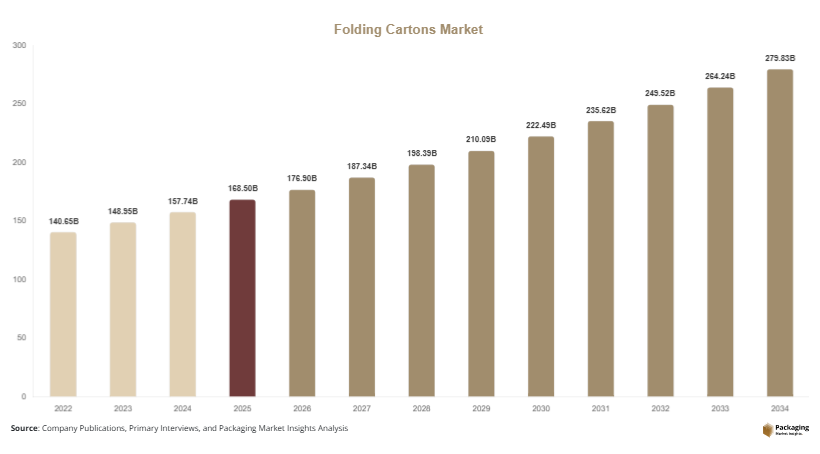
The global folding cartons market size was valued at USD 168.5 billion in 2025 and is expected to reach USD 176.9 billion in 2026, further growing to approximately USD 279.6 billion by 2034, registering a CAGR of 5.9% during the forecast period (2025–2034). Folding cartons are widely used for packaging food, beverages, pharmaceuticals, personal care products, and consumer goods due to their versatility, cost-effectiveness, and recyclability. The folding cartons market continues to expand steadily, driven by increasing demand for sustainable and lightweight packaging solutions across multiple industries.
One of the primary growth factors is the increasing shift toward eco-friendly packaging materials. Governments and regulatory bodies are implementing strict policies to reduce plastic waste, encouraging the adoption of paper-based packaging such as folding cartons. This transition is supported by consumer awareness regarding sustainability, which is influencing purchasing behavior and driving demand for recyclable packaging formats. Additionally, the rapid expansion of the food and beverage industry is significantly contributing to the market’s growth. Folding cartons are widely used for packaged foods, ready-to-eat meals, and frozen products, offering protection, convenience, and branding opportunities.
Key Highlights
- Asia Pacific dominated the market with a 38.2% share in 2025, while Latin America is projected to grow at the fastest CAGR of 6.4%.
- Straight tuck end cartons led the type segment with a 30.1% share, while crash lock bottom cartons are expected to grow at a CAGR of 6.6%.
- Paperboard materials dominated with a 100% share, while coated paperboard is forecasted to grow at a CAGR of 6.1%.
- Food & beverage applications led the segment with 46.3% share, while pharmaceutical packaging is expected to grow at a CAGR of 6.5%.
- China remained the dominant country with a market size of USD 21.4 billion in 2025 and USD 22.6 billion in 2026.
Explore more data points, trends and opportunities Download Free Sample Report
Market Trends
Increasing adoption of sustainable and recyclable packaging solutions
Sustainability continues to influence the folding cartons market as companies transition toward environmentally responsible packaging materials. Folding cartons are primarily made from paperboard, which is recyclable and biodegradable, making them a preferred alternative to plastic packaging. Manufacturers are investing in sustainable sourcing of raw materials and improving recycling processes to reduce environmental impact. Additionally, advancements in water-based coatings and inks are enabling eco-friendly printing without compromising quality. Brands are also using folding cartons to communicate sustainability messages, enhancing consumer trust. This trend is expected to strengthen as environmental regulations become more stringent and consumer demand for green packaging increases.
Rising demand for premium and visually appealing packaging designs
The demand for premium packaging is increasing as brands focus on differentiation and consumer engagement. Folding cartons offer excellent printability and design flexibility, allowing manufacturers to create visually appealing packaging. High-quality graphics, embossing, and specialty coatings are being used to enhance shelf appeal. This trend is particularly prominent in cosmetics, personal care, and luxury food segments. Digital printing technologies are enabling short-run production and customization, allowing brands to adapt quickly to market trends. As competition intensifies, companies are leveraging innovative packaging designs to attract consumers and strengthen brand identity.
Market Drivers
Growth of food and beverage industry driving packaging demand
The expansion of the food and beverage industry is a significant driver of the folding cartons market. Increasing demand for packaged and processed foods is creating a need for efficient packaging solutions that ensure product safety and freshness. Folding cartons are widely used for packaging cereals, snacks, dairy products, and frozen foods. They provide structural integrity and protection while allowing for easy storage and transportation. Additionally, changing consumer lifestyles and the growing preference for convenience foods are supporting market growth. The ability of folding cartons to offer branding opportunities further enhances their appeal in the food sector.
Expansion of e-commerce and retail distribution channels
The rapid growth of e-commerce and organized retail is driving demand for folding cartons. These packaging solutions are lightweight, durable, and easy to handle, making them suitable for shipping products across long distances. Folding cartons also provide protection against external factors such as moisture and physical damage. Retailers are increasingly using folding cartons for product display and branding, enhancing the overall shopping experience. The integration of smart packaging features such as QR codes and interactive elements is further supporting market growth. As e-commerce continues to expand globally, the demand for folding cartons is expected to increase significantly.
Market Restraint
Fluctuating raw material prices impacting production costs
One of the key challenges in the folding cartons market is the volatility in raw material prices, particularly paperboard and pulp. Fluctuations in the cost of these materials can significantly impact production expenses and profit margins for manufacturers. Factors such as supply chain disruptions, environmental regulations, and changes in demand for raw materials contribute to price instability. For example, increased demand for paper-based packaging can lead to shortages in pulp supply, driving up costs. This creates challenges for manufacturers in maintaining competitive pricing while ensuring product quality. Additionally, smaller companies may face difficulties in managing cost fluctuations, affecting market competitiveness.
Market Opportunities
Advancements in digital printing and customization technologies
Technological advancements in digital printing are creating new opportunities in the folding cartons market. Digital printing allows for high-quality graphics, faster production, and cost-effective short runs. This enables manufacturers to offer customized packaging solutions tailored to specific consumer preferences. Brands can use personalized packaging to enhance customer engagement and differentiate their products. Additionally, digital printing reduces waste and improves efficiency, supporting sustainability goals. As demand for customized packaging continues to grow, the adoption of digital printing technologies is expected to increase, creating significant opportunities for market expansion.
Increasing demand for pharmaceutical and healthcare packaging
The growing pharmaceutical and healthcare industries present significant opportunities for the folding cartons market. Folding cartons are widely used for packaging medicines, medical devices, and healthcare products due to their protective properties and ease of handling. The need for tamper-evident and secure packaging is driving innovation in this segment. Additionally, regulatory requirements for labeling and product information are supporting the use of folding cartons. The rising demand for healthcare products, particularly in emerging markets, is expected to drive growth in this segment. Manufacturers are focusing on developing specialized packaging solutions to meet industry standards.
Report Scope
| Report Metric | Details |
|---|---|
| Market Size in 2025 | USD 168.5 Billion |
| Market Size in 2026 | USD 176.9 Billion |
| Market Size in 2034 | USD 279.6 Billion |
| CAGR | 5.9% (2026-2034) |
| Base Year for Estimation | 2025 |
| Historical Data | 2022-2024 |
| Forecast Period | 2026-2034 |
| Report Coverage | Revenue Forecast, Competitive Landscape, Supply Chain Disruption, Growth Factors, Environment & Regulatory Landscape and Trends |
| Geographies Covered | North America, Europe, APAC, Middle East and Africa, LATAM |
| Countries Covered | U.S., Canada, U.K., Germany, France, Spain, Italy, Russia, Nordic, Benelux, Rest of Europe, China, South Korea, Japan, India, Australia, Singapore, Taiwan, South East Asia, Rest of Asia-Pacific, UAE, Turky, Saudi Arabia, South Africa, Egypt, Nigeria, Rest of MEA, Brazil, Mexico, Argentina, Chile, Colombia, Rest of LATAM |
Explore more data points, trends and opportunities Download Free Sample Report
Segmental Analysis
By Type
Straight tuck end cartons accounted for the largest share in 2024, holding approximately 30.1% of the market. These cartons are widely used due to their simplicity and cost-effectiveness. They are commonly used for packaging food, pharmaceuticals, and consumer goods. The design allows for easy assembly and efficient storage, making them suitable for high-volume production. Additionally, straight tuck end cartons provide adequate protection for products while maintaining a compact structure. Their compatibility with automated packaging lines further enhances their popularity among manufacturers.
Crash lock bottom cartons are expected to be the fastest-growing segment, registering a CAGR of 6.6% during the forecast period. These cartons offer enhanced strength and durability, making them suitable for heavier products. The pre-glued bottom allows for quick assembly, reducing labor costs and improving efficiency. They are widely used in retail packaging, particularly for food and beverage products. The increasing demand for sturdy packaging solutions is driving the growth of this segment.
By Material
Paperboard dominated the market in 2024, accounting for nearly 100% of the share. Paperboard is the primary material used in folding cartons due to its recyclability and versatility. It provides excellent printability and structural integrity, making it suitable for various applications. The availability of different grades of paperboard allows manufacturers to meet specific packaging requirements.
Coated paperboard is projected to grow at the fastest CAGR of 6.1% during the forecast period. Coatings enhance the appearance and performance of paperboard, providing resistance to moisture and grease. This makes coated paperboard suitable for food and beverage packaging. The increasing demand for high-quality packaging is driving the adoption of coated paperboard.
By Application
Food and beverage applications dominated the market in 2024, accounting for approximately 46.3% of the total share. Folding cartons are widely used in this sector due to their ability to protect products and enhance shelf appeal. They are commonly used for packaging cereals, snacks, and frozen foods. The growing demand for convenience foods is driving the adoption of folding cartons.
Pharmaceutical applications are expected to grow at the fastest CAGR of 6.5% during the forecast period. Folding cartons are used for packaging medicines and healthcare products. The need for secure and tamper-evident packaging is driving demand in this segment. Additionally, regulatory requirements for labeling and product information are supporting growth.
Folding Cartons Market Segmentations
By Product Type
- Straight Tuck End Cartons
- Reverse Tuck End Cartons
- Crash Lock Bottom Cartons
- Sleeve Cartons
By Application
- Food & Beverage
- Pharmaceuticals
- Personal Care
- Consumer Goods
By Material
- Paperboard
- Coated Paperboard
- Uncoated Paperboard
Regional Analysis
North America
North America accounted for approximately 24.6% of the folding cartons market share in 2025 and is projected to grow at a CAGR of 5.1% during the forecast period. The region benefits from a well-established packaging industry and high demand for sustainable packaging solutions. Increasing consumer awareness regarding environmental issues is driving the adoption of recyclable materials such as folding cartons.
The United States dominates the regional market due to its large consumer base and advanced manufacturing capabilities. A unique growth factor in this region is the increasing adoption of smart packaging technologies, which enhance product tracking and consumer engagement.
Europe
Europe held a 23.4% market share in 2025 and is expected to register a CAGR of 5.4% through 2034. The region’s growth is driven by strict environmental regulations and increasing demand for sustainable packaging solutions. Folding cartons are widely used across food, beverage, and pharmaceutical industries.
Germany leads the European market due to its strong industrial base and focus on innovation. A unique growth factor is the implementation of circular economy initiatives, encouraging the use of recyclable and reusable packaging materials.
Asia Pacific
Asia Pacific dominated the market with a 38.2% share in 2025 and is projected to grow at a CAGR of 6.2% during the forecast period. Rapid urbanization, population growth, and increasing consumption of packaged goods are driving market expansion.
China remains the dominant country due to its large manufacturing sector. A unique growth factor is the expansion of retail and e-commerce platforms, increasing demand for folding cartons.
Middle East & Africa
The Middle East & Africa region accounted for 7.1% of the market share in 2025 and is expected to grow at a CAGR of 5.7%. The market is supported by increasing demand for packaged goods and improvements in retail infrastructure.
Saudi Arabia leads the regional market due to economic development. A unique growth factor is the growth of the food processing industry, driving demand for folding cartons.
Latin America
Latin America held a 6.7% share in 2025 and is projected to grow at a CAGR of 6.4% during the forecast period. The region is experiencing increased demand for sustainable packaging solutions.
Brazil dominates the regional market due to its large population. A unique growth factor is the expansion of the retail sector, supporting demand for folding cartons.
Competitive Landscape
The folding cartons market is highly competitive, with several global and regional players focusing on innovation and sustainability. Companies are investing in advanced technologies to improve product quality and efficiency. Strategic partnerships and acquisitions are common strategies used to expand market presence.
International Paper Company is a leading player in the market, known for its extensive product portfolio and strong global presence. The company has recently introduced sustainable packaging solutions to meet increasing demand for eco-friendly products. Other major players such as WestRock Company, Smurfit Kappa Group, and Mondi Group are also focusing on innovation and expansion strategies.
Key Players List
- International Paper Company
- WestRock Company
- Smurfit Kappa Group
- DS Smith Plc
- Packaging Corporation of America
- Georgia-Pacific LLC
- Mondi Group
- Stora Enso Oyj
- Rengo Co., Ltd.
- Oji Holdings Corporation
- Mayr-Melnhof Karton AG
- Huhtamaki Oyj
- Sonoco Products Company
- AR Packaging Group
- Graphic Packaging Holding Company