Folding Carton In Healthcare Market Size and Growth
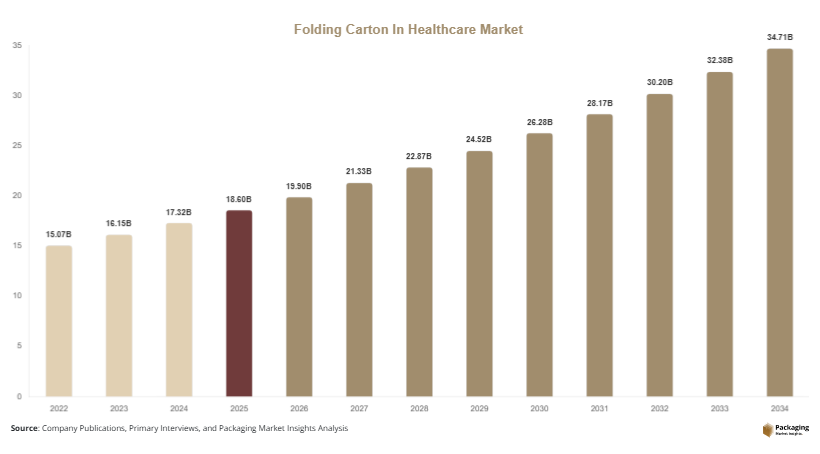
The global folding carton in healthcare market was valued at approximately USD 18.6 billion in 2025 and is expected to reach USD 19.9 billion in 2026, with projections indicating growth to nearly USD 34.8 billion by 2034, registering a CAGR of 7.2% from 2025 to 2034. Folding cartons are widely used in pharmaceutical, medical device, and personal healthcare packaging due to their versatility, printability, and ability to protect products during transportation and storage. The folding carton in healthcare market is experiencing steady growth as the healthcare industry increasingly adopts sustainable, lightweight, and cost-effective packaging solutions.
One of the primary growth factors is the rising demand for pharmaceutical products driven by an aging population and increasing prevalence of chronic diseases. This has led to higher consumption of medicines, requiring reliable and efficient packaging solutions such as folding cartons. Another key factor is the growing emphasis on sustainable packaging, as folding cartons are made from paperboard and are recyclable, aligning with environmental regulations. Additionally, advancements in printing technologies are enabling high-quality graphics and labeling, improving product visibility and compliance with regulatory requirements.
Key Highlights:
- Asia Pacific dominated the market with a 39.1% share in 2025, while Latin America is projected to grow at the fastest CAGR of 7.9%.
- Paperboard cartons led the type segment with a 64.5% share, while coated cartons are expected to grow at a CAGR of 7.6%.
- Pharmaceutical packaging dominated with a 58.3% share, while medical devices are forecasted to grow at a CAGR of 7.4%.
- Oral drug packaging led the application segment with 36.2% share, while biologics packaging is expected to grow at a CAGR of 8.1%.
- China remained the dominant country with a market size of USD 3.2 billion in 2025 and USD 3.5 billion in 2026.
Explore more data points, trends and opportunities Download Free Sample Report
Market Trends
Growing demand for sustainable and recyclable healthcare packaging
The increasing focus on environmental sustainability is shaping the folding carton in healthcare market. Healthcare companies are shifting toward paper-based packaging solutions to reduce their environmental footprint. Folding cartons are widely preferred due to their recyclability and biodegradability, which align with global sustainability goals. Regulatory frameworks are encouraging the use of eco-friendly materials, pushing manufacturers to adopt sustainable practices. Additionally, consumers are becoming more aware of environmental issues, influencing purchasing decisions and driving demand for green packaging solutions. This trend is encouraging innovation in materials and production processes, supporting long-term market growth.
Integration of smart packaging and advanced printing technologies
The adoption of smart packaging solutions is gaining traction in the healthcare sector. Folding cartons are increasingly being integrated with features such as QR codes, RFID tags, and tamper-evident seals to enhance product safety and traceability. Advanced printing technologies enable high-quality graphics and detailed labeling, which are essential for regulatory compliance. These innovations are improving supply chain transparency and reducing the risk of counterfeit products. Additionally, digital printing allows for customization and shorter production runs, enabling manufacturers to respond quickly to changing market demands. This trend is expected to drive further innovation in the market.
Market Drivers
Rising demand for pharmaceutical and healthcare products
The increasing prevalence of chronic diseases and the growing aging population are driving demand for pharmaceutical products. This, in turn, is boosting the need for reliable packaging solutions such as folding cartons. These cartons provide protection, ease of handling, and efficient storage for a wide range of healthcare products. The expansion of the pharmaceutical industry, particularly in emerging markets, is further supporting market growth. Additionally, the increasing demand for over-the-counter medicines and healthcare products is contributing to the adoption of folding cartons.
Regulatory requirements for safe and compliant packaging
Strict regulations governing healthcare packaging are encouraging the use of folding cartons. Packaging must meet specific standards for labeling, safety, and traceability to ensure patient safety. Folding cartons provide ample space for detailed information, including dosage instructions and warnings. They also support tamper-evident features, which are essential for maintaining product integrity. Compliance with these regulations is driving manufacturers to adopt advanced packaging solutions, supporting the growth of the folding carton market in healthcare.
Market Restraint
Fluctuating raw material prices and competition from alternative packaging
The folding carton in healthcare market faces challenges due to the volatility in raw material prices, particularly paperboard. Fluctuations in supply and demand, along with environmental factors, can impact production costs. Additionally, competition from alternative packaging solutions such as plastic containers and flexible packaging poses a restraint. These alternatives may offer advantages such as moisture resistance and durability, which can limit the adoption of folding cartons in certain applications. For example, some medical devices require packaging with higher barrier properties, which may not be fully met by paper-based cartons. These factors can affect market growth and require manufacturers to innovate and improve product performance.
Market Opportunities
Expansion of healthcare infrastructure in emerging economies
Emerging markets present significant opportunities for the folding carton in healthcare market. Rapid urbanization and increasing investments in healthcare infrastructure are driving demand for pharmaceutical and medical products. Governments are focusing on improving healthcare access, leading to the establishment of new hospitals and clinics. This expansion is increasing the need for packaging solutions such as folding cartons. Additionally, rising disposable incomes and growing awareness of healthcare are contributing to market growth in these regions.
Advancements in eco-friendly materials and lightweight packaging
Technological advancements in materials are creating new opportunities for the market. Manufacturers are developing lightweight and eco-friendly folding cartons that reduce material usage while maintaining strength and durability. These innovations help lower production costs and improve sustainability. Additionally, the use of biodegradable coatings and inks is enhancing the environmental performance of folding cartons. These advancements are enabling manufacturers to meet regulatory requirements and consumer expectations, supporting market growth.
Report Scope
| Report Metric | Details |
|---|---|
| Market Size in 2025 | USD 18.6 Billion |
| Market Size in 2026 | USD 19.9 Billion |
| Market Size in 2034 | USD 34.8 Billion |
| CAGR | 7.2% (2026-2034) |
| Base Year for Estimation | 2025 |
| Historical Data | 2022-2024 |
| Forecast Period | 2026-2034 |
| Report Coverage | Revenue Forecast, Competitive Landscape, Supply Chain Disruption, Growth Factors, Environment & Regulatory Landscape and Trends |
| Geographies Covered | North America, Europe, APAC, Middle East and Africa, LATAM |
| Countries Covered | U.S., Canada, U.K., Germany, France, Spain, Italy, Russia, Nordic, Benelux, Rest of Europe, China, South Korea, Japan, India, Australia, Singapore, Taiwan, South East Asia, Rest of Asia-Pacific, UAE, Turky, Saudi Arabia, South Africa, Egypt, Nigeria, Rest of MEA, Brazil, Mexico, Argentina, Chile, Colombia, Rest of LATAM |
Explore more data points, trends and opportunities Download Free Sample Report
Segmental Analysis
By Material Type
Paperboard cartons dominated the segment with a market share of 64.5% in 2024, driven by their widespread use in pharmaceutical packaging. These cartons offer advantages such as lightweight structure, recyclability, and cost-effectiveness. The increasing demand for sustainable packaging solutions is further supporting the growth of this segment. Additionally, paperboard cartons provide excellent printability, allowing manufacturers to include detailed product information and branding elements.
Coated cartons are expected to grow at a CAGR of 7.6% during the forecast period. These cartons offer enhanced barrier properties, making them suitable for packaging sensitive healthcare products. The growing demand for moisture-resistant and durable packaging solutions is driving the adoption of coated cartons. Additionally, advancements in coating technologies are improving performance, supporting segment growth.
By Application
Pharmaceutical packaging accounted for the largest share of 58.3% in 2024, driven by the increasing demand for medicines and healthcare products. Folding cartons are widely used for packaging tablets, capsules, and syrups due to their protective and informative features. The growing pharmaceutical industry and rising demand for over-the-counter products are supporting the growth of this segment.
Medical device packaging is expected to grow at a CAGR of 7.4% during the forecast period. The increasing demand for medical devices and equipment is driving the need for reliable packaging solutions. Folding cartons provide structural strength and customization options, making them suitable for various medical devices. Additionally, the focus on product safety and compliance is supporting the adoption of folding cartons in this segment.
By End-Use
Oral drug packaging dominated the segment with a share of 36.2% in 2024, driven by the high consumption of oral medications. Folding cartons are widely used for packaging tablets and capsules due to their convenience and protective properties. The increasing prevalence of chronic diseases is further supporting the growth of this segment.
Biologics packaging is expected to be the fastest-growing subsegment, registering a CAGR of 8.1% during the forecast period. The rising demand for biologic drugs and personalized medicine is driving the need for advanced packaging solutions. Folding cartons with enhanced barrier properties and tamper-evident features are being adopted to ensure product safety. This trend is contributing to the growth of the segment.
Folding Carton In Healthcare Market Segmentations
By Material Type
- Paperboard Cartons
- Coated Cartons
By Application
- Pharmaceutical Packaging
- Medical Device Packaging
By End-User
- Oral Drugs
- Biologics
- Medical Equipment
- Personal Healthcare Products
Regional Analysis
North America
North America accounted for approximately 25.2% of the folding carton in healthcare market share in 2025 and is projected to grow at a CAGR of 6.8%. The region’s well-established healthcare system and high demand for pharmaceutical products are key factors driving market growth. The presence of advanced packaging technologies and strong regulatory frameworks also supports the adoption of folding cartons in healthcare applications.
The United States dominates the regional market due to its large pharmaceutical industry and high healthcare expenditure. A key growth factor is the increasing adoption of sustainable packaging solutions by pharmaceutical companies. This shift is driven by environmental regulations and corporate sustainability goals, supporting the growth of folding cartons in the region.
Europe
Europe held a market share of around 23.7% in 2025 and is expected to grow at a CAGR of 6.9%. The region’s strict environmental regulations and focus on sustainability are driving demand for recyclable packaging solutions. The pharmaceutical industry is a major contributor to market growth, with increasing demand for safe and compliant packaging.
Germany leads the European market due to its strong manufacturing base and advanced packaging technologies. A unique growth factor is the implementation of stringent packaging regulations, which promote the use of eco-friendly materials. These policies are encouraging manufacturers to adopt folding cartons, supporting market expansion.
Asia Pacific
Asia Pacific dominated the market with a share of 39.1% in 2025 and is expected to grow at a CAGR of 7.8%. Rapid urbanization, population growth, and increasing healthcare expenditure are driving demand for pharmaceutical products and packaging solutions. The expansion of the healthcare industry in the region is further supporting market growth.
China is the leading country in the region, supported by its large manufacturing capacity and growing healthcare sector. A key growth factor is the increasing production of pharmaceuticals and medical devices, which is driving demand for folding cartons. Government initiatives to improve healthcare infrastructure are also contributing to market growth.
Middle East & Africa
The Middle East & Africa region accounted for a market share of 6.9% in 2025 and is projected to grow at a CAGR of 7.3%. Increasing investments in healthcare infrastructure and rising demand for pharmaceutical products are driving market growth. The region is also witnessing improvements in packaging technologies and supply chain systems.
Saudi Arabia is a dominant country in this region, driven by its focus on healthcare development. A unique growth factor is the increasing investment in pharmaceutical manufacturing facilities. These investments are boosting demand for packaging solutions such as folding cartons, supporting market growth.
Latin America
Latin America held a market share of 5.1% in 2025 and is expected to grow at the fastest CAGR of 7.9%. The region’s growing healthcare sector and increasing demand for pharmaceutical products are key drivers of market growth. The expansion of retail and distribution networks is also supporting the adoption of folding cartons.
Brazil is the leading country in the region, supported by its large population and growing healthcare industry. A key growth factor is the increasing demand for affordable healthcare products, which is driving the need for cost-effective packaging solutions. Folding cartons offer an economical and sustainable option, supporting market growth.
Competitive Landscape
The folding carton in healthcare market is characterized by a competitive environment with several global players focusing on innovation, sustainability, and capacity expansion. Companies are investing in advanced technologies and eco-friendly materials to strengthen their market position. Strategic partnerships and acquisitions are common as companies aim to expand their product offerings and geographic presence.
WestRock Company is considered a leading player in the market due to its strong portfolio and global reach. The company recently introduced sustainable packaging solutions with improved recyclability to meet increasing demand. Other key players are focusing on digital printing technologies and lightweight designs to enhance product differentiation. Sustainability initiatives and regulatory compliance remain key focus areas for market participants.
Key Players List
- WestRock Company
- International Paper Company
- Amcor plc
- Sonoco Products Company
- Huhtamaki Oyj
- DS Smith plc
- Graphic Packaging International LLC
- Stora Enso Oyj
- Smurfit Kappa Group
- UPM-Kymmene Corporation
- Mayr-Melnhof Karton AG
- Rengo Co., Ltd.
- Georgia-Pacific LLC
- Oji Holdings Corporation
- AR Packaging Group