Foldable Plastic Pallet Boxes Market Size
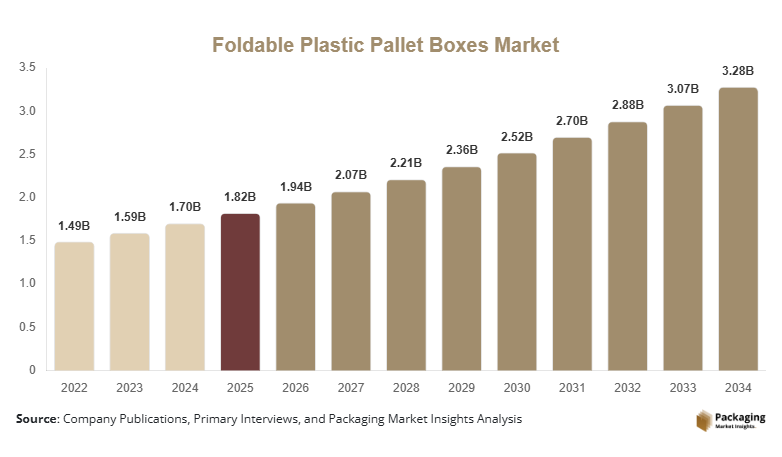
The foldable plastic pallet box market size is projected at USD 1.94 billion in 2026 and is expected to hit USD 3.28 billion by 2034 with a CAGR of 6.8%. The report provides extensive quantitative analysis covering production capacity, demand distribution, trade dynamics, pricing trends, segmentation, and competitive benchmarking. It also evaluates regional manufacturing capabilities, technological developments, and the competitive landscape to support strategic decision-making.
Foldable plastic pallet boxes are reusable bulk storage and transportation containers designed with collapsible sidewalls to optimize warehouse utilization and reverse logistics. Global production exceeded 15.8 million units in 2025, while adoption across industrial supply chains surpassed 63% in developed logistics networks. Automotive applications contributed nearly 39% of total demand, food & beverage accounted for 34%, and pharmaceutical logistics represented approximately 12%. Continuous expansion of returnable transport packaging continues to strengthen the foldable plastic pallet boxes market.
Explore more data points, trends and opportunities Download Free Sample Report
Foldable Plastic Pallet Boxes Trends
Growing Adoption of Reusable Logistics Packaging
Manufacturers are increasingly replacing wooden and metal bulk containers with foldable plastic pallet boxes to reduce transportation costs and improve operational efficiency. Production exceeded 16 million units, while reusable packaging adoption increased by 12.4% during 2025. More than 58% of logistics operators expanded investments in reusable transport assets, reinforcing the foldable plastic pallet boxes market.
Automation within warehouses and distribution centers is accelerating demand for standardized pallet containers compatible with robotic handling systems. Smart tracking technologies have been integrated into nearly 29% of premium pallet box fleets, while warehouse automation investments increased by 15% globally. Industrial manufacturing and cross-border logistics continue generating strong demand, supporting the foldable plastic pallet boxes market.
Foldable Plastic Pallet Boxes Drivers
Expansion of Reusable Supply Chain and Warehouse Automation
Growing emphasis on circular logistics and warehouse automation continues driving adoption of reusable pallet containers. More than 67% of large distribution centers utilize returnable packaging systems, while logistics efficiency improved by nearly 18% through foldable container deployment. Annual industrial shipments exceeded 15 million units, strengthening the foldable plastic pallet boxes market.
Foldable Plastic Pallet Box Restraints
High Initial Procurement Costs for Industrial Users
Although reusable containers reduce lifecycle costs, initial acquisition expenses remain significantly higher than disposable alternatives. Procurement costs increased by 9%, while resin prices fluctuated by nearly 7% during recent procurement cycles. Small manufacturers continue facing capital investment limitations, restricting wider adoption across the foldable plastic pallet boxes market.
Foldable Plastic Pallet Boxes Opportunities
Growth in Cold Chain and Export Logistics
Expansion of temperature-controlled logistics and international trade is creating new opportunities for durable pallet containers. Cold-chain transportation volumes increased by 10.6%, while export-oriented industrial shipments expanded by 8.4%. Investments in reusable logistics infrastructure exceeded USD 850 million globally during 2025, supporting future expansion of the foldable plastic pallet boxes market.
Challenges in Foldable Plastic Pallet Boxes
Managing Standardization Across Global Supply Chains
Manufacturers face challenges in maintaining compatibility with regional pallet standards while improving load-bearing capacity and reducing weight. Nearly 23% of logistics operators reported interoperability concerns, while compliance costs increased by 6.3%. Achieving durability exceeding 5,000 handling cycles without increasing manufacturing costs remains a significant challenge for the foldable plastic pallet boxes market.
Report Scope
| Report Metric | Details |
|---|---|
| Market Size in 2025 | USD 1.82 Billion |
| Market Size in 2026 | USD 1.94 Billion |
| Market Size in 2034 | USD 3.28 Billion |
| CAGR | 6.8% (2026-2034) |
| Base Year for Estimation | 2025 |
| Historical Data | 2022-2024 |
| Forecast Period | 2026-2034 |
| Report Coverage | Revenue Forecast, Competitive Landscape, Supply Chain Disruption, Growth Factors, Environment & Regulatory Landscape and Trends |
| Geographies Covered | North America, Europe, APAC, Middle East and Africa, LATAM |
| Countries Covered | U.S., Canada, U.K., Germany, France, Spain, Italy, Russia, Nordic, Benelux, Rest of Europe, China, South Korea, Japan, India, Australia, Singapore, Taiwan, South East Asia, Rest of Asia-Pacific, UAE, Turky, Saudi Arabia, South Africa, Egypt, Nigeria, Rest of MEA, Brazil, Mexico, Argentina, Chile, Colombia, Rest of LATAM |
Explore more data points, trends and opportunities Download Free Sample Report
Foldable Plastic Pallet Boxes Market Segmentation
The market is segmented by material and end user, with HDPE accounting for approximately 48% of total production while automotive applications contribute nearly 39% of overall demand. Increasing warehouse automation and sustainable logistics continue supporting segment growth.
By Material
HDPE represents nearly 48% of total production because of superior impact resistance, durability, and chemical stability. Production exceeded 7.5 million units, supporting heavy-duty industrial and export logistics applications with load capacities exceeding 500 kg.
PP accounts for approximately 34% of market demand due to lightweight construction and excellent fatigue resistance. More than 5.3 million units were produced during 2025, providing improved stacking performance and reusable transportation efficiency.
Recycled plastic contributes around 18% of production as sustainability initiatives encourage circular packaging solutions. Annual production surpassed 2.8 million units, reducing virgin resin consumption while maintaining structural performance for industrial logistics.
By End User
Automotive dominates with approximately 39% market share, utilizing reusable pallet boxes for component transportation and inventory management. More than 6.1 million units were deployed across automotive supply chains with return rates exceeding 91%.
Food & beverage represents nearly 34% of market demand, supported by hygienic transport and storage applications. Production exceeded 5.4 million units, while reusable packaging penetration surpassed 54% among large food processors.
Pharmaceuticals account for approximately 12% of total consumption due to secure transport requirements and regulatory compliance. Annual deployment exceeded 1.9 million units, supporting temperature-sensitive and high-value product logistics.
Foldable Plastic Pallet Boxes Market Segmentations
Material
- High-Density Polyethylene (HDPE)
- Polypropylene (PP)
- Recycled Plastic
End User
- Automotive
- Food & Beverage
- Pharmaceuticals
Foldable Plastic Pallet Boxes Regional Outlook
North America: North America accounts for approximately 34% of global demand, producing over 5.3 million units annually. The United States contributes nearly 79% of regional production, supported by advanced warehouse automation and industrial logistics.
Europe: Europe represents around 31% of the market, with Germany, France, Italy, and the United Kingdom leading production. Reusable transport packaging adoption exceeded 69%, supported by sustainability regulations and circular economy initiatives.
Asia-Pacific: Asia-Pacific contributes nearly 28% of global demand, led by China, Japan, India, and South Korea. Regional production surpassed 4.4 million units, while industrial manufacturing output increased by 8.9% during 2025.
Latin America: Latin America accounts for approximately 4% of worldwide demand, with Brazil and Mexico serving as the primary manufacturing and logistics hubs for industrial packaging.
Middle East & Africa: The region contributes nearly 3% of global consumption, supported by expanding manufacturing sectors, export logistics, and warehousing investments.
Top Players In Foldable Plastic Pallet Boxes
- Schoeller Allibert
- CABKA Group
- ORBIS Corporation
- Craemer Group
- Buckhorn Inc.
- SSI Schaefer
- IPL Plastics Inc.
- DS Smith Plc
- Georg Utz Holding AG
- Tosca Services LLC
- TranPak Inc.
- Nally Group
- Enlightening Pallet Industry Co., Ltd.
- Rehrig Pacific Company
- CHEP
Schoeller Allibert
- Estimated market share: 13–15%
- Global leader in reusable transport packaging with an extensive portfolio of foldable plastic pallet boxes.
- Strong manufacturing presence across Europe, Asia, and North America.
- Focuses on sustainable materials, RFID-enabled logistics solutions, and circular packaging programs.
- Serves automotive, retail, food, and industrial sectors through advanced engineering, customized container designs, and long product lifecycles, maintaining a strong competitive position through continuous innovation and global distribution capabilities.
ORBIS Corporation
- Estimated market share: 10–12%
- Leading supplier of reusable plastic packaging and pallet containers in North America.
- Offers heavy-duty foldable pallet boxes designed for warehouse automation and closed-loop logistics.
- Invests in recyclable materials, product durability, and integrated supply chain optimization.
- Maintains long-term partnerships with automotive manufacturers, food processors, and industrial distributors while expanding reusable packaging adoption through advanced logistics solutions.