Foil Laminates Market Size
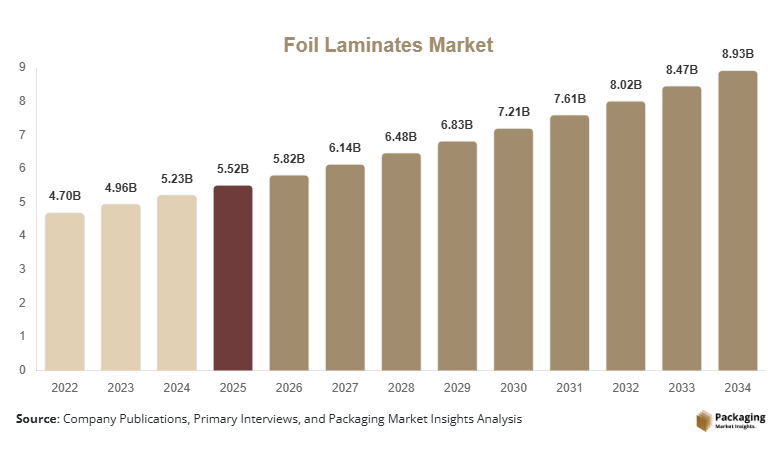
The foil laminates market size is projected at USD 5.82 billion in 2026 and is expected to hit USD 8.94 billion by 2034 with a CAGR of 5.5%. The report provides a detailed quantitative assessment of production, consumption, pricing, value chains, technological developments, and competitive benchmarking across major economies. It further evaluates market segmentation, regional performance, investment patterns, and competitive positioning to provide a comprehensive assessment of the foil laminates market.
Foil laminates are multilayer packaging materials manufactured by combining aluminum foil with polymer films, paper, or specialty substrates to deliver superior barrier performance against moisture, oxygen, light, and contaminants. Global production exceeded 9.4 million metric tons in 2025, while packaging applications accounted for nearly 68% of total consumption. Food packaging represented approximately 46% of total demand, pharmaceuticals contributed 24%, and personal care applications represented 13%. Adoption across flexible packaging exceeded 72%, supported by increasing demand for high-barrier solutions, reinforcing the foil laminates market.
Explore more data points, trends and opportunities Download Free Sample Report
Foil Laminates Market Trends
Rising Adoption of Sustainable High-Barrier Packaging
Manufacturers are increasingly investing in recyclable mono-material laminates and thinner foil structures to reduce material consumption while maintaining barrier efficiency. More than 1.8 million metric tons of recyclable laminate structures entered commercial production during 2025, while lightweight laminate adoption increased by 18% year-over-year. Digital quality inspection systems now cover nearly 61% of large manufacturing facilities, improving yield by 11% and reducing waste by 9%, strengthening the foil laminates market.
Automation and Smart Manufacturing Expansion
Production facilities continue integrating AI-driven inspection, automated lamination, and precision coating technologies. Automated converting lines processed over 5.6 million metric tons of laminated materials in 2025, while smart monitoring systems achieved implementation across 57% of newly commissioned plants. Pharmaceutical packaging demand increased by 8.7%, and retort packaging production surpassed 1.3 million metric tons, accelerating innovation throughout the foil laminates market.
Foil Laminates Market Drivers
Growing Demand for High-Barrier Flexible Packaging
Demand for packaged food, healthcare products, and consumer goods continues expanding worldwide. Flexible packaging consumption exceeded 38 million metric tons in 2025, while high-barrier laminate demand increased by 7.8% annually. Food safety regulations now influence over 82% of export packaging requirements, encouraging manufacturers to adopt multilayer foil laminates with oxygen transmission rates below 0.1 cc/m²/day. Pharmaceutical blister packaging production also increased by 9.2%, supporting the foil laminates market.
Foil Laminates Market Restraints
Volatility in Raw Material and Aluminum Prices
Fluctuating aluminum prices and polymer resin costs continue affecting production economics. Aluminum accounts for approximately 42% of total laminate manufacturing cost, while resin materials contribute nearly 31%. Raw material prices experienced annual fluctuations between 10% and 18%, increasing procurement risks for converters producing more than 500,000 metric tons annually. These cost pressures remain significant restraints for the foil laminates market.
Foil Laminates Market Opportunities
Expansion of Pharmaceutical and Sustainable Packaging
Healthcare packaging production continues rising due to increasing medicine consumption and stricter packaging regulations. Pharmaceutical laminate demand is expected to expand by over 7% annually, while recyclable laminate investments surpassed USD 620 million during 2025. Sustainable packaging initiatives influence nearly 69% of new product development programs, creating substantial opportunities for the foil laminates market.
Challenges in Foil Laminates Market
Complex Recycling and Multilayer Material Recovery
Recycling multilayer foil laminates remains technically challenging because aluminum, adhesives, and polymer layers require specialized separation technologies. Less than 35% of multilayer flexible packaging currently enters advanced recycling systems, while recovery efficiency remains below 60% in many regions. Investments exceeding USD 450 million in recycling infrastructure are helping improve circularity, although processing complexity continues to challenge the foil laminates market.
Report Scope
| Report Metric | Details |
|---|---|
| Market Size in 2025 | USD 5.52 Billion |
| Market Size in 2026 | USD 5.82 Billion |
| Market Size in 2034 | USD 8.94 Billion |
| CAGR | 5.5% (2026-2034) |
| Base Year for Estimation | 2025 |
| Historical Data | 2022-2024 |
| Forecast Period | 2026-2034 |
| Report Coverage | Revenue Forecast, Competitive Landscape, Supply Chain Disruption, Growth Factors, Environment & Regulatory Landscape and Trends |
| Geographies Covered | North America, Europe, APAC, Middle East and Africa, LATAM |
| Countries Covered | U.S., Canada, U.K., Germany, France, Spain, Italy, Russia, Nordic, Benelux, Rest of Europe, China, South Korea, Japan, India, Australia, Singapore, Taiwan, South East Asia, Rest of Asia-Pacific, UAE, Turkey, Saudi Arabia, South Africa, Egypt, Nigeria, Rest of MEA, Brazil, Mexico, Argentina, Chile, Colombia, Rest of LATAM |
Explore more data points, trends and opportunities Download Free Sample Report
Foil Laminates Market Segmentation
The market is segmented by product type and end-use industry, with aluminum foil laminates accounting for nearly 56% of total volume, while food & beverage applications contribute approximately 46% of overall demand. Production exceeded 9.4 million metric tons, supported by expanding industrial packaging requirements.
By Product Type
Aluminum foil laminates dominate the market with approximately 56% share and production exceeding 5.2 million metric tons annually. These laminates provide barrier protection exceeding 99% against light and moisture, making them suitable for food, pharmaceutical, and industrial packaging applications.
Plastic foil laminates account for nearly 29% of market volume, with annual production above 2.7 million metric tons. They offer enhanced flexibility, puncture resistance above 18 N, and sealing temperatures between 120°C and 180°C, supporting pouch, sachet, and medical packaging.
Paper foil laminates contribute around 15% of total production, exceeding 1.4 million metric tons annually. These laminates combine printability, stiffness, and moisture resistance, making them suitable for confectionery, beverage cartons, and specialty consumer packaging.
By End-use Industry
Food & beverage remains the leading application with nearly a 46% share, consuming more than 4.3 million metric tons annually. Applications include snacks, dairy products, beverages, coffee, frozen foods, and retort pouches with packaging penetration exceeding 74%.
Pharmaceuticals account for approximately 24% of market demand. Production exceeded 2.2 million metric tons, supporting blister packs, strip packs, sachets, and medical device packaging requiring high barrier performance and regulatory compliance.
Personal care represents nearly 13% of total demand, with production exceeding 1.2 million metric tons. Laminates are widely used in cosmetic sachets, creams, shampoos, wipes, and premium packaging requiring excellent print quality and extended shelf life.
Foil Laminates Market Segmentations
Product Type
- Aluminum Foil Laminates
- Plastic Foil Laminates
- Paper Foil Laminates
End-use Industry
- Food & Beverage
- Pharmaceuticals
- Personal Care
Foil Laminates Regional Outlook
North America
North America accounts for approximately 28% of global consumption, producing more than 2.5 million metric tons annually. The United States contributes nearly 81% of regional production, driven by pharmaceutical packaging, processed food manufacturing, and premium consumer goods.
Europe
Europe represents around 25% of global demand, with annual production exceeding 2.3 million metric tons. Germany, France, Italy, and the United Kingdom collectively contribute over 73% of regional manufacturing, supported by sustainability regulations and advanced converting technologies.
Asia-Pacific
The Asia-Pacific leads the global market with approximately 39% share and production exceeding 3.7 million metric tons. China contributes nearly 48% of regional output, followed by India, Japan, and South Korea. Rapid urbanization, packaged food demand, and pharmaceutical manufacturing continue driving regional expansion.
Latin America
Latin America accounts for nearly 5% of global demand. Brazil and Mexico together contribute approximately 67% of regional production, supported by growing food processing and flexible packaging industries.
Middle East & Africa
The Middle East & Africa represent approximately 3% of total demand. Saudi Arabia, the UAE, and South Africa account for over 62% of regional consumption, supported by healthcare investments and expanding packaged food production.
Top Players In The Foil Laminates Market
- Amcor plc
- Constantia Flexibles
- Mondi plc
- Huhtamaki Oyj
- UFlex Ltd.
- Berry Global, Inc.
- Winpak Ltd.
- Sealed Air Corporation
- Coveris Holdings S.A.,
- ProAmpac LLC,
- Clondalkin Group
- Sonoco Products Company
Amcor plc estimated market presence of 12–14% across global high-barrier flexible packaging. Operates advanced foil laminate manufacturing facilities across North America, Europe, Asia-Pacific, and Latin America. Invests heavily in recyclable laminate technologies, lightweight packaging, and digital manufacturing systems. Strong customer base across food, healthcare, beverage, and personal care industries with extensive global converting capabilities and continuous sustainability-focused product innovation. Constantia Flexibles: Estimated global market presence of 8–10% in premium foil laminates. Maintains strong leadership in pharmaceutical and food packaging applications. Operates multiple manufacturing facilities with advanced extrusion coating, lamination, and printing technologies. Focuses on recyclable packaging structures, high-barrier materials, and customized flexible packaging solutions supported by continuous investments in research, automation, and global production capacity.