Foam Protective Packaging Market Size and Growth
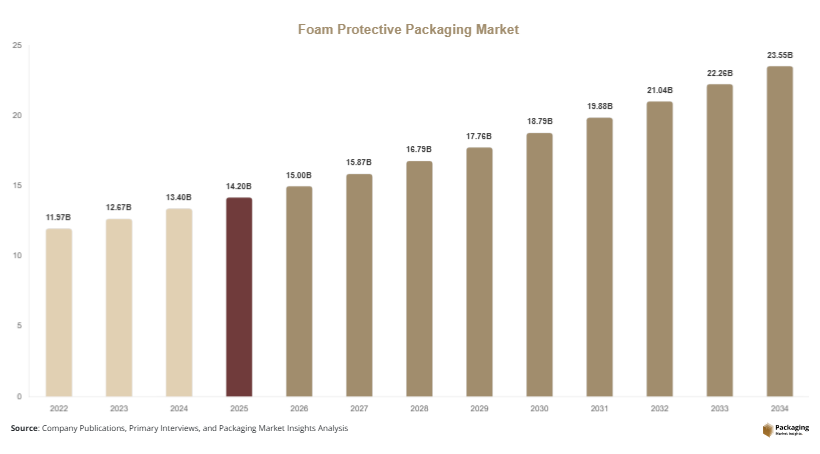
The global foam protective packaging market size was valued at approximately USD 14.2 billion in 2025 and is expected to reach USD 15.0 billion in 2026. Over the forecast period, the market is projected to grow to USD 23.6 billion by 2034, registering a compound annual growth rate (CAGR) of 5.8% from 2025 to 2034. This growth reflects the rising need for protective packaging solutions in e-commerce, electronics, automotive, and healthcare sectors. The global foam protective packaging market is expanding steadily due to increasing demand for secure, lightweight, and shock-absorbing packaging solutions across various industries.
Foam protective packaging materials such as polyethylene (PE), polyurethane (PU), and polystyrene (PS) are widely used to protect fragile and high-value products during storage and transportation. These materials offer excellent cushioning, thermal insulation, and vibration resistance, making them suitable for a wide range of applications. The increasing complexity of global supply chains has further emphasized the importance of reliable packaging solutions that can minimize product damage.
Market Insights:
- Asia Pacific dominated the market with a 38.5% share in 2025, while Latin America is projected to grow at the fastest CAGR of 6.4%.
- Polyethylene foam led the type segment with a 41.2% share, while polyurethane foam is expected to grow at a CAGR of 6.0%.
- Plastic-based foam packaging dominated with a 52.3% share, while biodegradable foam is forecasted to grow at a CAGR of 6.2%.
- Electronics applications led the segment with 39.6% share, while healthcare packaging is expected to grow at a CAGR of 6.1%.
- China remained the dominant country with a market size of USD 3.6 billion in 2025 and USD 3.9 billion in 2026.
Explore more data points, trends and opportunities Download Free Sample Report
Market Trends
Increasing Adoption of Sustainable Foam Materials
Sustainability is becoming an important focus in the foam protective packaging market as environmental concerns continue to influence packaging choices. Manufacturers are investing in the development of biodegradable and recyclable foam materials to reduce environmental impact. The shift toward eco-friendly packaging is driven by regulatory requirements and consumer awareness regarding plastic waste.
Bio-based foams derived from renewable resources are gaining traction as an alternative to conventional petroleum-based materials. Companies are also exploring ways to reduce material usage through innovative design and manufacturing techniques. These efforts are helping to balance sustainability with performance, ensuring that protective packaging requirements are met without compromising environmental goals. As sustainability becomes a key priority, the demand for eco-friendly foam packaging solutions is expected to increase.
Growth of Customization and Advanced Packaging Design
Customization and advanced packaging design are playing a significant role in shaping the foam protective packaging market. Manufacturers are focusing on developing tailored packaging solutions that meet specific product requirements. Custom foam inserts are widely used to protect delicate and high-value items, ensuring a secure fit and minimizing movement during transit.
Advancements in design technologies, such as computer-aided design (CAD) and automation, are enabling precise and efficient production of customized packaging solutions. These innovations are improving packaging efficiency and reducing material waste. Additionally, companies are incorporating branding elements into packaging design to enhance customer experience. The growing demand for customized packaging solutions is expected to drive market growth.
Market Drivers
Expansion of E-Commerce and Logistics Industry
The rapid growth of e-commerce and logistics is a major driver of the foam protective packaging market. Online retail requires packaging solutions that can withstand handling and transportation while ensuring product safety. Foam packaging materials provide excellent cushioning and protection, making them ideal for shipping fragile and high-value items.
The increasing volume of shipments and the need for efficient packaging solutions are driving demand for foam protective packaging. Companies are investing in packaging innovations to reduce damage rates and improve customer satisfaction. As e-commerce continues to expand globally, the demand for foam protective packaging is expected to grow significantly.
Rising Demand from Electronics and Automotive Industries
The electronics and automotive industries are key contributors to the growth of the foam protective packaging market. Electronic products such as smartphones, laptops, and components require protective packaging to prevent damage during transportation. Foam materials offer excellent shock absorption and thermal insulation, making them suitable for these applications.
In the automotive sector, foam packaging is used to protect parts and components during shipping and assembly. The increasing production of vehicles and the complexity of automotive components are driving demand for reliable packaging solutions. These factors are expected to support market growth over the forecast period.
Market Restraint
Environmental Concerns and Recycling Challenges
Environmental concerns related to foam packaging materials present a significant challenge for the foam protective packaging market. Traditional foam materials, particularly those derived from petroleum, are difficult to recycle and contribute to environmental pollution. Governments and regulatory bodies are implementing strict regulations to reduce the use of non-recyclable materials.
The growing preference for sustainable packaging solutions is also influencing market dynamics, with some companies opting for alternative materials such as paper-based or molded pulp packaging. For example, certain e-commerce companies are replacing foam packaging with recyclable materials to meet sustainability goals. These factors may limit the growth of the foam protective packaging market, particularly in regions with stringent environmental regulations. However, ongoing research and development efforts are focused on improving the recyclability and sustainability of foam materials.
Market Opportunities
Development of Biodegradable and Recyclable Foam Solutions
The development of biodegradable and recyclable foam solutions presents a significant opportunity for the foam protective packaging market. Manufacturers are investing in research and development to create materials that offer the same level of protection as traditional foam while reducing environmental impact. These innovations are expected to drive the adoption of sustainable foam packaging solutions across various industries.
Companies that focus on eco-friendly packaging technologies are likely to gain a competitive advantage. The increasing demand for sustainable packaging is creating new opportunities for market players to expand their product portfolios. As environmental regulations become more stringent, the demand for biodegradable foam packaging is expected to grow.
Growth in Emerging Markets and Industrial Applications
Emerging markets offer substantial growth opportunities for the foam protective packaging market. Rapid industrialization, urbanization, and increasing consumer demand are driving the need for protective packaging solutions in these regions. The expansion of manufacturing and logistics industries is further supporting market growth.
Industrial applications such as machinery packaging and heavy equipment transportation are also contributing to demand for foam protective packaging. These applications require durable and reliable packaging solutions to prevent damage during handling and transportation. As emerging markets continue to develop, the demand for foam protective packaging is expected to increase.
Report Scope
| Report Metric | Details |
|---|---|
| Market Size in 2025 | USD 14.2 Billion |
| Market Size in 2026 | USD 15.0 Billion |
| Market Size in 2034 | USD 23.6 Billion |
| CAGR | 5.8% (2026-2034) |
| Base Year for Estimation | 2025 |
| Historical Data | 2022-2024 |
| Forecast Period | 2026-2034 |
| Report Coverage | Revenue Forecast, Competitive Landscape, Supply Chain Disruption, Growth Factors, Environment & Regulatory Landscape and Trends |
| Geographies Covered | North America, Europe, APAC, Middle East and Africa, LATAM |
| Countries Covered | U.S., Canada, U.K., Germany, France, Spain, Italy, Russia, Nordic, Benelux, Rest of Europe, China, South Korea, Japan, India, Australia, Singapore, Taiwan, South East Asia, Rest of Asia-Pacific, UAE, Turky, Saudi Arabia, South Africa, Egypt, Nigeria, Rest of MEA, Brazil, Mexico, Argentina, Chile, Colombia, Rest of LATAM |
Explore more data points, trends and opportunities Download Free Sample Report
Segmental Analysis
By Type
Polyethylene foam dominated the foam protective packaging market in 2024, accounting for approximately 41.2% of total revenue. This material is widely used due to its lightweight nature, flexibility, and excellent cushioning properties. Polyethylene foam is suitable for a wide range of applications, including electronics and consumer goods packaging.
Polyurethane foam is expected to grow at the fastest CAGR of 6.0% during the forecast period. This growth is driven by its superior shock absorption and durability. Polyurethane foam is increasingly used in applications that require high-performance packaging solutions, such as automotive and industrial sectors.
By Application
The electronics segment dominated the market in 2024, accounting for 39.6% of total revenue. Foam packaging is widely used to protect electronic devices and components from damage during transportation. The increasing demand for electronic products is supporting segment growth.
The healthcare segment is expected to grow at a CAGR of 6.1%. This growth is driven by the need for safe and hygienic packaging solutions for medical products. Advances in foam materials are enhancing their suitability for healthcare applications.
By End-Use
The industrial segment dominated the foam protective packaging market in 2024, accounting for a significant share of total revenue. The use of foam packaging in machinery and equipment transportation is driving this segment.
The consumer goods segment is expected to grow at a CAGR of 5.9%. The increasing demand for packaged consumer products is driving the need for protective packaging solutions. Foam packaging’s versatility makes it suitable for a wide range of applications.
Foam Protective Packaging Market Segmentations
By Product Type
- Polyethylene Foam
- Polyurethane Foam
- Polystyrene Foam
By Application
- Electronics
- Healthcare
- Automotive
- Consumer Goods
By Distribution Channel
- Direct Sales (B2B)
- Distributors & Wholesalers
- Online Procurement Platforms
- Specialty Packaging Suppliers
- Retail Supply Chains
Regional Analysis
North America
North America accounted for approximately 24.1% of the foam protective packaging market share in 2025 and is expected to grow at a CAGR of 5.2% during the forecast period. The region’s growth is driven by strong demand from e-commerce, electronics, and healthcare industries. Increasing focus on packaging efficiency and product safety is also supporting market expansion.
The United States dominates the North American market due to its large consumer base and advanced logistics infrastructure. A key growth factor is the increasing adoption of sustainable packaging solutions, which is encouraging manufacturers to develop recyclable foam materials.
Europe
Europe held a significant share of approximately 26.7% in 2025 and is projected to grow at a CAGR of 5.4%. The region is characterized by stringent environmental regulations and high consumer awareness regarding sustainability. These factors are influencing the adoption of eco-friendly foam packaging solutions.
Germany is a leading market in Europe, supported by its strong industrial base. A unique growth factor is the increasing adoption of circular economy practices, which is driving innovation in recyclable and biodegradable packaging materials.
Asia Pacific
Asia Pacific dominated the foam protective packaging market with a share of 38.5% in 2025 and is expected to grow at a CAGR of 6.1%. Rapid industrialization, urbanization, and expansion of e-commerce are driving market growth in the region.
China leads the regional market due to its large manufacturing base and growing consumer demand. A key growth factor is the expansion of the electronics industry, which is increasing demand for protective packaging solutions.
Middle East & Africa
The Middle East & Africa region accounted for approximately 5.3% of the market in 2025 and is expected to grow at a CAGR of 4.9%. The region’s growth is supported by increasing industrial activities and demand for protective packaging solutions.
The United Arab Emirates is a key market in the region, driven by its growing logistics sector. A unique growth factor is the increasing adoption of advanced packaging solutions to support trade and export activities.
Latin America
Latin America held a share of approximately 5.4% in 2025 and is projected to grow at the fastest CAGR of 6.4%. The region’s growth is driven by expanding industrial and e-commerce sectors.
Brazil dominates the market in Latin America, supported by its large population and growing consumer base. A key growth factor is the increasing demand for protective packaging solutions in the manufacturing sector.
Competitive Landscape
The foam protective packaging market is moderately competitive, with several key players focusing on innovation, sustainability, and expansion strategies. Companies are investing in research and development to create advanced packaging solutions that meet evolving industry requirements.
Sealed Air Corporation is a leading player in the market, known for its innovative packaging solutions. The company has recently introduced sustainable foam packaging products to address environmental concerns. Other major players are focusing on expanding their production capacities and entering new markets to strengthen their position.
Key Players List
- Sealed Air Corporation
- Sonoco Products Company
- Pregis LLC
- FoamPartner Group
- JSP Corporation
- BASF SE
- Armacell International S.A.
- Zotefoams plc
- UFP Technologies, Inc.
- Recticel NV
- Rogers Corporation
- ACH Foam Technologies
- Wisconsin Foam Products
- Plastifoam Company
- Clark Foam Products