Flow Wrap Machines Market Size
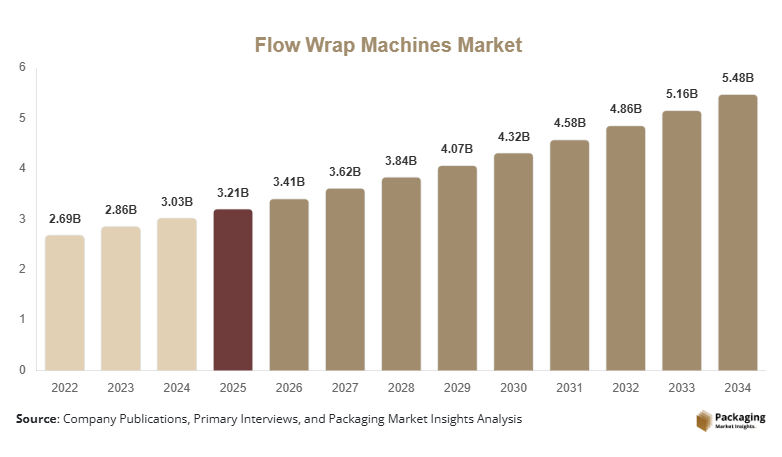
The flow wrap machine market size is projected at USD 3.41 billion in 2026 and is expected to hit USD 5.48 billion by 2034 with a CAGR of 6.1%.
The report provides quantitative and qualitative evaluation of the industry by assessing market performance across machine types, end-use industries, regional production, technological advancements, and competitive positioning. It offers detailed segmentation, investment analysis, manufacturing statistics, supply chain assessment, and competitive landscape to support strategic business decisions across the global flow wrap machines industry.
Flow wrap machines are automated packaging systems designed to wrap products using flexible film through continuous horizontal or vertical sealing processes. These machines are extensively used across food processing, pharmaceuticals, cosmetics, bakery, confectionery, and consumer goods industries to improve packaging efficiency and product protection. Global production exceeded 142,000 units in 2025, while automated systems represented nearly 71% of total installations. Food and beverage applications contributed approximately 58% of total equipment demand, pharmaceuticals accounted for 19%, and personal care applications represented 12%, reinforcing continued adoption across industrial packaging operations and supporting the flow wrap machines market.
Explore more data points, trends and opportunities Download Free Sample Report
Flow Wrap Machines Market Trends
Rising Adoption of Smart Packaging Automation
Manufacturers are increasingly integrating Industry 4.0 technologies, servo-driven motion control, predictive maintenance, and IoT-enabled monitoring into flow wrap equipment. More than 62% of newly manufactured systems incorporated digital control interfaces during 2025, while annual production surpassed 145,000 units globally. High-speed systems operating above 300 packs per minute witnessed growing demand from the bakery and confectionery industries, strengthening automation across production facilities and reinforcing the flow wrap machine market.
Growing investments in sustainable packaging have accelerated compatibility with recyclable mono-material films and biodegradable packaging substrates. Nearly 44% of newly installed systems supported recyclable packaging materials, while flexible packaging production exceeded 39 million metric tons globally. Adoption across pharmaceutical packaging increased by 11%, and demand from ready-to-eat food manufacturers expanded significantly, supporting continuous technological advancement within the flow wrap machines market.
Flow Wrap Machines Market Drivers
Growing Automation Across Food Packaging Facilities
The expansion of processed food manufacturing and labor optimization initiatives continues to accelerate equipment deployment. Automated packaging lines increased by 16% during 2025, while food processing accounted for over 58% of machine installations. More than 87,000 new packaging machines were commissioned globally for food applications, with productivity improvements ranging between 20% and 35%, driving continuous investment across the flow wrap machines market.
Flow Wrap Machines Market Restraints
High Initial Capital Investment and Maintenance Costs
Advanced servo-controlled machines require substantial capital expenditure, skilled technicians, and periodic component replacement. Installation expenses frequently account for 18–25% of total project costs, while maintenance contributes nearly 7% of annual operating expenses. Small and medium manufacturers continue to delay automation despite productivity gains, limiting wider adoption across developing economies and restraining the flow wrap machine market.
Flow Wrap Machines Market Opportunities
Expansion of Sustainable Flexible Packaging
Growing preference for recyclable films, paper-based wraps, and compostable materials creates substantial opportunities for machine manufacturers. Sustainable packaging demand increased by approximately 14% during 2025, while over 46% of packaging companies announced investments in environmentally compatible production lines. Equipment supporting multiple film formats and digital automation is expected to experience significant commercial expansion, strengthening the flow wrap machines market.
Challenges in Flow Wrap Machines Market
Supply Chain Volatility and Component Availability
Electronic controllers, servo motors, stainless-steel assemblies, and automation components remain vulnerable to procurement delays. Component lead times increased by nearly 18%, while raw material prices fluctuated between 8% and 15% during recent procurement cycles. Manufacturers continue investing in localized sourcing and inventory optimization to reduce production interruptions while maintaining operational efficiency across the flow wrap machines market.
Report Scope
| Report Metric | Details |
|---|---|
| Market Size in 2025 | USD 3.21 Billion |
| Market Size in 2026 | USD 3.41 Billion |
| Market Size in 2034 | USD 5.48 Billion |
| CAGR | 6.1% (2026-2034) |
| Base Year for Estimation | 2025 |
| Historical Data | 2022-2024 |
| Forecast Period | 2026-2034 |
| Report Coverage | Revenue Forecast, Competitive Landscape, Supply Chain Disruption, Growth Factors, Environment & Regulatory Landscape and Trends |
| Geographies Covered | North America, Europe, APAC, Middle East and Africa, LATAM |
| Countries Covered | U.S., Canada, U.K., Germany, France, Spain, Italy, Russia, Nordic, Benelux, Rest of Europe, China, South Korea, Japan, India, Australia, Singapore, Taiwan, South East Asia, Rest of Asia-Pacific, UAE, Turky, Saudi Arabia, South Africa, Egypt, Nigeria, Rest of MEA, Brazil, Mexico, Argentina, Chile, Colombia, Rest of LATAM |
Explore more data points, trends and opportunities Download Free Sample Report
Flow Wrap Machines Market Segmentation
The market is segmented according to machine type and end-use industry. Horizontal systems dominate with nearly 57% market contribution, while food and beverage applications account for approximately 58% of overall installations. Pharmaceutical packaging continues to record higher automation adoption supported by regulatory compliance and productivity improvements.
By Machine Type
Horizontal machines account for approximately 57% of global installations due to versatility and continuous operation. Production exceeded 81,000 units during 2025, with operating speeds ranging from 120 to 600 packs per minute. These systems dominate bakery, confectionery, snack food, and frozen food packaging because of superior sealing consistency and high throughput.
Vertical systems represent nearly 28% of global demand and are widely deployed for powders, granules, and loose food products. Annual production exceeded 40,000 units, while automated weighing integration surpassed 65% across new installations. Their compact footprint supports efficient industrial packaging operations.
Rotary machines contribute approximately 15% of total demand and are primarily utilized for premium confectionery, healthcare products, and specialty packaging. Production exceeded 21,000 units, with precision sealing accuracy exceeding 99% for high-value products requiring consistent package integrity.
By End-use Industry
Food and beverage remains the leading application with nearly 58% market share. More than 82,000 machines supported bakery, dairy, frozen foods, snacks, confectionery, and ready-to-eat products. Automation penetration exceeded 72% across large-scale processing facilities owing to hygiene requirements and higher packaging speeds.
Pharmaceutical applications account for approximately 19% of installations. Production lines handling medical devices, tablets, and healthcare consumables increasingly utilize flow wrapping because of tamper evidence and contamination control. Automated packaging penetration reached nearly 64% across regulated pharmaceutical manufacturing facilities.
Personal care and consumer goods contribute roughly 12% of global demand. Packaging for soaps, tissues, cosmetics, hygiene products, and household goods continues expanding with production exceeding 17,000 machine installations globally. Flexible product handling and attractive package presentation remain primary adoption factors.
Flow Wrap Machines Market Segmentations
Machine Type
- Horizontal Flow Wrap Machines
- Vertical Flow Wrap Machines
- Rotary Flow Wrap Machines
End-use Industry
- Food & Beverage
- Pharmaceuticals
- Personal Care & Consumer Goods
Flow Wrap Machines Regional Outlook
North America
North America accounts for nearly 27% of global demand, supported by advanced food processing and pharmaceutical manufacturing. The United States contributes almost 82% of regional production, while Canada expands investment in automated packaging for the frozen foods, bakery, and healthcare sectors. Annual machine installations exceeded 18,000 units across the region.
Europe
Europe represents approximately 31% of global share due to strong packaging equipment manufacturing capabilities. Germany, Italy, France, and the United Kingdom collectively contribute over 74% of regional machine production. Sustainable packaging adoption exceeded 49%, accelerating replacement of conventional equipment with intelligent packaging systems.
Asia-Pacific
The Asia-Pacific remains the fastest expanding regional market, with approximately 34% global contribution. China accounts for nearly 46% of regional production, followed by Japan, India, and South Korea. Annual production surpassed 56,000 units, supported by food processing expansion, rising exports, and increasing automation investments.
Latin America
Latin America contributes around 5% of worldwide demand. Brazil and Mexico remain major manufacturing centers with food processing accounting for nearly 61% of regional equipment installations. Growing packaged food consumption continues supporting industrial packaging investments.
Middle East & Africa
The Middle East & Africa represents approximately 3% of global demand. Saudi Arabia, the UAE, and South Africa continue investing in food manufacturing and pharmaceutical production. Regional packaging automation increased by nearly 9%, supported by industrial diversification initiatives.
Top Players In The Flow Wrap Machine Market
- Syntegon Technology
- IMA Group
- ULMA Packaging
- FUJI Machinery
- Omori Machinery
- PFM Packaging Machinery
- Ilapak International
- Bosch Packaging Technology
- Campbell Wrapper Corporation
- Mamata Machinery
- Record Packaging Systems
- Mespack
- Nichrome India
- Hayssen Flexible Systems
- BW Flexible Systems
Syntegon Technology
- Estimated global market share: 12–14%
- Strong presence across food and pharmaceutical automation
- Extensive portfolio of high-speed servo-driven flow wrapping solutions
- Broad international service network supporting advanced digital packaging operations
IMA Group
- Estimated global market share: 10–12%
- Leading supplier of integrated packaging equipment
- Strong pharmaceutical and food processing customer base
- Continuous investment in sustainable packaging technologies, intelligent automation, and flexible production systems for high-volume industrial packaging applications