Flexible Plastic Pouches Packaging Market Size and Growth
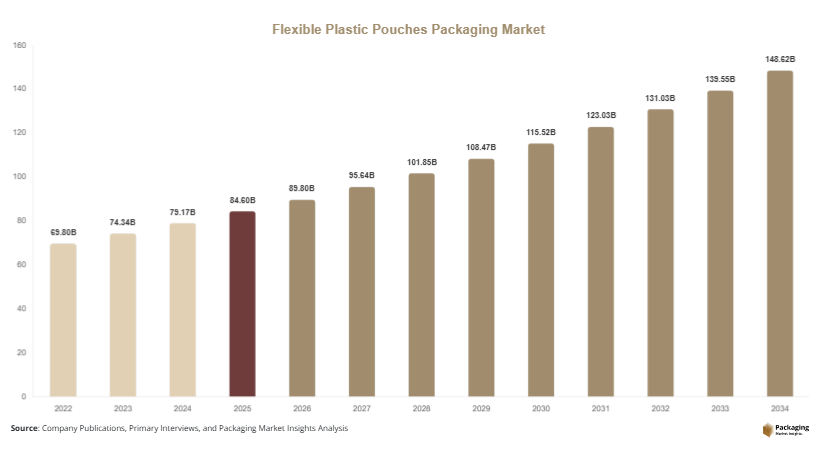
The global flexible plastic pouches packaging market was valued at approximately USD 84.6 billion in 2025 and is projected to reach USD 89.8 billion in 2026. By 2034, the market is forecasted to reach nearly USD 148.7 billion, expanding at a CAGR of 6.5% during 2025–2034. Flexible plastic pouches continue to gain popularity because they offer cost efficiency, product protection, portability, and reduced transportation expenses compared to rigid packaging formats. The flexible plastic pouches packaging market is experiencing stable growth due to rising demand for lightweight packaging, increasing adoption of convenient consumer packaging formats, and expanding applications across food, beverage, healthcare, and personal care industries.
One of the major growth factors driving the flexible plastic pouches packaging market is the increasing demand for packaged and processed food products. Consumers prefer convenient, resealable, and portable packaging solutions for snacks, frozen foods, ready-to-eat meals, and beverages. Flexible pouches extend product shelf life while improving storage efficiency and visual appeal, making them highly attractive for food manufacturers and retailers.
Key Highlights
- Asia Pacific dominated the market with a 38.2% share in 2025.
- Latin America is projected to grow at the fastest CAGR of 7.2%.
- Stand-up pouches led the product type segment with a 41.5% share.
- Polyethylene materials dominated the material segment with a 46.9% share.
- Food & beverage applications led the end-use segment with 52.4% share.
- The US remained the dominant country with a market size of USD 15.2 billion in 2025 and USD 16.1 billion in 2026.
Explore more data points, trends and opportunities Download Free Sample Report
Market Trends
Increasing Adoption of Recyclable Mono-Material Pouches
The transition toward recyclable mono-material flexible pouches is becoming a significant trend in the flexible plastic pouches packaging market. Packaging manufacturers are increasingly replacing multi-layer mixed-material structures with mono-material polyethylene and polypropylene pouches to improve recyclability and comply with environmental regulations. Consumer goods companies are actively introducing recyclable packaging to support sustainability targets and reduce packaging waste. Food, personal care, and household product brands are adopting mono-material stand-up pouches because they provide adequate barrier protection while simplifying recycling processes. Technological improvements in high-barrier films and sealing performance are helping recyclable pouches achieve broader commercial adoption. This trend is expected to strengthen as governments implement stricter plastic waste management regulations globally.
Growth of Digitally Printed and Customized Pouch Packaging
Digitally printed flexible pouches are gaining popularity across the packaging industry due to increasing demand for product differentiation and shorter production cycles. Brands are using high-quality graphics, personalized designs, and limited-edition packaging to improve customer engagement and strengthen shelf visibility. Digital printing technologies allow manufacturers to reduce setup costs and support small-batch production for promotional campaigns and seasonal product launches. Flexible pouches with QR codes, smart labels, and traceability features are also becoming more common in food and pharmaceutical applications. The growing emphasis on brand identity, convenience packaging, and rapid product innovation is expected to continue driving demand for customized flexible pouch packaging solutions.
Market Drivers
Rising Demand for Convenient and Lightweight Packaging
The increasing demand for convenient and lightweight packaging solutions is a major driver supporting the flexible plastic pouches packaging market. Consumers prefer portable and easy-to-store packaging for food, beverages, pet food, and personal care products. Flexible pouches offer advantages such as resealable closures, reduced storage space, and lower transportation costs compared to rigid containers. Food manufacturers are increasingly using stand-up pouches and spouted pouches to improve convenience and extend shelf life. Retailers also favor lightweight packaging because it improves logistics efficiency and reduces shipping expenses. The continued growth of urban lifestyles and on-the-go consumption patterns is expected to sustain strong market demand.
Expansion of E-commerce and Retail Distribution Networks
The rapid expansion of e-commerce and organized retail sectors is another important driver for the flexible plastic pouches packaging market. Online retailers require durable and lightweight packaging formats capable of protecting products during transportation while minimizing shipping costs. Flexible pouches are increasingly used for snacks, detergents, cosmetics, supplements, and household products sold through digital commerce platforms. Retail chains are also promoting pouch packaging because it enhances shelf efficiency and product visibility. Packaging manufacturers are developing tamper-evident closures, leak-resistant structures, and recyclable films specifically designed for e-commerce logistics. Growing internet penetration and digital shopping behavior across emerging economies are expected to further support market expansion.
Market Restraint
Environmental Concerns Related to Plastic Waste and Recycling Challenges
One of the key restraints affecting the flexible plastic pouches packaging market is the increasing concern regarding plastic waste generation and recycling limitations. Many flexible pouches are manufactured using multi-layer plastic structures that are difficult to recycle through conventional waste management systems. Governments and environmental organizations are increasing pressure on manufacturers to reduce plastic packaging waste and improve recyclability. Companies relying heavily on traditional plastic pouch materials may face compliance challenges and rising operational costs associated with packaging redesign and recycling initiatives. For example, food manufacturers using aluminum-plastic laminated pouches may need to shift toward recyclable mono-material alternatives, which often require investment in new production technologies and supply chain modifications. These environmental concerns can slow market growth in regions with strict packaging regulations.
Market Opportunities
Expansion of Sustainable Packaging Technologies
The growing focus on sustainable packaging technologies presents significant opportunities for flexible plastic pouch manufacturers. Companies are increasingly investing in recyclable films, biodegradable plastics, and compostable pouch materials to meet evolving environmental regulations and consumer expectations. Brand owners across food, beverage, and personal care industries are actively seeking sustainable packaging solutions capable of maintaining product quality and shelf life. Packaging suppliers are developing advanced barrier coatings and recyclable mono-material structures to improve environmental performance. As governments continue introducing packaging waste reduction policies, demand for eco-friendly flexible pouches is expected to increase substantially across global markets.
Growth in Pharmaceutical and Healthcare Packaging Applications
The healthcare and pharmaceutical sectors are creating strong growth opportunities for the flexible plastic pouches packaging market. Pharmaceutical companies increasingly use pouches for medical devices, diagnostic kits, powdered medicines, and liquid products due to their lightweight structure and contamination resistance. Flexible packaging solutions also improve transportation efficiency and reduce packaging material usage compared to rigid containers. Manufacturers are introducing sterile and tamper-evident pouch designs suitable for healthcare applications. Rising healthcare expenditure, expanding pharmaceutical manufacturing, and increasing demand for convenient medical packaging products in emerging economies are expected to support continued market growth during the forecast period.
Report Scope
| Report Metric | Details |
|---|---|
| Market Size in 2025 | USD 84.6 Billion |
| Market Size in 2026 | USD 89.8 Billion |
| Market Size in 2034 | USD 148.7 Billion |
| CAGR | 6.5% (2026-2034) |
| Base Year for Estimation | 2025 |
| Historical Data | 2022-2024 |
| Forecast Period | 2026-2034 |
| Report Coverage | Revenue Forecast, Competitive Landscape, Supply Chain Disruption, Growth Factors, Environment & Regulatory Landscape and Trends |
| Geographies Covered | North America, Europe, APAC, Middle East and Africa, LATAM |
| Countries Covered | U.S., Canada, U.K., Germany, France, Spain, Italy, Russia, Nordic, Benelux, Rest of Europe, China, South Korea, Japan, India, Australia, Singapore, Taiwan, South East Asia, Rest of Asia-Pacific, UAE, Turky, Saudi Arabia, South Africa, Egypt, Nigeria, Rest of MEA, Brazil, Mexico, Argentina, Chile, Colombia, Rest of LATAM |
Explore more data points, trends and opportunities Download Free Sample Report
Segmental Analysis
By Product Type
Stand-up pouches dominated the product type segment in 2024, accounting for approximately 41.5% of total market share. These pouches are widely used across food, beverage, pet food, and personal care industries because they provide strong shelf visibility, resealable convenience, and efficient storage capabilities. Manufacturers prefer stand-up pouches because they require less material than rigid packaging while maintaining excellent barrier protection and printing quality. Consumers also value the portability and easy handling offered by stand-up pouch packaging. Advancements in zipper closures, spouts, and high-barrier films are further improving product functionality and supporting broader adoption across retail and industrial applications.
Recyclable mono-material pouches are expected to witness the fastest growth, registering a CAGR of 7.8% during the forecast period. Increasing environmental regulations and sustainability commitments are encouraging companies to replace multi-layer mixed-material packaging with recyclable alternatives. Mono-material pouches made from polyethylene or polypropylene simplify recycling processes and support circular economy initiatives. Packaging manufacturers are investing in advanced film technologies to improve oxygen barriers, moisture resistance, and sealing performance while maintaining recyclability. Food and beverage companies are increasingly adopting recyclable pouch packaging to strengthen sustainability branding and comply with packaging waste reduction regulations across developed and emerging markets.
By Material
Polyethylene dominated the material segment in 2024 with approximately 46.9% share due to its flexibility, durability, and cost efficiency. Polyethylene films are widely used for food packaging, detergents, cosmetics, and industrial products because they provide moisture resistance and compatibility with multiple packaging formats. Manufacturers prefer polyethylene because it supports lightweight packaging production while maintaining product protection during transportation and storage. The material is also increasingly used in recyclable mono-material pouch applications. Technological advancements in high-density and linear low-density polyethylene films are improving barrier performance and supporting broader adoption across several end-use industries.
Biodegradable plastics are projected to be the fastest-growing material segment with a CAGR of 7.5% during the forecast period. Rising environmental awareness and government regulations limiting plastic waste are encouraging packaging companies to develop bio-based and compostable pouch materials. Manufacturers are investing in biodegradable polymers derived from renewable resources such as cornstarch and sugarcane to reduce environmental impact. Food service operators and organic product brands are increasingly adopting biodegradable flexible pouches to strengthen sustainability positioning. Improvements in compostable film durability and shelf-life performance are expected to support wider commercial adoption across global markets.
By End Use
Food & beverage applications dominated the end-use segment in 2024, accounting for approximately 52.4% of the total market share. Flexible plastic pouches are extensively used for snacks, frozen foods, sauces, beverages, dairy products, and ready-to-eat meals due to their lightweight structure and strong barrier properties. Food manufacturers increasingly prefer pouches because they extend shelf life, improve convenience, and reduce packaging material usage. Consumer demand for portable and resealable food packaging is also supporting segment growth. Packaging suppliers are introducing advanced barrier films and easy-open features to improve user experience and maintain food freshness during transportation and storage.
Pharmaceutical applications are expected to register the fastest CAGR of 7.1% during the forecast period. Flexible pouches are increasingly used for medical products, powdered medicines, surgical kits, and diagnostic devices because they offer contamination resistance and transportation efficiency. Pharmaceutical companies are adopting sterile pouch packaging with tamper-evident features to improve product safety and compliance with healthcare regulations. Rising healthcare expenditure and expanding pharmaceutical manufacturing in emerging economies are contributing significantly to segment growth. Manufacturers are also investing in high-barrier medical pouch materials capable of maintaining product stability and extending shelf life.
Flexible Plastic Pouches Packaging Market Segmentations
By Product Type
- Stand-Up Pouches
- Flat Pouches
- Spouted Pouches
- Vacuum Pouches
By Material
- Polyethylene
- Polypropylene
- PET
- Biodegradable Plastics
By End User
- Food & Beverage
- Pharmaceuticals
- Personal Care
- Household Products
- Pet Food
Regional Analysis
North America
North America accounted for approximately 28.6% of the global flexible plastic pouches packaging market share in 2025 and is projected to grow at a CAGR of 5.8% during the forecast period. The region benefits from strong demand for packaged food products, established retail distribution networks, and widespread adoption of convenience packaging. Food manufacturers and consumer goods companies are increasingly using flexible pouches to reduce packaging costs and improve logistics efficiency. Sustainability initiatives promoting recyclable pouch structures are also contributing to regional market development.
The United States dominates the North American market due to its large packaged food industry and expanding e-commerce sector. A unique growth factor is the increasing use of pouch packaging in meal-kit delivery services and ready-to-eat food products. These applications require lightweight and durable packaging capable of preserving freshness while reducing transportation expenses and storage requirements.
Europe
Europe held approximately 24.9% of the global market share in 2025 and is expected to register a CAGR of 5.6% through 2034. Strong environmental regulations and increasing adoption of recyclable flexible packaging are supporting market growth across the region. Food and beverage companies are replacing rigid packaging with lightweight pouch formats to reduce carbon emissions and improve packaging efficiency. Investments in recyclable mono-material pouch technologies are also increasing among packaging manufacturers operating within the European market.
Germany remains the dominant country in Europe due to its advanced packaging industry and strong focus on sustainability innovation. A unique growth factor is the expansion of refill pouch systems within personal care and household product industries. Consumers increasingly prefer refill packaging solutions that reduce plastic consumption and support circular economy initiatives across retail markets.
Asia Pacific
Asia Pacific dominated the flexible plastic pouches packaging market with a 38.2% share in 2025 and is projected to grow at a CAGR of 7.1% during the forecast period. Rapid urbanization, expanding middle-class populations, and rising demand for packaged food products are driving strong regional growth. Food delivery services, organized retail, and online shopping platforms are significantly increasing demand for lightweight and affordable packaging formats. Manufacturers across the region are expanding production capacities to meet rising domestic and export demand.
China leads the Asia Pacific market due to its extensive manufacturing infrastructure and rapidly growing consumer goods sector. A unique growth factor is the expansion of instant food and beverage packaging applications within urban retail channels. Flexible pouches are increasingly used for sauces, snacks, dairy products, and ready-to-drink beverages because they offer convenience and cost efficiency for high-volume production.
Middle East & Africa
The Middle East & Africa region represented approximately 4.8% of the global market share in 2025 and is expected to grow at a CAGR of 5.9% during the forecast period. Rising urban populations, increasing packaged food consumption, and expanding retail infrastructure are supporting market development across the region. International food brands and retail chains are increasing their presence in urban markets, contributing to higher demand for flexible pouch packaging products.
Saudi Arabia dominates the regional market due to strong growth in food processing and consumer goods industries. A unique growth factor is the increasing demand for flexible pouches in packaged dates, dairy products, and convenience food applications. Local manufacturers are investing in advanced flexible packaging production technologies to support growing domestic consumption and export activities.
Latin America
Latin America accounted for approximately 3.5% of the global market share in 2025 and is projected to grow at the fastest CAGR of 7.2% through 2034. Growing urbanization, rising disposable income, and increasing demand for affordable packaged products are supporting regional market expansion. Flexible pouch packaging is becoming popular among food manufacturers and personal care brands because it reduces packaging costs and improves transportation efficiency across large distribution networks.
Brazil remains the leading country in the Latin American market due to its strong food processing sector and expanding retail industry. A unique growth factor is the increasing adoption of pouch packaging for liquid detergents and household cleaning products. Consumer preference for convenient refill packaging formats is encouraging manufacturers to introduce cost-effective and lightweight pouch solutions across retail channels.
Competitive Landscape
The flexible plastic pouches packaging market is highly competitive, with major companies focusing on sustainability innovation, production expansion, and advanced packaging technologies. Manufacturers are investing heavily in recyclable films, lightweight packaging structures, and digital printing solutions to strengthen market positioning and comply with environmental regulations. Strategic partnerships with food manufacturers, retailers, and healthcare companies are also increasing across the industry.
Amcor plc remains one of the leading players in the flexible plastic pouches packaging market due to its broad global packaging portfolio and strong investment in sustainable packaging technologies. In 2024, the company launched a recyclable mono-material stand-up pouch designed for food and household product applications. Other major companies including Berry Global Inc., Mondi Group, Sonoco Products Company, and Sealed Air Corporation are expanding production capacities and introducing advanced high-barrier pouch solutions. Companies are also focusing on automation and smart packaging technologies to improve operational efficiency and support growing demand from e-commerce and retail industries.
Key Players List
- Amcor plc
- Berry Global Inc.
- Mondi Group
- Sonoco Products Company
- Sealed Air Corporation
- Huhtamaki
- Constantia Flexibles
- ProAmpac
- Coveris Holdings S.A.
- Winpak Ltd.
- Glenroy Inc.
- Clondalkin Group
- UFlex Ltd.
- Smurfit Kappa Group
- Printpack Inc.