Flexible Plastic Pouches Market Size and Growth
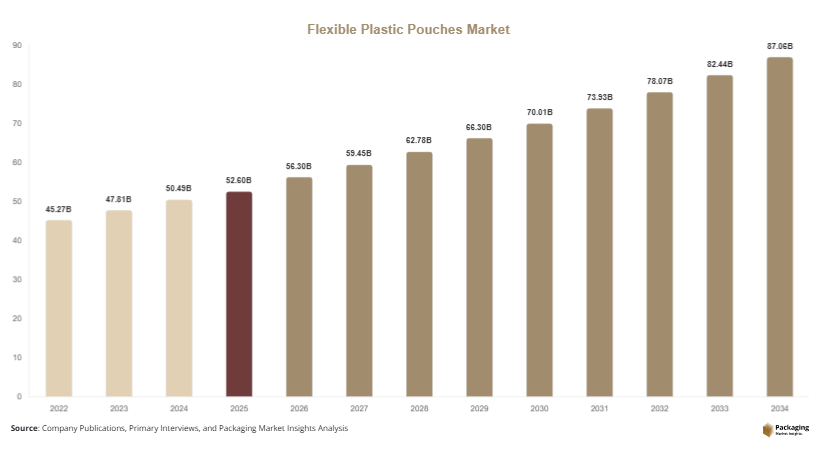
The global flexible plastic pouches market size was valued at USD 52.6 billion in 2025 and is projected to reach USD 56.3 billion in 2026, further growing to approximately USD 92.4 billion by 2034, registering a CAGR of 5.6% during the forecast period (2025–2034). Flexible plastic pouches are widely adopted due to their ability to reduce material consumption, enhance product shelf life, and lower transportation costs. The global flexible plastic pouches market is experiencing consistent expansion, driven by the increasing demand for lightweight, cost-efficient, and sustainable packaging formats across multiple industries.
A key growth factor is the rising demand for convenience packaging in the food and beverage industry. Consumers increasingly prefer easy-to-carry, resealable, and space-saving packaging formats, which flexible pouches effectively deliver. Another significant factor is the expansion of e-commerce and online retail platforms, where durable yet lightweight packaging is essential to ensure product protection during transit. Additionally, the growing emphasis on sustainability has encouraged manufacturers to develop recyclable, mono-material, and biodegradable pouch solutions.
Key Highlights
- Asia Pacific dominated the market with a 38.1% share in 2025, while Latin America is projected to grow at the fastest CAGR of 6.4%.
- Stand-up pouches led the type segment with a 31.8% share, while spouted pouches are expected to grow at a CAGR of 6.7%.
- Polyethylene-based pouches dominated with a 49.2% share, while biodegradable plastics are forecasted to grow at a CAGR of 7.1%.
- Food & beverage applications led the segment with 44.6% share, while pharmaceutical packaging is expected to grow at a CAGR of 6.5%.
- China remained the dominant country with a market size of USD 12.4 billion in 2025 and USD 13.2 billion in 2026.
Explore more data points, trends and opportunities Download Free Sample Report
Market Trends
Rising adoption of sustainable and recyclable pouch materials
Sustainability has become a defining factor in the flexible plastic pouches market as regulatory frameworks and consumer expectations continue to evolve. Manufacturers are transitioning from complex multi-layer packaging structures toward mono-material designs that are easier to recycle. This shift supports circular economy goals and helps companies align with environmental compliance requirements. The use of post-consumer recycled content is also increasing, allowing brands to reduce their environmental footprint while maintaining packaging functionality.
Innovations in biodegradable and compostable polymers are gaining traction, especially in regions with strict plastic waste regulations. These materials provide improved environmental performance without compromising barrier properties or durability. Companies are also focusing on lifecycle assessments to optimize packaging design and reduce emissions. As sustainability becomes a key purchasing factor, brands are prioritizing eco-friendly pouch solutions to enhance consumer trust and maintain competitiveness in the global market.
Integration of smart packaging and advanced printing technologies
Technological innovation is reshaping packaging design through the integration of smart features and advanced printing methods. Digital printing enables high-quality graphics, shorter production runs, and cost-efficient customization, which is particularly beneficial for small and medium enterprises. This capability allows brands to respond quickly to market trends and personalize packaging for targeted consumer segments.
At the same time, smart packaging features such as QR codes, NFC tags, and freshness indicators are being incorporated into flexible pouches. These technologies enhance traceability, improve supply chain transparency, and provide real-time product information to consumers. In industries such as pharmaceuticals and food, these features support safety and compliance requirements. The combination of digital printing and smart packaging is enabling companies to create interactive and value-added packaging solutions, strengthening their market presence.
Market Drivers
Increasing demand for convenient and lightweight packaging solutions
The demand for convenient packaging continues to rise as consumer lifestyles become more fast-paced and urbanized. Flexible plastic pouches offer several advantages, including ease of handling, portability, and resealability. These features make them suitable for a wide range of products such as snacks, beverages, and personal care items. Their lightweight nature reduces transportation costs and supports efficient logistics, which is particularly important for global supply chains.
Additionally, flexible pouches require less raw material compared to rigid packaging, resulting in lower production costs and reduced environmental impact. This combination of convenience and cost efficiency has led to widespread adoption across multiple industries. As consumers continue to prioritize ease of use and sustainability, the demand for flexible pouch packaging is expected to grow steadily over the forecast period.
Expansion of food, beverage, and e-commerce sectors
The rapid growth of the food and beverage industry is a major factor driving the flexible plastic pouches market. Increasing consumption of packaged and ready-to-eat foods has created a strong demand for packaging solutions that can preserve freshness and extend shelf life. Flexible pouches provide effective barriers against moisture, oxygen, and contaminants, making them ideal for food applications.
The rise of e-commerce has further accelerated market growth, as online retail requires packaging that is both durable and lightweight. Flexible pouches meet these requirements by offering protection during transit while minimizing shipping costs. The increasing penetration of online grocery platforms and direct-to-consumer brands is expected to sustain demand for flexible packaging solutions. This trend is particularly prominent in emerging markets, where digital adoption is rapidly increasing.
Market Restraint
Environmental concerns and recycling limitations
Environmental concerns remain a key challenge for the flexible plastic pouches market, particularly due to the complexity of recycling multi-layer materials. Many flexible pouches are composed of different polymers and barrier layers, making them difficult to process through conventional recycling systems. This has led to increased scrutiny from regulators and environmental organizations, resulting in stricter policies on plastic usage and waste management.
In several regions, governments are implementing regulations that limit the use of non-recyclable packaging materials. This creates pressure on manufacturers to redesign their products and invest in sustainable alternatives. However, the transition to recyclable or biodegradable materials involves higher costs and technical challenges. Limited recycling infrastructure in developing regions further complicates waste management efforts. These factors collectively act as a restraint, slowing down market growth despite increasing demand for flexible packaging solutions.
Market Opportunities
Growth potential in emerging economies
Emerging markets are presenting strong growth opportunities for the flexible plastic pouches market due to rapid urbanization and increasing consumer spending. Countries across Asia Pacific, Latin America, and Africa are witnessing rising demand for packaged food, beverages, and personal care products. Flexible pouches provide an affordable and efficient packaging option, making them highly suitable for these regions.
The expansion of modern retail formats and improved distribution networks is further supporting market penetration. Local manufacturers are adopting advanced packaging technologies to meet evolving consumer preferences. Additionally, the growing middle-class population is driving demand for convenience products, which in turn increases the need for flexible packaging. These factors create a favorable environment for market growth in emerging economies.
Advancements in biodegradable and high-performance materials
Technological advancements in material science are opening new avenues for innovation in flexible plastic pouches. The development of biodegradable and bio-based polymers is enabling manufacturers to produce environmentally friendly packaging solutions without compromising performance. These materials are designed to degrade naturally, reducing the impact on landfills and ecosystems.
At the same time, improvements in barrier technologies are enhancing the functionality of flexible pouches. High-performance coatings and nanomaterials are being used to improve resistance to moisture, oxygen, and light. These advancements are particularly beneficial for sensitive products such as pharmaceuticals and perishable foods. As sustainability regulations become more stringent, companies that invest in advanced materials are likely to gain a competitive advantage and capture new market opportunities.
Report Scope
| Report Metric | Details |
|---|---|
| Market Size in 2025 | USD 52.6 Billion |
| Market Size in 2026 | USD 56.3 Billion |
| Market Size in 2034 | USD 92.4 Billion |
| CAGR | 5.6% (2026-2034) |
| Base Year for Estimation | 2025 |
| Historical Data | 2022-2024 |
| Forecast Period | 2026-2034 |
| Report Coverage | Revenue Forecast, Competitive Landscape, Supply Chain Disruption, Growth Factors, Environment & Regulatory Landscape and Trends |
| Geographies Covered | North America, Europe, APAC, Middle East and Africa, LATAM |
| Countries Covered | U.S., Canada, U.K., Germany, France, Spain, Italy, Russia, Nordic, Benelux, Rest of Europe, China, South Korea, Japan, India, Australia, Singapore, Taiwan, South East Asia, Rest of Asia-Pacific, UAE, Turky, Saudi Arabia, South Africa, Egypt, Nigeria, Rest of MEA, Brazil, Mexico, Argentina, Chile, Colombia, Rest of LATAM |
Explore more data points, trends and opportunities Download Free Sample Report
Segmental Analysis
By Type
Stand-up pouches accounted for the largest share of the flexible plastic pouches market in 2024, holding approximately 31.8% of the overall market. Their dominance is attributed to their versatility, durability, and strong shelf appeal. These pouches are widely used in food, beverage, and personal care applications due to their ability to maintain structure while standing upright. Features such as resealable zippers, tear notches, and spouts enhance convenience for consumers. Additionally, stand-up pouches require less material compared to rigid packaging, reducing production and transportation costs. Their compatibility with high-quality printing also enables brands to create visually appealing packaging, improving product visibility and consumer engagement in competitive retail environments.
Spouted pouches are expected to witness the fastest growth, registering a CAGR of 6.7% during the forecast period. These pouches are increasingly used for packaging liquid and semi-liquid products such as juices, sauces, and detergents. The convenience of controlled dispensing and reduced risk of spillage makes them highly attractive to consumers. Advancements in spout design and sealing technologies have improved durability and functionality. The growing demand for portable and easy-to-use packaging solutions, particularly in emerging markets, is further driving the adoption of spouted pouches. Their ability to replace traditional rigid containers also contributes to cost savings and sustainability benefits.
By Material
Polyethylene-based pouches held the dominant share in 2024, accounting for approximately 49.2% of the market. This material is widely used due to its flexibility, durability, and excellent moisture barrier properties. Polyethylene is suitable for a variety of applications, including food packaging, where it helps maintain product freshness and extend shelf life. Its ease of processing and cost-effectiveness make it a preferred choice for manufacturers. The availability of different grades, such as low-density and high-density polyethylene, further enhances its versatility. As a result, polyethylene continues to be a key material in the production of flexible plastic pouches.
Biodegradable plastics are projected to grow at the fastest CAGR of 7.1% during the forecast period. The increasing focus on environmental sustainability is driving the adoption of eco-friendly materials. Biodegradable pouches offer similar performance to conventional plastics while reducing environmental impact. Innovations in bio-based polymers and compostable films are enabling manufacturers to develop high-quality packaging solutions that meet regulatory requirements. Consumer preference for sustainable products is also influencing purchasing decisions, encouraging companies to adopt biodegradable materials. As production technologies advance, the cost of these materials is expected to decrease, supporting wider adoption.
By Application
Food and beverage applications dominated the market in 2024, accounting for approximately 44.6% of the total share. Flexible plastic pouches are widely used for packaging snacks, beverages, dairy products, and ready-to-eat meals. Their ability to provide effective barriers against moisture and oxygen helps preserve product quality and extend shelf life. The increasing demand for convenient and portable packaging solutions is driving their adoption in this segment. Additionally, features such as resealable closures and easy-tear openings enhance consumer convenience. The expansion of the global food industry continues to support the growth of flexible pouch packaging.
Pharmaceutical applications are expected to grow at the fastest CAGR of 6.5% during the forecast period. The need for safe, hygienic, and reliable packaging solutions in the healthcare sector is driving demand for flexible pouches. These pouches are used for packaging medical devices, drugs, and diagnostic kits, offering protection against contamination and ensuring product integrity. Advancements in high-barrier materials and tamper-evident features are enhancing the safety of pharmaceutical packaging. The growing healthcare infrastructure and increasing demand for medical products in emerging markets are further supporting the growth of this segment.
Flexible Plastic Pouches Market Segmentations
By Type
- Stand-Up Pouches
- Flat Pouches
- Spouted Pouches
- Vacuum Pouches
By Material
- Polyethylene
- Polypropylene
- PET
- Biodegradable Plastics
By Application
- Food & Beverage
- Pharmaceuticals
- Personal Care
- Industrial
Regional Analysis
North America
North America accounted for approximately 24.6% of the flexible plastic pouches market share in 2025 and is projected to grow at a CAGR of 4.8% during the forecast period. The region benefits from strong demand across food, healthcare, and personal care industries. Advanced packaging technologies and established supply chains further support market growth. Increasing investments in sustainable packaging solutions are also contributing to the adoption of flexible pouches.
The United States dominates the regional market due to high consumption of packaged goods and the expansion of e-commerce platforms. A key growth factor in this region is the strong regulatory focus on sustainable packaging, encouraging manufacturers to adopt recyclable and eco-friendly materials. This shift is driving innovation and creating opportunities for market players.
Europe
Europe held a 21.3% market share in 2025 and is expected to register a CAGR of 5.1% through 2034. The region’s growth is driven by stringent environmental regulations and increasing consumer awareness regarding sustainability. The demand for recyclable and biodegradable packaging materials is particularly strong in Western Europe, where governments are actively promoting circular economy initiatives.
Germany leads the European market, supported by its advanced manufacturing capabilities and focus on innovation. A key growth factor in this region is the implementation of strict waste management policies, which are encouraging companies to develop sustainable packaging solutions. This regulatory environment is fostering long-term market growth.
Asia Pacific
Asia Pacific dominated the market with a 38.1% share in 2025 and is projected to grow at a CAGR of 6.2% during the forecast period. Rapid industrialization, urbanization, and population growth are driving demand for packaged products in the region. The increasing adoption of flexible packaging in food, beverage, and healthcare sectors is further supporting market expansion.
China remains the dominant country due to its large manufacturing base and strong consumer demand. A key growth factor is the rapid expansion of e-commerce and online food delivery services, which require efficient and durable packaging solutions. This trend is significantly boosting the demand for flexible plastic pouches in the region.
Middle East & Africa
The Middle East & Africa region accounted for 7.2% of the market share in 2025 and is expected to grow at a CAGR of 5.4%. The market is driven by increasing demand for packaged food and beverages, along with the expansion of retail and hospitality sectors. Investments in infrastructure and economic development are also supporting market growth.
Saudi Arabia leads the regional market due to its strong economic growth and rising consumer base. A key growth factor is the increasing investment in food processing industries, which is driving demand for flexible packaging solutions. This trend is expected to continue as the region diversifies its economy.
Latin America
Latin America held an 8.8% share in 2025 and is projected to grow at a CAGR of 6.4% during the forecast period. The region is experiencing increased demand for packaged goods due to urbanization and changing consumer lifestyles. Flexible pouches are gaining popularity as cost-effective and efficient packaging solutions.
Brazil dominates the regional market, supported by its large population and expanding retail sector. A key growth factor is the adoption of flexible packaging by local manufacturers to reduce costs and improve product accessibility. This shift is driving market growth across the region.
Competitive Landscape
The flexible plastic pouches market is characterized by a moderately fragmented competitive environment, with both global and regional players actively participating. Companies are focusing on product innovation, sustainability initiatives, and strategic collaborations to strengthen their market position. The emphasis on recyclable and biodegradable materials is shaping competitive strategies, as companies aim to comply with evolving regulations and consumer expectations.
Amcor plc stands out as a leading player due to its extensive product portfolio and strong commitment to sustainability. The company has introduced advanced recyclable pouch solutions to address environmental concerns and improve packaging efficiency. Other major companies are also investing in research and development to enhance material performance and expand their product offerings. Mergers, acquisitions, and partnerships are commonly used strategies to increase market share and geographic presence.
Key Players List
- Amcor plc
- Berry Global Inc.
- Sealed Air Corporation
- Mondi Group
- Huhtamaki Oyj
- Sonoco Products Company
- ProAmpac LLC
- Constantia Flexibles
- Coveris Holdings S.A.
- Clondalkin Group
- Winpak Ltd.
- Uflex Ltd.
- Glenroy Inc.
- Transcontinental Inc.
- Scholle IPN