Flexible Packaging For Beverage Market Size and Growth
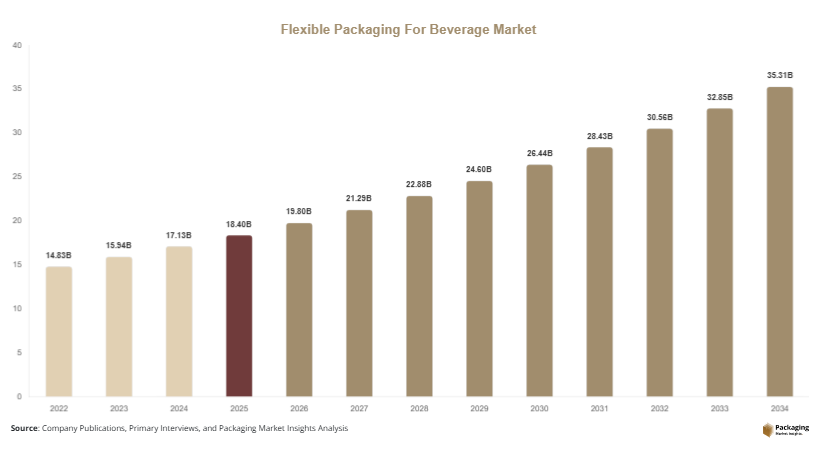
The global flexible packaging for beverage market size reached approximately USD 18.4 billion in 2025 and is expected to grow to USD 19.8 billion in 2026. With continued advancements in material science and packaging technologies, the market is projected to reach USD 37.6 billion by 2034, registering a compound annual growth rate (CAGR) of 7.5% during the forecast period (2025–2034). The flexible packaging for beverage market is experiencing steady expansion driven by the increasing consumption of ready-to-drink beverages, rising demand for lightweight packaging solutions, and the growing emphasis on sustainability.
Flexible packaging solutions, such as pouches, sachets, and flexible bottles, are gaining popularity due to their cost efficiency, portability, and ability to extend product shelf life. Beverage manufacturers are increasingly shifting from rigid packaging formats to flexible alternatives to reduce transportation costs and enhance convenience for end users. Additionally, the growth of on-the-go consumption patterns and urban lifestyles is further accelerating the adoption of flexible packaging in the beverage sector.
Key Highlights
- Market size reached USD 18.4 billion in 2025, reflecting steady growth driven by rising consumption of packaged beverages and increasing preference for convenient packaging formats. The market continues to expand due to strong demand across both developed and emerging economies.
- The market is expected to grow at a CAGR of 7.5% from 2025 to 2034, supported by continuous innovation in packaging technologies and increasing focus on cost-efficient solutions. Growing urbanization and changing consumer lifestyles are also contributing to this sustained growth rate.
- The forecast value is projected to reach USD 37.6 billion by 2034, indicating significant expansion opportunities for manufacturers and stakeholders. Increased investments in sustainable materials and advanced packaging solutions are expected to drive long-term market growth.
- Strong demand from food and beverage consumption trends is fueling the adoption of flexible packaging solutions, particularly for ready-to-drink and on-the-go products. The shift toward convenience and portability is playing a crucial role in market expansion.
- Increasing adoption of sustainable and high-barrier materials is transforming the packaging landscape, as companies focus on reducing environmental impact while maintaining product quality. Advanced materials are improving shelf life and performance, making them highly attractive to beverage manufacturers.
Explore more data points, trends and opportunities Download Free Sample Report
Market Trends
Rising Adoption of Sustainable Flexible Packaging
Sustainability has become a central trend in the flexible packaging for beverage market, driven by increasing environmental awareness and regulatory pressures. Beverage companies are adopting recyclable and bio-based materials to reduce plastic waste and carbon emissions. Flexible packaging formats require less raw material compared to rigid alternatives, making them inherently more resource-efficient. Innovations in mono-material films and compostable laminates are further enhancing recyclability.
Brands are also investing in closed-loop recycling systems and eco-friendly labeling practices to improve sustainability credentials. Consumer preference for environmentally responsible products is influencing purchasing decisions, encouraging manufacturers to integrate green packaging solutions. This trend is expected to gain further traction as governments implement stricter packaging waste regulations globally.
Growth of Convenience-Oriented Packaging Formats
Convenience-driven packaging formats are becoming increasingly popular in the beverage industry. Flexible packaging solutions such as stand-up pouches, spouted pouches, and single-serve sachets are designed to meet the needs of busy consumers seeking portability and ease of use. These formats offer features like resealability, lightweight design, and improved storage efficiency.
The rise of e-commerce and home delivery services has also contributed to the demand for durable and lightweight packaging solutions that can withstand transportation without compromising product quality. Additionally, flexible packaging enables innovative designs and branding opportunities, helping beverage companies enhance shelf appeal and customer engagement. This trend is expected to continue as consumer lifestyles evolve toward convenience and mobility.
Market Drivers
Increasing Demand for Ready-to-Drink Beverages
The growing consumption of ready-to-drink (RTD) beverages is a major driver of the flexible packaging for beverage market. Urbanization, busy lifestyles, and changing dietary preferences have led to a surge in demand for convenient beverage options such as juices, energy drinks, flavored water, and dairy-based drinks. Flexible packaging formats are well-suited for these products due to their portability and ease of handling.
Manufacturers are leveraging flexible packaging to offer single-serve and multi-serve options that cater to diverse consumer needs. The ability to maintain product freshness and extend shelf life further enhances the appeal of flexible packaging. As the RTD beverage segment continues to expand, the demand for innovative and efficient packaging solutions is expected to grow significantly.
Cost Efficiency and Lightweight Packaging Benefits
Flexible packaging offers significant cost advantages compared to traditional rigid packaging formats. It requires less material, reduces transportation costs, and minimizes storage space, making it an economically attractive option for beverage manufacturers. The lightweight nature of flexible packaging also contributes to lower carbon emissions during logistics and distribution.
In addition, flexible packaging allows for faster production cycles and reduced energy consumption, improving overall operational efficiency. These benefits are particularly important for companies operating in competitive markets where cost optimization is critical. As businesses continue to focus on efficiency and sustainability, the adoption of flexible packaging is expected to increase.
Market Restraint
Limited Recycling Infrastructure and Material Complexity
Despite its advantages, the flexible packaging for beverage market faces challenges related to recycling and material complexity. Many flexible packaging products are made from multi-layered materials that combine plastic, aluminum, and other components to achieve desired barrier properties. These composite materials are difficult to recycle using conventional recycling systems.
The lack of adequate recycling infrastructure in several regions further exacerbates the issue, leading to environmental concerns and regulatory scrutiny. Governments and environmental organizations are pushing for stricter regulations on plastic waste, which may impact the adoption of certain flexible packaging materials.
For example, multi-layered pouches used for beverage packaging often end up in landfills due to the absence of efficient recycling technologies. This creates pressure on manufacturers to develop sustainable alternatives, which can increase production costs. Addressing these challenges requires investment in advanced recycling technologies and the development of eco-friendly materials.
Market Opportunities
Advancements in High-Barrier Packaging Technologies
Technological advancements in high-barrier materials present significant growth opportunities for the flexible packaging for beverage market. Innovations in barrier coatings and laminates are enabling improved protection against moisture, oxygen, and light, ensuring product freshness and extended shelf life.
These advancements are particularly important for sensitive beverages such as dairy products and functional drinks. Manufacturers are investing in research and development to create packaging solutions that offer superior performance while maintaining sustainability. The integration of nanotechnology and advanced polymers is further enhancing barrier properties, opening new avenues for market growth.
Expansion in Emerging Markets
Emerging economies offer substantial growth potential for the flexible packaging for beverage market. Rapid urbanization, rising disposable incomes, and changing consumption patterns are driving the demand for packaged beverages in these regions. Countries in Asia Pacific, Latin America, and Africa are witnessing increased adoption of flexible packaging solutions.
Local manufacturers are expanding their production capacities to meet growing demand, while global players are entering these markets through partnerships and investments. The increasing penetration of retail and e-commerce channels is also contributing to market expansion. As infrastructure improves and consumer awareness increases, the adoption of flexible packaging is expected to accelerate.
Report Scope
| Report Metric | Details |
|---|---|
| Market Size in 2025 | USD 18.4 Billion |
| Market Size in 2026 | USD 19.8 Billion |
| Market Size in 2034 | USD 37.6 Billion |
| CAGR | 7.5% (2026-2034) |
| Base Year for Estimation | 2025 |
| Historical Data | 2022-2024 |
| Forecast Period | 2026-2034 |
| Report Coverage | Revenue Forecast, Competitive Landscape, Supply Chain Disruption, Growth Factors, Environment & Regulatory Landscape and Trends |
| Geographies Covered | North America, Europe, APAC, Middle East and Africa, LATAM |
| Countries Covered | U.S., Canada, U.K., Germany, France, Spain, Italy, Russia, Nordic, Benelux, Rest of Europe, China, South Korea, Japan, India, Australia, Singapore, Taiwan, South East Asia, Rest of Asia-Pacific, UAE, Turky, Saudi Arabia, South Africa, Egypt, Nigeria, Rest of MEA, Brazil, Mexico, Argentina, Chile, Colombia, Rest of LATAM |
Explore more data points, trends and opportunities Download Free Sample Report
Segmental Analysis
By Type
Plastic-based flexible packaging dominated the market in 2024, accounting for approximately 62% of the total share. This dominance is attributed to the material’s superior flexibility, durability, and cost efficiency. Plastic films and laminates offer excellent barrier properties against moisture, oxygen, and contaminants, making them highly suitable for beverage packaging. Additionally, their lightweight nature reduces transportation costs and improves supply chain efficiency, which is a critical factor for large-scale beverage manufacturers.
Biodegradable and paper-based packaging is the fastest-growing segment, projected to register a CAGR of 9.2% during the forecast period. The growth is driven by increasing environmental concerns and regulatory pressure to reduce plastic waste. Companies are investing in innovative materials such as bio-polymers and recyclable paper laminates to develop sustainable packaging solutions. This shift is also supported by consumer preference for eco-friendly products, particularly in developed markets.
By Application
Non-alcoholic beverages dominated the market in 2024, holding approximately 68% share. This segment includes soft drinks, juices, dairy beverages, and functional drinks, all of which require efficient packaging to maintain freshness and quality. Flexible packaging formats such as pouches and sachets are widely used due to their convenience, cost-effectiveness, and ability to extend shelf life. The growing demand for ready-to-drink beverages is further strengthening this segment.
Alcoholic beverages represent the fastest-growing segment, expected to expand at a CAGR of 8.1% during the forecast period. Growth is driven by increasing demand for innovative and portable packaging formats such as flexible pouches for wine and spirits. These packaging solutions offer advantages such as reduced weight, improved storage efficiency, and enhanced convenience for consumers, making them an attractive alternative to traditional glass bottles.
By End-Use
The food and beverage industry dominated the market in 2024 with a share exceeding 70%. This dominance is due to the extensive use of flexible packaging for a wide range of beverage products. The ability to provide extended shelf life, maintain product quality, and reduce packaging costs makes flexible packaging highly suitable for this industry. Additionally, advancements in barrier technologies are enabling better protection of beverages against external factors.
The e-commerce and retail segment is the fastest-growing segment, projected to grow at a CAGR of 9.5% during the forecast period. The rapid growth of online beverage sales is driving demand for durable and lightweight packaging solutions that can withstand transportation and handling. Flexible packaging meets these requirements effectively while also offering space-saving benefits and improved logistics efficiency, making it ideal for e-commerce applications.
Flexible Packaging For Beverage Market Segmentations
Product Type
- Plastic Flexible Packaging
- Paper-Based Flexible Packaging
- Aluminum Foil Packaging
- Biodegradable & Compostable Packaging
Application
- Non-Alcoholic Beverages
- Alcoholic Beverages
End-Use
- Food & Beverage Industry
- Retail & E-commerce
- Others
Regional Analysis
North America
North America accounted for approximately 28% of the flexible packaging for beverage market share in 2025 and is projected to expand at a CAGR of 6.8% during 2025–2034. The region benefits from high consumption of packaged beverages, particularly ready-to-drink (RTD) products such as juices, energy drinks, and functional beverages. Strong presence of leading packaging manufacturers and advanced production technologies further support market growth. Additionally, increasing regulatory pressure to reduce plastic waste is encouraging innovation in recyclable and sustainable flexible packaging solutions.
The United States dominates the regional market due to its well-established beverage industry and high demand for convenience packaging. A key growth factor is the rapid adoption of sustainable flexible packaging solutions, driven by consumer awareness and corporate sustainability commitments. Beverage brands are increasingly shifting toward mono-material and recyclable films, which is accelerating innovation and reshaping packaging strategies across the country.
Europe
Europe held around 24% market share in 2025 and is expected to grow at a CAGR of 6.5% over the forecast period. The region is characterized by stringent environmental regulations, including policies targeting single-use plastics and promoting circular economy practices. As a result, manufacturers are focusing on developing recyclable and biodegradable flexible packaging materials. The growing demand for premium beverages and high-quality packaging is also contributing to steady market expansion across the region.
Germany leads the European market due to its strong industrial base and advanced packaging technologies. A unique growth factor is the widespread implementation of circular economy initiatives, which emphasize recycling and reuse of materials. This has encouraged companies to invest in eco-friendly flexible packaging formats, particularly for beverage applications requiring high barrier protection and extended shelf life.
Asia Pacific
Asia Pacific dominated the market with approximately 32% share in 2025 and is anticipated to grow at the highest CAGR of 8.5% during the forecast period. Rapid urbanization, population growth, and rising disposable incomes are driving the demand for packaged beverages. The region has witnessed a significant shift toward convenient and affordable packaging solutions, making flexible packaging a preferred choice among manufacturers and consumers alike.
China is the dominant country in this region, supported by its large consumer base and expanding beverage industry. The key growth factor is the increasing demand for cost-effective and lightweight packaging solutions, particularly in emerging urban areas. Additionally, the growth of e-commerce and retail sectors is boosting the adoption of flexible packaging formats that are easy to transport and store.
Middle East & Africa
The Middle East & Africa region accounted for around 8% of the market share in 2025 and is projected to grow at a CAGR of 7.2% during the forecast period. The market is driven by increasing consumption of packaged beverages, particularly bottled water and energy drinks. Improvements in retail infrastructure and rising urban populations are also contributing to the growing demand for flexible packaging solutions in the region.
Saudi Arabia is a key market in the region, supported by high demand for packaged beverages due to climatic conditions. A unique growth factor is the strong demand for packaged drinking water and hydration products, which require durable and lightweight packaging. Flexible packaging solutions offer convenience and cost efficiency, making them increasingly popular among beverage manufacturers in the region.
Latin America
Latin America held approximately 8% of the market share in 2025 and is expected to grow at a CAGR of 7.0% during the forecast period. The region is experiencing steady growth due to increasing urbanization and rising demand for packaged beverages. Expansion of retail and distribution networks is further supporting the adoption of flexible packaging solutions.
Brazil dominates the regional market due to its large beverage industry and growing consumer base. A key growth factor is the increasing adoption of flexible packaging for both alcoholic and non-alcoholic beverages, driven by convenience and cost advantages. Manufacturers are also focusing on innovative packaging designs to attract consumers and enhance brand visibility.
Competitive Landscape
The flexible packaging for beverage market is moderately fragmented, with several global and regional players competing based on innovation, product quality, and sustainability. Companies are focusing on developing advanced materials and expanding their product portfolios to strengthen their market position.
Amcor Plc is a leading player in the market, known for its extensive range of flexible packaging solutions. The company recently introduced recyclable packaging solutions aimed at reducing environmental impact. Other major players are also investing in research and development to enhance product performance and meet evolving consumer demands.
Key Players List
- Amcor Plc
- Sealed Air Corporation
- Berry Global Inc.
- Mondi Group
- Sonoco Products Company
- Huhtamaki Oyj
- Constantia Flexibles Group
- Coveris Holdings S.A.
- Glenroy Inc.
- ProAmpac LLC
- Clondalkin Group
- Uflex Ltd.
- Winpak Ltd.
- Printpack Inc.
- Transcontinental Inc.