Flexible Packaging Adhesive Market Size and Growth
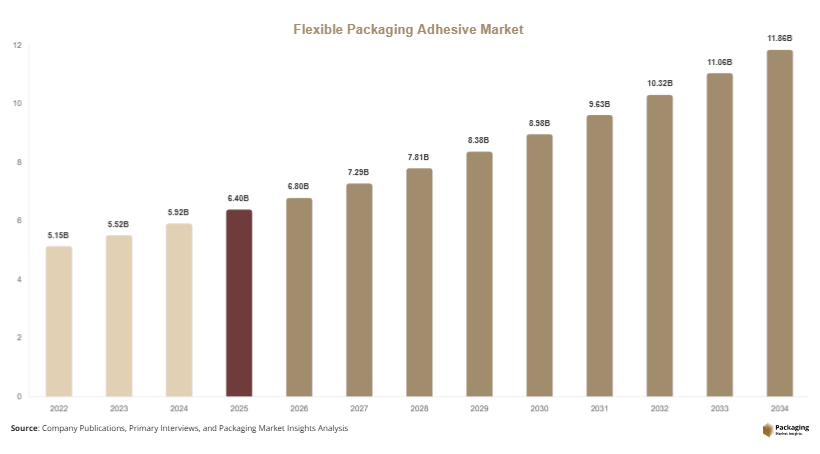
In 2025, the global Flexible Packaging Adhesive Market size is estimated at USD 6.4 billion, and it is projected to reach approximately USD 6.8 billion in 2026. By 2034, the market is expected to attain a value of USD 12.1 billion, growing at a CAGR of 7.2% from 2025 to 2034. This growth reflects increasing demand for high-performance adhesive systems that ensure durability, barrier protection, and compatibility with multilayer packaging structures. The global flexible packaging adhesive market is experiencing steady expansion driven by the rising adoption of flexible packaging formats across food & beverage, pharmaceuticals, personal care, and industrial applications.
Several factors are contributing to the expansion of the market. First, the rapid growth of packaged food consumption, especially in urbanized regions, is increasing the need for efficient lamination adhesives. Second, sustainability initiatives are pushing manufacturers toward solvent-free and water-based adhesive formulations. Third, technological advancements in adhesive chemistry are improving bonding strength, heat resistance, and chemical stability for high-speed packaging lines.
Key Highlights:
- Market size in 2025 is estimated at USD 6.4 billion, reflecting steady demand from key end-use industries such as food packaging and pharmaceuticals. Growth during this period is primarily supported by increasing adoption of flexible packaging solutions globally.
- In 2026, the market is projected to reach USD 6.8 billion, driven by rising consumption of packaged goods and expanding e-commerce logistics. This incremental growth highlights continued investment in advanced adhesive technologies.
- By 2034, the Flexible Packaging Adhesive Market is forecast to attain USD 12.1 billion, indicating strong long-term expansion. The growth is strongly influenced by sustainability trends and increasing regulatory support for eco-friendly materials.
- The market is expected to grow at a CAGR of 7.2% from 2025 to 2034, supported by continuous innovation in adhesive formulations and rising demand for high-performance packaging solutions.
- Strong demand from food, pharmaceutical, and e-commerce sectors is accelerating market adoption, as these industries require durable, safe, and high-barrier packaging materials.
- Increasing adoption of eco-friendly adhesive formulations is shaping market dynamics, with manufacturers shifting toward low-VOC, solvent-free, and bio-based solutions to meet environmental regulations and sustainability goals.
Explore more data points, trends and opportunities Download Free Sample Report
Market Trends
Shift Toward Sustainable and Low-VOC Adhesives
One of the most prominent trends in the flexible packaging adhesive market is the transition toward sustainable and low-VOC adhesive systems. Manufacturers are increasingly adopting water-based, solvent-free, and bio-based adhesives to comply with environmental regulations and corporate sustainability goals. This shift is driven by growing concerns about emissions, recyclability of packaging, and consumer preference for eco-friendly products. Packaging converters are also investing in adhesive technologies that support mono-material packaging structures, which simplify recycling processes. As global regulatory frameworks tighten, especially in Europe and North America, demand for green adhesive solutions is expected to rise significantly. This trend is also encouraging R&D investments aimed at improving performance parity between sustainable adhesives and traditional solvent-based systems.
Increasing Use of High-Performance Laminating Adhesives in Advanced Packaging
Another key trend shaping the market is the rising use of high-performance laminating adhesives in multilayer flexible packaging. These adhesives are designed to withstand extreme conditions such as high temperature, moisture exposure, and chemical interaction, making them suitable for pharmaceutical and industrial packaging. The growing complexity of packaging structures, including barrier films and smart packaging materials, is driving the need for advanced adhesive formulations. Additionally, high-speed production lines require adhesives with fast curing times and strong initial bonding strength. The expansion of packaged convenience foods and ready-to-eat products is further accelerating the adoption of advanced laminating adhesives across global markets.
Market Drivers
Expansion of Food & Beverage Packaging Industry
The food & beverage industry is a major growth driver for the flexible packaging adhesive market. Rising urbanization, changing lifestyles, and increasing demand for convenience foods are boosting the consumption of packaged goods globally. Flexible packaging solutions such as pouches, sachets, and wraps rely heavily on adhesives for multilayer lamination and sealing performance. As food safety regulations become stricter, manufacturers are adopting high-quality adhesive systems that ensure contamination-free packaging and extended shelf life. Additionally, growth in frozen and processed food segments is increasing the demand for heat-resistant and moisture-stable adhesives. This sustained expansion of the food packaging industry continues to significantly influence adhesive consumption patterns.
Growth in E-Commerce and Protective Packaging Demand
The rapid growth of e-commerce platforms is another major driver of the market. Online retail requires durable, lightweight, and protective packaging solutions that can withstand long-distance transportation and handling stress. Flexible packaging adhesives play a crucial role in ensuring the integrity of mailers, pouches, and courier bags. The increasing volume of cross-border trade and direct-to-consumer shipping models has further intensified demand. In addition, e-commerce packaging often requires tamper-evident and secure sealing solutions, which depend on high-performance adhesives. As digital commerce continues to expand globally, adhesive demand is expected to grow proportionally.
Market Restraint
High Volatility in Raw Material Prices and Supply Chain Disruptions
One of the primary restraints in the flexible packaging adhesive market is the volatility in raw material prices, particularly for petrochemical-based inputs such as resins, polyurethanes, and solvents. These materials are highly dependent on crude oil price fluctuations, which directly impact production costs for adhesive manufacturers. Sudden increases in raw material costs reduce profit margins and create pricing instability across the supply chain. Additionally, global supply chain disruptions, including transportation delays and geopolitical uncertainties, have affected the timely availability of critical ingredients. This has led to production inefficiencies and delayed order fulfillment for packaging converters.
For example, during periods of crude oil price spikes, adhesive manufacturers often struggle to maintain stable pricing contracts with packaging companies. Smaller manufacturers are particularly affected as they have limited capacity to absorb cost fluctuations. This restraint also slows down innovation, as companies allocate more resources to cost management rather than research and development. Overall, raw material instability remains a significant challenge that impacts long-term market growth and operational efficiency.
Market Opportunities
Expansion of Bio-Based Adhesive Technologies
The growing demand for environmentally sustainable packaging is creating significant opportunities for bio-based adhesive technologies in the flexible packaging adhesive market. These adhesives are derived from renewable resources such as starch, soy protein, and natural resins, offering reduced environmental impact compared to conventional petrochemical-based products. Regulatory pressure and corporate sustainability commitments are encouraging packaging manufacturers to adopt greener alternatives. Additionally, advancements in polymer chemistry are improving the performance characteristics of bio-based adhesives, making them more competitive in terms of bonding strength and durability. This shift is expected to open new revenue streams for adhesive manufacturers focusing on sustainable innovation.
Rising Demand from Emerging Economies
Emerging economies in Asia Pacific, Latin America, and parts of Africa present strong growth opportunities due to rapid industrialization and urbanization. Increasing disposable income levels are driving higher consumption of packaged goods, which in turn boosts demand for flexible packaging solutions. Local packaging industries are expanding their production capacities, creating strong demand for adhesive materials. Furthermore, government initiatives supporting food safety and pharmaceutical packaging standards are contributing to market expansion. As multinational packaging companies enter these regions, they are introducing advanced adhesive technologies, further accelerating market development.
Report Scope
| Report Metric | Details |
|---|---|
| Market Size in 2025 | USD 6.4 Billion |
| Market Size in 2026 | USD 6.8 Billion |
| Market Size in 2034 | USD 12.1 Billion |
| CAGR | 7.2% (2026-2034) |
| Base Year for Estimation | 2025 |
| Historical Data | 2022-2024 |
| Forecast Period | 2026-2034 |
| Report Coverage | Revenue Forecast, Competitive Landscape, Supply Chain Disruption, Growth Factors, Environment & Regulatory Landscape and Trends |
| Geographies Covered | North America, Europe, APAC, Middle East and Africa, LATAM |
| Countries Covered | U.S., Canada, U.K., Germany, France, Spain, Italy, Russia, Nordic, Benelux, Rest of Europe, China, South Korea, Japan, India, Australia, Singapore, Taiwan, South East Asia, Rest of Asia-Pacific, UAE, Turky, Saudi Arabia, South Africa, Egypt, Nigeria, Rest of MEA, Brazil, Mexico, Argentina, Chile, Colombia, Rest of LATAM |
Explore more data points, trends and opportunities Download Free Sample Report
Segmental Analysis
By Type
Solvent-based adhesives accounted for approximately 38% share in 2024, due to their strong bonding performance and widespread use in high-speed packaging applications. These adhesives are widely used in multilayer laminations for food packaging due to durability and resistance properties.
Water-based adhesives are the fastest-growing subsegment with a projected CAGR of 8.0%, driven by environmental regulations and increasing demand for low-emission packaging solutions. Their adoption is supported by advancements in polymer dispersion technology and improved performance in flexible substrates.
By Application
Lamination applications dominated with approximately 42% market share in 2024, as they are essential for multilayer packaging structures used in food and pharmaceutical industries. These adhesives provide barrier protection and structural integrity.
Coating applications represent the fastest-growing segment with a CAGR of 7.8%, driven by rising demand for specialty coatings that enhance moisture resistance, thermal stability, and shelf life extension in packaged goods.
By End-Use Industry
Food & beverage accounted for approximately 46% share in 2024, making it the largest end-use segment. The segment relies heavily on adhesives for pouches, wraps, and sealed packaging solutions.
Pharmaceutical packaging is the fastest-growing end-use segment with a CAGR of 8.3%, driven by stringent safety standards and increasing demand for tamper-evident and sterile packaging solutions.
Flexible Packaging Adhesive Market Segmentations
By Type
- Solvent-based Adhesives
- Water-based Adhesives
- Hot-melt Adhesives
- Reactive Adhesives
By Application
- Lamination
- Coating
- Sealing
- Labeling
By End-Use Industry
- Food & Beverage
- Pharmaceuticals
- Personal Care & Cosmetics
- Industrial Packaging
- E-commerce & Logistics
Regional Analysis
North America
North America accounted for approximately 28% market share in 2025, with a projected CAGR of 6.5% during the forecast period. The region benefits from strong demand across food processing, pharmaceuticals, and e-commerce packaging sectors. High adoption of advanced packaging technologies supports steady adhesive consumption.
The United States dominates the regional market due to its large packaged food industry and well-established logistics infrastructure. A key growth factor is the increasing shift toward sustainable packaging materials and regulatory pressure to reduce VOC emissions in industrial adhesives.
Europe
Europe held around 24% market share in 2025, with a forecast CAGR of 6.8%. The region shows strong adoption of eco-friendly adhesive systems, supported by strict environmental regulations. Demand is particularly strong in Germany, France, and Italy.
Germany is the dominant country due to its strong chemical manufacturing base. A key growth factor is the rapid transition toward circular economy packaging models, which require recyclable and mono-material adhesive solutions.
Asia Pacific
Asia Pacific dominates the market with approximately 32% share in 2025, and a projected CAGR of 8.1%. Growth is driven by rapid industrialization, population growth, and expanding packaged food consumption.
China leads the region due to its large-scale manufacturing ecosystem. A key growth factor is the expansion of e-commerce logistics and food delivery services requiring high-volume flexible packaging adhesives.
Middle East & Africa
The region accounted for nearly 8% market share in 2025, with a CAGR of 7.0%. Growth is supported by rising food import dependency and pharmaceutical distribution networks.
Saudi Arabia dominates the market due to infrastructure development and retail expansion. A key growth factor is increasing investment in food security and packaging modernization initiatives.
Latin America
Latin America held approximately 8% market share in 2025, with a CAGR of 6.9%. The market is expanding due to growth in processed food industries and retail modernization.
Brazil leads the region due to strong food manufacturing capacity. A key growth factor is rising demand for packaged consumer goods driven by urban population growth.
Competitive Landscape
The flexible packaging adhesive market is moderately consolidated, with several global and regional players competing based on product innovation, sustainability, and pricing strategies. Key companies include Henkel, Arkema, H.B. Fuller, Dow, and Sika. These companies focus on expanding their adhesive portfolios with eco-friendly and high-performance formulations.
Henkel is considered a prominent player due to its strong global distribution network and diversified adhesive product range. Recently, the company expanded its water-based adhesive production capacity to support sustainable packaging demand. H.B. Fuller and Arkema are also investing heavily in bio-based adhesive technologies to strengthen their market position. Competition is intensifying as companies focus on reducing environmental impact while improving performance efficiency.
Key Players List
- Henkel AG & Co. KGaA
- H.B. Fuller Company
- Arkema Group
- Dow Inc.
- Sika AG
- Bostik (Arkema)
- 3M Company
- Wacker Chemie AG
- Ashland Global Holdings Inc.
- RPM International Inc.
- DIC Corporation
- Evonik Industries AG
- Eastman Chemical Company
- Paramelt B.V.
- Gellner Industrial LLC