Flexible Food And Beverage Packaging Market Size and Growth
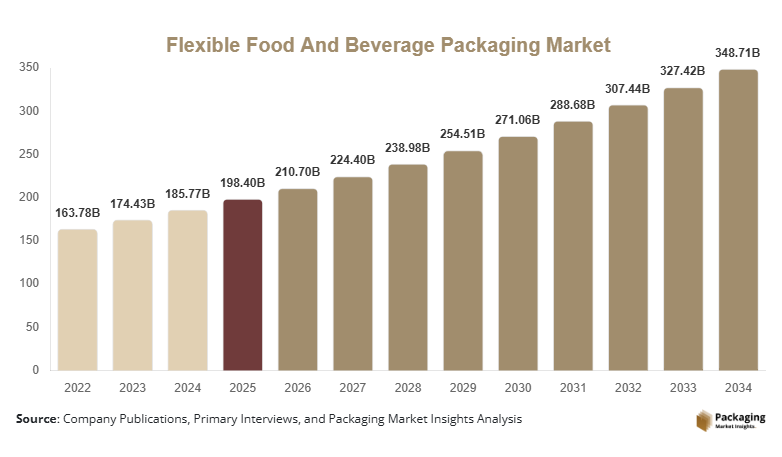
The global flexible food and beverage packaging market size was estimated at approximately USD 198.4 billion in 2025 and is expected to reach USD 210.7 billion in 2026. By 2034, the market is projected to attain nearly USD 348.6 billion, registering a CAGR of 6.5% during 2025–2034. Flexible food and beverage packaging includes pouches, bags, wraps, sachets, films, and flexible containers designed to provide product protection, convenience, and cost-efficient transportation for food and beverage applications. The flexible food and beverage packaging market is witnessing strong growth due to rising demand for lightweight packaging solutions, increasing consumption of packaged food products, and expanding adoption of sustainable packaging materials across the food and beverage industry.
One of the major growth factors driving the market is the increasing demand for convenience food and ready-to-drink beverages. Consumers are increasingly preferring portable and easy-to-use packaging formats that support busy lifestyles and on-the-go consumption. Another key growth factor is the rapid expansion of e-commerce grocery and food delivery services, which require durable and lightweight packaging solutions for safe product transportation. Flexible packaging materials reduce logistics costs and improve storage efficiency compared to rigid packaging formats, supporting their widespread adoption among manufacturers and retailers.
Key Highlights
- Asia Pacific dominated the market with a 39.8% share in 2025.
- Latin America is projected to grow at the fastest CAGR of 7.2%.
- Plastic-based flexible packaging led the material segment with a 61.4% share.
- Pouches dominated the packaging type segment with a 34.7% share.
- Food applications led the market with 68.9% share.
- The US remained the dominant country with a market size of USD 36.4 billion in 2025 and USD 38.7 billion in 2026.
Explore more data points, trends and opportunities Download Free Sample Report
Market Trends
Increasing Adoption of Sustainable Flexible Packaging
Sustainability has become one of the major trends shaping the flexible food and beverage packaging market. Food and beverage manufacturers are increasingly adopting recyclable mono-material packaging structures, compostable films, and bio-based polymers to reduce environmental impact. Consumers are showing stronger preference for packaging solutions that generate lower plastic waste and support circular economy initiatives. Packaging companies are investing in lightweight materials that reduce carbon emissions associated with transportation and raw material usage. Governments and regulatory agencies are also introducing stricter packaging waste management policies, encouraging manufacturers to accelerate adoption of sustainable flexible packaging technologies across food and beverage applications.
Growth of Smart and Resealable Packaging Solutions
The growing demand for convenience-oriented packaging is driving adoption of smart and resealable flexible packaging formats. Consumers increasingly prefer packaging that improves freshness retention, portion control, and product usability. Manufacturers are introducing resealable zippers, easy-tear openings, and microwave-compatible pouches for snacks, frozen foods, and ready-to-eat meals. Smart packaging technologies such as QR codes and freshness indicators are also gaining popularity in premium food and beverage categories. These innovations improve consumer engagement and enhance product traceability. Additionally, resealable packaging reduces food waste by maintaining product quality after opening, supporting stronger demand across retail and household applications.
Market Drivers
Rising Demand for Packaged and Convenience Foods
The increasing global consumption of packaged and convenience foods is one of the primary drivers supporting the flexible food and beverage packaging market. Urbanization, changing dietary habits, and fast-paced lifestyles are encouraging consumers to purchase ready-to-eat meals, frozen foods, packaged snacks, and instant beverages. Flexible packaging solutions provide portability, extended shelf life, and improved storage efficiency, making them suitable for convenience-oriented food products. Food manufacturers are increasingly shifting toward lightweight packaging formats that reduce logistics costs while maintaining product quality. The expansion of modern retail channels and online grocery platforms is also supporting continued demand for flexible packaging materials worldwide.
Expansion of E-Commerce Food Delivery Services
The rapid growth of e-commerce food delivery and online grocery platforms is another major factor driving market growth. Flexible packaging solutions are widely used because they provide durability, lightweight performance, and efficient product protection during transportation. Online food retailers and delivery service providers require packaging formats that reduce shipping costs while minimizing product damage risks. Flexible pouches, films, and wraps are increasingly used for packaged foods, beverages, dairy products, and frozen meals within e-commerce distribution systems. The expansion of digital retail channels and changing consumer purchasing behavior are expected to continue supporting strong demand for flexible food and beverage packaging products.
Market Restraint
Volatility in Raw Material Prices and Recycling Challenges
One of the major restraints affecting the flexible food and beverage packaging market is the volatility in raw material prices, particularly petroleum-based polymers such as polyethylene and polypropylene. Fluctuations in crude oil prices can significantly influence production costs for packaging manufacturers, creating pricing uncertainty and margin pressure across the supply chain. Small and medium-sized packaging companies may face operational challenges when raw material costs rise sharply. Additionally, supply chain disruptions and geopolitical factors can further impact raw material availability and procurement costs.
Recycling challenges associated with multilayer flexible packaging structures also limit market growth. Many flexible packaging products combine different materials such as plastic films, aluminum layers, and adhesives to improve barrier protection and durability. However, separating these materials during recycling can be technically difficult and costly. For example, multilayer snack pouches and beverage sachets often require specialized recycling infrastructure that may not be widely available in developing regions. Environmental concerns regarding plastic waste management and landfill accumulation are encouraging regulatory scrutiny of flexible packaging materials. These factors may create compliance challenges and increase investment requirements for packaging manufacturers seeking sustainable alternatives.
Market Opportunities
Expansion of Bio-Based and Compostable Packaging Materials
The development of bio-based and compostable flexible packaging materials is creating significant growth opportunities for market participants. Packaging manufacturers are investing in renewable feedstock materials such as starch blends, cellulose films, and plant-based polymers to address environmental concerns and changing consumer preferences. Food and beverage companies are increasingly adopting compostable packaging formats for organic foods, snacks, and sustainable beverage products. Governments are also supporting adoption of eco-friendly packaging materials through regulatory incentives and plastic reduction initiatives. Continuous innovation in barrier performance and compostability standards is expected to accelerate growth within this segment over the forecast period.
Rising Demand for Premium and Customized Packaging
Increasing demand for premium food and beverage products is creating opportunities for customized flexible packaging solutions. Consumers are increasingly influenced by product appearance, convenience, and branding when making purchasing decisions. Packaging companies are introducing advanced digital printing technologies, matte finishes, transparent windows, and personalized packaging designs to improve shelf appeal and brand differentiation. Premium packaging formats are particularly gaining popularity in gourmet snacks, specialty beverages, and health-focused food categories. Additionally, brands are using customized flexible packaging to improve consumer engagement and support targeted marketing strategies across retail and online sales channels.
Report Scope
| Report Metric | Details |
|---|---|
| Market Size in 2025 | USD 198.4 Billion |
| Market Size in 2026 | USD 210.7 Billion |
| Market Size in 2034 | USD 348.6 Billion |
| CAGR | 6.5% (2026-2034) |
| Base Year for Estimation | 2025 |
| Historical Data | 2022-2024 |
| Forecast Period | 2026-2034 |
| Report Coverage | Revenue Forecast, Competitive Landscape, Supply Chain Disruption, Growth Factors, Environment & Regulatory Landscape and Trends |
| Geographies Covered | North America, Europe, APAC, Middle East and Africa, LATAM |
| Countries Covered | U.S., Canada, U.K., Germany, France, Spain, Italy, Russia, Nordic, Benelux, Rest of Europe, China, South Korea, Japan, India, Australia, Singapore, Taiwan, South East Asia, Rest of Asia-Pacific, UAE, Turky, Saudi Arabia, South Africa, Egypt, Nigeria, Rest of MEA, Brazil, Mexico, Argentina, Chile, Colombia, Rest of LATAM |
Explore more data points, trends and opportunities Download Free Sample Report
Segmental Analysis
By Material
Plastic-based flexible packaging dominated the flexible food and beverage packaging market in 2024 and accounted for approximately 61.4% of the global market share. Plastic materials such as polyethylene, polypropylene, and polyethylene terephthalate are widely used because they provide durability, flexibility, moisture resistance, and cost efficiency. Food and beverage manufacturers prefer plastic-based packaging for snacks, frozen foods, dairy products, and beverages due to its strong barrier performance and lightweight characteristics. The segment benefits from increasing packaged food consumption and rapid adoption of pouches and wraps across retail applications. Advancements in recyclable plastic films and mono-material packaging structures are also supporting continued demand within the segment.
Bio-based materials are projected to be the fastest-growing subsegment, registering a CAGR of 7.8% during the forecast period. Packaging companies are increasingly investing in renewable and compostable materials derived from plant-based feedstocks to address sustainability concerns. Bio-based films and flexible packaging structures are gaining popularity among organic food brands and environmentally conscious consumers. Governments and environmental agencies are promoting adoption of sustainable packaging materials through plastic waste reduction initiatives and regulatory frameworks. Continuous innovation in compostable barrier technologies and biodegradable polymers is expected to support strong growth within the segment globally.
By Packaging Type
Pouches represented the dominant packaging type segment in 2024 and captured approximately 34.7% of the total market share. Flexible pouches are widely used for snacks, sauces, beverages, dairy products, frozen foods, and pet food because they provide portability, product protection, and efficient shelf utilization. Food manufacturers increasingly prefer pouch packaging because it reduces material usage and transportation costs compared to rigid containers. Pouches also support high-quality graphics and branding customization, improving product visibility in retail environments. Rising consumer preference for lightweight and resealable packaging formats continues to strengthen demand for pouches across food and beverage applications globally.
Stand-up pouches are anticipated to witness the fastest growth, expanding at a CAGR of 7.5% during the forecast period. These packaging formats are increasingly popular because they offer stability, convenience, and strong shelf presence. Beverage companies and snack manufacturers are adopting stand-up pouches for ready-to-drink beverages, nutritional products, and liquid foods due to their portability and resealable functionality. Consumers prefer stand-up pouches because they are easy to store and reduce food waste through freshness retention features. Continuous innovation in spout designs, zipper closures, and high-barrier materials is expected to support segment expansion.
By Application
Food applications dominated the market in 2024 with a share of approximately 68.9%. Flexible packaging is extensively used for packaged snacks, frozen foods, bakery products, confectionery items, dairy products, and ready-to-eat meals because it provides extended shelf life and efficient product protection. Food manufacturers increasingly prefer flexible packaging because it reduces logistics costs and supports convenient product storage. The growth of processed food consumption and expansion of retail distribution channels continue to support strong demand within this segment. Additionally, innovations in microwave-compatible and resealable packaging formats are improving functionality and consumer convenience.
Beverage applications are expected to grow at the fastest CAGR of 7.1% during the forecast period. Flexible beverage packaging formats such as pouches and sachets are gaining popularity for juices, flavored milk, sports drinks, and ready-to-drink coffee products. Beverage companies are increasingly adopting lightweight packaging solutions to reduce transportation costs and improve sustainability performance. Flexible beverage packaging also supports portion control and portable consumption trends among urban consumers. Rising demand for on-the-go beverages and expanding beverage product innovation are expected to create substantial opportunities for packaging manufacturers over the forecast period.
Flexible Food And Beverage Packaging Market Segmentations
By Material
- Plastic
- Paper
- Aluminum Foil
- Bio-Based Materials
By Packaging Type
- Pouches
- Bags
- Wraps and Films
- Sachets
By Application
- Food
- Beverages
- Dairy Products
- Frozen and Ready-to-Eat Foods
Regional Analysis
North America
North America accounted for approximately 26.4% of the global flexible food and beverage packaging market share in 2025 and is expected to grow at a CAGR of 5.8% during the forecast period. The region benefits from strong packaged food consumption, advanced food processing infrastructure, and increasing adoption of sustainable packaging solutions. Food manufacturers and retailers are increasingly using flexible packaging formats to improve transportation efficiency and reduce material usage. The expansion of online grocery shopping and demand for convenience foods are also contributing to market growth across the United States and Canada.
The United States dominates the North American market because of its large packaged food industry and high consumer demand for convenience-oriented products. One unique growth factor is the increasing use of microwave-compatible flexible packaging for ready-to-eat meals and frozen foods. Consumers are seeking packaging formats that support quick meal preparation and portion convenience, encouraging food manufacturers to invest in advanced flexible packaging technologies.
Europe
Europe represented approximately 28.1% of the market share in 2025 and is projected to expand at a CAGR of 5.9% during the forecast period. Sustainability regulations and increasing consumer awareness regarding packaging waste are major factors influencing market growth in the region. Packaging companies are introducing recyclable mono-material films and compostable pouches to comply with environmental standards. The region also benefits from strong demand for packaged dairy products, snacks, and premium beverage packaging solutions. Technological innovation in printing and barrier materials continues to support market expansion.
Germany remains the dominant country within the European market due to its advanced packaging manufacturing industry and strong food processing sector. One unique growth factor is the increasing adoption of recyclable flexible packaging among private-label food brands. Retailers are focusing on sustainable packaging initiatives to strengthen brand image and comply with evolving environmental policies. This trend is supporting demand for eco-friendly packaging solutions across the country.
Asia Pacific
Asia Pacific dominated the global market with a 39.8% share in 2025 and is projected to register a CAGR of 6.9% during the forecast period. Rapid urbanization, population growth, and increasing packaged food consumption are major contributors to regional market expansion. Food and beverage manufacturers are increasingly adopting flexible packaging because of its affordability, lightweight structure, and efficient product preservation capabilities. Rising disposable income levels and expanding retail distribution networks are also supporting market demand across emerging economies in the region.
China dominates the Asia Pacific market because of its large food manufacturing industry and expanding e-commerce grocery sector. One unique growth factor is the increasing consumption of packaged snacks and ready-to-drink beverages among urban consumers. Food companies are using flexible packaging formats to improve product portability and shelf appeal while reducing logistics costs. This trend continues to strengthen regional market growth.
Middle East & Africa
The Middle East & Africa region accounted for approximately 3.7% of the global market share in 2025 and is expected to grow at a CAGR of 6.3% during the forecast period. Rising urbanization, increasing retail modernization, and growing packaged food imports are supporting demand for flexible packaging solutions across the region. Flexible packaging formats are particularly popular because they provide cost-efficient transportation and extended shelf stability in regions with warm climatic conditions. Beverage manufacturers are also increasingly using lightweight packaging materials to improve operational efficiency.
Saudi Arabia dominates the regional market due to its expanding food processing industry and increasing demand for packaged dairy products and snacks. One unique growth factor is the growing popularity of flexible pouches for flavored milk and juice packaging among younger consumers. Manufacturers are investing in modern packaging technologies to improve convenience and product accessibility across supermarkets and retail stores.
Latin America
Latin America represented approximately 2.0% of the global market share in 2025 and is projected to grow at the fastest CAGR of 7.2% during the forecast period. Rising consumption of packaged foods, expansion of retail infrastructure, and increasing urban population are major drivers supporting market growth. Food manufacturers are increasingly adopting flexible packaging because it provides affordability, lightweight transportation, and efficient storage capabilities. The growth of regional snack and beverage industries is also contributing to increasing demand for flexible packaging products.
Brazil remains the dominant country within the Latin American market because of its strong food processing industry and growing packaged beverage sector. One unique growth factor is the increasing export of packaged coffee and fruit-based snack products using flexible packaging formats. Manufacturers are focusing on lightweight packaging solutions to reduce shipping costs and improve product shelf life for international distribution.
Competitive Landscape
The flexible food and beverage packaging market is highly competitive, with major packaging manufacturers focusing on sustainability innovation, lightweight materials, and advanced barrier technologies. Companies are investing in recyclable films, compostable packaging materials, and digital printing solutions to strengthen market position and meet changing consumer preferences. Strategic partnerships with food and beverage manufacturers are also increasing across the industry.
Amcor plc remains one of the leading participants in the market due to its extensive flexible packaging portfolio and global manufacturing network. In 2024, the company introduced a recyclable high-barrier pouch solution designed for snack and frozen food applications. Other key companies operating in the market include Sealed Air Corporation, Mondi Group, Berry Global Inc., and Huhtamaki Oyj. These companies are focusing on sustainable packaging development, production capacity expansion, and advanced printing technologies to address rising global demand for flexible food and beverage packaging solutions.
Key Players List
- Amcor plc
- Sealed Air Corporation
- Mondi Group
- Berry Global Inc.
- Huhtamaki Oyj
- Sonoco Products Company
- Coveris Holdings S.A.
- Constantia Flexibles
- ProAmpac LLC
- UFlex Limited
- Winpak Ltd.
- Clondalkin Group
- Smurfit Kappa Group
- DS Smith Plc
- Glenroy Inc.
- TC Transcontinental Inc.
- Novolex Holdings LLC