Filling and Sealing Machines Market Size and Growth
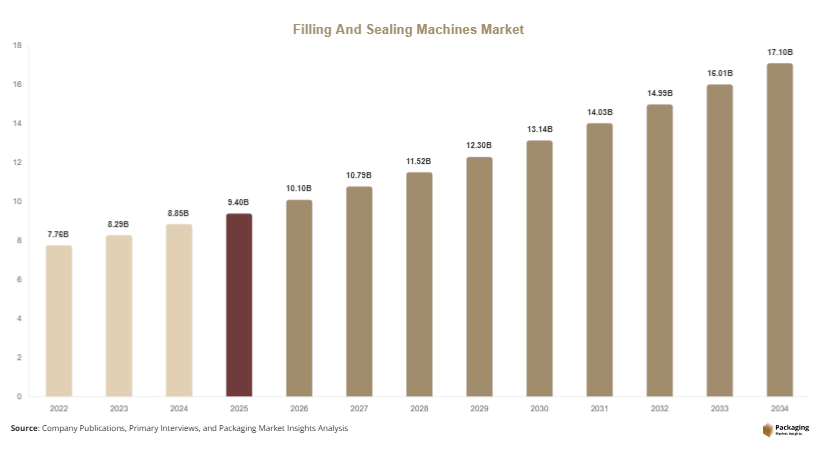
The global filling and sealing machines market size was estimated at USD 9.4 billion in 2025 and is projected to reach USD 10.1 billion in 2026. Over the forecast period from 2025 to 2034, the market is expected to expand at a compound annual growth rate (CAGR) of 6.8%, reaching approximately USD 17.8 billion by 2034. Market growth is supported by the increasing need for high-speed packaging lines, improved precision in filling operations, and stricter regulatory requirements related to product hygiene and safety.
The filling and sealing machines market is experiencing steady expansion as manufacturing industries continue to automate packaging operations. These machines are widely used across food and beverage, pharmaceutical, cosmetics, and chemical industries to accurately fill products into containers and seal them for storage, transportation, and retail distribution. Growing emphasis on product safety, improved packaging efficiency, and operational cost reduction is encouraging manufacturers to adopt automated filling and sealing technologies.
Key Highlights
- The Filling And Sealing Machines Market was valued at USD 9.4 billion in 2025 and is projected to reach USD 17.8 billion by 2034, growing at a CAGR of 6.8% during 2025–2034.
- The food and beverage industry remains the largest end-use segment, driven by rising demand for packaged and ready-to-consume products.
- Increasing automation and adoption of smart packaging technologies are significantly shaping market growth and improving production efficiency.
Explore more data points, trends and opportunities Download Free Sample Report
Market Trends
Integration of Smart Automation in Packaging Lines
One of the major trends influencing the filling and sealing machines market is the integration of smart automation and digital monitoring technologies. Manufacturers are increasingly implementing advanced automation systems that allow filling and sealing machines to operate with minimal human intervention. Modern machines are equipped with programmable logic controllers, sensors, and machine vision systems that monitor product levels, detect sealing defects, and ensure consistent packaging quality.
The use of industrial connectivity and data analytics is also improving operational efficiency. Smart machines collect production data in real time, allowing operators to track performance, identify maintenance needs, and optimize production schedules. This trend is particularly strong in large-scale food processing and pharmaceutical manufacturing facilities where high production volumes demand reliable and precise packaging solutions.
Growing Demand for Flexible and Multi-Product Packaging Systems
Another significant trend in the filling and sealing machines market is the increasing demand for flexible packaging systems capable of handling multiple product types and packaging formats. Manufacturers are shifting toward versatile machines that can quickly switch between different container sizes, materials, and product viscosities.
This trend is driven by changing consumer preferences and shorter product life cycles. Companies frequently launch new product variants, seasonal offerings, and customized packaging formats. As a result, packaging equipment must adapt quickly without lengthy downtime. Filling and sealing machines that support quick format changes and modular design are gaining attention, especially among small and medium-sized manufacturers seeking efficient and adaptable production lines.
Market Drivers
Expansion of the Packaged Food and Beverage Industry
The rapid expansion of the packaged food and beverage sector is a major driver for the filling and sealing machines market. Urbanization, changing consumer lifestyles, and rising disposable income have increased the consumption of packaged food products. Consumers are purchasing ready meals, dairy products, beverages, sauces, and snack foods that require reliable filling and sealing processes.
Food manufacturers are investing in automated packaging equipment to maintain product freshness and meet high production demands. Filling and sealing machines allow precise portioning and airtight sealing, which helps extend shelf life and reduce product waste. As food safety regulations continue to evolve, manufacturers are adopting advanced packaging machinery that meets hygiene standards and supports efficient mass production.
Rising Pharmaceutical Production and Sterile Packaging Requirements
Another key driver for the filling and sealing machines market is the expansion of global pharmaceutical production. Pharmaceutical companies require highly specialized filling and sealing equipment to package liquids, powders, and injectable medications in sterile environments.
Regulatory authorities enforce strict guidelines regarding dosage accuracy and contamination prevention. Filling and sealing machines equipped with sterile filling technology and automated sealing mechanisms help pharmaceutical manufacturers meet these standards. The growth of biologics, vaccines, and injectable drugs is also increasing the demand for advanced aseptic filling systems. As pharmaceutical production capacity expands worldwide, the need for reliable packaging machinery continues to rise.
Market Restraint
High Initial Investment and Maintenance Costs
Despite the steady growth of the filling and sealing machines market, high capital investment remains a significant restraint for many manufacturers. Advanced filling and sealing machines incorporate automation technology, precision sensors, and high-speed components that increase equipment costs. Small and medium-sized companies often face financial limitations when upgrading their packaging lines with modern machinery.
In addition to the initial purchase cost, maintenance and operational expenses can also be substantial. Automated machines require regular calibration, replacement of mechanical components, and periodic software updates. Skilled technicians are often needed to maintain complex packaging systems, which increases operational expenses.
For example, pharmaceutical-grade aseptic filling machines involve highly controlled environments and sterilization systems that significantly increase equipment and installation costs. Companies operating in emerging markets may delay automation investments due to these financial constraints. As a result, some manufacturers continue to rely on semi-automatic packaging equipment, which slows the adoption rate of fully automated filling and sealing machines across certain industries.
Market Opportunities
Growing Demand for Sustainable Packaging Solutions
Sustainability initiatives are creating new opportunities in the filling and sealing machines market. Governments and consumers are encouraging manufacturers to reduce plastic waste and adopt environmentally friendly packaging materials. As a result, packaging companies are experimenting with biodegradable containers, recyclable materials, and lightweight packaging designs.
Filling and sealing machine manufacturers are developing equipment capable of handling these alternative materials without compromising packaging integrity. Machines designed to work with compostable films, paper-based containers, and recyclable polymers are gaining traction among food and beverage producers. Companies that invest in equipment compatible with sustainable packaging formats are likely to benefit from the growing shift toward environmentally responsible production practices.
Rapid Industrialization in Emerging Economies
Another important opportunity in the filling and sealing machines market lies in the rapid industrialization of emerging economies. Countries in Asia, Latin America, and parts of Africa are witnessing strong growth in manufacturing sectors such as food processing, pharmaceuticals, and consumer goods.
As these industries expand, companies are establishing modern production facilities that require automated packaging solutions. Governments are also promoting industrial development through favorable policies and infrastructure investments. This environment is encouraging manufacturers to adopt advanced filling and sealing machines to improve productivity and meet international packaging standards. As emerging markets continue to industrialize, equipment suppliers have significant opportunities to expand their global presence.
Report Scope
| Report Metric | Details |
|---|---|
| Market Size in 2025 | USD 9.4 Billion |
| Market Size in 2026 | USD 10.1 Billion |
| Market Size in 2034 | USD 17.8 Billion |
| CAGR | 6.8% (2026-2034) |
| Base Year for Estimation | 2025 |
| Historical Data | 2022-2024 |
| Forecast Period | 2026-2034 |
| Report Coverage | Revenue Forecast, Competitive Landscape, Supply Chain Disruption, Growth Factors, Environment & Regulatory Landscape and Trends |
| Geographies Covered | North America, Europe, APAC, Middle East and Africa, LATAM |
| Countries Covered | U.S., Canada, U.K., Germany, France, Spain, Italy, Russia, Nordic, Benelux, Rest of Europe, China, South Korea, Japan, India, Australia, Singapore, Taiwan, South East Asia, Rest of Asia-Pacific, UAE, Turky, Saudi Arabia, South Africa, Egypt, Nigeria, Rest of MEA, Brazil, Mexico, Argentina, Chile, Colombia, Rest of LATAM |
Explore more data points, trends and opportunities Download Free Sample Report
Segmental Analysis
By Type
The automatic filling and sealing machines segment dominated the filling and sealing machines market, accounting for approximately 58% of the market share in 2024. These machines are widely used in large-scale production facilities because they offer high-speed operation, consistent product filling, and reduced labor dependency. Automatic systems integrate advanced sensors, programmable controls, and robotic components that enable manufacturers to achieve precise filling levels and reliable sealing performance.
Large food processing companies and pharmaceutical manufacturers rely heavily on automatic machines to maintain production efficiency and meet strict hygiene standards. These machines are capable of handling multiple packaging formats and operating continuously with minimal human supervision. The ability to integrate automatic filling and sealing machines with other packaging line equipment further enhances their adoption across industries requiring large production volumes.
The semi-automatic filling and sealing machines segment is expected to witness the fastest growth with a CAGR of approximately 7.2% during the forecast period. These machines are gaining popularity among small and medium-sized manufacturers that require cost-effective packaging solutions while maintaining operational flexibility.
Semi-automatic machines provide a balance between manual and fully automated processes. They require some operator involvement but still offer improved accuracy and efficiency compared to manual filling methods. Growing numbers of small food processing businesses and emerging pharmaceutical manufacturers are adopting semi-automatic machines as an intermediate step toward full automation.
By Application
The liquid filling and sealing segment held the largest market share of about 46% in 2024. This segment includes packaging applications for beverages, dairy products, sauces, pharmaceutical liquids, and chemical solutions. Liquid products require precise filling volumes and leak-proof sealing to maintain product integrity during transportation and storage.
Manufacturers rely on specialized filling technologies such as gravity filling, piston filling, and vacuum filling to ensure accurate liquid packaging. The increasing demand for bottled beverages, dairy products, and pharmaceutical syrups continues to support the dominance of this segment. Advanced liquid filling machines also incorporate anti-drip nozzles and automated cleaning systems that enhance hygiene and operational efficiency.
The powder filling and sealing segment is projected to grow at the fastest CAGR of around 7.5% during the forecast period. Powder packaging is widely used for products such as protein supplements, pharmaceutical powders, spices, and instant beverages. Accurate measurement is critical in powder packaging because even small variations can affect product quality.
Modern powder filling machines utilize auger-based systems that allow precise dosing of powder materials. Growth in nutritional supplements, pharmaceutical powders, and packaged food ingredients is increasing demand for specialized powder filling solutions. As consumer health products gain popularity, manufacturers are expanding their powder packaging capacity.
By End-Use Industry
The food and beverage industry segment accounted for the largest share of the filling and sealing machines market at approximately 52% in 2024. Food manufacturers rely heavily on automated packaging equipment to process high production volumes while maintaining product safety and freshness. Filling and sealing machines are widely used for packaging beverages, sauces, dairy products, snacks, and ready-to-eat meals.
Food companies are continuously expanding their product portfolios and launching new packaging formats to attract consumers. This trend requires flexible packaging machinery capable of handling multiple container types and sizes. Automated filling and sealing machines help manufacturers maintain consistent packaging quality while meeting strict food safety regulations.
The pharmaceutical industry segment is expected to register the fastest growth with a CAGR of about 7.9% during the forecast period. Pharmaceutical packaging requires precise filling, sterile conditions, and tamper-proof sealing. As pharmaceutical production increases globally, companies are investing in advanced packaging equipment that ensures dosage accuracy and prevents contamination.
The growth of injectable medications, biologics, and vaccines is particularly driving demand for specialized filling machines. Pharmaceutical manufacturers are expanding their production capacity and upgrading packaging infrastructure to meet regulatory standards and global demand for medical products.
Filling And Sealing Machines Market Segmentations
Type
- Automatic Filling and Sealing Machines
- Semi-Automatic Filling and Sealing Machines
Application
- Liquid Filling
- Powder Filling
- Granule Filling
End-Use Industry
- Food and Beverage
- Pharmaceutical
- Cosmetics and Personal Care
- Chemical Industry
Regional Analysis
North America
North America accounted for approximately 29% of the global filling and sealing machines market share in 2025. The region is expected to grow at a CAGR of around 6.2% during the forecast period. Market growth is supported by the presence of established food processing companies and pharmaceutical manufacturers that require automated packaging systems. Companies in the region continue to invest in advanced packaging equipment to improve efficiency, reduce labor costs, and maintain strict product quality standards.
The United States dominates the regional market due to its extensive manufacturing infrastructure and strong pharmaceutical industry. One of the key growth factors in the country is the rising demand for sterile pharmaceutical packaging solutions. Biopharmaceutical companies are increasing production of injectable drugs and vaccines, which require precise filling and sealing processes. This trend is encouraging pharmaceutical manufacturers to invest in high-performance automated packaging machinery.
Europe
Europe held nearly 25% of the filling and sealing machines market share in 2025 and is projected to expand at a CAGR of approximately 6.0% between 2025 and 2034. The region’s market growth is supported by strict regulatory standards for food safety and pharmaceutical packaging. Manufacturers are adopting advanced packaging machinery that ensures compliance with hygiene regulations while maintaining high production efficiency.
Germany represents the leading market within Europe due to its strong industrial machinery manufacturing sector. A major growth factor in the country is the presence of advanced engineering companies that develop innovative packaging equipment. German manufacturers are focusing on energy-efficient machines and modular designs that allow flexible packaging operations across multiple industries.
Asia Pacific
Asia Pacific represented the largest share of the filling and sealing machines market at around 34% in 2025. The region is expected to record the highest CAGR of about 7.8% during the forecast period. Rapid industrialization, increasing consumer demand for packaged goods, and expanding pharmaceutical production are contributing to strong market growth.
China dominates the Asia Pacific market due to its extensive manufacturing base and large food processing industry. One major growth factor is the expansion of domestic consumer goods production. Manufacturers are increasing investment in automated packaging machinery to support large-scale production and improve packaging efficiency. As consumer demand for packaged products continues to grow, China remains a major contributor to regional market expansion.
Middle East & Africa
The Middle East & Africa accounted for approximately 6% of the filling and sealing machines market share in 2025. The market is expected to grow at a CAGR of around 6.5% during the forecast period. Growth in the region is driven by expanding food processing industries and rising demand for packaged consumer goods.
The United Arab Emirates leads the regional market due to its growing food processing and logistics sectors. A unique growth factor in the country is the expansion of food import and packaging operations. Companies import bulk food products and package them locally for distribution across the Middle East, increasing the demand for automated filling and sealing machines.
Latin America
Latin America captured roughly 6% of the global filling and sealing machines market share in 2025 and is projected to grow at a CAGR of 6.6% during the forecast period. The region is experiencing increasing demand for packaged food products and beverages, which is driving the adoption of automated packaging equipment.
Brazil represents the dominant market in Latin America. One key growth factor is the rapid expansion of the country’s food processing sector. Brazilian manufacturers are investing in modern production facilities that require efficient packaging systems to maintain product quality and meet export standards. As the food industry grows, the demand for filling and sealing machines continues to increase.
Competitive Landscape
The filling and sealing machines market is moderately competitive, with several international and regional manufacturers offering advanced packaging solutions. Companies compete by focusing on product innovation, automation technology, and customization capabilities. Manufacturers are also expanding their global distribution networks to serve growing demand from emerging markets.
Leading companies are investing in research and development to design high-speed filling machines with improved accuracy and reduced energy consumption. Automation, robotics, and digital monitoring systems are becoming key differentiators in the market. Many equipment manufacturers also offer integrated packaging solutions that combine filling, sealing, labeling, and inspection functions.
One of the market leaders is Tetra Pak, known for its advanced food packaging and processing solutions. The company recently introduced upgraded filling systems designed for sustainable packaging materials. Other major companies continue to focus on expanding their product portfolios and strengthening partnerships with food and pharmaceutical manufacturers.
Key Players List
- Tetra Pak
- Bosch Packaging Technology
- Krones AG
- IMA Group
- ProMach Inc.
- Coesia Group
- Serac Group
- Accutek Packaging Equipment
- KHS Group
- GEA Group
- JBT Corporation
- Ronchi Mario S.p.A.
- Nichrome India Ltd.
- Barry-Wehmiller Companies
- Viking Masek Global Packaging Technologies