Fiberboard Packaging Market Size and Growth
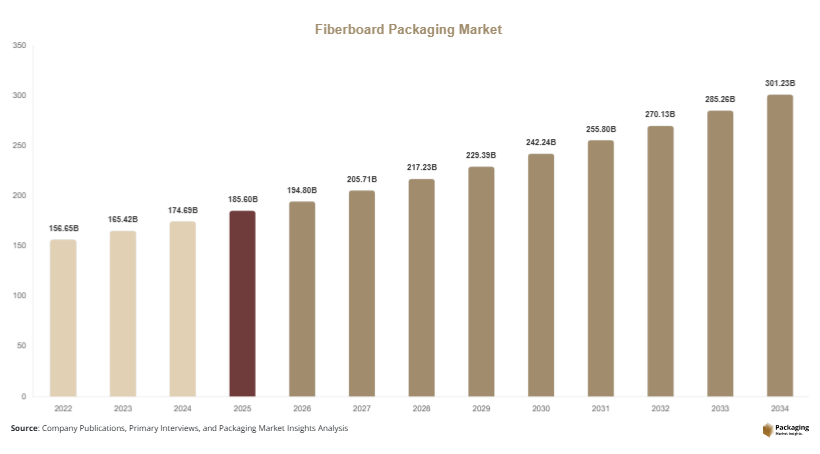
The global fiberboard packaging market size was valued at approximately USD 185.6 billion in 2025 and is projected to reach USD 194.8 billion in 2026. Over the forecast period from 2025 to 2034, the market is expected to expand at a CAGR of 5.6%, reaching nearly USD 315.7 billion by 2034. The increasing shift toward environmentally responsible packaging materials is playing a central role in driving market expansion. The fiberboard packaging market is experiencing consistent growth, supported by rising demand for sustainable packaging solutions across industries such as food and beverage, consumer goods, and e-commerce.
One of the key growth factors is the global emphasis on reducing plastic waste. Governments and regulatory bodies are promoting the use of recyclable and biodegradable materials, encouraging industries to adopt fiberboard-based packaging solutions. Another important factor is the rapid growth of the e-commerce sector, which relies heavily on durable and lightweight packaging materials for shipping and logistics. Fiberboard packaging offers strength, cushioning, and cost efficiency, making it suitable for protecting goods during transportation. Additionally, the rising demand for packaged food and beverages is contributing significantly to market growth, as fiberboard materials provide excellent insulation and protection.
Key Highlights:
- Asia Pacific dominated the market with a 39.2% share in 2025, while Latin America is projected to grow at the fastest CAGR of 6.3%.
- Corrugated fiberboard led the type segment with a 61.5% share, while molded fiberboard is expected to grow at a CAGR of 6.7%.
- Industrial packaging dominated with a 47.8% share, while retail packaging is forecasted to grow at a CAGR of 5.9%.
- Food & beverage applications led the segment with 44.6% share, while electronics packaging is expected to grow at a CAGR of 6.2%.
- China remained the dominant country with a market size of USD 32.4 billion in 2025 and USD 34.1 billion in 2026.
Explore more data points, trends and opportunities Download Free Sample Report
Market Trends
Increasing Adoption of Circular Economy Practices
The fiberboard packaging market is increasingly influenced by circular economy principles, where materials are reused, recycled, and reintegrated into production cycles. Companies are focusing on designing packaging that can be easily recycled without compromising strength or durability. This approach not only reduces environmental impact but also lowers raw material dependency. Fiberboard packaging is inherently recyclable, making it a preferred choice for companies aiming to align with sustainability goals. The integration of recycled fibers into manufacturing processes is gaining traction, enabling cost efficiency while maintaining product performance. This trend is expected to shape long-term industry dynamics and encourage innovation in material design.
Growth of Lightweight and High-Strength Packaging Solutions
Another significant trend is the development of lightweight yet high-strength fiberboard packaging solutions. Manufacturers are optimizing material composition and structural design to reduce weight while maintaining load-bearing capacity. This innovation helps reduce transportation costs and carbon emissions, making it attractive for industries such as e-commerce and logistics. Advanced production technologies are enabling the creation of customized packaging solutions tailored to specific product requirements. As businesses seek efficient and cost-effective packaging options, the demand for lightweight fiberboard solutions is expected to grow steadily across global markets.
Market Drivers
Expansion of E-Commerce and Logistics Industry
The rapid expansion of the e-commerce sector is a major driver for the fiberboard packaging market. Online retail platforms require reliable packaging solutions to ensure product safety during transit. Fiberboard packaging offers durability, cushioning, and adaptability, making it suitable for a wide range of products. The increasing volume of online orders is driving demand for corrugated boxes and protective packaging materials. Additionally, the growth of global trade and logistics networks is further supporting market expansion, as companies seek efficient packaging solutions for international shipping.
Rising Demand for Sustainable Packaging Solutions
The growing emphasis on sustainability is significantly influencing the fiberboard packaging market. Consumers and businesses are increasingly prioritizing environmentally friendly packaging materials that reduce carbon footprint. Fiberboard packaging is biodegradable and recyclable, making it an ideal alternative to plastic packaging. Governments are also implementing regulations to promote the use of sustainable materials, encouraging industries to transition toward fiber-based packaging solutions. This shift is expected to drive long-term growth and create new opportunities for manufacturers.
Market Restraint
Fluctuating Raw Material Prices and Supply Chain Challenges
The fiberboard packaging market faces challenges due to fluctuations in raw material prices, particularly wood pulp and recycled paper. These materials are subject to supply-demand imbalances, environmental regulations, and geopolitical factors, which can impact production costs. Manufacturers often face difficulties in maintaining consistent pricing and supply, affecting profitability and operational efficiency. For example, disruptions in pulp supply can lead to increased costs for corrugated fiberboard production, forcing companies to adjust pricing strategies. Additionally, transportation and logistics challenges can further complicate supply chain management, limiting market growth.
Market Opportunities
Innovation in Coated and Moisture-Resistant Fiberboard
The development of coated and moisture-resistant fiberboard packaging presents significant opportunities for market growth. These innovations enhance the durability and functionality of fiberboard materials, making them suitable for a wider range of applications, including food and beverage packaging. Advanced coatings provide resistance to moisture, grease, and temperature variations, improving product protection. As industries seek versatile packaging solutions, the adoption of enhanced fiberboard materials is expected to increase.
Growth in Emerging Markets and Industrialization
Emerging economies are offering substantial growth opportunities for the fiberboard packaging market. Rapid industrialization, urbanization, and increasing consumer spending are driving demand for packaged goods. The expansion of manufacturing and retail sectors in these regions is creating a need for efficient and cost-effective packaging solutions. Companies can capitalize on these opportunities by establishing local production facilities and adapting their products to regional requirements. This strategy can improve market penetration and support long-term growth.
Report Scope
| Report Metric | Details |
|---|---|
| Market Size in 2025 | USD 185.6 Billion |
| Market Size in 2026 | USD 194.8 Billion |
| Market Size in 2034 | USD 315.7 Billion |
| CAGR | 5.6% (2026-2034) |
| Base Year for Estimation | 2025 |
| Historical Data | 2022-2024 |
| Forecast Period | 2026-2034 |
| Report Coverage | Revenue Forecast, Competitive Landscape, Supply Chain Disruption, Growth Factors, Environment & Regulatory Landscape and Trends |
| Geographies Covered | North America, Europe, APAC, Middle East and Africa, LATAM |
| Countries Covered | U.S., Canada, U.K., Germany, France, Spain, Italy, Russia, Nordic, Benelux, Rest of Europe, China, South Korea, Japan, India, Australia, Singapore, Taiwan, South East Asia, Rest of Asia-Pacific, UAE, Turky, Saudi Arabia, South Africa, Egypt, Nigeria, Rest of MEA, Brazil, Mexico, Argentina, Chile, Colombia, Rest of LATAM |
Explore more data points, trends and opportunities Download Free Sample Report
Segmental Analysis
Type
Corrugated fiberboard accounted for the largest share of the fiberboard packaging market in 2024, contributing approximately 61.5% of total revenue. This segment is widely used in shipping and logistics due to its strength, durability, and cost efficiency. Corrugated fiberboard provides excellent protection for goods during transportation and is suitable for a wide range of applications. Its recyclability and lightweight nature further enhance its appeal, making it a preferred choice for packaging manufacturers.
Molded fiberboard is the fastest-growing segment, expected to register a CAGR of 6.7% during the forecast period. The increasing demand for sustainable and biodegradable packaging solutions is driving the adoption of molded fiberboard. This material is commonly used for protective packaging and food containers due to its eco-friendly properties. Manufacturers are investing in advanced production technologies to improve product quality and expand applications.
Application
Industrial packaging accounted for the largest share in 2024, contributing 47.8% of the total market. This segment includes packaging solutions used in manufacturing, logistics, and transportation of goods. Fiberboard materials provide durability and cost efficiency, making them suitable for industrial applications. The growth of global trade and supply chains is further supporting demand in this segment.
Retail packaging is expected to grow at the fastest rate, with a CAGR of 5.9% over the forecast period. The increasing demand for attractive and functional packaging solutions in the retail sector is driving this segment. Fiberboard packaging offers customization options and enhances product presentation, making it a popular choice for consumer goods.
End-Use
Food & beverage applications accounted for the largest share of the market in 2024, contributing 44.6% of total revenue. The demand for packaged food products and takeaway services is driving this segment. Fiberboard packaging provides protection and insulation, ensuring product quality and safety.
Electronics packaging is the fastest-growing segment, with a projected CAGR of 6.2%. The increasing demand for electronic devices and the need for protective packaging solutions are driving this segment. Fiberboard materials offer cushioning and durability, making them suitable for transporting sensitive electronic products.
Fiberboard Packaging Market Segmentations
By Type
- Corrugated Fiberboard
- Solid Fiberboard
- Molded Fiberboard
By Application
- Industrial Packaging
- Retail Packaging
- Food Packaging
By End-User
- Food & Beverage
- Electronics
- Healthcare
- Consumer Goods
Regional Analysis
North America
North America accounted for approximately 27.8% of the fiberboard packaging market share in 2025 and is projected to grow at a CAGR of 5.1% during the forecast period. The region benefits from a well-established packaging industry and strong demand from e-commerce and retail sectors. Technological advancements and the adoption of sustainable packaging solutions are further supporting market growth across the region.
The United States dominates the North American market due to its large consumer base and advanced logistics infrastructure. A key growth factor is the increasing demand for sustainable packaging from major retailers and e-commerce companies. Businesses are investing in recyclable and biodegradable packaging solutions to meet environmental regulations and consumer expectations.
Europe
Europe held around 23.6% of the market share in 2025 and is expected to grow at a CAGR of 5.0% through 2034. The region is characterized by strict environmental regulations and a strong focus on sustainability. These factors are encouraging the adoption of fiberboard packaging across various industries.
Germany leads the European market, supported by its advanced manufacturing capabilities and strong emphasis on environmental responsibility. Circular economy initiatives are driving demand for recyclable packaging solutions, creating opportunities for manufacturers to innovate and expand their product offerings.
Asia Pacific
Asia Pacific emerged as the largest regional market, accounting for 39.2% of the global share in 2025. The region is expected to grow at a CAGR of 6.0% during the forecast period. Rapid industrialization, urbanization, and population growth are key factors driving demand for fiberboard packaging.
China dominates the Asia Pacific market due to its large manufacturing base and growing consumer market. The expansion of e-commerce and logistics industries is a major growth factor, increasing demand for durable and cost-effective packaging solutions across the region.
Middle East & Africa
The Middle East & Africa region accounted for approximately 5.4% of the market share in 2025 and is projected to grow at a CAGR of 5.4%. Increasing urbanization and industrial development are driving demand for packaging solutions in the region.
The United Arab Emirates leads the regional market, supported by a growing retail sector and strong logistics infrastructure. The demand for high-quality packaging solutions in the food and beverage industry is a key factor driving market growth.
Latin America
Latin America held a market share of around 3.9% in 2025 and is expected to grow at the fastest CAGR of 6.3% during the forecast period. The region is experiencing increased demand for packaged goods due to urbanization and changing consumer preferences.
Brazil dominates the Latin American market due to its large population and expanding industrial base. Increasing investments in local manufacturing are improving supply chain efficiency and supporting the growth of the fiberboard packaging market.
Competitive Landscape
The fiberboard packaging market is characterized by moderate competition, with several global and regional players focusing on innovation and sustainability. Companies are investing in advanced manufacturing technologies and expanding their product portfolios to meet evolving market demands. Strategic partnerships and mergers are common strategies used to strengthen market presence.
International Paper Company is recognized as a leading player in the market, driven by its extensive product portfolio and focus on sustainable packaging solutions. The company recently expanded its production capacity for recycled fiberboard products, aligning with global sustainability goals. Other key players are also investing in research and development to enhance product performance and reduce environmental impact.
Key Players List
- International Paper Company
- WestRock Company
- Smurfit Kappa Group
- DS Smith Plc
- Mondi Group
- Packaging Corporation of America
- Oji Holdings Corporation
- Stora Enso Oyj
- Nippon Paper Industries Co., Ltd.
- Georgia-Pacific LLC
- Klabin S.A.
- Cascades Inc.
- Pratt Industries Inc.
- Mayr-Melnhof Karton AG
- Rengo Co., Ltd.