Fiber Based Bottles Market Size and Growth
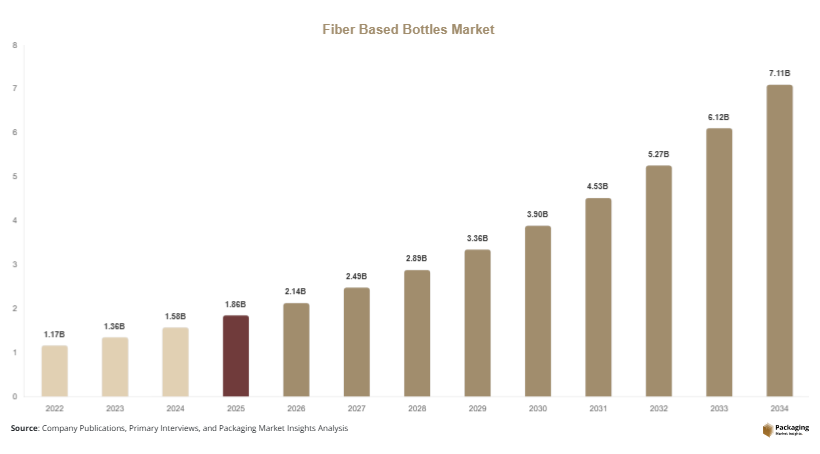
The global fiber based bottles market size was valued at approximately USD 1.86 billion in 2025 and is projected to reach USD 2.14 billion in 2026. By 2034, the market is forecasted to reach nearly USD 7.12 billion, expanding at a CAGR of 16.2% during 2025–2034. The market is benefiting from increasing investments in sustainable packaging innovation and growing consumer preference for recyclable and compostable packaging solutions.
Several factors are supporting market expansion. First, governments across Europe and North America are implementing strict plastic reduction policies, encouraging adoption of paper-based alternatives. Second, global beverage companies are investing in low-carbon packaging strategies to improve sustainability targets and brand positioning. Third, advances in barrier coating technologies are improving the moisture resistance and durability of fiber-based bottles, making them suitable for liquid applications.
Key Highlights
- Europe dominated the market with a 34.6% share in 2025.
- Asia Pacific is expected to grow at the fastest CAGR of 17.5%.
- Beverage applications led the market with a 48.2% share.
- Recycled fiber materials accounted for 56.7% market share.
- Molded pulp bottle formats dominated with a 51.9% share because of lower production costs and scalability.
- The US remained the leading country in North America with a market size of USD 0.28 billion in 2025 and USD 0.33 billion in 2026.
Explore more data points, trends and opportunities Download Free Sample Report
Market Trends
Adoption of Biodegradable Barrier Coatings
One of the most important trends shaping the fiber based bottles market is the development of biodegradable barrier coatings that improve liquid resistance and shelf life. Traditional paper bottles often faced limitations related to moisture absorption and product leakage. To address these issues, manufacturers are introducing plant-based coatings and water-dispersible barriers that enhance structural integrity without reducing recyclability. Beverage brands are increasingly testing these technologies for juices, dairy products, and alcoholic beverages. For example, several European packaging firms are developing fully biodegradable bottle linings using algae-based and cellulose-based coatings. This trend is expected to strengthen as sustainability regulations become stricter and brands seek alternatives to petroleum-based plastic liners.
Expansion of Sustainable Packaging Partnerships
Another major trend in the fiber based bottles market is the growing collaboration between packaging companies and consumer goods brands to develop commercially viable fiber bottle solutions. Beverage manufacturers, cosmetics companies, and household product brands are partnering with pulp technology providers to accelerate innovation and scale production capacity. For instance, premium beverage brands are launching pilot programs using paper-based bottles to improve sustainability branding and reduce carbon emissions in packaging operations. These partnerships are helping reduce production costs while improving supply chain efficiency. In the future, large-scale commercialization agreements between pulp manufacturers and global FMCG companies are expected to accelerate adoption across retail markets.
Market Drivers
Rising Global Restrictions on Single-Use Plastics
The increasing implementation of regulations restricting single-use plastics is a major factor driving the fiber based bottles market. Governments worldwide are introducing bans, taxation policies, and recycling mandates aimed at reducing plastic pollution. This regulatory environment is encouraging manufacturers to shift toward renewable and recyclable packaging materials. For example, several European countries have established packaging waste reduction targets that encourage beverage companies to adopt fiber-based alternatives. Retailers are also prioritizing environmentally friendly packaging suppliers to meet corporate sustainability goals. As environmental policies continue to tighten globally, fiber-based bottles are expected to gain wider commercial acceptance across food, beverage, and personal care industries.
Increasing Consumer Preference for Sustainable Packaging
Consumer demand for environmentally responsible products is another important growth driver. Modern consumers increasingly evaluate products based on packaging sustainability, carbon footprint, and recyclability. Fiber-based bottles are perceived as eco-friendly alternatives because they use renewable raw materials and reduce dependence on fossil-fuel-based plastics. For example, personal care brands are introducing paper-based packaging for shampoos and lotions to appeal to environmentally conscious buyers. Social media campaigns and sustainability labeling are further influencing purchasing decisions. This consumer-driven shift is encouraging packaging manufacturers to invest in innovative fiber molding technologies and recyclable barrier systems.
Market Restraint
Limited Moisture Resistance and High Production Costs
Despite growing adoption, the fiber based bottles market faces challenges related to limited moisture resistance and relatively high manufacturing costs. Fiber-based bottles often require specialized coatings and multilayer structures to maintain durability when storing liquids. These additional processing steps increase production complexity and operational costs compared to traditional plastic bottles. For example, beverage companies using paper bottles for carbonated drinks must incorporate advanced internal barrier technologies to prevent leakage and maintain shelf stability.
Another challenge is the scalability of production infrastructure. Existing plastic bottle manufacturing systems are highly optimized and cost-efficient, while fiber bottle production lines are still developing in many regions. Small and medium-sized packaging companies may struggle to invest in specialized molded pulp equipment and drying systems. In addition, transportation and storage conditions can affect bottle performance if humidity levels are not properly controlled.
The lack of universal recycling standards for coated fiber bottles also creates uncertainty in waste management systems. Some fiber bottles still contain thin polymer layers that complicate recycling processes. As a result, manufacturers must balance sustainability objectives with product durability and commercial feasibility. Until production technologies mature and economies of scale improve, these limitations may continue to restrain broader market penetration.
Market Opportunities
Expansion in Alcoholic and Premium Beverage Packaging
The premium beverage industry presents significant opportunities for fiber-based bottle manufacturers. Alcoholic beverage brands are increasingly exploring sustainable packaging solutions to improve environmental branding and attract younger consumers. Fiber-based bottles provide unique visual appeal and differentiate products in competitive retail markets. For example, several whiskey and wine producers are testing molded fiber bottles for limited-edition product launches and eco-focused campaigns. These bottles reduce transportation weight and lower carbon emissions during distribution. As premium beverage brands continue prioritizing sustainability initiatives, adoption of paper-based bottle formats is expected to increase across global markets.
Growth in E-Commerce and Direct-to-Consumer Packaging
The rapid growth of e-commerce is creating new opportunities for lightweight and protective fiber-based packaging solutions. Direct-to-consumer brands seek packaging materials that reduce shipping costs while supporting sustainability commitments. Fiber-based bottles are lightweight, customizable, and suitable for secondary packaging integration, making them attractive for online retail operations. For example, personal care and wellness companies are using molded fiber bottles for subscription-based product delivery models. The ability to print branding and sustainability messaging directly onto fiber surfaces also enhances customer engagement. Future advancements in impact-resistant fiber structures may further strengthen adoption in e-commerce supply chains.
Report Scope
| Report Metric | Details |
|---|---|
| Market Size in 2025 | USD 1.86 Billion |
| Market Size in 2026 | USD 2.14 Billion |
| Market Size in 2034 | USD 7.12 Billion |
| CAGR | 16.2% (2026-2034) |
| Base Year for Estimation | 2025 |
| Historical Data | 2022-2024 |
| Forecast Period | 2026-2034 |
| Report Coverage | Revenue Forecast, Competitive Landscape, Supply Chain Disruption, Growth Factors, Environment & Regulatory Landscape and Trends |
| Geographies Covered | North America, Europe, APAC, Middle East and Africa, LATAM |
| Countries Covered | U.S., Canada, U.K., Germany, France, Spain, Italy, Russia, Nordic, Benelux, Rest of Europe, China, South Korea, Japan, India, Australia, Singapore, Taiwan, South East Asia, Rest of Asia-Pacific, UAE, Turky, Saudi Arabia, South Africa, Egypt, Nigeria, Rest of MEA, Brazil, Mexico, Argentina, Chile, Colombia, Rest of LATAM |
Explore more data points, trends and opportunities Download Free Sample Report
Segmental Analysis
By Type
Molded pulp bottles dominated the fiber based bottles market with a 51.9% share in 2024, primarily due to their cost efficiency, scalability, and compatibility with various liquid packaging applications. These bottles are widely used in beverage and household product industries because they offer lightweight structures and strong environmental positioning. Manufacturers favor molded pulp technology because it enables high-volume production while reducing raw material waste. For example, several beverage brands are using molded pulp bottles for water, juices, and dairy alternatives to strengthen sustainability branding. In addition, advancements in compression molding and fiber layering technologies are improving bottle strength and surface quality, enabling broader commercial adoption across retail and industrial packaging applications.
Barrier-coated fiber bottles are projected to be the fastest-growing segment, expanding at a CAGR of 17.8% during the forecast period. Growth is driven by increasing demand for enhanced moisture resistance and longer shelf life in liquid packaging applications. These bottles incorporate plant-based or biodegradable barrier coatings that improve durability while maintaining recyclability. For instance, premium beverage companies are increasingly adopting barrier-coated paper bottles for alcoholic beverages and carbonated drinks. Future developments in bio-based coating technologies are expected to improve oxygen resistance and product stability, making these bottles suitable for a wider range of applications. As sustainable packaging regulations strengthen globally, barrier-coated fiber bottles are expected to gain significant traction.
By Material
Recycled fiber materials accounted for approximately 56.7% market share in 2024, supported by rising sustainability initiatives and increasing consumer preference for environmentally responsible packaging. Recycled fibers reduce raw material consumption and lower carbon emissions during production compared to virgin pulp alternatives. Packaging manufacturers are increasingly sourcing post-consumer recycled paper to improve sustainability credentials and comply with environmental regulations. For example, several European beverage brands are promoting recycled fiber bottle packaging as part of carbon reduction campaigns. The segment also benefits from growing retailer preference for products packaged in recyclable and renewable materials. Improved recycling technologies and stronger waste collection systems are further supporting recycled fiber adoption across packaging supply chains.
Virgin fiber materials are expected to register the fastest CAGR of 16.9% during 2025–2034. Growth is supported by demand for higher structural strength, improved appearance, and enhanced food safety compliance. Virgin fibers provide better consistency and smoother surface finishes, making them suitable for premium beverage and cosmetic packaging applications. Companies are increasingly blending virgin pulp with biodegradable coatings to improve product durability and branding quality. In addition, advancements in sustainable forestry management are helping manufacturers maintain reliable raw material supplies. The premiumization trend in personal care and luxury beverage packaging is expected to further increase demand for high-quality virgin fiber bottle materials.
By End-Use
The beverage segment dominated the fiber based bottles market with a 48.2% share in 2024, driven by increasing adoption of sustainable packaging solutions by water, juice, dairy, and alcoholic beverage companies. Beverage brands are actively replacing conventional plastic bottles with fiber-based alternatives to improve environmental branding and reduce packaging-related emissions. For example, several bottled water companies in Europe and North America have introduced pilot product lines using molded fiber bottles with biodegradable liners. The beverage industry also benefits from high consumer visibility, allowing brands to communicate sustainability commitments directly through packaging design. Growing demand for eco-friendly retail packaging continues to strengthen the position of the beverage segment.
Personal care and cosmetics are expected to be the fastest-growing end-use segment, expanding at a CAGR of 17.3% during the forecast period. This growth is driven by increasing consumer demand for sustainable beauty and skincare products packaged in environmentally friendly materials. Fiber-based bottles are being used for shampoos, lotions, body washes, and liquid cosmetics to reduce plastic waste and improve brand differentiation. Several cosmetic companies are also investing in refillable fiber bottle systems to support circular packaging strategies. Future innovations in water-resistant coatings and premium printing technologies are expected to further increase adoption across the beauty and wellness industry.
Fiber Based Bottles Market Segmentations
By Product Type
- Molded Pulp Bottles
- Barrier-Coated Fiber Bottles
- Hybrid Fiber Bottles
- Compostable Fiber Bottles
By Material
- Recycled Fiber
- Virgin Fiber
- Blended Fiber Materials
- Bio-Based Fiber Composites
By End-User
- Beverages
- Personal Care & Cosmetics
- Household Products
- Healthcare & Pharmaceuticals
- Industrial Liquids
By Distribution Channel
- Retail Stores
- Online Retail
- Direct B2B Supply
- Supermarkets & Hypermarkets
- Specialty Packaging Distributors
Regional Analysis
North America
North America accounted for approximately 26.8% market share in 2025 and is expected to expand at a CAGR of 15.4% during 2025–2034. The region benefits from strong consumer awareness regarding sustainable packaging and increasing investments in eco-friendly product innovation. Beverage manufacturers and personal care brands are rapidly adopting fiber-based bottles to reduce plastic waste and improve corporate sustainability performance. Regulatory support for recyclable packaging materials and retailer demand for environmentally responsible packaging are also supporting market expansion across the United States and Canada.
The United States dominates the North American market due to its advanced packaging technology sector and strong sustainability initiatives among multinational consumer brands. A unique growth factor in the country is the rapid adoption of low-carbon packaging strategies by beverage companies. For example, several U.S.-based beverage startups are launching fiber bottle pilot programs for premium water and energy drink products. Increasing investment in pulp molding infrastructure is further supporting domestic production capacity and market development.
Europe
Europe held the largest market share of 34.6% in 2025 and is forecast to grow at a CAGR of 16.1%. The region remains a major hub for sustainable packaging innovation due to strict environmental regulations and strong circular economy policies. Countries across Europe are implementing plastic reduction mandates, encouraging manufacturers to adopt recyclable and biodegradable packaging alternatives. Retailers and food service providers are also prioritizing fiber-based packaging to meet sustainability targets and improve environmental branding.
Germany leads the European market because of its advanced recycling infrastructure and strong industrial packaging sector. A unique growth factor is the increasing collaboration between packaging manufacturers and automotive beverage suppliers focused on reducing packaging emissions. German beverage producers are actively testing molded pulp bottle systems for carbon footprint reduction programs. In addition, public support for environmentally responsible packaging continues to drive adoption across supermarkets and specialty retail channels.
Asia Pacific
Asia Pacific represented 29.4% market share in 2025 and is expected to register the fastest CAGR of 17.5% through 2034. Rapid urbanization, increasing environmental awareness, and growing packaged beverage consumption are major drivers supporting regional growth. Countries such as China, Japan, and India are witnessing increased investments in sustainable packaging technologies as governments strengthen regulations on plastic waste management. The region’s large manufacturing base and expanding e-commerce industry are also accelerating demand for fiber-based packaging solutions.
China dominates the regional market due to its large-scale pulp production capabilities and strong consumer goods manufacturing ecosystem. A unique growth factor is the government’s push for biodegradable packaging adoption across food and beverage industries. Chinese packaging companies are investing heavily in automated molded fiber production systems to improve efficiency and export competitiveness. The rapid growth of online retail and food delivery services is also encouraging adoption of lightweight and recyclable bottle formats across urban markets.
Middle East & Africa
The Middle East & Africa accounted for approximately 4.8% market share in 2025 and is projected to grow at a CAGR of 14.2% during the forecast period. Market growth is supported by increasing awareness regarding sustainable packaging and rising investments in eco-friendly retail infrastructure. Although adoption remains at an early stage compared to developed regions, multinational beverage and personal care companies are gradually introducing fiber-based bottle packaging across urban markets.
The United Arab Emirates dominates the regional market due to strong sustainability initiatives and expanding hospitality sectors. A unique growth factor is the growing demand for environmentally friendly packaging in luxury hotels and tourism-related industries. For example, hospitality chains in Dubai are introducing fiber-based bottles for water and personal care amenities to reduce plastic waste. Government-led sustainability programs are further encouraging investment in recyclable packaging technologies.
Latin America
Latin America held nearly 4.4% market share in 2025 and is anticipated to expand at a CAGR of 15.1% through 2034. The region is benefiting from rising environmental awareness and increasing adoption of sustainable packaging formats in food and beverage industries. Brazil and Mexico are witnessing growth in eco-conscious consumer segments, encouraging brands to invest in renewable packaging materials. Flexible packaging regulations and retailer sustainability campaigns are also supporting market development.
Brazil remains the dominant country in the region due to its strong pulp and paper industry and expanding beverage manufacturing sector. A unique growth factor is the availability of renewable forestry resources that support cost-effective pulp production. Several Brazilian packaging companies are partnering with local beverage brands to commercialize molded fiber bottle formats for juices and dairy products. The country’s growing focus on export-oriented sustainable packaging solutions is expected to support future market growth.
Competitive Landscape
The fiber based bottles market is moderately competitive, with packaging manufacturers focusing on sustainable innovation, strategic partnerships, and commercialization of molded fiber technologies. Key companies operating in the market include Paboco AB, PulPac AB, Amcor plc, Stora Enso Oyj, and ALPLA Group. Among these, Paboco AB is considered a leading player due to its dedicated focus on paper bottle development and collaborations with global beverage brands.
Companies are investing heavily in advanced barrier coatings, recyclable liners, and automated pulp molding systems to improve scalability and product performance. Strategic partnerships between packaging firms and beverage manufacturers are accelerating commercialization efforts across Europe and North America. Recent developments include pilot launches of fully recyclable fiber bottles and expansion of sustainable packaging production facilities. Competition is expected to intensify as more consumer goods companies adopt renewable packaging solutions to meet sustainability commitments and regulatory requirements.
Key Players List
- Paboco AB
- PulPac AB
- Amcor plc
- Stora Enso Oyj
- ALPLA Group
- DS Smith plc
- Huhtamaki Oyj
- UFP Technologies
- Sonoco Products Company
- WestRock Company
- Billerud AB
- Elopak AS
- SIG Group
- Mondi Group
- Smurfit Kappa Group