Fertilizer Bag Market Size and Growth
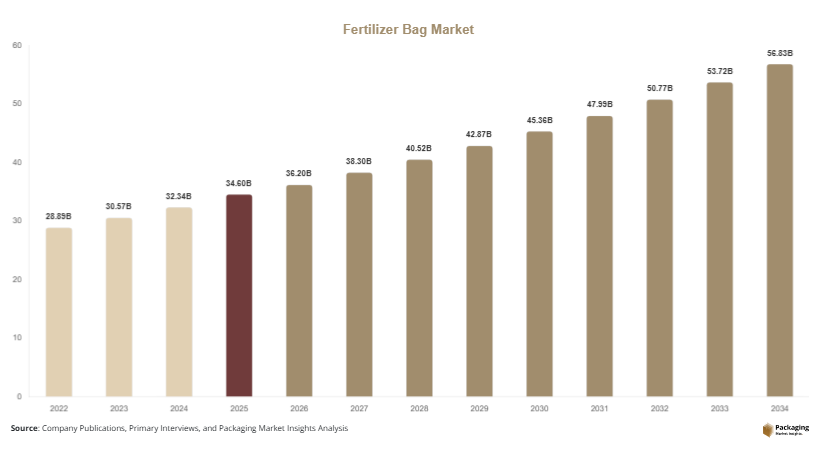
The global ertilizer bag market size is estimated at USD 34.6 billion in 2025 and is expected to reach USD 36.2 billion in 2026. Over the forecast period from 2025 to 2034, the market is projected to grow at a CAGR of 5.8%, reaching approximately USD 60.4 billion by 2034. This growth highlights the essential role of packaging in preserving fertilizer quality, ensuring safe handling, and enabling efficient logistics across agricultural supply chains. The fertilizer bag market is experiencing steady expansion as global agriculture continues to evolve in response to rising food demand, changing climatic conditions, and advancements in farming practices.
The expansion of global agriculture remains a central factor influencing the market. As food consumption rises due to population growth, farmers are increasingly relying on fertilizers to enhance crop yield and maintain soil fertility. This directly drives demand for high-performance packaging solutions that protect fertilizers from moisture, contamination, and physical damage during storage and transport. In regions with high humidity or unpredictable weather conditions, the need for robust fertilizer bags becomes even more critical.
Key Highlights
- Asia Pacific dominated the market with a 38.1% share in 2025, while Latin America is projected to grow at the fastest CAGR of 6.4%.
- Woven polypropylene bags led the type segment with a 46.7% share, while biodegradable bags are expected to grow at a CAGR of 6.8%.
- Plastic-based packaging dominated with a 54.2% share, while paper-based packaging is forecasted to grow at a CAGR of 6.1%.
- Agriculture applications led the segment with 88.5% share, while horticulture applications are expected to grow at a CAGR of 6.6%.
- China remained the dominant country with a market size of USD 9.8 billion in 2025 and USD 10.3 billion in 2026.
Explore more data points, trends and opportunities Download Free Sample Report
Market Trends
Growing preference for sustainable and recyclable packaging solutions
The fertilizer bag market is undergoing a structural shift as sustainability becomes a central focus across the packaging industry. Manufacturers are increasingly adopting biodegradable materials, recyclable plastics, and paper-based alternatives to reduce environmental impact. This change is largely influenced by stricter government regulations aimed at minimizing plastic waste and encouraging circular economy practices. Agricultural companies are also aligning their packaging strategies with sustainability goals to enhance brand value and comply with environmental standards. Advances in material science have improved the strength and moisture resistance of eco-friendly bags, making them more suitable for fertilizer storage and transport. As awareness continues to grow among stakeholders, sustainable packaging solutions are expected to play a significant role in shaping long-term market dynamics.
Increasing integration of advanced packaging technologies
Technological innovation is reshaping the fertilizer bag market by enhancing product functionality and supply chain efficiency. Modern fertilizer bags are now equipped with features such as UV protection, anti-slip surfaces, and high-strength stitching to improve durability under harsh conditions. In addition, the integration of digital elements such as QR codes and tracking labels is enabling better traceability and inventory management. These features allow farmers and distributors to access product information, usage guidelines, and safety instructions more efficiently. Automation in manufacturing processes is also improving consistency and reducing production costs. As global fertilizer distribution becomes more complex, the adoption of technologically advanced packaging solutions is expected to increase, supporting both operational efficiency and product safety.
Market Drivers
Rising agricultural demand and increasing fertilizer consumption
The continuous growth in global population has intensified the demand for food production, which in turn is driving fertilizer consumption. Fertilizers play a crucial role in improving soil fertility and crop yield, making them indispensable in modern agriculture. This rising usage directly increases the demand for reliable and efficient packaging solutions. Fertilizer bags are essential for maintaining product quality, preventing contamination, and ensuring safe transportation. In developing economies, government initiatives aimed at boosting agricultural productivity are further supporting market growth. The expansion of commercial farming and agribusiness sectors has also led to higher demand for bulk packaging solutions. As agricultural output continues to grow, the need for durable and cost-effective fertilizer bags is expected to remain strong.
Expansion of global logistics and bulk handling infrastructure
The development of global supply chains and logistics networks is another key factor driving the fertilizer bag market. Fertilizers are often transported across long distances, requiring packaging solutions that can withstand various environmental and handling conditions. The adoption of bulk handling systems, including automated loading and unloading, has increased the need for standardized and high-strength packaging formats. Woven polypropylene bags and other durable materials are widely used to meet these requirements. Efficient packaging reduces product loss, improves transportation efficiency, and supports large-scale distribution. As international trade in fertilizers continues to expand, the demand for advanced packaging solutions is expected to grow in parallel, reinforcing the importance of innovation in bag design and materials.
Market Restraint
Environmental concerns related to plastic-based fertilizer bags
Environmental challenges associated with plastic waste continue to influence the fertilizer bag market. Traditional packaging materials such as polyethylene and polypropylene are widely used due to their durability and cost efficiency, but they pose long-term environmental risks. Increasing awareness about plastic pollution has led to stricter regulations in many regions, limiting the use of non-biodegradable materials. This creates challenges for manufacturers that rely heavily on conventional plastics. Transitioning to sustainable alternatives often involves higher production costs and technological adjustments, which can impact profit margins. In addition, farmers in price-sensitive markets may be hesitant to adopt eco-friendly packaging due to cost considerations. These factors collectively create a barrier to market growth, while also pushing the industry toward innovation and sustainable practices.
Market Opportunities
Development of eco-friendly and bio-based packaging materials
The shift toward sustainability presents significant opportunities for innovation in the fertilizer bag market. Manufacturers are exploring bio-based polymers, compostable materials, and advanced paper composites to develop environmentally friendly packaging solutions. These materials are designed to offer similar performance characteristics as traditional plastics while reducing environmental impact. Increasing investment in research and development is accelerating the commercialization of such solutions. Companies that adopt sustainable materials early can gain a competitive advantage by meeting regulatory requirements and attracting environmentally conscious customers. Collaboration between packaging companies and agricultural stakeholders is also fostering the development of customized solutions that address specific industry needs.
Growth potential in emerging agricultural economies
Emerging markets are creating new avenues for growth in the fertilizer bag market. Regions such as Asia Pacific, Africa, and Latin America are experiencing rapid agricultural expansion due to increasing food demand and supportive government policies. Investments in irrigation systems, modern farming equipment, and fertilizer usage are driving the need for efficient packaging solutions. The rise of small and medium-scale farmers is also contributing to demand for affordable and versatile fertilizer bags. Local production capabilities are improving, enabling cost-effective manufacturing and reducing reliance on imports. Companies that tailor their products to meet the specific requirements of these markets are well positioned to benefit from this growth potential.
Report Scope
| Report Metric | Details |
|---|---|
| Market Size in 2025 | USD 34.6 Billion |
| Market Size in 2026 | USD 36.2 Billion |
| Market Size in 2034 | USD 60.4 Billion |
| CAGR | 5.8% (2026-2034) |
| Base Year for Estimation | 2025 |
| Historical Data | 2022-2024 |
| Forecast Period | 2026-2034 |
| Report Coverage | Revenue Forecast, Competitive Landscape, Supply Chain Disruption, Growth Factors, Environment & Regulatory Landscape and Trends |
| Geographies Covered | North America, Europe, APAC, Middle East and Africa, LATAM |
| Countries Covered | U.S., Canada, U.K., Germany, France, Spain, Italy, Russia, Nordic, Benelux, Rest of Europe, China, South Korea, Japan, India, Australia, Singapore, Taiwan, South East Asia, Rest of Asia-Pacific, UAE, Turky, Saudi Arabia, South Africa, Egypt, Nigeria, Rest of MEA, Brazil, Mexico, Argentina, Chile, Colombia, Rest of LATAM |
Explore more data points, trends and opportunities Download Free Sample Report
Segmental Analysis
By Type
Woven polypropylene bags accounted for the largest share of the fertilizer bag market in 2024, representing approximately 46.7% of the total market. These bags are widely used due to their high tensile strength, resistance to moisture, and ability to handle heavy loads. Their durability makes them suitable for bulk packaging and long-distance transportation. In addition, they can be customized with printed branding and product information, enhancing their commercial appeal. The cost efficiency of polypropylene materials further supports their dominance, particularly in large-scale agricultural operations where affordability and performance are key considerations.
Biodegradable bags are expected to register the fastest growth, with a CAGR of 6.8% during the forecast period. The increasing emphasis on environmental sustainability is driving demand for eco-friendly packaging alternatives. Advances in material technology have improved the performance of biodegradable bags, making them more durable and resistant to environmental factors. These improvements are helping to overcome earlier limitations, encouraging wider adoption. As regulatory pressure on plastic usage continues to increase, biodegradable fertilizer bags are expected to gain significant traction in both developed and developing markets.
By Material
Plastic-based materials dominated the fertilizer bag market in 2024, accounting for 54.2% of the total share. These materials are preferred for their strength, flexibility, and resistance to moisture and chemicals. They are widely used in large-scale agricultural applications where durability is essential. Established manufacturing processes and widespread availability further support their dominance.
Paper-based materials are projected to grow at a CAGR of 6.1% during the forecast period. The demand for environmentally friendly packaging solutions is driving the adoption of paper-based fertilizer bags. Technological advancements, such as improved coatings and multi-layer designs, are enhancing their strength and moisture resistance. These innovations are expanding their usability across different agricultural applications.
By Application
Agriculture applications held the largest share of the fertilizer bag market in 2024, accounting for 88.5% of the total market. The extensive use of fertilizers in crop production drives the demand for reliable packaging solutions. Large-scale farming operations require durable bags that can handle bulk quantities and ensure product safety during transportation and storage.
Horticulture applications are expected to grow at a CAGR of 6.6% over the forecast period. The increasing popularity of gardening and specialty crops is driving demand for smaller and more convenient packaging formats. This trend is encouraging manufacturers to develop innovative bag designs that cater to specific user requirements, supporting market growth.
Fertilizer Bag Market Segmentations
By Type
- Woven Polypropylene Bags
- Paper Bags
- Plastic Bags
- Biodegradable Bags
By Material
- Plastic
- Paper
- Bio-based Materials
By Application
- Agriculture
- Horticulture
- Industrial Use
Regional Analysis
North America
North America accounted for approximately 21.3% of the fertilizer bag market share in 2025 and is expected to grow at a CAGR of 4.9% over the forecast period. The region benefits from advanced agricultural infrastructure and high fertilizer consumption. Large-scale farming operations require durable and high-capacity packaging solutions, which supports steady demand for fertilizer bags. Environmental regulations are also encouraging the adoption of sustainable packaging materials.
The United States leads the regional market due to its extensive agricultural activities and strong distribution networks. The adoption of precision agriculture technologies is a unique growth factor in this region. These technologies require specialized fertilizer formulations and packaging, driving innovation in bag design and material selection.
Europe
Europe held a 19.6% share of the fertilizer bag market in 2025 and is projected to grow at a CAGR of 5.2%. The region is characterized by strict environmental policies that promote the use of recyclable and biodegradable packaging materials. This has led to increased demand for eco-friendly fertilizer bags.
Germany dominates the European market due to its strong manufacturing base and focus on sustainability. The emphasis on circular economy practices is a key growth factor, encouraging the reuse and recycling of packaging materials. This trend is influencing product development and market strategies across the region.
Asia Pacific
Asia Pacific led the fertilizer bag market with a 38.1% share in 2025 and is expected to grow at a CAGR of 6.3%. The region’s growth is driven by high agricultural activity and increasing fertilizer consumption. Rapid population growth and food demand are key factors supporting market expansion.
China remains the dominant country in this region, supported by large-scale fertilizer production and consumption. Government initiatives aimed at agricultural modernization act as a unique growth factor, boosting demand for high-quality packaging solutions.
Middle East & Africa
The Middle East & Africa region accounted for 10.2% of the fertilizer bag market share in 2025 and is projected to grow at a CAGR of 5.7%. Growth is supported by increasing investments in agriculture and efforts to improve food security. Harsh climatic conditions require durable packaging solutions.
Saudi Arabia leads the regional market, driven by government initiatives to expand agricultural production. The use of advanced irrigation systems is a unique growth factor, increasing fertilizer usage and the demand for reliable packaging solutions.
Latin America
Latin America held a 10.8% share of the fertilizer bag market in 2025 and is expected to grow at the fastest CAGR of 6.4%. The region’s agricultural sector is expanding rapidly, driven by exports of crops such as soybeans and corn. This growth is increasing demand for fertilizer bags.
Brazil dominates the regional market due to its large agricultural base. The adoption of modern farming techniques is a unique growth factor, requiring efficient fertilizer management and packaging solutions, thereby driving market growth.
Competitive Landscape
The fertilizer bag market is characterized by moderate competition, with both global and regional players focusing on innovation and sustainability. Companies are investing in advanced materials and production technologies to improve product performance and meet regulatory requirements. Strategic collaborations and capacity expansions are common as firms aim to strengthen their market position.
Amcor plc is recognized as a leading player in the market, driven by its focus on sustainable packaging solutions. The company has introduced recyclable fertilizer bags designed to meet environmental standards while maintaining durability. Other companies are also prioritizing product innovation and customization to address diverse agricultural needs. Competitive strategies often include pricing optimization, product differentiation, and geographic expansion. As sustainability becomes a central focus, companies that can offer eco-friendly and high-performance packaging solutions are expected to maintain a strong competitive position.
Key Players List
- Amcor plc
- Mondi Group
- Berry Global Inc.
- Sonoco Products Company
- LC Packaging International BV
- Uflex Ltd.
- ProAmpac LLC
- NNZ Group
- Global-Pak Inc.
- Greif Inc.
- Sealed Air Corporation
- Trombini Embalagens S.A.
- RKW Group
- WestRock Company
- Huhtamaki Oyj