Extra High Performance Linerboard Market Size and Growth
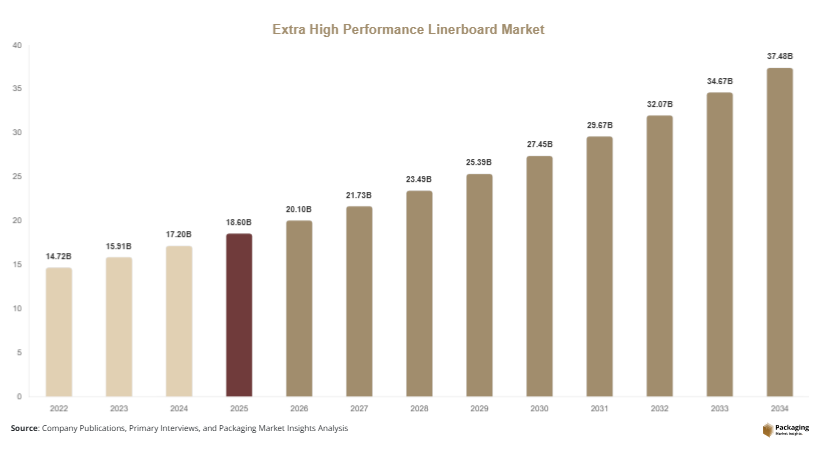
In 2025, the global market size is estimated at approximately USD 18.6 billion. By 2026, it is expected to reach around USD 20.1 billion, supported by rising global trade activity and increasing adoption of premium packaging solutions. By 2034, the market is projected to reach nearly USD 36.9 billion, expanding at a CAGR of 8.1% during 2025–2034. The extra high performance linerboard market is experiencing steady expansion due to rising demand for durable, high-strength, and sustainable packaging materials across e-commerce, industrial shipping, and FMCG sectors. Extra high performance linerboard is widely used in corrugated boxes and protective packaging applications where superior compression strength, moisture resistance, and structural integrity are required.
Key growth factors include the rapid expansion of e-commerce logistics networks, which require high-performance corrugated packaging to ensure product safety during long-distance transportation. Another major factor is the increasing demand from industrial packaging applications such as automotive parts, electronics, and heavy machinery, where structural strength is essential. A third growth driver is the shift toward sustainable packaging materials, where linerboard is increasingly replacing plastic-based protective packaging due to recyclability and lower environmental impact.
Key Highlights:
- Market size (2025): USD 18.6 billion, driven by strong demand from e-commerce packaging and industrial corrugated applications, supported by increasing global trade and rising adoption of durable linerboard materials.
- Market size (2026): USD 20.1 billion, reflecting steady growth due to expanding logistics networks and increasing use of high-performance packaging solutions across manufacturing and retail sectors.
- Forecast size (2034): USD 36.9 billion, indicating long-term expansion supported by rising sustainability initiatives, growth in export-oriented packaging, and increasing replacement of plastic-based materials with paper-based alternatives.
- CAGR (2025–2034): 8.1%, driven by technological improvements in fiber processing, increasing demand for recyclable packaging, and continuous growth in e-commerce and industrial shipping activities globally.
- Strong demand from e-commerce and industrial packaging sectors, supported by rising online retail penetration and increasing need for high-strength corrugated boxes for safe product transportation and storage.
- Rising shift toward recyclable paper-based packaging, driven by environmental regulations and corporate sustainability goals, encouraging adoption of linerboard as an alternative to plastic packaging materials.
- Advancements in high-strength fiber technology, enabling manufacturers to produce stronger, lighter, and more durable linerboard products that improve packaging efficiency and reduce material consumption.
Explore more data points, trends and opportunities Download Free Sample Report
Market Trends
Shift Toward Lightweight High-Strength Packaging Solutions
The extra high performance linerboard market is witnessing a growing trend toward lightweight yet high-strength packaging materials. Manufacturers are focusing on reducing material usage while maintaining or improving compression strength and durability. This is particularly important in e-commerce and logistics, where shipping cost optimization is directly linked to packaging weight. Advanced fiber engineering techniques, including refined pulp blending and multi-layer linerboard structures, are being used to achieve higher performance at lower basis weight. Companies are also investing in machine-grade linerboards that improve corrugation efficiency, reduce waste, and enhance stacking strength for large-scale distribution systems.
Integration of Recycled Fiber and Circular Packaging Systems
Another significant trend is the increasing integration of recycled fibers into extra high performance linerboard production. Companies are adopting closed-loop recycling systems to reduce dependency on virgin pulp and improve sustainability metrics. This trend is strongly influenced by corporate sustainability targets and government regulations promoting circular economy practices. Recycled linerboard is being improved through advanced de-inking, purification, and fiber strengthening technologies to match the performance of virgin materials. Additionally, packaging converters are collaborating with paper mills to ensure consistent quality in recycled high-performance grades, making this trend a key driver of long-term market transformation.
Market Drivers
Rapid Expansion of E-commerce and Logistics Industry
The growth of global e-commerce is one of the primary drivers of the extra high performance linerboard market. Online retail requires durable and cost-effective packaging solutions capable of protecting products during multi-stage transportation and handling. Extra high performance linerboard is widely used in corrugated boxes due to its superior strength and cushioning properties. The rise in cross-border shipping, direct-to-consumer models, and last-mile delivery networks is increasing demand for high-quality corrugated packaging. Additionally, logistics companies are focusing on reducing product damage rates and improving operational efficiency, further boosting adoption of high-performance linerboard materials across supply chains.
Rising Demand from Industrial and Manufacturing Sectors
Industrial sectors such as automotive, electronics, machinery, and chemicals are significantly driving demand for extra high performance linerboard. These industries require packaging solutions that can withstand heavy loads, stacking pressure, and long-distance transportation. Linerboard is increasingly replacing plastic crates and wooden packaging due to its recyclability and cost efficiency. Manufacturing globalization has further increased the need for export-grade packaging materials that ensure product integrity during international shipments. As industrial production expands in emerging economies, demand for high-strength corrugated packaging solutions continues to grow steadily.
Market Restraint
One of the key restraints in the extra high performance linerboard market is volatility in raw material prices, particularly pulp and recovered fiber. Fluctuations in wood pulp supply due to environmental regulations, forestry restrictions, and transportation costs directly impact production expenses for linerboard manufacturers. Additionally, energy costs associated with paper manufacturing processes further increase operational expenses. For example, mills relying on imported pulp face higher cost variability, which affects pricing stability in end-use packaging markets. This price uncertainty creates challenges for small and mid-sized manufacturers in maintaining profit margins and competitive pricing. It also limits long-term investment planning in capacity expansion and technological upgrades, thereby slowing overall market efficiency in certain regions.
Market Opportunities
Expansion of Sustainable Packaging Regulations
The increasing enforcement of sustainability regulations presents a major opportunity for the extra high performance linerboard market. Governments across North America, Europe, and Asia Pacific are implementing strict policies to reduce plastic packaging waste, encouraging industries to shift toward recyclable paper-based materials. Extra high performance linerboard is well-positioned to benefit from this transition due to its recyclability and biodegradability. Companies investing in eco-friendly packaging solutions are expected to gain regulatory advantages and consumer trust. This trend is also driving innovation in water-resistant coatings and fiber strengthening technologies, enabling linerboard to replace plastic-based protective packaging in more demanding applications.
Growth in Emerging Industrial Economies
Emerging economies offer significant growth opportunities due to rapid industrialization, urbanization, and expansion of manufacturing sectors. Countries in Asia Pacific, Latin America, and parts of Africa are witnessing increasing demand for export-oriented packaging solutions. As global supply chains expand, these regions are becoming key production hubs for electronics, automotive components, and consumer goods, all requiring high-performance packaging materials. Investments in logistics infrastructure and warehousing are further supporting demand for corrugated packaging. Local production of linerboard is also increasing, reducing dependency on imports and creating opportunities for regional manufacturers to expand their market presence.
Report Scope
| Report Metric | Details |
|---|---|
| Market Size in 2025 | USD 18.6 Billion |
| Market Size in 2026 | USD 20.1 Billion |
| Market Size in 2034 | USD 36.9 Billion |
| CAGR | 8.1% (2026-2034) |
| Base Year for Estimation | 2025 |
| Historical Data | 2022-2024 |
| Forecast Period | 2026-2034 |
| Report Coverage | Revenue Forecast, Competitive Landscape, Supply Chain Disruption, Growth Factors, Environment & Regulatory Landscape and Trends |
| Geographies Covered | North America, Europe, APAC, Middle East and Africa, LATAM |
| Countries Covered | U.S., Canada, U.K., Germany, France, Spain, Italy, Russia, Nordic, Benelux, Rest of Europe, China, South Korea, Japan, India, Australia, Singapore, Taiwan, South East Asia, Rest of Asia-Pacific, UAE, Turky, Saudi Arabia, South Africa, Egypt, Nigeria, Rest of MEA, Brazil, Mexico, Argentina, Chile, Colombia, Rest of LATAM |
Explore more data points, trends and opportunities Download Free Sample Report
Segmental Analysis
By Grade Type
Kraft linerboard dominates the market with approximately 45% share in 2024 due to its superior strength, durability, and wide usage in corrugated packaging applications. It is highly preferred in e-commerce and industrial packaging sectors.
The fastest-growing subsegment is recycled linerboard, expanding at a CAGR of 9.4% due to rising sustainability requirements and increasing adoption of circular economy practices across packaging industries.
By Application
Corrugated boxes dominate the market with around 52% share in 2024, driven by widespread use in shipping, logistics, and retail packaging. Their strength and recyclability make them essential for modern supply chains.
Heavy-duty industrial packaging is the fastest-growing subsegment with a CAGR of 9.0%, supported by increasing demand from automotive, machinery, and electronics sectors requiring high-strength protective packaging.
By End-Use Industry
E-commerce and retail dominate with approximately 40% share in 2024 due to massive growth in online shopping and home delivery services. This sector relies heavily on corrugated packaging solutions.
Industrial manufacturing is the fastest-growing segment with a CAGR of 8.7%, driven by expansion in global trade and increasing need for export-grade durable packaging materials.
Extra High Performance Linerboard Market Segmentations
By Grade Type
- Kraft Linerboard
- Recycled Linerboard
- White Top Linerboard
- Bleached Linerboard
- Specialty High-Performance Linerboard
By Application
- Corrugated Boxes
- Industrial Packaging
- Consumer Goods Packaging
- Protective Packaging
- Export Packaging
By End-Use Industry
- E-commerce & Retail
- Food & Beverage
- Industrial Manufacturing
- Electronics & Electricals
- Automotive
Regional Analysis
North America
North America holds approximately 26% market share in 2025 and is projected to grow at a CAGR of 7.9%. The region benefits from strong e-commerce penetration and advanced packaging technologies.
The United States dominates the regional market due to high demand from retail distribution networks and increasing adoption of sustainable corrugated packaging solutions in logistics and manufacturing industries.
Europe
Europe accounts for around 28% market share in 2025 with a CAGR of 8.0%. Strict environmental regulations and circular economy initiatives strongly influence market growth.
Germany leads the region due to advanced paper manufacturing infrastructure and strong adoption of recycled fiber-based high-performance linerboard products.
Asia Pacific
Asia Pacific holds nearly 32% market share in 2025 and is expected to grow at a CAGR of 9.1%, the fastest globally.
China dominates the region due to large-scale manufacturing activities, expanding e-commerce platforms, and strong export-oriented packaging demand.
Middle East & Africa
Middle East & Africa accounts for about 8% market share in 2025 with a CAGR of 7.8%. Growth is driven by retail expansion and improving logistics infrastructure.
The UAE leads the region due to rapid development of warehousing facilities and increasing adoption of modern corrugated packaging systems.
Latin America
Latin America holds around 6% market share in 2025 and is projected to grow at a CAGR of 8.2%. Growth is supported by industrial expansion and rising consumer goods demand.
Brazil dominates the region due to strong manufacturing activities and increasing exports requiring durable packaging solutions.
Competitive Landscape
The market is moderately consolidated with major players focusing on capacity expansion, sustainability initiatives, and fiber technology innovation. Key companies include International Paper, WestRock Company, Smurfit Kappa Group, Mondi Group, and Stora Enso. International Paper remains a leading player due to its extensive production network and strong presence in sustainable packaging solutions. Recently, the company expanded its high-strength linerboard production capacity in North America, focusing on recycled fiber integration and energy-efficient manufacturing processes, strengthening its competitive position in the global market.
Key Players List
- International Paper
- WestRock Company
- Smurfit Kappa Group
- Mondi Group
- Stora Enso
- Georgia-Pacific LLC
- Nippon Paper Industries
- Oji Holdings Corporation
- Sappi Limited
- Packaging Corporation of America
- Nine Dragons Paper Holdings
- Pratt Industries Inc.
- DS Smith Plc
- Rengo Co. Ltd.
- Cascades Inc.