Expanded Polystyrene for Packaging Market size
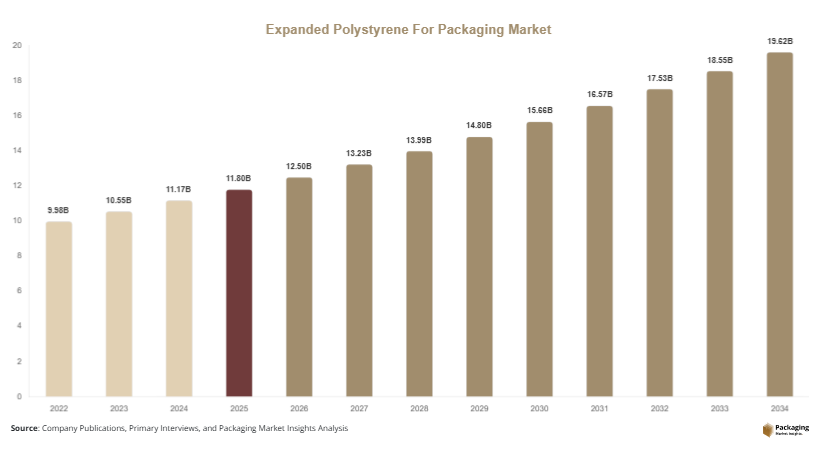
The global expanded polystyrene for packaging market size is estimated at USD 11.8 billion in 2025, increasing to approximately USD 12.5 billion in 2026. The market is projected to reach USD 19.7 billion by 2034, registering a compound annual growth rate (CAGR) of 5.8% from 2025 to 2034. Demand continues to expand as manufacturers and logistics providers seek protective packaging that balances performance and cost efficiency.
The expanded polystyrene for packaging market has witnessed steady development due to its lightweight structure, thermal insulation capability, and cost-efficient manufacturing process. Expanded polystyrene (EPS) is widely used in packaging for electronics, appliances, food, pharmaceuticals, and industrial components because it protects products from impact and temperature fluctuations during transportation. The growing expansion of e-commerce logistics networks and international trade has further strengthened the role of EPS packaging materials in modern supply chains.
Key Highlights
- The expanded polystyrene for packaging market is valued at USD 11.8 billion in 2025 and is projected to reach USD 19.7 billion by 2034, growing at a CAGR of 5.8% during 2025–2034.
- Market growth is primarily driven by the rapid expansion of e-commerce logistics, increasing cold chain distribution, and rising demand for efficient protective packaging solutions across industries.
- The industry is also witnessing a growing shift toward recyclable EPS materials and sustainable packaging innovations, supporting long-term market development.
Explore more data points, trends and opportunities Download Free Sample Report
Market Trends
Increasing Adoption of Recyclable and Circular EPS Packaging
One of the most visible trends in the expanded polystyrene for packaging market is the growing focus on recyclability and circular material usage. Governments and environmental agencies in several regions are introducing regulations that encourage manufacturers to reduce packaging waste and improve recycling rates. In response, EPS producers are developing technologies that allow expanded polystyrene packaging to be collected, compacted, and reprocessed into new packaging materials or construction products.
Manufacturers are also investing in closed-loop recycling systems that convert post-consumer EPS waste into raw material pellets for new packaging applications. This approach allows companies to maintain the protective qualities of EPS while reducing reliance on virgin raw materials. In addition, partnerships between packaging companies and recycling facilities are expanding in urban areas, where large volumes of EPS waste can be collected from electronics retailers, appliance distributors, and food delivery companies.
Rising Integration of EPS Packaging in Cold Chain Distribution
The growth of cold chain logistics networks is another significant trend influencing the expanded polystyrene for packaging market. The transportation of temperature-sensitive goods, including fresh food products, seafood, vaccines, and pharmaceuticals, requires reliable insulation materials that can maintain stable internal temperatures during shipping. EPS packaging provides high thermal insulation while remaining lightweight, making it a preferred option for temperature-controlled packaging solutions.
As international trade in perishable food products expands, exporters are increasingly adopting EPS boxes and containers to maintain product quality during long shipping cycles. Pharmaceutical companies are also using EPS insulated packaging for the transportation of biologics and vaccines that require controlled temperature ranges. The continued development of healthcare distribution networks and global food supply chains is expected to support sustained demand for EPS packaging solutions.
Market Drivers
Rapid Expansion of Global E-Commerce Logistics
The rapid growth of online retail platforms has significantly increased demand for protective packaging materials, making it a key driver for the expanded polystyrene for packaging market. As consumers increasingly purchase electronics, appliances, and household goods online, the need for packaging that can withstand handling, transportation, and long shipping distances has grown. EPS packaging offers structural strength and shock absorption, which helps reduce product damage during transit.
Retailers and logistics providers are also seeking packaging materials that can minimize shipping weight while maintaining protective performance. EPS is significantly lighter than many alternative packaging materials, which helps reduce transportation costs and improve logistics efficiency. As cross-border e-commerce continues to expand and same-day delivery networks grow, the demand for reliable packaging solutions is expected to increase, supporting long-term EPS packaging market growth.
Growth of the Global Cold Chain and Food Delivery Industry
The global expansion of cold chain infrastructure is another major factor driving the expanded polystyrene for packaging market. The increasing demand for fresh food delivery, seafood exports, frozen products, and temperature-sensitive pharmaceuticals has created a need for insulated packaging materials capable of maintaining stable temperatures during transport.
EPS containers and boxes are widely used in cold chain logistics because they offer excellent insulation and durability. These properties help preserve product quality while reducing spoilage during long shipping durations. Additionally, the growing adoption of online grocery platforms and meal delivery services is increasing the volume of perishable items shipped directly to consumers. This shift in consumer behavior is expected to create sustained demand for EPS insulated packaging solutions across global logistics networks.
Market Restraint
Environmental Concerns and Regulatory Restrictions on Polystyrene
Despite its functional advantages, environmental concerns related to polystyrene waste present a significant restraint for the expanded polystyrene for packaging market. EPS is a petroleum-based plastic material that can take a long time to decompose if not properly recycled. As a result, environmental organizations and regulators in several countries have introduced policies aimed at reducing the use of single-use plastic materials, including polystyrene packaging.
Some municipalities have implemented restrictions or bans on specific polystyrene packaging applications, particularly in food service packaging. These regulatory developments can create uncertainty for manufacturers and packaging suppliers that rely on EPS materials. For example, packaging companies operating in regions with strict environmental regulations may need to invest in recycling infrastructure or transition toward alternative materials such as molded fiber or biodegradable packaging.
However, the industry is responding to these challenges by developing improved recycling systems and increasing the use of recycled EPS content in packaging products. Manufacturers are also working with governments and recycling organizations to improve waste collection and processing capabilities. While regulatory pressures remain a constraint, innovation in recycling technology may help mitigate long-term environmental concerns.
Market Opportunities
Expansion of Recycled EPS Material Technologies
The development of advanced recycling technologies for expanded polystyrene presents a significant opportunity for market participants. Chemical recycling and densification technologies now allow EPS waste to be processed into reusable raw materials that can be reintroduced into packaging production. These technologies reduce landfill waste while enabling manufacturers to comply with emerging environmental regulations.
Companies investing in recycled EPS solutions can differentiate themselves by offering packaging materials with reduced environmental impact. This approach is particularly attractive for electronics manufacturers and consumer goods companies that are actively seeking sustainable packaging alternatives. As recycling infrastructure improves globally, the availability of recycled EPS feedstock is expected to increase, creating opportunities for packaging producers to develop circular production systems.
Growth of Protective Packaging for High-Value Electronics
Another emerging opportunity in the expanded polystyrene for packaging market is the increasing demand for protective packaging for high-value electronics and appliances. Products such as televisions, computers, medical equipment, and smart home devices require packaging materials capable of protecting delicate components during transportation and storage.
EPS packaging offers excellent cushioning properties that help prevent damage from shock and vibration. As consumer electronics sales continue to grow and product designs become more sophisticated, manufacturers are prioritizing packaging materials that ensure safe delivery to consumers. Additionally, the expansion of global electronics manufacturing hubs is expected to increase demand for molded EPS protective packaging used in large-scale shipping and distribution operations.
Report Scope
| Report Metric | Details |
|---|---|
| Market Size in 2025 | USD 11.8 Billion |
| Market Size in 2026 | USD 12.5 Billion |
| Market Size in 2034 | USD 19.7 Billion |
| CAGR | 5.8% (2026-2034) |
| Base Year for Estimation | 2025 |
| Historical Data | 2022-2024 |
| Forecast Period | 2026-2034 |
| Report Coverage | Revenue Forecast, Competitive Landscape, Supply Chain Disruption, Growth Factors, Environment & Regulatory Landscape and Trends |
| Geographies Covered | North America, Europe, APAC, Middle East and Africa, LATAM |
| Countries Covered | U.S., Canada, U.K., Germany, France, Spain, Italy, Russia, Nordic, Benelux, Rest of Europe, China, South Korea, Japan, India, Australia, Singapore, Taiwan, South East Asia, Rest of Asia-Pacific, UAE, Turky, Saudi Arabia, South Africa, Egypt, Nigeria, Rest of MEA, Brazil, Mexico, Argentina, Chile, Colombia, Rest of LATAM |
Explore more data points, trends and opportunities Download Free Sample Report
Segmental Analysis
By Type
The molded EPS packaging segment dominated the market in 2024, accounting for approximately 61% of total market share. Molded EPS packaging is widely used for protective packaging of electronics, appliances, and industrial components due to its ability to be customized into complex shapes. Manufacturers can design molded EPS structures that precisely fit the product, providing enhanced cushioning and protection during shipping. The segment also benefits from efficient manufacturing processes that allow high-volume production at relatively low cost. As a result, molded EPS packaging remains a preferred choice for industries that require consistent product protection and standardized packaging designs.
The EPS sheets and blocks segment is projected to be the fastest-growing, registering a CAGR of around 6.3% during the forecast period. Growth in this segment is driven by increasing demand for customizable packaging materials that can be cut and shaped for different product types. EPS sheets are commonly used in protective packaging for furniture, appliances, and fragile industrial components. The flexibility of EPS sheets allows logistics providers to adjust packaging configurations depending on product size and shipping conditions. Additionally, improvements in EPS manufacturing technologies are enabling producers to develop sheets with enhanced durability and impact resistance.
By Application
The protective packaging application segment accounted for the largest share of approximately 57% in 2024. This segment includes packaging used for electronics, appliances, industrial components, and consumer goods. EPS packaging is widely used in these applications due to its ability to absorb shock and protect delicate products from damage during transportation. As global trade volumes continue to grow, the need for reliable protective packaging solutions has increased significantly. Manufacturers and logistics providers prefer EPS packaging because it combines strength, lightweight properties, and cost efficiency, making it suitable for large-scale distribution operations.
The insulated packaging segment is expected to register the fastest growth, with a projected CAGR of about 6.5% through 2034. This growth is largely driven by the expansion of cold chain logistics networks and increasing demand for temperature-controlled shipping solutions. EPS insulated containers are commonly used for transporting seafood, frozen food, pharmaceuticals, and vaccines. The material’s excellent thermal insulation properties help maintain consistent temperatures during transportation, reducing product spoilage and ensuring compliance with regulatory requirements. As healthcare and food distribution systems continue to evolve, insulated EPS packaging is expected to experience strong demand.
By End-Use Industry
The electronics and appliances industry held the dominant market share of around 38% in 2024. Consumer electronics products such as televisions, computers, and home appliances require protective packaging capable of preventing damage from shocks and vibrations. EPS packaging is commonly used for these products because it can be molded into shapes that securely hold devices in place during transportation. The continued growth of the global electronics manufacturing sector, combined with rising consumer demand for electronic devices, is supporting sustained demand for EPS protective packaging.
The food and beverage industry is projected to be the fastest-growing end-use segment, registering a CAGR of approximately 6.7% during the forecast period. The increasing popularity of online grocery shopping, seafood exports, and meal delivery services is driving demand for insulated packaging materials that can preserve product freshness. EPS containers are widely used for transporting perishable items such as fish, meat, fruits, and frozen food products. As global food distribution networks become more complex, the demand for reliable insulated packaging solutions is expected to increase significantly.
Expanded Polystyrene For Packaging Market Segmentations
Type
- Molded EPS Packaging
- EPS Sheets and Blocks
- EPS Foam Containers
Application
- Protective Packaging
- Insulated Packaging
- Cushioning and Void Fill
End-Use Industry
- Electronics and Appliances
- Food and Beverage
- Pharmaceuticals
- Industrial Goods
Regional Analysis
North America
North America accounted for approximately 28% of the global expanded polystyrene for packaging market share in 2025. The region is expected to register a CAGR of around 5.2% during the forecast period. Growth is supported by well-established e-commerce logistics networks and advanced packaging manufacturing infrastructure. Demand for protective packaging for consumer electronics, appliances, and pharmaceutical products continues to expand across the United States and Canada.
The United States represents the dominant country in the region due to its large consumer goods market and strong e-commerce ecosystem. A unique growth factor in the country is the expansion of temperature-controlled pharmaceutical distribution networks. Increasing demand for vaccine transportation and biologics shipping has accelerated the use of insulated EPS packaging in healthcare logistics.
Europe
Europe held nearly 24% of the global market share in 2025, with a projected CAGR of about 4.9% through 2034. Market growth is influenced by strict packaging regulations and increasing investments in recycling infrastructure. European packaging manufacturers are actively adopting recycled EPS materials and sustainable packaging solutions to comply with environmental policies introduced by regional regulatory authorities.
Germany remains the dominant country in the European EPS packaging market due to its advanced manufacturing sector and strong export economy. A notable growth factor is the country’s large electronics and appliance manufacturing industry, which requires reliable protective packaging materials for domestic distribution and international shipments.
Asia Pacific
Asia Pacific represented the largest regional share at approximately 34% in 2025, and it is expected to record the fastest CAGR of around 6.6% during the forecast period. Rapid industrialization, rising consumer spending, and expanding e-commerce markets are driving demand for protective packaging solutions across major economies in the region.
China is the leading market within Asia Pacific due to its extensive electronics manufacturing industry and high export volumes. A key growth factor is the country’s large logistics and manufacturing ecosystem, which requires cost-effective packaging materials to protect products during domestic and international transportation.
Middle East & Africa
The Middle East & Africa accounted for roughly 7% of the global expanded polystyrene for packaging market share in 2025, with a projected CAGR of about 4.5%. Market growth is supported by increasing trade activity and the expansion of food import and distribution networks across Gulf Cooperation Council countries.
The United Arab Emirates is the dominant country in the region due to its role as a regional logistics and re-export hub. A distinctive growth factor is the rapid development of cold storage and seafood distribution networks, which rely heavily on insulated EPS packaging to maintain product freshness during transport.
Latin America
Latin America held approximately 7% of the global market share in 2025, with an expected CAGR of around 5.0% through 2034. Demand for protective packaging is rising as regional manufacturing and export industries continue to expand. Growth in agricultural exports and consumer goods distribution is supporting demand for EPS packaging solutions.
Brazil leads the regional market due to its strong agricultural export sector and growing electronics manufacturing activities. A unique growth factor is the country’s expanding seafood and fresh produce export industry, which requires insulated EPS packaging to maintain product quality during long-distance shipping.
Competitive Landscape
The expanded polystyrene for packaging market is moderately consolidated, with several global and regional packaging manufacturers competing through product innovation, recycling initiatives, and strategic partnerships. Companies are investing in advanced molding technologies and recycled EPS production processes to strengthen their market position. Packaging manufacturers are also collaborating with logistics providers and consumer goods companies to develop customized protective packaging solutions.
One of the leading companies in the market is BASF SE, which has established a strong presence through its EPS raw material innovations and sustainability initiatives. The company has recently expanded its recycled polystyrene product portfolio to support circular packaging solutions. Other major players are focusing on geographic expansion, particularly in Asia Pacific, where demand for protective packaging continues to increase due to growing manufacturing and export activities.
Competition in the market is expected to intensify as companies develop environmentally responsible EPS packaging products that meet evolving regulatory standards and sustainability expectations.
Key Players List
- BASF SE
- TotalEnergies SE
- Synthos S.A.
- Sunpor Kunststoff GmbH
- Alpek S.A.B. de C.V.
- Atlas EPS
- SABIC
- Kaneka Corporation
- Versalis S.p.A.
- Nova Chemicals Corporation
- Flint Hills Resources
- Ravago Group
- Insulfoam
- JSP Corporation
- ACH Foam Technologies