Expanded Polyethylene Protective Packaging Market Size
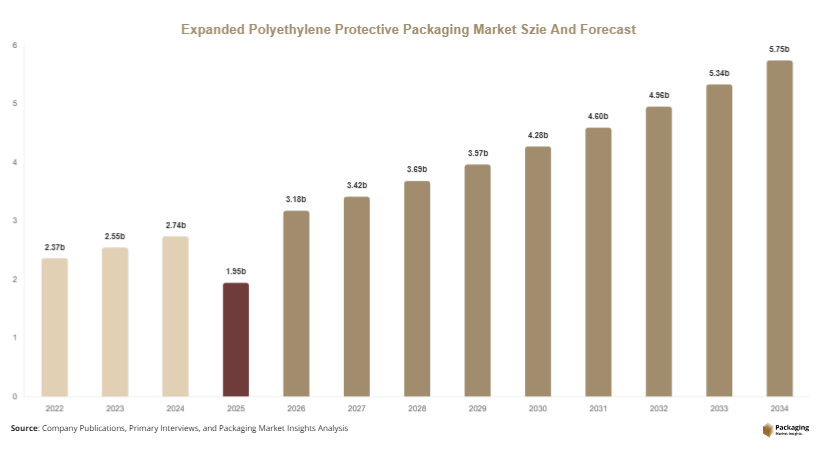
Expanded Polyethylene Protective Packaging market size is projected at USD 3.18 billion in 2026 and is expected to hit USD 5.74 billion by 2034 with a CAGR of 7.68%. The report provides an in-depth evaluation of industry structure, supply-demand balance, production trends, segmentation performance, and competitive positioning across major economies. It also examines investment activities, capacity expansion, pricing patterns, and innovation strategies to provide a comprehensive assessment of the global market landscape.
Expanded polyethylene protective packaging refers to lightweight, closed-cell foam packaging materials designed to provide cushioning, shock absorption, thermal insulation, vibration control, and moisture resistance during transportation and storage. Global production exceeded 1.95 million metric tons in 2025, while manufacturing utilization remained above 81% across leading facilities. Electronics accounted for nearly 38% of overall consumption, automotive represented 27%, and healthcare contributed 16%, with the remaining 19% distributed across industrial and consumer applications. The industry continues to benefit from increasing adoption of lightweight protective materials, supporting continued market expansion.
Explore more data points, trends and opportunities Download Free Sample Report
Expanded Polyethylene Protective Packaging Market Trends
Increasing Adoption of Sustainable Lightweight Packaging Solutions
Manufacturers are increasingly replacing conventional protective materials with recyclable expanded polyethylene solutions, supported by more than 14% annual growth in sustainable packaging investments. Production capacity additions surpassed 180,000 metric tons during 2025, while automated foam conversion technologies improved manufacturing efficiency by approximately 18%. Nearly 63% of packaging converters have integrated advanced cutting and molding systems, reinforcing long-term industry development.
Digital manufacturing technologies, including CNC foam fabrication and automated design software, are improving production precision while reducing material waste by nearly 22%. Demand from e-commerce packaging exceeded 520 million units annually, with protective foam penetration reaching approximately 58% across premium consumer electronics shipments. These developments continue to accelerate industry modernization and reinforce long-term market adoption.
Expanded Polyethylene Protective Packaging Drivers
Rapid Expansion of Electronics and E-commerce Logistics
The rapid expansion of global electronics manufacturing and online retail has significantly increased demand for protective packaging materials. Consumer electronics shipments exceeded 2.7 billion units, while global parcel deliveries surpassed 210 billion shipments annually. Approximately 72% of premium electronic products utilize advanced protective foam packaging, reducing transit damage by nearly 45%. Growing industrial automation and cross-border logistics continue supporting strong market performance.
Expanded Polyethylene Protective Packaging Restraints
Volatility in Petrochemical Raw Material Prices
Expanded polyethylene production depends heavily on petrochemical feedstocks, exposing manufacturers to fluctuations in resin pricing. Polyethylene resin prices experienced annual variations of 12–20%, while transportation expenses increased nearly 9% during recent years. Rising energy costs have also increased manufacturing expenditures by approximately 11%, creating pricing pressure for converters and end users across multiple industries.
Expanded Polyethylene Protective Packaging Opportunities
Growing Demand for Customized Protective Packaging
Customized foam packaging solutions are gaining widespread adoption across medical devices, industrial machinery, and precision electronics. Demand for engineered protective packaging increased by approximately 17%, while custom molded component production exceeded 420 million units annually. Investments in automated foam design technologies grew by over 21%, creating new opportunities for value-added manufacturing and premium packaging applications.
Challenges in Expanded Polyethylene Protective Packaging
Environmental Compliance and Recycling Infrastructure
Although expanded polyethylene offers durability and recyclability, recycling infrastructure remains uneven across developing economies. Less than 48% of collected foam packaging is effectively recycled, while collection efficiency varies between 30% and 75% depending on regional regulations. Manufacturers continue investing in circular economy initiatives and recycled resin incorporation to improve sustainability performance and regulatory compliance.
Report Scope
| Report Metric | Details |
|---|---|
| Market Size in 2025 | USD 1.95 billion |
| Market Size in 2026 | USD 3.18 billion |
| Market Size in 2034 | USD 5.74 billion |
| CAGR | 7.68% (2026-2034) |
| Base Year for Estimation | 2025 |
| Historical Data | 2022-2024 |
| Forecast Period | 2026-2034 |
| Report Coverage | Revenue Forecast, Competitive Landscape, Supply Chain Disruption, Growth Factors, Environment & Regulatory Landscape and Trends |
| Geographies Covered | North America, Europe, APAC, Middle East and Africa, LATAM |
| Countries Covered | U.S., Canada, U.K., Germany, France, Spain, Italy, Russia, Nordic, Benelux, Rest of Europe, China, South Korea, Japan, India, Australia, Singapore, Taiwan, South East Asia, Rest of Asia-Pacific, UAE, Turky, Saudi Arabia, South Africa, Egypt, Nigeria, Rest of MEA, Brazil, Mexico, Argentina, Chile, Colombia, Rest of LATAM |
Explore more data points, trends and opportunities Download Free Sample Report
Expanded Polyethylene Protective Packaging Market Segmentation
The market is segmented by product type and end-user industry. Foam rolls account for approximately 41% of total revenue, followed by sheets at 34% and custom molded components at 25%. Electronics remains the leading application with nearly 38% market contribution, supported by consistent demand for impact-resistant packaging.
By Product Type
Sheets
Expanded polyethylene sheets account for approximately 34% of production volume, exceeding 650,000 metric tons annually. These products provide high compressive strength, moisture resistance below 0.5%, and excellent thermal insulation, making them suitable for industrial packaging and appliance protection.
Foam Rolls
Foam rolls represent nearly 41% of global demand with production surpassing 800,000 metric tons annually. Their flexibility, lightweight construction, and continuous roll configuration support efficient packaging operations across logistics, furniture, and consumer goods industries.
Custom Molded Components
Custom molded components contribute around 25% of market revenue while production exceeds 410 million molded pieces each year. Precision-engineered designs improve shock absorption by approximately 35% and reduce transportation damage for delicate products requiring application-specific protection.
By End User
Electronics
Electronics represents the largest application with approximately 38% market share. Annual demand exceeds 760 million packaging units, while usage penetration surpasses 72% for premium electronic devices. Protective foam minimizes vibration, electrostatic exposure, and mechanical impact throughout global distribution networks.
Automotive
Automotive contributes nearly 27% of overall consumption. More than 290 million protective packaging components are utilized annually for automotive parts, batteries, sensors, and precision assemblies. High-density foam enhances product stability during long-distance transportation and warehouse handling.
Healthcare
Healthcare accounts for approximately 16% of market demand, supported by rising shipments of diagnostic equipment, pharmaceutical products, and medical devices. Production exceeded 180 million specialized packaging units, while demand increased by approximately 12% due to expanding healthcare infrastructure worldwide.
Expanded Polyethylene Protective Packaging Market Szie And Forecast Segmentations
Product Type
- Sheets
- Foam Rolls
- Custom Molded Components
End User
- Electronics
- Automotive
- Healthcare
Expanded Polyethylene Protective Packaging Regional Outlook
North America
North America accounts for approximately 31% of global market revenue. The United States contributes nearly 82% of regional production, supported by advanced packaging automation, electronics manufacturing, and healthcare logistics. Regional output exceeded 610,000 metric tons during 2025.
Europe
Europe represents approximately 27% of global demand, led by Germany, France, Italy, and the United Kingdom. Automotive applications contribute nearly 36% of regional consumption, while sustainable packaging initiatives continue increasing recycled material utilization above 28%.
Asia-Pacific
Asia-Pacific dominates manufacturing with approximately 34% market share. China contributes nearly 47% of regional production, followed by Japan, India, and South Korea. Total production surpassed 780,000 metric tons, supported by expanding electronics exports and industrial manufacturing.
Latin America
Latin America contributes approximately 5% of global revenue. Brazil and Mexico account for nearly 68% of regional demand, supported by automotive production, industrial exports, and growing consumer goods packaging requirements.
Middle East & Africa
The Middle East & Africa represents around 3% of global consumption. Industrial packaging, infrastructure projects, and healthcare investments continue supporting steady expansion, while regional production capacity exceeded 65,000 metric tons.
Top players in Expanded Polyethylene Protective Packaging
- Sealed Air Corporation
- JSP Corporation
- Pregis LLC
- Zotefoams plc
- DS Smith plc
- Sonoco Products Company
- FoamPartner Group
- UFP Technologies Inc.
- ACH Foam Technologies
- Recticel NV
- Kaneka Corporation
- Furukawa Electric Co., Ltd.
- Pactiv Evergreen Inc.
- Storopack Hans Reichenecker GmbH
- Smurfit Westrock
Sealed Air Corporation
-
Estimated market share: 11–13%
-
Strong leadership in protective packaging innovation, automated packaging systems, sustainable product development, and global manufacturing capabilities with extensive operations across North America, Europe, and Asia-Pacific.
Pregis LLC
-
Estimated market share: 8–10%
-
Maintains a strong competitive position through engineered protective packaging, custom foam fabrication, recyclable material development, and strategic investments in automated manufacturing technologies serving electronics, healthcare, and industrial sectors.