EPE Foam Packaging Market Size and Growth
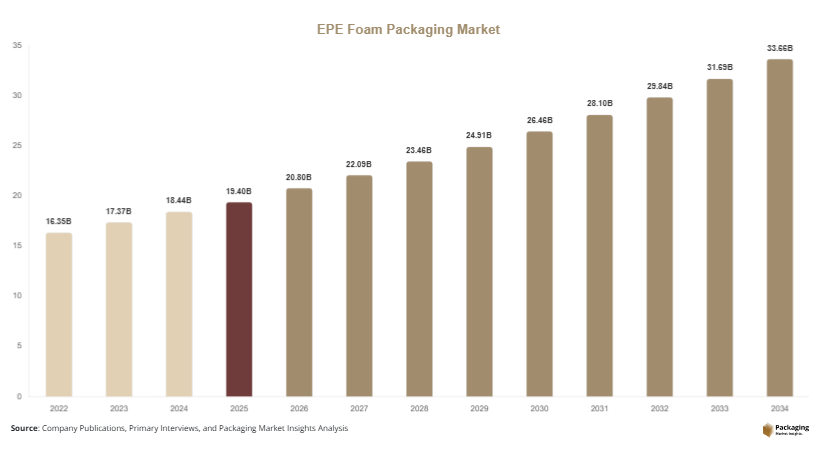
The global EPE foam packaging market size was valued at approximately USD 19.4 billion in 2025 and is expected to reach USD 20.8 billion in 2026. Over the forecast period from 2025 to 2034, the market is projected to grow at a CAGR of 6.2%, reaching an estimated value of USD 36.2 billion by 2034. The EPE foam packaging market is experiencing steady growth due to rising demand for lightweight, protective, and cost-effective packaging solutions across industries such as electronics, automotive, healthcare, and consumer goods. Expanded polyethylene (EPE) foam is widely used for cushioning and insulation, offering properties such as shock absorption, moisture resistance, and flexibility.
One of the primary growth factors driving the EPE foam packaging market is the rapid expansion of the e-commerce sector, which requires efficient packaging solutions to protect goods during transportation. EPE foam provides reliable cushioning for fragile and high-value products, reducing the risk of damage. Another key factor is the increasing demand for consumer electronics such as smartphones, televisions, and appliances, which rely heavily on protective packaging materials. Additionally, the automotive industry is contributing to market growth, as EPE foam is used for packaging components and parts that require protection during shipping and handling.
Key Highlights:
- Asia Pacific dominated the market with a 42.1% share in 2025, while Latin America is projected to grow at the fastest CAGR of 6.7%.
- Sheets and rolls led the type segment with a 38.9% share, while molded foam is expected to grow at a CAGR of 6.5%.
- Protective packaging dominated with a 56.4% share, while insulation applications are forecasted to grow at a CAGR of 6.3%.
- Electronics applications led the segment with 44.7% share, while healthcare packaging is expected to grow at a CAGR of 6.4%.
- China remained the dominant country with a market size of USD 6.3 billion in 2025 and USD 6.8 billion in 2026.
Explore more data points, trends and opportunities Download Free Sample Report
Market Trends
Increasing demand for lightweight and protective packaging solutions
The EPE foam packaging market is witnessing growing demand for lightweight materials that provide effective protection during transportation. EPE foam is preferred due to its ability to absorb shocks and vibrations, making it suitable for fragile and sensitive products. Industries such as electronics and automotive are increasingly adopting EPE foam to reduce product damage and improve shipping efficiency. The material’s flexibility allows it to be customized into different shapes and sizes, enhancing its usability across various applications. As logistics networks expand globally, the need for reliable protective packaging solutions continues to drive demand for EPE foam.
Rising focus on recyclable and reusable foam materials
Sustainability is becoming a key consideration in the EPE foam packaging market. Manufacturers are developing recyclable and reusable foam materials to reduce environmental impact and comply with regulatory requirements. EPE foam can be recycled and reused in various applications, making it an attractive option for companies aiming to reduce waste. Innovations in foam production are enabling the use of eco-friendly additives and processes that minimize environmental footprint. The shift toward circular economy practices is encouraging companies to adopt sustainable packaging solutions, which is expected to influence market growth in the coming years.
Market Drivers
Growth of the global electronics industry
The expansion of the electronics industry is a major factor driving the EPE foam packaging market. Products such as smartphones, laptops, televisions, and home appliances require protective packaging to prevent damage during shipping and storage. EPE foam provides excellent cushioning and insulation, making it suitable for these applications. As consumer demand for electronic devices continues to rise, manufacturers are increasing production, which in turn drives demand for packaging materials. The trend toward miniaturization and high-value electronics further increases the need for reliable protective packaging solutions.
Increasing demand from the automotive sector
The automotive industry is contributing significantly to the growth of the EPE foam packaging market. EPE foam is used for packaging automotive components such as sensors, electronic modules, and interior parts. These components require protection from physical damage and environmental factors during transportation. The growing production of vehicles, including electric vehicles, is driving demand for packaging materials. EPE foam’s lightweight properties also help reduce shipping costs, making it a preferred choice for automotive manufacturers and suppliers.
Market Restraints
Environmental concerns related to foam waste
One of the key challenges in the EPE foam packaging market is the environmental impact associated with foam waste. Although EPE foam is recyclable, improper disposal can contribute to environmental pollution. Regulatory restrictions on plastic-based materials in certain regions are creating challenges for manufacturers. Companies may face increased costs associated with compliance and waste management. For example, stricter regulations on packaging waste in developed markets have led to increased pressure on companies to adopt sustainable alternatives. These factors may limit the growth of traditional EPE foam packaging solutions.
Market Opportunities
Development of eco-friendly foam alternatives
The increasing focus on sustainability presents opportunities for innovation in the EPE foam packaging market. Manufacturers are investing in the development of eco-friendly foam alternatives that offer similar performance characteristics while reducing environmental impact. These innovations include biodegradable foam materials and the use of recycled content in production. Companies that adopt sustainable practices can gain a competitive advantage and meet evolving consumer preferences. The demand for environmentally responsible packaging solutions is expected to drive growth in this segment.
Expansion of e-commerce and logistics sectors
The rapid growth of e-commerce and logistics industries is creating opportunities for the EPE foam packaging market. The need for efficient packaging solutions that protect products during transit is increasing as online shopping continues to expand. EPE foam is widely used for packaging fragile items, ensuring safe delivery. The growth of last-mile delivery services and global trade is further driving demand for packaging materials. As logistics networks become more complex, the need for reliable and cost-effective packaging solutions is expected to increase.
Report Scope
| Report Metric | Details |
|---|---|
| Market Size in 2025 | USD 19.4 Billion |
| Market Size in 2026 | USD 20.8 Billion |
| Market Size in 2034 | USD 36.2 Billion |
| CAGR | 6.2% (2026-2034) |
| Base Year for Estimation | 2025 |
| Historical Data | 2022-2024 |
| Forecast Period | 2026-2034 |
| Report Coverage | Revenue Forecast, Competitive Landscape, Supply Chain Disruption, Growth Factors, Environment & Regulatory Landscape and Trends |
| Geographies Covered | North America, Europe, APAC, Middle East and Africa, LATAM |
| Countries Covered | U.S., Canada, U.K., Germany, France, Spain, Italy, Russia, Nordic, Benelux, Rest of Europe, China, South Korea, Japan, India, Australia, Singapore, Taiwan, South East Asia, Rest of Asia-Pacific, UAE, Turky, Saudi Arabia, South Africa, Egypt, Nigeria, Rest of MEA, Brazil, Mexico, Argentina, Chile, Colombia, Rest of LATAM |
Explore more data points, trends and opportunities Download Free Sample Report
Segmental Analysis
By Type
Sheets and rolls accounted for the largest share of the EPE foam packaging market in 2024, representing approximately 38.9% of total demand. These forms are widely used due to their flexibility and ease of customization. They can be cut and shaped to fit various products, making them suitable for a wide range of applications. The cost-effectiveness and availability of sheets and rolls further support their dominance in the market.
Molded foam is expected to grow at the fastest rate, with a CAGR of 6.5% during the forecast period. Molded EPE foam provides precise fit and enhanced protection for specific products. It is commonly used in electronics and automotive applications where customized packaging solutions are required. The increasing demand for tailored packaging is driving growth in this segment.
By Application
Protective packaging held the largest share of the EPE foam packaging market in 2024, accounting for approximately 56.4% of total demand. EPE foam is widely used for cushioning and protecting products during transportation. Its shock-absorbing properties make it ideal for packaging fragile items. The growth of e-commerce and logistics industries is driving demand for protective packaging solutions.
Insulation applications are expected to grow at the fastest rate, with a CAGR of 6.3%. EPE foam is used for thermal insulation in various industries, including construction and automotive. The increasing demand for energy-efficient solutions is driving the adoption of insulation materials. This trend is supporting growth in the insulation segment.
By End-Use
Electronics industry accounted for the largest share of the EPE foam packaging market in 2024, representing approximately 44.7% of total demand. The need for protective packaging for electronic devices is driving demand for EPE foam. The increasing production of consumer electronics is supporting growth in this segment.
Healthcare industry is expected to grow at the fastest rate, with a CAGR of 6.4%. The need for safe transportation of medical devices and equipment is driving demand for protective packaging materials. EPE foam provides cushioning and protection, making it suitable for healthcare applications. The growth of the healthcare sector is supporting demand for packaging solutions.
EPE Foam Packaging Market Segmentations
By Product Type
- Sheets and Rolls
- Molded Foam
- Foam Profiles
By Application
- Protective Packaging
- Insulation
- Surface Protection
By Distribution Channel
- Direct Sales
- Packaging Distributors
- Online Sales Channels
- Industrial Suppliers
- Logistics Service Providers
Regional Analysis
North America
North America accounted for approximately 23.6% of the EPE foam packaging market share in 2025 and is projected to grow at a CAGR of 5.9% through 2034. The region benefits from strong demand in the electronics and automotive sectors. Advanced logistics infrastructure and high adoption of e-commerce are supporting the use of protective packaging materials. Companies in the region are also focusing on sustainable packaging solutions, which is influencing market dynamics.
The United States dominates the North American market due to its large consumer base and well-established manufacturing sector. A key growth factor is the increasing adoption of advanced packaging technologies that improve product protection and reduce material usage. This trend is driving demand for high-performance EPE foam packaging solutions.
Europe
Europe held around 19.4% share of the EPE foam packaging market in 2025 and is expected to grow at a CAGR of 5.7% during the forecast period. The region’s growth is driven by demand from automotive and industrial sectors. Strong environmental regulations are encouraging companies to adopt sustainable packaging materials.
Germany leads the European market due to its strong automotive industry and manufacturing capabilities. A unique growth factor is the region’s focus on reducing packaging waste and promoting recycling. This is encouraging the development and adoption of eco-friendly EPE foam products.
Asia Pacific
Asia Pacific dominated the EPE foam packaging market with a 42.1% share in 2025 and is projected to grow at a CAGR of 6.6% through 2034. The region benefits from rapid industrialization, growing consumer electronics demand, and expanding e-commerce activities. Countries such as China, India, and Japan are key contributors to market growth.
China remains the dominant country in the region due to its large manufacturing base and strong export activities. A key growth factor is the expansion of electronics production, which drives demand for protective packaging materials. The presence of major manufacturing hubs further supports market growth.
Middle East & Africa
The Middle East & Africa region accounted for approximately 6.8% of the EPE foam packaging market in 2025 and is expected to grow at a CAGR of 5.4%. Growth in this region is supported by increasing industrial activities and infrastructure development. The adoption of e-commerce is also contributing to demand for packaging materials.
The United Arab Emirates is a leading market in the region, driven by its focus on trade and logistics. A unique growth factor is the expansion of warehousing and distribution networks, which increases demand for protective packaging solutions.
Latin America
Latin America held around 7.9% share of the EPE foam packaging market in 2025 and is projected to grow at the fastest CAGR of 6.7% through 2034. The region is witnessing growth in manufacturing and e-commerce sectors, which is driving demand for packaging materials.
Brazil dominates the Latin American market due to its growing industrial base and consumer market. A key growth factor is the increasing adoption of online shopping, which requires efficient packaging solutions. This trend is supporting the growth of the EPE foam packaging market.
Competitive Landscape
The EPE foam packaging market is moderately competitive, with several global and regional players focusing on product innovation and expansion strategies. Sealed Air Corporation is a leading player in the market, known for its advanced packaging solutions and global presence. The company has recently introduced new recyclable foam packaging products to address sustainability concerns. Other key players are investing in research and development to improve material performance and reduce environmental impact. Strategic partnerships and product launches are common strategies used by companies to strengthen their market position.
Key Players List
- Sealed Air Corporation
- Pregis LLC
- JSP Corporation
- Zotefoams plc
- BASF SE
- FoamPartner Group
- Kaneka Corporation
- DS Smith plc
- Storopack Hans Reichenecker GmbH
- Wisconsin Foam Products
- UFP Technologies
- ACH Foam Technologies
- Synbra Technology
- Hanwha Solutions
- Sekisui Chemical Co., Ltd.