Electronic Packaging Materials Market Size and Growth
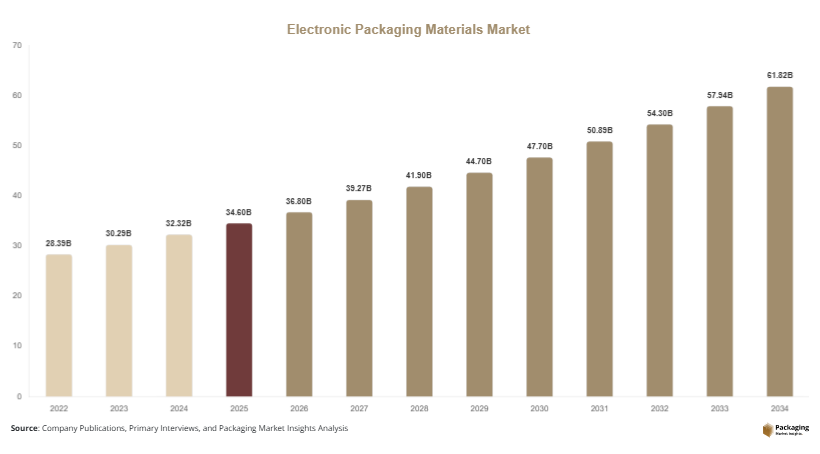
The global electronic packaging materials market was valued at approximately USD 34.6 billion in 2025 and is projected to reach USD 36.8 billion in 2026. By 2034, the market is forecasted to reach nearly USD 61.7 billion, registering a CAGR of 6.7% during 2025–2034. The electronic packaging materials market is expanding steadily due to rising semiconductor production, increasing demand for consumer electronics, and rapid growth in electric vehicles and advanced communication technologies. Electronic packaging materials are essential for protecting electronic components from moisture, heat, contamination, and mechanical damage while ensuring electrical insulation and thermal management. These materials include encapsulation resins, thermal interface materials, conductive adhesives, substrates, laminates, and shielding materials used across semiconductor packaging, printed circuit boards, and electronic assembly applications.
One of the primary growth factors driving the electronic packaging materials market is the increasing global demand for compact and high-performance electronic devices. Smartphones, wearable devices, laptops, and gaming systems require advanced packaging materials capable of supporting miniaturization and thermal efficiency. Another major growth factor is the rapid expansion of semiconductor manufacturing and integrated circuit packaging technologies. The growing adoption of advanced chip architectures such as 3D ICs, system-in-package solutions, and heterogeneous integration is increasing demand for specialized packaging materials with improved electrical and thermal performance.
Key Highlights
- Asia Pacific dominated the market with a 43.6% share in 2025.
- North America is projected to grow at the fastest CAGR of 7.2%.
- Thermal interface materials led the product type segment with a 28.4% share.
- Semiconductor packaging applications dominated with a 41.9% share.
- Consumer electronics led the end-use segment with 46.7% share.
- The US remained the dominant country with a market size of USD 9.4 billion in 2025 and USD 10.1 billion in 2026, supported by growing semiconductor manufacturing investments and advanced electronics production capacity.
Explore more data points, trends and opportunities Download Free Sample Report
Market Trends
Increasing Adoption of Advanced Semiconductor Packaging Technologies
Advanced semiconductor packaging technologies are becoming an important trend in the electronic packaging materials market. Semiconductor manufacturers are increasingly adopting 3D packaging, chiplet integration, and system-in-package architectures to improve computing performance and reduce device size. These technologies require highly specialized packaging materials capable of delivering improved thermal conductivity, electrical insulation, and mechanical stability. Materials such as advanced substrates, underfill encapsulants, and thermal interface compounds are gaining strong demand across semiconductor fabrication facilities. Growing investments in AI processors, high-performance computing systems, and data center infrastructure are further accelerating adoption of advanced semiconductor packaging materials designed for next-generation integrated circuit manufacturing applications.
Rising Demand for Sustainable and Lightweight Electronic Materials
Sustainability and material efficiency are becoming significant trends influencing the electronic packaging materials market. Electronics manufacturers are focusing on reducing environmental impact by adopting recyclable materials, low-halogen laminates, and environmentally friendly adhesives. Lightweight electronic packaging materials are also gaining popularity due to increasing demand for portable electronic devices and electric vehicles. Manufacturers are developing bio-based resins, lead-free solder materials, and thermally efficient composites that improve electronic performance while supporting sustainability objectives. The growing emphasis on regulatory compliance and circular economy initiatives is encouraging continuous innovation in eco-friendly packaging material technologies across global electronics manufacturing industries.
Market Drivers
Expansion of Consumer Electronics and Smart Devices
The rapid growth of consumer electronics and smart device manufacturing is one of the primary drivers supporting the electronic packaging materials market. Smartphones, tablets, laptops, gaming consoles, and wearable electronics require advanced packaging materials capable of supporting miniaturization, heat dissipation, and electrical insulation. Rising consumer demand for high-performance devices with compact designs is encouraging manufacturers to adopt advanced semiconductor packaging materials and lightweight substrates. Increasing penetration of IoT-enabled electronics and connected devices is also contributing to material demand across electronic assembly operations. As electronic manufacturers continue introducing multifunctional and compact products, demand for innovative packaging materials with enhanced durability and thermal management capabilities is expected to rise steadily.
Growing Adoption of Electric Vehicles and Automotive Electronics
The increasing integration of electronics within modern vehicles is significantly driving growth in the electronic packaging materials market. Electric vehicles, autonomous driving systems, infotainment platforms, and battery management systems rely heavily on semiconductors and electronic components that require highly reliable packaging materials. Automotive electronic systems operate under demanding environmental conditions involving heat, vibration, and moisture exposure, creating demand for durable encapsulation and thermal interface materials. Growing investments in electric mobility infrastructure and advanced automotive electronics are encouraging material manufacturers to develop high-performance packaging solutions suitable for automotive-grade semiconductor applications. Rising global EV production is expected to continue accelerating market expansion throughout the forecast period.
Market Restraint
Volatility in Raw Material Prices and Supply Chain Disruptions
One of the major restraints affecting the electronic packaging materials market is the volatility in raw material prices and supply chain disruptions. Electronic packaging materials rely on specialized chemicals, metals, polymers, and semiconductor-grade substrates, many of which are subject to price fluctuations caused by geopolitical tensions, trade restrictions, and raw material shortages. Supply chain disruptions can significantly impact production schedules and increase manufacturing costs for electronic component suppliers. For example, fluctuations in copper prices and shortages of semiconductor-grade resins have affected packaging material production and electronic assembly operations in recent years. In addition, manufacturers operating globally may face logistical challenges involving transportation delays and regional sourcing limitations. These issues can increase operational uncertainty, reduce profit margins, and slow investments in advanced packaging material development, particularly among smaller manufacturers with limited procurement flexibility.
Market Opportunities
Growth in 5G Infrastructure and Data Center Expansion
The expansion of 5G communication networks and large-scale data center infrastructure presents significant opportunities for the electronic packaging materials market. High-speed communication systems and cloud computing platforms require advanced semiconductor devices capable of handling greater processing power and thermal loads. Electronic packaging materials such as thermal interface compounds, high-frequency laminates, and electromagnetic shielding materials are increasingly used in networking equipment, servers, and communication modules. The rising deployment of edge computing systems and AI-driven data processing infrastructure is expected to create strong long-term demand for high-performance packaging materials optimized for advanced electronic systems and high-frequency applications.
Development of Flexible and Wearable Electronics
The growing market for flexible electronics and wearable devices is creating new growth opportunities within the electronic packaging materials industry. Flexible displays, smart textiles, fitness trackers, and medical wearable devices require lightweight and flexible packaging materials capable of maintaining electrical performance under bending and mechanical stress conditions. Manufacturers are developing stretchable adhesives, thin-film encapsulation materials, and flexible conductive substrates to support next-generation electronic product designs. Increasing consumer interest in portable healthcare monitoring devices and foldable electronic products is expected to accelerate demand for innovative flexible packaging materials across consumer electronics and medical technology applications.
Report Scope
| Report Metric | Details |
|---|---|
| Market Size in 2025 | USD 34.6 Billion |
| Market Size in 2026 | USD 36.8 Billion |
| Market Size in 2034 | USD 61.7 Billion |
| CAGR | 6.7% (2026-2034) |
| Base Year for Estimation | 2025 |
| Historical Data | 2022-2024 |
| Forecast Period | 2026-2034 |
| Report Coverage | Revenue Forecast, Competitive Landscape, Supply Chain Disruption, Growth Factors, Environment & Regulatory Landscape and Trends |
| Geographies Covered | North America, Europe, APAC, Middle East and Africa, LATAM |
| Countries Covered | U.S., Canada, U.K., Germany, France, Spain, Italy, Russia, Nordic, Benelux, Rest of Europe, China, South Korea, Japan, India, Australia, Singapore, Taiwan, South East Asia, Rest of Asia-Pacific, UAE, Turky, Saudi Arabia, South Africa, Egypt, Nigeria, Rest of MEA, Brazil, Mexico, Argentina, Chile, Colombia, Rest of LATAM |
Explore more data points, trends and opportunities Download Free Sample Report
Segmental Analysis
By Product Type
Thermal interface materials dominated the electronic packaging materials market in 2024, accounting for approximately 28.4% of the total market share. These materials are widely used in semiconductor devices, processors, automotive electronics, and communication equipment to improve heat dissipation and maintain electronic performance stability. The increasing complexity and miniaturization of electronic systems are significantly driving demand for advanced thermal management solutions. Consumer electronics manufacturers and semiconductor companies are increasingly adopting high-conductivity thermal interface compounds to improve device reliability and reduce overheating risks. Growth in high-performance computing systems, gaming devices, and electric vehicle battery technologies is also supporting strong consumption of thermal management materials. Continuous advancements in thermally conductive polymers and phase-change materials are expected to further strengthen segment growth during the forecast period.
Conductive adhesives are projected to register the fastest CAGR of 7.5% during the forecast period. Growth in this segment is driven by rising demand for lightweight and flexible electronic assembly solutions across consumer electronics, automotive systems, and wearable devices. Conductive adhesives provide electrical conductivity while enabling low-temperature assembly processes and reduced mechanical stress on sensitive electronic components. Manufacturers are increasingly adopting conductive adhesives as alternatives to traditional soldering technologies in advanced semiconductor packaging and flexible electronics applications. The expansion of foldable devices, medical wearable technologies, and compact IoT systems is accelerating demand for advanced adhesive materials capable of maintaining electrical performance under dynamic operating conditions. Technological developments in silver-based and carbon-based conductive formulations are also contributing to segment expansion.
By Application
Semiconductor packaging applications dominated the electronic packaging materials market in 2024 with approximately 41.9% of the total market share. Semiconductor packaging materials play a critical role in protecting integrated circuits, improving thermal performance, and supporting electrical connectivity within advanced electronic systems. Increasing production of AI processors, memory chips, and communication semiconductors is driving substantial demand for encapsulation resins, substrates, underfill materials, and thermal compounds. Semiconductor manufacturers are investing heavily in advanced chip packaging technologies such as system-in-package and 3D IC integration, further increasing material consumption. Rising demand for high-speed computing systems, cloud infrastructure, and consumer electronics is strengthening growth within the semiconductor packaging segment. Continuous innovation in miniaturized chip architectures and high-density packaging technologies is expected to support long-term market expansion.
Electric vehicle electronics applications are anticipated to grow at the fastest CAGR of 7.8% during the forecast period. Electric vehicles require sophisticated semiconductor systems for battery management, power electronics, infotainment, and autonomous driving technologies. These applications demand highly durable electronic packaging materials capable of withstanding vibration, temperature fluctuations, and moisture exposure. Automotive manufacturers are increasingly adopting advanced encapsulation materials, thermal interface compounds, and conductive adhesives to improve reliability and thermal efficiency within EV electronic systems. Rising global EV production, government incentives for electric mobility, and increasing investments in autonomous driving technologies are contributing significantly to segment growth. Expansion of charging infrastructure and smart transportation systems is also expected to accelerate demand for automotive electronic packaging materials.
By End-Use
Consumer electronics dominated the end-use segment in 2024, accounting for approximately 46.7% of the global market share. Smartphones, laptops, wearable devices, televisions, and gaming systems require advanced packaging materials to support miniaturization, heat management, and product durability. Electronics manufacturers are continuously introducing compact devices with higher processing power and improved connectivity features, increasing demand for advanced semiconductor packaging solutions. Growing adoption of 5G-enabled smartphones, AI-powered consumer devices, and portable electronics is driving strong material consumption across global electronics assembly operations. Manufacturers are also investing in lightweight and environmentally sustainable packaging materials to improve product efficiency and align with sustainability goals. Continuous innovation in smart consumer electronics is expected to support stable market growth throughout the forecast period.
Automotive electronics are expected to register the fastest CAGR of 7.6% during the forecast period. Modern vehicles increasingly rely on electronic systems for safety, connectivity, infotainment, and energy management functions. Electric vehicles and autonomous driving technologies require highly reliable semiconductor systems supported by advanced packaging materials capable of operating under harsh automotive conditions. Automotive manufacturers are adopting thermally conductive materials, encapsulants, and shielding solutions to improve system reliability and thermal stability. Rising investments in connected vehicle technologies and EV battery systems are accelerating demand for high-performance electronic packaging materials. In addition, increasing government support for electric mobility and smart transportation infrastructure is expected to contribute significantly to segment expansion.
Electronic Packaging Materials Market Segmentations
By Material Type
- Conductive Polymers
- Thermal Interface Materials
- Encapsulation Resins
- Electromagnetic Shielding Materials
- Adhesives and Sealants
By Application
- Consumer Electronics
- Semiconductor Packaging
- Automotive Electronics
- Industrial Electronics
- Telecommunication Devices
By Packaging Format
- Flexible Packaging Materials
- Rigid Protective Packaging
- Anti-Static Packaging
- Vacuum Packaging
- Moisture Barrier Packaging
Regional Analysis
North America
North America accounted for approximately 24.8% of the global electronic packaging materials market share in 2025 and is expected to grow at a CAGR of 7.2% during the forecast period. The region benefits from strong semiconductor innovation, increasing investments in AI computing infrastructure, and rising adoption of advanced automotive electronics. Electronics manufacturers are focusing on developing high-performance packaging materials capable of supporting next-generation semiconductor applications and high-speed communication systems. The presence of leading semiconductor companies is also contributing to regional market growth.
The United States dominates the North American market due to its advanced semiconductor ecosystem and expanding data center infrastructure. A unique growth factor is the rapid investment in domestic semiconductor manufacturing and advanced chip packaging facilities supported by government initiatives. These developments are encouraging higher consumption of thermal interface materials, advanced laminates, and conductive packaging materials across semiconductor manufacturing operations.
Europe
Europe represented nearly 21.7% of the electronic packaging materials market share in 2025 and is projected to grow at a CAGR of 6.4% through 2034. The region benefits from increasing automotive electronics production, rising industrial automation, and growing adoption of renewable energy technologies. Electronics manufacturers across Europe are investing in environmentally sustainable packaging materials and advanced semiconductor assembly technologies to support industrial innovation and regulatory compliance.
Germany remains the dominant country within Europe due to its strong automotive manufacturing sector and industrial electronics expertise. A unique growth factor is the increasing integration of semiconductor systems within electric vehicles and smart factory automation platforms. German manufacturers are investing heavily in automotive-grade electronic packaging materials designed for high-reliability industrial and transportation applications.
Asia Pacific
Asia Pacific accounted for approximately 43.6% of the global market share in 2025 and is projected to maintain strong growth at a CAGR of 6.9% during the forecast period. The region dominates global semiconductor manufacturing, consumer electronics production, and electronic assembly operations. Rapid expansion of smartphone manufacturing, semiconductor fabrication facilities, and electric vehicle production is supporting substantial demand for electronic packaging materials throughout the region.
China dominates the Asia Pacific market due to its large electronics manufacturing base and rapidly growing semiconductor industry. A unique growth factor is the expansion of domestic semiconductor packaging and testing facilities aimed at strengthening regional electronics supply chains. Chinese manufacturers are increasing investments in advanced electronic packaging materials to improve semiconductor production capabilities and support high-volume electronics exports.
Middle East & Africa
The Middle East & Africa region held approximately 4.7% of the global electronic packaging materials market share in 2025 and is anticipated to grow at a CAGR of 5.8% during the forecast period. Increasing investments in telecommunications infrastructure, industrial automation, and renewable energy technologies are supporting regional market growth. Governments are also promoting digital transformation initiatives that require expanded electronic manufacturing and communication equipment deployment.
The United Arab Emirates dominates the regional market due to its growing technology infrastructure and investments in smart city projects. A unique growth factor is the increasing deployment of advanced communication systems and data infrastructure within commercial and industrial sectors. These developments are creating demand for high-performance electronic components and supporting growth in electronic packaging material consumption.
Latin America
Latin America accounted for nearly 5.2% of the electronic packaging materials market share in 2025 and is projected to grow at a CAGR of 6.1% through 2034. Growth in the region is supported by increasing consumer electronics demand, expansion of automotive manufacturing activities, and rising industrial digitalization. Electronics assembly operations across Latin America are gradually adopting advanced packaging materials to improve product quality and reliability.
Brazil remains the dominant country in Latin America due to its growing automotive electronics industry and expanding consumer electronics market. A unique growth factor is the increasing localization of electronic assembly operations aimed at reducing import dependency and improving regional manufacturing capabilities. This trend is encouraging investments in semiconductor packaging and electronic material supply chains within the country.
Competitive Landscape
The electronic packaging materials market is highly competitive, with leading companies focusing on advanced thermal management technologies, semiconductor packaging innovation, and sustainable material development. Major market participants are investing in research and development to improve electrical conductivity, thermal efficiency, and material durability for next-generation electronic applications. Strategic collaborations with semiconductor manufacturers and automotive electronics companies are also influencing competitive positioning within the market.
Henkel AG & Co. KGaA remains one of the leading companies in the market due to its broad portfolio of electronic adhesives, thermal materials, and semiconductor packaging solutions. In 2024, the company introduced advanced thermally conductive materials designed for AI processors and high-performance automotive semiconductor applications. Other major companies include Hitachi Chemical, DuPont, Shin-Etsu Chemical Co., Ltd., and Sumitomo Bakelite Co., Ltd. These firms are focusing on expanding advanced semiconductor packaging capabilities, improving sustainable material formulations, and strengthening global manufacturing networks. Growing investments in semiconductor fabrication and electric vehicle electronics are expected to intensify competition and accelerate technological innovation across the market.
Key Players List
- Henkel AG & Co. KGaA
- DuPont
- Shin-Etsu Chemical Co., Ltd.
- Hitachi Chemical
- Sumitomo Bakelite Co., Ltd.
- BASF SE
- Dow Inc.
- Panasonic Holdings Corporation
- LG Chem
- ASE Group
- Kyocera Corporation
- Mitsubishi Chemical Group
- Nitto Denko Corporation
- Toppan Inc.
- Resonac Holdings Corporation