Egg Boxes And Trays Market Size and Growth
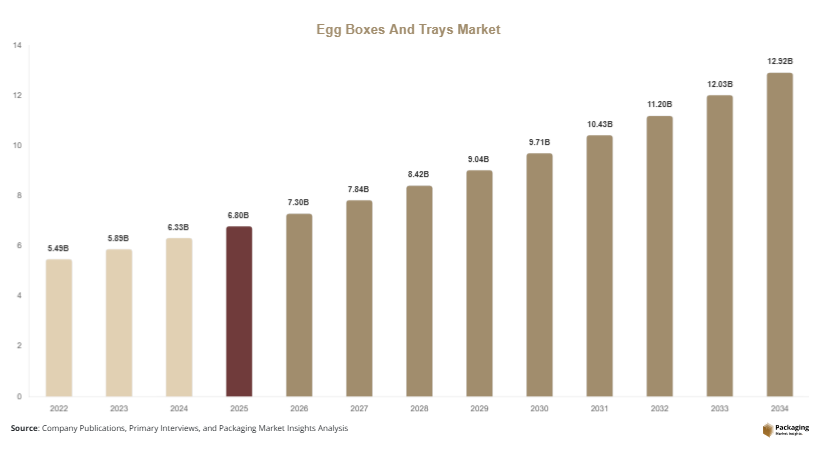
The Egg Boxes And Trays Market size was valued at approximately USD 6.8 billion in 2025 and is projected to reach USD 7.3 billion in 2026. With growing consumption of eggs across households, food service industries, and processed food manufacturers, the market is expected to reach USD 13.9 billion by 2034, registering a CAGR of 7.4% during the forecast period (2025–2034). The egg boxes and trays market is witnessing steady growth due to increasing global egg consumption and rising demand for safe, cost-effective, and sustainable packaging solutions.
One of the primary growth factors is the increasing demand for protective packaging to prevent egg breakage during transportation and storage. Egg boxes and trays provide cushioning and structural support, ensuring product safety from farms to retail shelves. The growing scale of egg production and distribution networks is creating consistent demand for reliable packaging solutions.
Key Highlights:
- The market size reached USD 6.8 billion in 2025 and is projected to grow steadily, reaching USD 13.9 billion by 2034. This growth reflects increasing demand for efficient egg packaging solutions across global markets.
- The market is expected to expand at a CAGR of 7.4% during the forecast period from 2025 to 2034. This steady growth is supported by rising consumption of eggs and expansion of poultry farming.
- There is a rising demand for protective and cost-effective packaging solutions. This is driven by the need to reduce breakage during transportation and ensure product safety.
- The increasing adoption of sustainable and biodegradable materials is further supporting market growth. Manufacturers are focusing on eco-friendly packaging to reduce environmental impact and meet regulatory requirements.
Explore more data points, trends and opportunities Download Free Sample Report
Market Trends
Growing Adoption of Molded Pulp Packaging
A key trend in the egg boxes and trays market is the increasing adoption of molded pulp packaging. This material is derived from recycled paper and is widely used due to its biodegradability and cost efficiency. Molded pulp trays offer excellent cushioning properties, reducing the risk of egg breakage during transportation. As sustainability becomes a priority, manufacturers are focusing on replacing plastic packaging with paper-based alternatives. This trend is supported by regulatory policies promoting eco-friendly materials. Additionally, molded pulp packaging is lightweight and easy to stack, improving logistics efficiency. The demand for such solutions is expected to grow steadily in the coming years.
Increasing Demand for Customized and Branded Packaging
Another notable trend is the rising demand for customized and branded egg packaging solutions. Producers and retailers are focusing on packaging designs that enhance product visibility and brand identity. Printed egg boxes with logos, labels, and product information are becoming common in retail markets. Customization also allows for differentiation based on product types, such as organic or free-range eggs. This trend is particularly strong in premium segments where branding plays a key role in influencing consumer choices. The integration of innovative designs and printing technologies is expected to drive growth in this segment.
Market Drivers
Rising Global Egg Consumption
The increasing consumption of eggs worldwide is a major driver of the egg boxes and trays market. Eggs are a widely consumed source of protein, and their demand is growing across households and food service industries. The expansion of poultry farming and egg production is driving the need for efficient packaging solutions. Egg boxes and trays play a critical role in ensuring safe transportation and storage. As consumption patterns continue to rise, the demand for packaging solutions is expected to increase correspondingly.
Expansion of Retail and E-commerce Channels
The growth of retail and e-commerce channels is another key driver of the market. Supermarkets, hypermarkets, and online grocery platforms require reliable packaging to handle and deliver eggs safely. The increasing popularity of online grocery shopping is creating demand for packaging solutions that can withstand multiple handling stages. Egg boxes and trays provide durability and ease of handling, making them suitable for these applications. This driver is expected to contribute significantly to market growth.
Market Restraint
Fluctuations in Raw Material Prices
One of the major restraints in the egg boxes and trays market is the fluctuation in raw material prices, particularly paper and pulp. These materials are subject to price volatility due to factors such as supply chain disruptions and changes in demand. Rising raw material costs can impact profit margins for manufacturers and lead to increased product prices. This can affect the competitiveness of egg packaging solutions in price-sensitive markets.
For example, disruptions in the supply of recycled paper can lead to shortages and increased costs for molded pulp packaging. Manufacturers may face challenges in maintaining consistent production levels and pricing. While alternative materials are being explored, raw material volatility remains a significant concern for the industry.
Market Opportunities
Growth in Organic and Free-Range Egg Segment
The growing demand for organic and free-range eggs presents significant opportunities for the egg boxes and trays market. Consumers are increasingly seeking high-quality and ethically produced food products. This trend is driving demand for specialized packaging solutions that differentiate these products in the market. Egg boxes designed for premium segments often feature enhanced aesthetics and labeling. This creates opportunities for manufacturers to develop innovative packaging solutions.
Development of Advanced Packaging Materials
Another opportunity lies in the development of advanced packaging materials. Manufacturers are focusing on improving the strength and durability of egg boxes and trays while reducing material usage. Innovations in material science are enabling the production of lightweight and high-performance packaging solutions. This helps reduce transportation costs and environmental impact. The adoption of such materials is expected to create new growth avenues in the market.
Report Scope
| Report Metric | Details |
|---|---|
| Market Size in 2025 | USD 6.8 Billion |
| Market Size in 2026 | USD 7.3 Billion |
| Market Size in 2034 | USD 13.9 Billion |
| CAGR | 7.4% (2026-2034) |
| Base Year for Estimation | 2025 |
| Historical Data | 2022-2024 |
| Forecast Period | 2026-2034 |
| Report Coverage | Revenue Forecast, Competitive Landscape, Supply Chain Disruption, Growth Factors, Environment & Regulatory Landscape and Trends |
| Geographies Covered | North America, Europe, APAC, Middle East and Africa, LATAM |
| Countries Covered | U.S., Canada, U.K., Germany, France, Spain, Italy, Russia, Nordic, Benelux, Rest of Europe, China, South Korea, Japan, India, Australia, Singapore, Taiwan, South East Asia, Rest of Asia-Pacific, UAE, Turky, Saudi Arabia, South Africa, Egypt, Nigeria, Rest of MEA, Brazil, Mexico, Argentina, Chile, Colombia, Rest of LATAM |
Explore more data points, trends and opportunities Download Free Sample Report
Segmental Analysis
By Type
The molded pulp trays segment dominated the market in 2024, accounting for approximately 55% of the total share. These trays are widely used due to their cost-effectiveness and environmental benefits. They provide excellent cushioning and protection for eggs during transportation. The segment benefits from increasing adoption of sustainable packaging solutions.
The plastic egg trays segment is the fastest-growing, expected to register a CAGR of 8.0% during the forecast period. These trays offer durability and reusability, making them suitable for commercial applications. The increasing demand for reusable packaging solutions is driving growth in this segment.
By Application
The retail packaging segment held the largest market share in 2024, accounting for approximately 50% of the total market. The widespread use of egg boxes in supermarkets and grocery stores is driving growth in this segment. The segment benefits from increasing demand for packaged food products.
The food service segment is the fastest-growing, with a projected CAGR of 8.3% during the forecast period. Restaurants and catering services require bulk packaging solutions for eggs. The increasing demand for food services is driving growth in this segment.
By End-Use
The poultry farms segment dominated the market in 2024, accounting for approximately 52% of the total share. These farms require large volumes of packaging solutions for egg distribution. The adoption of egg trays helps improve efficiency and reduce breakage.
The e-commerce segment is the fastest-growing, expected to register a CAGR of 8.5% during the forecast period. The increasing popularity of online grocery shopping is driving demand for packaging solutions that can withstand multiple handling stages.
Egg Boxes And Trays Market Segmentations
By Type
- Molded Pulp Trays
- Plastic Egg Trays
- Paperboard Egg Boxes
By Application
- Retail Packaging
- Food Service
- Industrial Packaging
By End-Use
- Poultry Farms
- Retailers
- E-commerce Platforms
Regional Analysis
North America
North America accounted for approximately 25% of the global egg boxes and trays market share in 2025 and is expected to register a CAGR of 6.8% during the forecast period. The region benefits from a well-established poultry industry and high consumption of eggs. Increasing demand for sustainable packaging solutions is driving market growth. The presence of organized retail networks further supports demand for egg packaging.
The United States dominates the regional market due to its large-scale egg production and consumption. A unique growth factor is the increasing demand for cage-free eggs, which requires specialized packaging solutions. This trend is encouraging innovation in egg packaging.
Europe
Europe held around 23% of the market share in 2025 and is projected to grow at a CAGR of 6.7% through 2034. The region is characterized by strict environmental regulations and a strong focus on sustainability. Manufacturers are adopting eco-friendly packaging solutions to comply with regulatory requirements.
Germany leads the European market, driven by its strong poultry industry. A unique growth factor is the increasing adoption of organic farming practices, which is driving demand for premium egg packaging solutions.
Asia Pacific
Asia Pacific dominated the global market with a share of approximately 34% in 2025 and is expected to register the highest CAGR of 8.2% during the forecast period. The region is a major hub for egg production and consumption. Increasing population and rising income levels are driving demand for eggs.
China is the dominant country in the region, supported by large-scale poultry farming. A key growth factor is the expansion of modern retail channels, which require efficient packaging solutions. This is driving demand for egg boxes and trays.
Middle East & Africa
The Middle East & Africa region accounted for around 9% of the market share in 2025 and is expected to grow at a CAGR of 6.5% during the forecast period. The market is gradually expanding due to increasing demand for eggs and poultry products.
The United Arab Emirates is a leading country in the region, driven by its growing food retail sector. A unique growth factor is the expansion of food import and distribution networks, which require reliable packaging solutions.
Latin America
Latin America held approximately 9% of the global market share in 2025 and is projected to grow at a CAGR of 6.9% through 2034. The region is witnessing growth due to increasing egg consumption and expanding poultry farming.
Brazil dominates the regional market, supported by its large poultry industry. A key growth factor is the increasing demand for packaged food products, which is driving the need for efficient packaging solutions.
Competitive Landscape
The egg boxes and trays market is moderately fragmented, with several key players competing based on product innovation and sustainability initiatives. Companies are focusing on developing eco-friendly packaging solutions to meet regulatory requirements and consumer preferences.
A leading player in the market is Huhtamaki Oyj, which has been actively investing in sustainable packaging solutions. The company recently introduced new molded pulp packaging products for the food industry. Other major players are focusing on expanding their product portfolios and improving distribution networks.
Key Players List
- Huhtamaki Oyj
- Hartmann Packaging
- Pactiv Evergreen Inc.
- UFP Technologies Inc.
- Tekni-Plex Inc.
- CKF Inc.
- Primapack SAE
- Dispak UK
- DFM Packaging Solutions
- Zellwin Farms Company
- Europack Group
- Al-Ghadeer Group
- Fibro Corporation
- Ovotherm International Handels GmbH
- Starpak Ltd.