Eco Friendly Food Packaging Market Size and Growth
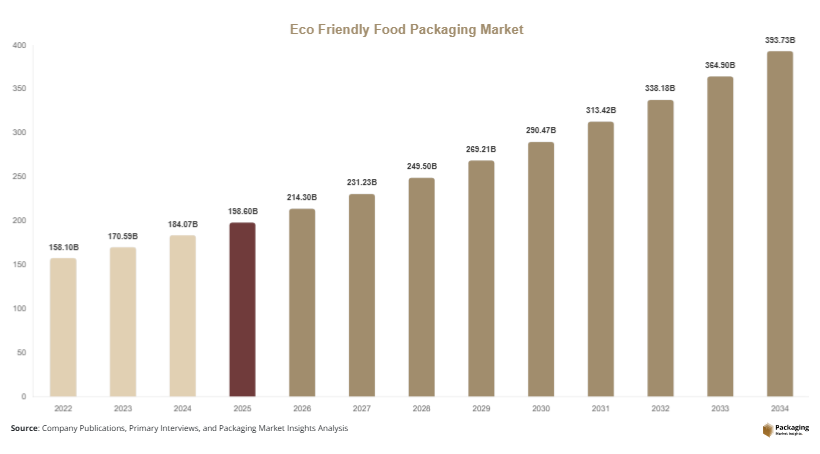
The global eco friendly food packaging market size was estimated at USD 198.6 billion in 2025 and is projected to reach USD 214.3 billion in 2026. Over the forecast period, the market is expected to grow steadily, reaching USD 395.7 billion by 2034, expanding at a compound annual growth rate (CAGR) of 7.9% from 2025 to 2034. This growth reflects a structural transformation in the packaging industry as governments implement stricter regulations on plastic waste and landfill usage.
The eco friendly food packaging market has experienced steady expansion as sustainability priorities reshape the global packaging industry. Food manufacturers, retailers, and foodservice providers are shifting toward environmentally responsible materials in response to regulatory pressure, consumer awareness, and corporate sustainability commitments. Eco-friendly food packaging refers to packaging solutions made from recyclable, biodegradable, compostable, or renewable materials designed to reduce environmental impact throughout the product lifecycle.
Key Highlights
- Global market size estimated at USD 198.6 billion in 2025
- Expected to reach USD 395.7 billion by 2034
- Projected CAGR of 7.9% (2025–2034)
- Strong growth driven by regulations, consumer awareness, and innovation in sustainable materials
- Increasing adoption by food manufacturers, retailers, and foodservice operators
Explore more data points, trends and opportunities Download Free Sample Report
Market Trends
Growing Adoption of Biodegradable and Compostable Materials
One of the most prominent trends in the eco friendly food packaging market is the increasing use of biodegradable and compostable materials in food packaging applications. Packaging producers are developing materials derived from plant sources such as corn starch, sugarcane bagasse, bamboo fiber, and cellulose. These materials naturally break down in industrial composting environments, reducing long-term environmental pollution associated with conventional plastics.
Food manufacturers are adopting compostable packaging for products such as fresh produce, bakery items, and ready-to-eat meals. Improvements in barrier properties and durability have made these materials suitable for a wider range of food products. Retail chains and restaurants are also replacing traditional plastic containers with compostable alternatives to meet sustainability commitments and comply with regional waste regulations.
Integration of Circular Economy Packaging Models
Another key trend shaping the eco friendly food packaging market is the adoption of circular economy packaging systems. Companies are increasingly designing packaging solutions that can be reused, recycled, or recovered efficiently. Circular packaging models focus on reducing waste by ensuring materials remain within the production cycle instead of being disposed of in landfills.
Food companies are collaborating with packaging suppliers to create recyclable mono-material structures that simplify recycling processes. Digital tracking technologies and material identification systems are also being implemented to improve waste management efficiency. As governments expand recycling infrastructure and introduce extended producer responsibility programs, circular packaging models are expected to become a central component of sustainable food packaging strategies.
Market Drivers
Rising Consumer Demand for Sustainable Packaging
Growing consumer awareness regarding environmental issues is a major factor driving the eco friendly food packaging market. Modern consumers are increasingly concerned about plastic waste and its impact on ecosystems. As a result, many consumers actively prefer products packaged in recyclable or biodegradable materials.
Food brands are responding to this shift by integrating sustainable packaging solutions into their product lines. Surveys conducted by retail associations indicate that a large percentage of consumers are willing to pay a small premium for environmentally responsible packaging. This trend has encouraged companies to redesign packaging formats, reduce plastic usage, and invest in renewable materials.
In addition, sustainability labeling and environmental certifications are helping consumers identify eco-friendly products more easily. As transparency in supply chains increases, companies that adopt sustainable packaging are gaining competitive advantages in the food industry.
Government Regulations Limiting Plastic Waste
Government regulations aimed at reducing plastic waste represent another significant growth driver for the eco friendly food packaging market. Several countries have introduced bans on single-use plastics and implemented regulations encouraging recyclable or compostable packaging solutions.
Policies such as plastic taxation, mandatory recycling targets, and extended producer responsibility schemes are pushing manufacturers to adopt sustainable alternatives. Food companies operating across multiple regions must comply with these regulations, leading to widespread adoption of eco-friendly packaging materials.
These regulatory measures are also stimulating research and development investments in sustainable packaging technologies. Packaging manufacturers are developing innovative materials that meet environmental standards while maintaining food safety and product protection requirements.
Market Restraint
Higher Production Costs Compared to Conventional Packaging
Despite strong demand growth, the eco friendly food packaging market faces challenges related to higher production costs compared to conventional plastic packaging. Sustainable materials such as biodegradable polymers, molded fiber, and plant-based plastics often require specialized production processes and raw materials. These factors increase manufacturing costs and limit adoption among cost-sensitive food manufacturers.
In many developing markets, traditional plastic packaging remains significantly cheaper due to established supply chains and large-scale production infrastructure. Small and medium-sized food producers may hesitate to transition toward eco-friendly alternatives because of cost concerns. Additionally, limited composting and recycling infrastructure in certain regions can reduce the effectiveness of sustainable packaging solutions.
The cost challenge is particularly visible in high-volume food categories such as snacks, dairy products, and frozen foods where packaging margins are relatively low. For example, compostable films used for flexible packaging can be considerably more expensive than petroleum-based plastics. This price difference may discourage large-scale adoption unless regulatory incentives or consumer demand offset the cost increase.
However, as production volumes increase and material technologies improve, the cost gap between conventional plastics and eco-friendly packaging is expected to gradually decline.
Market Opportunities
Expansion of Sustainable Packaging in E-Commerce Food Delivery
The rapid growth of online food delivery platforms presents a strong opportunity for the eco friendly food packaging market. Food delivery services require large volumes of packaging materials to maintain product safety and temperature during transportation. Traditionally, many of these packages relied on plastic containers and multilayer packaging materials that are difficult to recycle.
Restaurants and delivery platforms are now seeking sustainable packaging solutions that reduce environmental impact without compromising product quality. Compostable containers, molded fiber trays, and recyclable paper-based packaging are gaining popularity in the food delivery sector. These alternatives help companies reduce waste while meeting consumer expectations for environmentally responsible packaging.
As urban populations grow and online food ordering becomes more common, the demand for sustainable packaging solutions in the delivery segment is expected to increase significantly.
Innovation in Plant-Based Packaging Materials
Innovation in plant-based materials represents another important opportunity in the eco friendly food packaging market. Researchers and packaging companies are developing advanced materials derived from agricultural waste, seaweed, and biodegradable polymers. These materials offer improved strength, flexibility, and barrier properties suitable for various food packaging applications.
Plant-based packaging materials also reduce reliance on fossil fuel-based plastics. Several startups and packaging manufacturers are exploring technologies that convert crop residues and organic waste into packaging materials. These innovations support circular economy initiatives and reduce the environmental footprint of packaging production.
As technology advances and production processes become more efficient, plant-based materials are expected to play a larger role in sustainable food packaging solutions.
Report Scope
| Report Metric | Details |
|---|---|
| Market Size in 2025 | USD 198.6 Billion |
| Market Size in 2026 | USD 214.3 Billion |
| Market Size in 2034 | USD 395.7 Billion |
| CAGR | 7.9% (2026-2034) |
| Base Year for Estimation | 2025 |
| Historical Data | 2022-2024 |
| Forecast Period | 2026-2034 |
| Report Coverage | Revenue Forecast, Competitive Landscape, Supply Chain Disruption, Growth Factors, Environment & Regulatory Landscape and Trends |
| Geographies Covered | North America, Europe, APAC, Middle East and Africa, LATAM |
| Countries Covered | U.S., Canada, U.K., Germany, France, Spain, Italy, Russia, Nordic, Benelux, Rest of Europe, China, South Korea, Japan, India, Australia, Singapore, Taiwan, South East Asia, Rest of Asia-Pacific, UAE, Turky, Saudi Arabia, South Africa, Egypt, Nigeria, Rest of MEA, Brazil, Mexico, Argentina, Chile, Colombia, Rest of LATAM |
Explore more data points, trends and opportunities Download Free Sample Report
Segmental Analysis
By Material Type
Paper and paperboard materials dominated the eco friendly food packaging market in 2024, accounting for approximately 42% of global revenue share. These materials are widely used because they are recyclable, biodegradable, and derived from renewable resources. Food packaging products such as cartons, trays, wrappers, and folding boxes are commonly manufactured using paper-based materials. Their versatility makes them suitable for a wide range of food categories including bakery products, frozen meals, and fast food packaging.
Paper-based packaging solutions also offer strong printing capabilities, allowing brands to enhance product presentation and communicate sustainability messages. Additionally, advancements in barrier coatings and moisture resistance technologies have improved the performance of paper packaging for perishable food items. As environmental concerns continue to rise, many food manufacturers are replacing plastic packaging formats with paper-based alternatives.
Bioplastic materials are expected to be the fastest-growing subsegment, projected to expand at a CAGR of approximately 9.4% during the forecast period. Bioplastics are produced from renewable sources such as corn starch, sugarcane, and cellulose. These materials can be biodegradable or compostable, making them suitable alternatives to petroleum-based plastics.
The growth of bioplastics is driven by technological innovation and increasing investment in sustainable materials. Packaging manufacturers are developing advanced bioplastic films with improved strength and barrier properties suitable for flexible packaging applications. As production technologies mature and costs decline, the adoption of bioplastics in food packaging is expected to increase.
By Packaging Type
Flexible packaging accounted for the largest share of the eco friendly food packaging market in 2024, capturing approximately 48% of global revenue. Flexible packaging formats include pouches, wraps, and films made from recyclable or biodegradable materials. These solutions are widely used for snack foods, frozen foods, and ready-to-eat meals.
Flexible packaging offers several advantages such as lightweight design, lower transportation costs, and efficient storage. These benefits help reduce carbon emissions associated with logistics and distribution. In addition, manufacturers are increasingly adopting recyclable mono-material flexible packaging structures to improve sustainability and recycling efficiency.
Rigid packaging is projected to be the fastest-growing packaging type, with an estimated CAGR of 8.5% during the forecast period. Rigid packaging includes containers, trays, bottles, and jars made from eco-friendly materials such as molded fiber, recycled paperboard, and biodegradable plastics.
The growth of rigid eco-friendly packaging is largely driven by increasing demand in food delivery and ready-to-eat meal packaging. These packaging formats provide strong structural protection and maintain product freshness during transportation. Advances in molded fiber technology have enabled the production of durable, compostable containers suitable for hot and cold food applications.
By End-Use Industry
The food manufacturing industry held the dominant position in the eco friendly food packaging market in 2024, accounting for approximately 55% of total revenue share. Food manufacturers require packaging solutions that protect product quality, extend shelf life, and maintain regulatory compliance.
Packaged food categories such as dairy products, bakery items, frozen meals, and snack foods represent major demand segments for eco-friendly packaging solutions. Food manufacturers are increasingly redesigning packaging to reduce plastic content and improve recyclability. Large multinational food companies have announced sustainability targets that prioritize recyclable and compostable packaging materials.
The foodservice industry is expected to be the fastest-growing end-use segment, expanding at a CAGR of around 9.1% during the forecast period. Restaurants, quick-service chains, and online food delivery platforms require packaging materials that support takeaway and delivery services.
The expansion of urban food delivery services has increased demand for sustainable containers, trays, and cups made from compostable or recyclable materials. Foodservice providers are also adopting eco-friendly packaging to meet environmental regulations and improve brand perception among environmentally conscious consumers.
Eco Friendly Food Packaging Market Segmentations
Material Type
- Paper & Paperboard
- Bioplastics
- Glass
- Metal
Packaging Type
- Flexible Packaging
- Rigid Packaging
End-Use Industry
- Food Manufacturing
- Foodservice
- Retail Food Packaging
Regional Analysis
North America
North America accounted for a significant share of the eco friendly food packaging market, representing approximately 28% of global revenue in 2025. The region is projected to expand at a CAGR of 7.2% during the forecast period. Market growth is supported by strong environmental regulations, increasing consumer awareness, and corporate sustainability initiatives. Food manufacturers across the United States and Canada are actively replacing traditional plastic packaging with recyclable and biodegradable materials to align with environmental policies.
The United States dominates the regional market due to strong demand from the packaged food and foodservice industries. A key growth factor in the country is the expansion of sustainable packaging commitments by major food brands and retail chains. Many companies have introduced targets to eliminate non-recyclable packaging by 2030, which is accelerating the adoption of eco-friendly materials.
Europe
Europe held approximately 30% market share in 2025, making it one of the leading regions in the eco friendly food packaging market. The market is forecast to grow at a CAGR of around 7.5% through 2034. The region has implemented strict environmental regulations, including policies designed to reduce plastic waste and encourage recycling. These regulations have encouraged packaging manufacturers to develop innovative sustainable solutions.
Germany is a major contributor to market growth in Europe. The country has established strong recycling infrastructure and strict packaging waste regulations. A unique growth factor is the widespread adoption of deposit-return systems and recycling programs that encourage manufacturers to use recyclable materials in food packaging.
Asia Pacific
Asia Pacific represented approximately 27% of the global eco friendly food packaging market share in 2025 and is projected to register the fastest CAGR of about 8.6% during the forecast period. Rapid urbanization, rising packaged food consumption, and increasing environmental awareness are supporting market growth across the region.
China dominates the Asia Pacific market due to its large food manufacturing industry and growing sustainability initiatives. A key growth factor is government regulation aimed at reducing plastic waste in major cities. These policies are encouraging packaging manufacturers to introduce biodegradable materials and recyclable packaging solutions.
Middle East & Africa
The Middle East & Africa region accounted for approximately 7% of the global eco friendly food packaging market in 2025 and is projected to grow at a CAGR of 6.8% during the forecast period. Market growth is supported by increasing urban populations, expanding food retail sectors, and growing awareness regarding environmental sustainability.
United Arab Emirates is a leading market within the region. Government sustainability initiatives and environmental policies encouraging waste reduction are driving adoption of eco-friendly packaging. Additionally, the rapid expansion of food delivery services and tourism is contributing to demand for sustainable packaging solutions.
Latin America
Latin America represented approximately 8% of global market share in 2025 in the eco friendly food packaging market and is projected to grow at a CAGR of around 7.1% through 2034. The region is experiencing increasing demand for sustainable packaging solutions as governments introduce environmental regulations and consumers become more environmentally conscious.
Brazil leads the regional market due to its large food processing industry and expanding retail sector. A unique growth factor in the country is the availability of renewable raw materials such as sugarcane fibers used for biodegradable packaging. This local material supply is encouraging manufacturers to develop plant-based packaging products.
Competitive Landscape
The eco friendly food packaging market is moderately competitive, with several global and regional packaging manufacturers focusing on innovation, sustainable materials, and strategic partnerships. Companies are investing in research and development to improve biodegradable packaging technologies and expand product portfolios.
One of the leading players in the market is Tetra Pak, which has introduced several initiatives aimed at improving recyclability and reducing carbon emissions associated with packaging materials. The company recently expanded its sustainable carton packaging solutions that incorporate plant-based polymers and responsibly sourced paperboard.
Other major companies are focusing on partnerships with food manufacturers to develop customized packaging solutions that meet sustainability goals. Strategic mergers, acquisitions, and product innovations are common strategies used by companies to strengthen their market presence.
Packaging manufacturers are also investing in manufacturing facilities and recycling infrastructure to support the production and recovery of eco-friendly materials. These initiatives are expected to enhance competitiveness and drive further market expansion.
Key Players List
- Tetra Pak
- Amcor Plc
- Mondi Group
- Smurfit Kappa Group
- DS Smith Plc
- Sealed Air Corporation
- Berry Global Group
- WestRock Company
- Huhtamaki Oyj
- Stora Enso
- Uflex Ltd.
- Genpak LLC
- Vegware Ltd.
- Biopak Pty Ltd.
- Dart Container Corporation