Drugs Glass Packaging Market Size and Growth
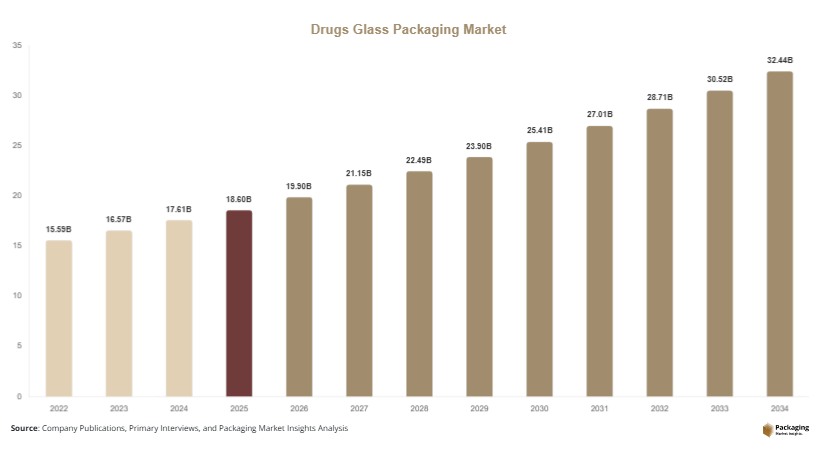
The global drug glass packaging market size was valued at approximately USD 18.6 billion in 2025 and is projected to reach USD 19.9 billion in 2026, with expectations to grow to nearly USD 32.4 billion by 2034, registering a CAGR of 6.3% from 2025 to 2034. Glass packaging remains a preferred choice for pharmaceutical applications because of its chemical stability, impermeability, and ability to preserve drug efficacy over extended periods. The drug glass packaging market is witnessing steady expansion due to the growing demand for safe, inert, and contamination-free packaging solutions in the pharmaceutical sector.
One of the primary growth factors is the rapid expansion of the global pharmaceutical industry, driven by increasing healthcare expenditure and the rising prevalence of chronic diseases. As the production of injectable drugs, vaccines, and biologics increases, the need for high-quality glass packaging solutions such as vials, ampoules, and bottles continues to grow. Additionally, regulatory requirements for drug safety and integrity are pushing manufacturers to adopt packaging materials that ensure zero interaction with pharmaceutical formulations.
Key Highlights:
- Asia Pacific dominated the market with a 36.8% share in 2025, while Latin America is projected to grow at the fastest CAGR of 6.7%.
- Type I borosilicate glass led the type segment with a 42.5% share, while Type III soda-lime glass is expected to grow at a CAGR of 6.4%.
- Vials dominated the product segment with a 38.9% share, while prefilled syringes are forecasted to grow at a CAGR of 6.9%.
- Injectable drugs led the application segment with 44.3% share, while biologics are expected to grow at a CAGR of 7.1%.
- China remained the dominant country with a market size of USD 4.2 billion in 2025 and USD 4.5 billion in 2026.
Explore more data points, trends and opportunities Download Free Sample Report
Market Trends
Increasing Adoption of Lightweight and High-Strength Glass Packaging
The drugs glass packaging market is witnessing a shift toward lightweight and high-strength glass materials that improve efficiency in logistics and reduce breakage rates. Manufacturers are investing in advanced production techniques to create thinner yet durable glass containers. This trend is driven by the need to reduce transportation costs and carbon emissions while maintaining the structural integrity required for pharmaceutical packaging. Lightweight glass also enhances handling convenience and minimizes storage space requirements. As pharmaceutical companies continue to optimize supply chains, the demand for such innovative packaging solutions is expected to increase steadily across both developed and emerging markets.
Growing Demand for Ready-to-Use and Sterilized Packaging Solutions
Another notable trend is the increasing preference for ready-to-use (RTU) and pre-sterilized glass packaging formats. Pharmaceutical companies are focusing on improving production efficiency and reducing contamination risks, which has led to the adoption of RTU vials, ampoules, and syringes. These solutions eliminate the need for in-house cleaning and sterilization processes, saving time and operational costs. This trend is particularly relevant for biologics and injectable drugs, where maintaining sterility is critical. The rising demand for efficient and safe manufacturing processes is expected to drive further innovation in this segment.
Market Drivers
Expansion of the Global Pharmaceutical Industry
The continuous growth of the pharmaceutical sector is a major driver for the drugs glass packaging market. Increasing demand for medications, vaccines, and biologics is boosting the need for reliable packaging solutions that ensure product safety and efficacy. Glass packaging is widely used due to its inert properties and compatibility with a wide range of drug formulations. As pharmaceutical companies expand their production capacities and enter new markets, the demand for high-quality packaging solutions is expected to increase significantly. This driver is further supported by government initiatives aimed at improving healthcare infrastructure.
Rising Demand for Biologics and Injectable Drugs
The growing popularity of biologics and injectable drugs is another key factor driving market growth. These drugs require specialized packaging solutions that can maintain stability and prevent contamination. Glass packaging is highly suitable for such applications due to its excellent barrier properties and resistance to chemical interactions. The increasing prevalence of chronic diseases and the shift toward personalized medicine are contributing to the rising demand for biologics, thereby boosting the need for advanced glass packaging solutions.
Market Restraint
High Production Costs and Fragility of Glass Packaging
One of the major challenges faced by the drugs glass packaging market is the high production cost associated with glass materials and the inherent fragility of glass containers. Manufacturing glass packaging requires significant energy consumption and specialized equipment, which increases overall costs. Additionally, glass containers are prone to breakage during transportation and handling, leading to product losses and increased operational expenses. For example, pharmaceutical companies shipping large volumes of injectable drugs may face challenges in maintaining packaging integrity over long distances. These factors can limit the adoption of glass packaging, particularly among cost-sensitive manufacturers, and encourage the use of alternative materials such as plastic.
Market Opportunities
Growth in Emerging Pharmaceutical Markets
Emerging economies present significant growth opportunities for the drugs glass packaging market. Rapid urbanization, increasing healthcare expenditure, and expanding pharmaceutical manufacturing capabilities are driving demand for packaging solutions in these regions. Countries in Asia Pacific and Latin America are witnessing a surge in pharmaceutical production, creating a strong demand for glass packaging. Additionally, government initiatives aimed at improving healthcare access are further supporting market growth. As these regions continue to develop, the demand for high-quality packaging solutions is expected to increase substantially.
Advancements in Smart and Functional Glass Packaging
The development of smart and functional glass packaging solutions offers new opportunities for market expansion. Innovations such as tamper-evident closures, anti-counterfeiting features, and improved barrier coatings are enhancing the functionality of glass packaging. These advancements are particularly important in the pharmaceutical industry, where product authenticity and safety are critical. The integration of advanced technologies into packaging solutions is expected to drive demand and create new growth avenues for manufacturers.
Report Scope
| Report Metric | Details |
|---|---|
| Market Size in 2025 | USD 18.6 Billion |
| Market Size in 2026 | USD 19.9 Billion |
| Market Size in 2034 | USD 32.4 Billion |
| CAGR | 6.3% (2026-2034) |
| Base Year for Estimation | 2025 |
| Historical Data | 2022-2024 |
| Forecast Period | 2026-2034 |
| Report Coverage | Revenue Forecast, Competitive Landscape, Supply Chain Disruption, Growth Factors, Environment & Regulatory Landscape and Trends |
| Geographies Covered | North America, Europe, APAC, Middle East and Africa, LATAM |
| Countries Covered | U.S., Canada, U.K., Germany, France, Spain, Italy, Russia, Nordic, Benelux, Rest of Europe, China, South Korea, Japan, India, Australia, Singapore, Taiwan, South East Asia, Rest of Asia-Pacific, UAE, Turky, Saudi Arabia, South Africa, Egypt, Nigeria, Rest of MEA, Brazil, Mexico, Argentina, Chile, Colombia, Rest of LATAM |
Explore more data points, trends and opportunities Download Free Sample Report
Segmental Analysis
By Type
Type I borosilicate glass dominated the drugs glass packaging market in 2024 with a share of approximately 42.5%. This type of glass is widely used in pharmaceutical applications due to its superior chemical resistance and thermal stability. It is particularly suitable for packaging sensitive drugs such as biologics and injectables. The increasing demand for high-quality packaging solutions is supporting the dominance of this segment.
Type III soda-lime glass is expected to be the fastest-growing subsegment, with a projected CAGR of 6.4%. This growth is driven by its cost-effectiveness and suitability for less sensitive drug formulations. Manufacturers are increasingly adopting this type of glass for packaging oral medications and other products where high chemical resistance is not required.
By Product Type
Vials accounted for the largest market share in 2024, at approximately 38.9%. These containers are widely used for storing injectable drugs and vaccines, making them a critical component of pharmaceutical packaging. The increasing demand for vaccines and biologics is driving the growth of this segment.
Prefilled syringes are projected to grow at the fastest CAGR of 6.9%. The growth is driven by their convenience and ability to reduce dosing errors. These syringes are increasingly used in self-administration of drugs, which is becoming more common with the rise of home healthcare.
By Application
Injectable drugs dominated the market in 2024 with a share of 44.3%. The need for sterile and reliable packaging solutions is driving demand in this segment. Glass packaging provides the necessary barrier properties to maintain drug stability and prevent contamination.
Biologics are expected to grow at the fastest CAGR of 7.1%. The increasing prevalence of chronic diseases and the shift toward personalized medicine are driving demand for biologics. These drugs require advanced packaging solutions, which is boosting the growth of this segment.
Drugs Glass Packaging Market Segmentations
By Type
- Type I Borosilicate Glass
- Type II Treated Soda-Lime Glass
- Type III Soda-Lime Glass
By Product Type
- Vials
- Ampoules
- Bottles
- Prefilled Syringes
By Application
- Injectable Drugs
- Oral Drugs
- Biologics
- Vaccines
Regional Analysis
North America
North America accounted for approximately 25.7% of the global drugs glass packaging market share in 2025 and is projected to grow at a CAGR of 5.9% during the forecast period. The region benefits from a well-established pharmaceutical industry and strong regulatory frameworks that emphasize drug safety and quality. High demand for injectable drugs and biologics is supporting the adoption of glass packaging solutions.
The United States dominates the regional market due to its advanced healthcare infrastructure and large pharmaceutical manufacturing base. A key growth factor is the increasing investment in biologics research and development, which requires specialized packaging solutions. This is driving demand for high-quality glass containers in the region.
Europe
Europe held a market share of around 22.4% in 2025 and is expected to grow at a CAGR of 5.8%. The region is characterized by stringent regulations related to pharmaceutical packaging and sustainability. These factors are encouraging the use of high-quality and recyclable glass materials.
Germany is the leading country in the European market, supported by its strong pharmaceutical and chemical industries. A unique growth factor is the focus on sustainable packaging solutions, which is driving innovation in glass manufacturing and increasing the adoption of eco-friendly materials.
Asia Pacific
Asia Pacific dominated the market with a 36.8% share in 2025 and is expected to grow at the highest CAGR of 6.6%. Rapid industrialization, expanding pharmaceutical production, and increasing healthcare expenditure are key factors driving market growth in this region.
China is the dominant country in Asia Pacific due to its large-scale pharmaceutical manufacturing capabilities. A unique growth factor is the increasing export of pharmaceutical products, which requires reliable packaging solutions to ensure product safety during transportation.
Middle East & Africa
The Middle East & Africa region accounted for approximately 7.6% of the market share in 2025 and is projected to grow at a CAGR of 6.0%. The growth is supported by increasing investments in healthcare infrastructure and pharmaceutical manufacturing.
Saudi Arabia is a key contributor to the regional market, driven by its efforts to diversify the economy and develop the healthcare sector. A unique growth factor is the rising demand for imported pharmaceutical products, which is increasing the need for high-quality packaging solutions.
Latin America
Latin America held a market share of around 7.5% in 2025 and is expected to grow at the fastest CAGR of 6.7%. The region is experiencing growth in pharmaceutical manufacturing and healthcare services.
Brazil dominates the regional market due to its expanding pharmaceutical industry. A unique growth factor is the increasing focus on local drug production, which is driving demand for packaging solutions that meet international quality standards.
Competitive Landscape
The drugs glass packaging market is characterized by the presence of several global and regional players competing based on product quality, innovation, and pricing strategies. Companies are focusing on expanding their production capacities and developing advanced packaging solutions to meet the evolving needs of the pharmaceutical industry.
Gerresheimer AG is a leading player in the market, known for its extensive product portfolio and strong global presence. The company recently introduced advanced glass packaging solutions designed for biologics, highlighting its focus on innovation. Other key players are also investing in research and development to enhance product performance and expand their market reach.
Strategic collaborations, mergers, and acquisitions are common in this market as companies aim to strengthen their position and gain a competitive edge. The focus on sustainability and technological advancements is expected to shape the competitive landscape in the coming years.
Key Players List
- Gerresheimer AG
- Schott AG
- SGD Pharma
- Nipro Corporation
- West Pharmaceutical Services
- Ardagh Group
- Piramal Glass
- Bormioli Pharma
- Stevanato Group
- Owens-Illinois Inc.
- Stolzle Glass Group
- Vitro Packaging
- Beatson Clark
- Shandong Pharmaceutical Glass Co., Ltd.
- Zignago Vetro