Disposable Medical Packaging Crepe Paper Market Size and GRowth
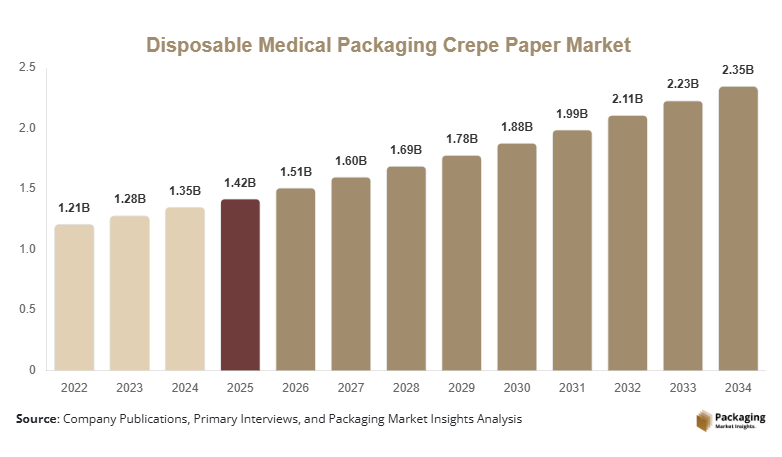
The global disposable medical packaging crepe paper market size is estimated at USD 1.42 billion in 2025, while the market is projected to reach USD 1.51 billion in 2026. By 2034, the industry is forecasted to achieve a value of approximately USD 2.48 billion, expanding at a CAGR of 5.7% during 2025–2034. The disposable medical packaging crepe paper market is experiencing steady expansion due to the growing need for sterile packaging solutions across hospitals, clinics, ambulatory surgical centers, and medical device manufacturing facilities. Disposable medical packaging crepe paper is widely used for wrapping surgical instruments and sterilized medical products because of its durability, breathability, microbial barrier properties, and compatibility with sterilization methods such as steam, ethylene oxide, and gamma radiation.
One of the major growth factors driving the market is the increasing volume of surgical procedures globally. Aging populations and the rising prevalence of chronic diseases are increasing hospital admissions and surgical interventions, creating higher demand for sterile packaging products. Another factor supporting market growth is the expansion of healthcare infrastructure in emerging economies. Governments and private healthcare providers are investing heavily in hospitals, diagnostic laboratories, and outpatient facilities, thereby increasing the consumption of disposable medical packaging materials.
Key Highlights
- Asia Pacific dominated the market with a 36.8% share in 2025.
- Latin America is projected to grow at the fastest CAGR of 6.3%.
- Standard crepe paper led the product type segment with a 48.7% share.
- Hospitals dominated the end-use segment with a 54.1% share.
- Surgical instrument packaging led the application segment with 46.5% share.
- The US remained the dominant country with a market size of USD 214 million in 2025 and USD 227 million in 2026.
Explore more data points, trends and opportunities Download Free Sample Report
Market Trends
Increasing Adoption of Sustainable and Recyclable Medical Packaging
Sustainability is becoming an important trend in the disposable medical packaging crepe paper market as healthcare providers and manufacturers focus on reducing environmental impact. Hospitals and medical institutions are increasingly adopting recyclable and biodegradable packaging materials to align with environmental regulations and waste reduction goals. Manufacturers are developing crepe paper products made from responsibly sourced pulp and chlorine-free processing methods. This trend is particularly visible in Europe and North America, where healthcare systems are emphasizing green procurement policies. Recyclable medical crepe paper also helps organizations reduce disposal costs while maintaining sterilization efficiency. The shift toward sustainable packaging solutions is expected to encourage further innovation in lightweight and low-emission production technologies during the forecast period.
Integration of High-Performance Sterile Barrier Technologies
Another significant trend shaping the disposable medical packaging crepe paper market is the development of high-performance sterile barrier systems. Manufacturers are improving the strength, porosity, and microbial resistance of crepe paper to support advanced sterilization methods and longer storage periods. Multi-layer crepe paper structures and reinforced fiber technologies are being introduced to improve tear resistance and packaging reliability during transportation. Healthcare facilities are increasingly demanding packaging materials that provide consistent sterility assurance while reducing contamination risks. The trend is also supported by the growing use of custom surgical kits and pre-packaged sterilized instruments. Enhanced sterile barrier technologies are helping healthcare providers improve operational efficiency and maintain compliance with stringent healthcare packaging standards.
Market Drivers
Rising Number of Surgical Procedures Worldwide
The increasing number of surgical procedures globally is one of the primary drivers of the disposable medical packaging crepe paper market. Aging populations, rising incidences of cardiovascular diseases, orthopedic disorders, and cancer treatments are contributing to higher surgical volumes in hospitals and specialty clinics. Every surgical procedure requires sterile instruments and protective packaging to maintain patient safety and reduce contamination risks. Disposable crepe paper is widely preferred because it offers reliable microbial barriers and compatibility with various sterilization techniques. Additionally, expanding healthcare access in emerging economies is increasing the number of healthcare facilities performing surgical procedures, further supporting market demand for sterile medical packaging products.
Growing Focus on Infection Prevention and Sterility Assurance
Healthcare institutions worldwide are strengthening infection prevention protocols to reduce hospital-acquired infections and improve patient outcomes. Disposable medical packaging crepe paper plays a critical role in maintaining sterility during storage, transportation, and handling of surgical instruments. Regulatory agencies are also implementing stricter standards regarding sterile barrier systems and packaging quality. As a result, hospitals and medical device manufacturers are investing in high-quality packaging solutions that provide reliable sterilization performance. The increasing awareness regarding cross-contamination risks in healthcare environments is further driving adoption. In addition, rising healthcare expenditure and modernization of sterilization departments are contributing to the growing demand for disposable crepe paper packaging products across both developed and emerging markets.
Market Restraint
Fluctuating Raw Material Costs and Waste Management Challenges
One of the major restraints affecting the disposable medical packaging crepe paper market is the fluctuation in raw material prices, particularly pulp and specialty paper inputs. Volatility in wood pulp supply chains, transportation costs, and energy prices can significantly impact manufacturing expenses for crepe paper producers. Rising costs often reduce profit margins for manufacturers and increase procurement expenses for healthcare facilities. In addition, the disposable nature of medical packaging products contributes to growing medical waste generation, creating environmental and disposal concerns. Several healthcare institutions are facing pressure to reduce single-use packaging waste while maintaining sterility standards. For example, hospitals in developed regions are increasingly evaluating reusable sterilization systems to reduce disposal costs and comply with sustainability initiatives. These factors may limit market expansion in certain cost-sensitive healthcare environments during the forecast period.
Market Opportunities
Expansion of Healthcare Infrastructure in Emerging Economies
Emerging economies present significant opportunities for the disposable medical packaging crepe paper market due to rapid healthcare infrastructure development. Countries across Asia Pacific, Latin America, and the Middle East are investing in hospitals, diagnostic centers, and surgical facilities to improve healthcare accessibility. Rising government healthcare spending and increasing private investments are supporting the establishment of modern sterilization departments and surgical units. These developments are creating strong demand for sterile packaging materials, including disposable crepe paper products. Furthermore, growing medical tourism in countries such as India, Thailand, and Brazil is increasing the volume of surgical procedures, thereby boosting packaging requirements. Manufacturers are expanding regional production capacities to capitalize on these emerging opportunities.
Development of Advanced Eco-Friendly Packaging Solutions
The growing demand for environmentally responsible healthcare packaging is creating new opportunities for manufacturers to develop advanced eco-friendly crepe paper solutions. Companies are investing in recyclable fibers, biodegradable coatings, and low-emission production processes to meet sustainability objectives. Hospitals and healthcare procurement agencies are increasingly favoring suppliers that offer environmentally compliant packaging products. In addition, innovations in lightweight medical-grade paper are helping reduce material usage while maintaining barrier performance and sterilization compatibility. The adoption of circular economy practices in healthcare packaging is expected to create long-term growth opportunities for companies that prioritize sustainable product development. This opportunity is likely to encourage partnerships between healthcare institutions and packaging manufacturers focused on green technologies.
Report Scope
| Report Metric | Details |
|---|---|
| Market Size in 2025 | USD 1.42 Billion |
| Market Size in 2026 | USD 1.51 Billion |
| Market Size in 2034 | USD 2.48 Billion |
| CAGR | 5.7% (2026-2034) |
| Base Year for Estimation | 2025 |
| Historical Data | 2022-2024 |
| Forecast Period | 2026-2034 |
| Report Coverage | Revenue Forecast, Competitive Landscape, Supply Chain Disruption, Growth Factors, Environment & Regulatory Landscape and Trends |
| Geographies Covered | North America, Europe, APAC, Middle East and Africa, LATAM |
| Countries Covered | U.S., Canada, U.K., Germany, France, Spain, Italy, Russia, Nordic, Benelux, Rest of Europe, China, South Korea, Japan, India, Australia, Singapore, Taiwan, South East Asia, Rest of Asia-Pacific, UAE, Turky, Saudi Arabia, South Africa, Egypt, Nigeria, Rest of MEA, Brazil, Mexico, Argentina, Chile, Colombia, Rest of LATAM |
Explore more data points, trends and opportunities Download Free Sample Report
Segmental Analysis
By Product Type
Standard crepe paper dominated the product type segment in 2024, accounting for approximately 48.7% of the market share. This segment maintains a strong position due to its widespread use in hospital sterilization departments and surgical instrument packaging applications. Standard crepe paper offers effective microbial barrier protection, flexibility, and compatibility with steam sterilization processes. Hospitals and healthcare facilities prefer these products because they are cost-effective and easy to handle during wrapping and storage procedures. The availability of different thickness levels and sheet sizes also supports broader adoption across surgical centers, clinics, and medical device sterilization facilities. In addition, manufacturers continue improving paper strength and porosity to enhance sterilization reliability and reduce contamination risks during transportation and storage.
Reinforced crepe paper is projected to be the fastest-growing subsegment, registering a CAGR of 6.5% during the forecast period. This growth is supported by increasing demand for durable sterile packaging materials capable of handling heavier surgical instruments and custom procedure trays. Reinforced crepe paper provides higher tear resistance and improved barrier performance, making it suitable for high-risk medical applications. Healthcare providers are increasingly adopting reinforced products to improve sterility assurance and reduce packaging failures during transportation. The growing use of advanced sterilization technologies and the expansion of surgical procedure volumes are also contributing to segment growth. Manufacturers are introducing multi-layer reinforced crepe paper solutions to address the evolving needs of healthcare facilities and medical device manufacturers.
By Application
Surgical instrument packaging dominated the application segment in 2024 with a market share of approximately 46.5%. The segment’s leadership is attributed to the extensive use of sterile packaging materials for wrapping reusable surgical tools and instruments in hospitals and clinics. Disposable medical packaging crepe paper is widely utilized because it offers strong microbial protection while maintaining sterilization efficiency. Rising surgical volumes globally are significantly increasing demand for safe and reliable packaging solutions. Furthermore, healthcare facilities are strengthening sterilization standards to reduce healthcare-associated infections and improve patient safety. The adoption of centralized sterile services departments in hospitals has also contributed to increased use of crepe paper for organized and efficient instrument sterilization procedures.
Custom procedure tray packaging is expected to grow at the fastest CAGR of 6.6% over the forecast period. The rising use of pre-packaged surgical kits and disposable medical trays is driving demand for specialized sterile barrier materials. Healthcare providers increasingly prefer custom procedure trays because they improve operational efficiency, reduce preparation time, and minimize contamination risks during surgeries. Disposable crepe paper is being integrated into these packaging systems to ensure sterility throughout transportation and storage. In addition, increasing outpatient surgeries and ambulatory care services are contributing to segment growth. Medical device manufacturers are collaborating with packaging companies to develop customized wrapping materials that meet specific surgical procedure requirements and sterilization standards.
By End-Use
Hospitals dominated the end-use segment in 2024, accounting for nearly 54.1% of the global market share. Large patient volumes, extensive surgical activities, and continuous sterilization requirements make hospitals the largest consumers of disposable medical packaging crepe paper products. Hospitals rely on sterile barrier systems to ensure safe handling and storage of surgical instruments, diagnostic devices, and medical equipment. Growing healthcare investments and modernization of hospital sterilization departments are supporting increased demand for disposable packaging materials. In addition, strict infection prevention protocols and accreditation requirements are encouraging hospitals to adopt reliable medical-grade crepe paper solutions. The segment also benefits from rising numbers of emergency procedures and chronic disease treatments requiring sterile surgical environments.
Ambulatory surgical centers are projected to witness the fastest CAGR of 6.8% during the forecast period. The increasing shift toward outpatient surgeries and minimally invasive procedures is supporting demand for efficient sterile packaging products in these facilities. Ambulatory surgical centers require lightweight and easy-to-handle packaging materials that maintain sterility while supporting rapid procedural workflows. Disposable crepe paper products are gaining popularity because they help reduce contamination risks and simplify sterilization operations. The growth of same-day surgical procedures and cost-effective outpatient care models is further driving adoption. Additionally, expanding healthcare access in emerging markets is leading to the establishment of more ambulatory care facilities, creating new growth opportunities for packaging manufacturers.
Disposable Medical Packaging Crepe Paper Market Segmentations
By Product Type
- Standard Crepe Paper
- Reinforced Crepe Paper
- Multi-Layer Crepe Paper
By Application
- Surgical Instrument Packaging
- Medical Device Packaging
- Custom Procedure Tray Packaging
- Pharmaceutical Packaging
By End-User
- Hospitals
- Ambulatory Surgical Centers
- Clinics
- Medical Device Manufacturers
Regional Analysis
North America
North America accounted for approximately 28.6% of the global disposable medical packaging crepe paper market share in 2025 and is expected to grow at a CAGR of 5.1% during the forecast period. The region benefits from advanced healthcare infrastructure, high surgical procedure volumes, and strong regulatory standards for sterile packaging. The presence of established medical device manufacturers and large hospital networks further supports market demand. Growing healthcare expenditure and increased adoption of infection prevention measures are also contributing to steady regional market expansion.
The United States dominates the North American market due to its large healthcare sector and significant demand for surgical instrument sterilization products. A unique growth factor in the country is the increasing use of customized surgical procedure kits in hospitals and ambulatory surgical centers. These kits require reliable sterile barrier packaging solutions, driving higher demand for high-performance disposable crepe paper products across healthcare facilities.
Europe
Europe held around 25.1% of the global market share in 2025 and is projected to register a CAGR of 5.0% over the forecast period. Strong regulatory compliance requirements regarding sterilization packaging and increasing awareness of healthcare-associated infections are supporting market growth. The region is also witnessing growing adoption of sustainable packaging materials due to environmental regulations and waste reduction initiatives. Healthcare modernization programs across several European countries are further contributing to increased demand for disposable sterile packaging products.
Germany leads the European market owing to its advanced healthcare manufacturing industry and strong hospital infrastructure. One unique growth factor is the country’s emphasis on environmentally sustainable medical packaging solutions. German healthcare institutions are increasingly adopting recyclable sterile barrier materials to reduce healthcare waste while maintaining strict sterilization standards, thereby encouraging innovation in medical-grade crepe paper manufacturing.
Asia Pacific
Asia Pacific dominated the disposable medical packaging crepe paper market with a 36.8% share in 2025 and is expected to grow at a CAGR of 6.4% through 2034. Rapid healthcare infrastructure development, growing surgical procedure volumes, and increasing investments in hospital sterilization systems are driving market expansion across the region. Rising awareness regarding infection control practices and the growing presence of pharmaceutical manufacturing facilities are also supporting demand for disposable sterile packaging materials.
China remains the dominant country in Asia Pacific due to its large healthcare system and expanding medical manufacturing industry. A unique growth factor is the rapid expansion of public hospital construction projects across urban and semi-urban regions. These developments are increasing the procurement of sterilization packaging materials, including disposable crepe paper products, to support modern surgical and medical equipment handling requirements.
Middle East & Africa
The Middle East & Africa region accounted for approximately 5.2% of the market share in 2025 and is projected to grow at a CAGR of 5.6% during the forecast period. Investments in healthcare modernization, increasing hospital construction activities, and rising demand for sterile medical products are contributing to regional growth. Governments across Gulf countries are expanding healthcare spending to improve medical services and strengthen infection prevention systems, supporting demand for disposable packaging solutions.
Saudi Arabia dominates the regional market due to its expanding healthcare infrastructure and growing number of specialized medical centers. A unique growth factor is the increasing focus on healthcare accreditation standards and sterilization compliance in hospitals. Healthcare facilities are investing in reliable sterile barrier systems to meet international healthcare quality requirements, which is driving adoption of disposable medical packaging crepe paper products.
Latin America
Latin America held nearly 4.3% of the global market share in 2025 and is expected to grow at the fastest CAGR of 6.3% during the forecast period. Rising healthcare investments, improving surgical care facilities, and growing awareness regarding infection prevention are supporting market expansion. Increasing imports of medical devices and surgical equipment are also creating higher demand for sterile packaging materials throughout the region.
Brazil is the leading country in the Latin American market due to its large healthcare network and growing private hospital sector. One unique growth factor is the increasing demand for outpatient and minimally invasive surgical procedures. These procedures require sterilized medical kits and instruments, leading to greater adoption of disposable crepe paper packaging solutions among healthcare providers and surgical facilities.
Competitive Landscape
The disposable medical packaging crepe paper market is moderately fragmented, with several global and regional companies competing through product innovation, sterilization compatibility, and sustainability initiatives. Major market participants are investing in advanced medical-grade paper technologies to improve microbial barrier performance, durability, and environmental compliance. Companies are also expanding manufacturing capacities and distribution networks to meet rising global demand from hospitals, medical device manufacturers, and sterilization service providers.
Ahlstrom is recognized as one of the leading companies in the market due to its strong product portfolio and extensive healthcare packaging expertise. In 2024, the company introduced a new recyclable medical crepe paper range designed for high-strength sterilization applications. Other important players include Billerud, Steris Corporation, Dynarex Corporation, and Cardinal Health. These companies are focusing on strategic collaborations, sustainable material development, and customized packaging solutions to strengthen their market positions. Competitive intensity is expected to increase as healthcare facilities demand higher-quality sterile barrier systems and environmentally responsible packaging materials.
Key Players List
- Ahlstrom
- Billerud
- Steris Corporation
- Cardinal Health
- Dynarex Corporation
- Medline Industries
- Halyard Health
- Crosstex International
- Thermo Fisher Scientific
- Amcor plc
- WestRock Company
- Berry Global Group
- DuPont
- Getinge AB
- VP Group
- Sterimed Group
- Winner Medical
- PMS Healthcare Technologies