Direct To Consumer Packaging Market Size And Growth
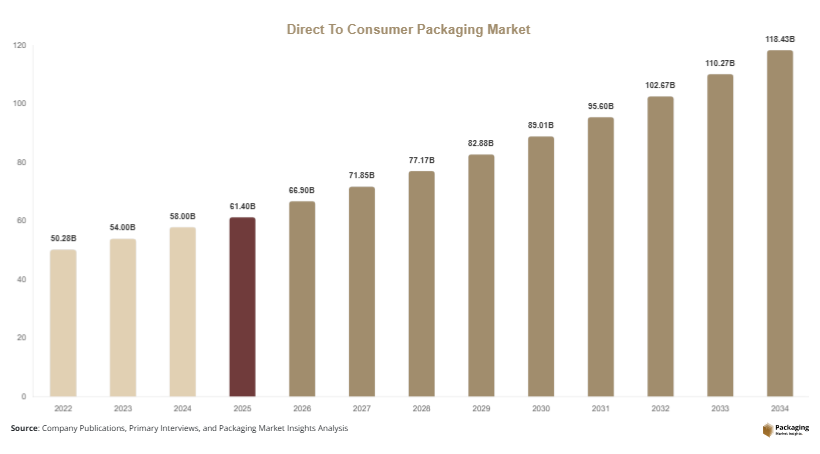
The global direct to consumer packaging market size is estimated at USD 61.4 billion in 2025, reflecting the growing importance of packaging solutions tailored for e-commerce fulfillment. The market is projected to reach approximately USD 66.9 billion in 2026, supported by rising online retail transactions and increasing demand for protective packaging formats such as corrugated boxes, flexible pouches, and recyclable mailers. Over the forecast period, the market is expected to expand significantly, reaching around USD 118.7 billion by 2034, representing a compound annual growth rate (CAGR) of 7.4% from 2025 to 2034.
The direct to consumer packaging market has gained notable momentum in recent years as brands increasingly shift toward e-commerce and direct engagement with customers. Direct-to-consumer (DTC) packaging refers to packaging solutions designed specifically for products shipped directly from brands or manufacturers to consumers through online platforms. These packaging systems are optimized for shipping efficiency, product protection, sustainability, and brand communication. As online retail continues to expand globally, companies are investing in packaging that enhances customer experience while reducing logistics costs.
Key Highlights
- The direct to consumer packaging market is projected to grow from USD 61.4 billion in 2025 to USD 118.7 billion by 2034, registering a CAGR of 7.4% during 2025–2034.
- Market growth is driven by the rapid expansion of e-commerce, increasing sustainability initiatives, and continuous packaging innovation across global supply chains.
- Rising demand from industries such as beauty & personal care, food delivery, and consumer electronics, along with the growing adoption of customized and recyclable packaging solutions, is supporting market expansion.
Explore more data points, trends and opportunities Download Free Sample Report
Market Trends
Rising Adoption of Sustainable and Recyclable Packaging Materials
One of the most prominent direct to consumer packaging market trends is the increasing adoption of sustainable packaging materials. Consumers are becoming more aware of environmental issues such as plastic waste and carbon emissions, prompting brands to shift toward eco-friendly packaging solutions. Corrugated cardboard, molded fiber packaging, paper mailers, and biodegradable films are gaining popularity as companies aim to reduce their environmental footprint. Packaging manufacturers are developing lightweight materials that reduce shipping costs while maintaining durability during transportation.
In addition, regulatory frameworks and sustainability commitments from global brands are encouraging the use of recyclable and compostable packaging formats. Many e-commerce companies are setting ambitious goals to eliminate single-use plastics and transition toward recyclable packaging by the end of the decade. As a result, packaging suppliers are investing in research and development to create innovative materials that meet sustainability requirements without compromising protective performance. This trend is expected to remain a defining characteristic of the market over the forecast period.
Growth of Branded and Personalized Unboxing Experiences
Another key trend shaping the direct to consumer packaging market is the growing emphasis on branded and personalized unboxing experiences. In the direct-to-consumer model, packaging serves not only as a protective layer but also as a marketing channel. Companies increasingly design packaging that reflects their brand identity through custom printing, color schemes, and personalized messages. Digital printing technology allows brands to produce small batches of customized packaging without significant cost increases.
The unboxing experience has also become a powerful tool for social media engagement and customer retention. Many brands encourage customers to share their unboxing experiences on platforms such as video-sharing and social networking sites. As a result, packaging designs are evolving to include aesthetically appealing elements such as tissue wraps, inserts, and product storytelling. This trend has significantly influenced packaging design strategies, particularly among beauty, lifestyle, and premium consumer product brands.
Market Drivers
Rapid Expansion of Global E-Commerce and Online Retail
The continuous expansion of global e-commerce is a primary driver of the direct to consumer packaging market growth. Online retail platforms have significantly changed purchasing behavior, allowing consumers to buy products directly from brands without visiting physical stores. This shift has increased the volume of individual parcel shipments, creating demand for packaging solutions designed specifically for shipping through courier networks.
Direct-to-consumer brands in sectors such as fashion, electronics, and personal care rely heavily on packaging that protects products during transportation while maintaining brand aesthetics. Additionally, logistics providers are encouraging the use of right-sized packaging to reduce shipping costs and improve warehouse efficiency. As e-commerce continues to grow across emerging markets and urban populations, the demand for innovative packaging solutions will expand further.
Increasing Focus on Product Protection and Logistics Efficiency
Another key driver influencing the direct to consumer packaging market is the growing need for efficient product protection during shipping. Products shipped through parcel delivery networks are often exposed to multiple handling points, vibrations, and varying environmental conditions. This creates the need for packaging materials that offer cushioning, structural strength, and tamper resistance.
Packaging manufacturers are developing innovative designs such as multi-layer corrugated boxes, flexible protective mailers, and inflatable cushioning systems. These solutions help reduce product damage rates, which can otherwise lead to costly returns and negative customer experiences. As logistics networks become more complex and globalized, companies are investing in packaging systems that balance durability, cost efficiency, and sustainability.
Market Restraint
Rising Raw Material Costs and Supply Chain Volatility
Despite strong growth prospects, the direct to consumer packaging market faces challenges related to fluctuating raw material costs and supply chain disruptions. Packaging materials such as paperboard, plastics, and specialty films are influenced by global commodity prices, energy costs, and availability of raw inputs. Sudden price increases can affect packaging manufacturers and reduce profit margins, particularly for companies operating with long-term supply contracts.
Supply chain volatility has also created challenges for packaging producers and e-commerce companies. Delays in material availability or transportation disruptions can affect production schedules and fulfillment operations. For instance, shortages of corrugated paperboard during periods of high e-commerce demand have previously caused bottlenecks in packaging supply. Such fluctuations may limit market expansion and force companies to explore alternative materials or redesign packaging formats to reduce dependency on specific raw materials.
Market Opportunities
Expansion of Direct-to-Consumer Brands and Subscription Services
The growth of digital-native brands and subscription services presents significant opportunities for the direct to consumer packaging market. Many emerging brands prefer to sell directly to consumers through online channels rather than traditional retail networks. Subscription models for products such as cosmetics, meal kits, health supplements, and pet supplies require recurring shipments, creating consistent demand for packaging solutions.
These companies often prioritize packaging designs that reinforce brand identity and enhance the customer experience. Customized boxes, inserts, and protective layers are used to create memorable unboxing experiences that strengthen brand loyalty. As subscription commerce continues to expand globally, packaging manufacturers have the opportunity to develop tailored solutions that meet the specific requirements of recurring shipments.
Integration of Smart and Connected Packaging Technologies
The adoption of smart packaging technologies is another emerging opportunity within the direct to consumer packaging market. Technologies such as QR codes, NFC tags, and digital authentication labels allow brands to connect packaging with digital platforms. Consumers can scan packaging to access product information, authenticity verification, and promotional content.
Smart packaging also enables improved supply chain visibility by allowing companies to track shipments and monitor environmental conditions during transit. For example, temperature-sensitive products such as cosmetics or food items may use sensors integrated into packaging to maintain quality. As brands seek to create interactive and technology-enabled customer experiences, smart packaging solutions are expected to gain traction in the coming years.
Report Scope
| Report Metric | Details |
|---|---|
| Market Size in 2025 | USD 61.4 Billion |
| Market Size in 2026 | USD 66.9 Billion |
| Market Size in 2034 | USD 118.7 Billion |
| CAGR | 7.4% (2026-2034) |
| Base Year for Estimation | 2025 |
| Historical Data | 2022-2024 |
| Forecast Period | 2026-2034 |
| Report Coverage | Revenue Forecast, Competitive Landscape, Supply Chain Disruption, Growth Factors, Environment & Regulatory Landscape and Trends |
| Geographies Covered | North America, Europe, APAC, Middle East and Africa, LATAM |
| Countries Covered | U.S., Canada, U.K., Germany, France, Spain, Italy, Russia, Nordic, Benelux, Rest of Europe, China, South Korea, Japan, India, Australia, Singapore, Taiwan, South East Asia, Rest of Asia-Pacific, UAE, Turky, Saudi Arabia, South Africa, Egypt, Nigeria, Rest of MEA, Brazil, Mexico, Argentina, Chile, Colombia, Rest of LATAM |
Explore more data points, trends and opportunities Download Free Sample Report
Segmental Analysis
By Material Type
The corrugated packaging segment held the dominant position in the direct to consumer packaging market, accounting for approximately 46% of the total market share in 2024. Corrugated boxes are widely used due to their strength, cost-effectiveness, and recyclability. These boxes provide reliable protection for products shipped through parcel delivery networks and are compatible with automated packaging equipment used in fulfillment centers. Additionally, corrugated materials can be easily customized with printed branding and structural designs tailored to specific product categories. Many e-commerce companies prefer corrugated packaging because it can withstand compression and stacking during transit. The availability of recyclable and lightweight corrugated solutions has further strengthened their adoption among companies focusing on sustainable packaging strategies.
The flexible packaging segment is projected to be the fastest-growing material category, registering a CAGR of around 8.6% during the forecast period. Flexible mailers, padded envelopes, and polybags are gaining popularity due to their lightweight structure and reduced shipping costs. These packaging formats are particularly suitable for shipping apparel, accessories, and small consumer goods. Companies are also developing recyclable and biodegradable flexible packaging materials to meet sustainability targets. The rapid expansion of online fashion retail and small parcel shipments has significantly increased the demand for flexible packaging solutions. As logistics providers prioritize weight reduction and space efficiency, flexible packaging is expected to experience strong growth in the coming years.
By Packaging Type
The boxes and cartons segment dominated the direct to consumer packaging market, capturing around 51% of the market share in 2024. Boxes and cartons provide superior protection for fragile or high-value items such as electronics, cosmetics, and home appliances. These packaging formats also offer large surface areas for branding and product information, which helps companies enhance their marketing strategies. In addition, boxes can be designed with inserts and cushioning materials that secure products during shipping. The widespread use of corrugated boxes in e-commerce fulfillment operations has further strengthened their market position. Their compatibility with automated packing systems and stacking efficiency makes them the preferred packaging format for large-scale e-commerce companies.
The protective mailers segment is expected to grow at the fastest rate, with an estimated CAGR of approximately 8.2% during the forecast period. Protective mailers combine lightweight design with built-in cushioning materials, providing adequate protection for smaller products while reducing shipping costs. Many companies are adopting paper-based padded mailers and recyclable bubble mailers to meet sustainability objectives. The rapid growth of online marketplaces selling small consumer products, including accessories, cosmetics, and electronics components, has increased the demand for these packaging formats. As brands continue to optimize shipping costs and reduce packaging waste, protective mailers are likely to gain further traction across the global market.
By End-Use Industry
The consumer electronics segment accounted for the largest share of the direct to consumer packaging market in 2024, representing approximately 29% of the total market. Electronics products require durable packaging solutions that provide shock absorption, moisture protection, and tamper resistance during shipping. Packaging designs often include foam inserts, molded pulp trays, or air cushions to secure products within boxes. The rapid growth of online sales of smartphones, accessories, and home electronics has significantly increased the demand for specialized packaging solutions in this segment. Additionally, companies are focusing on sustainable alternatives to plastic cushioning materials while maintaining high levels of product protection.
The beauty and personal care segment is expected to grow at the fastest rate, with a projected CAGR of around 9.1% during the forecast period. Direct-to-consumer beauty brands frequently rely on packaging as a key branding tool, emphasizing visually appealing designs and premium materials. Customized packaging inserts, printed tissue paper, and branded boxes are commonly used to enhance the customer experience. The rapid expansion of subscription beauty boxes and online skincare brands has further accelerated demand for innovative packaging solutions. As consumer preferences shift toward personalized and premium product experiences, the beauty and personal care sector is expected to remain a major growth driver for the market.
Direct To Consumer Packaging Market Segmentations
Material Type
- Corrugated Packaging
- Flexible Packaging
- Paper & Paperboard
- Plastic Packaging
Packaging Type
- Boxes & Cartons
- Protective Mailers
- Bags & Pouches
- Inserts & Cushioning
End-Use Industry
- Consumer Electronics
- Beauty & Personal Care
- Food & Beverage
- Apparel & Fashion
- Household Products
Regional Analysis
North America
North America accounted for approximately 34% of the global direct to consumer packaging market share in 2025, making it the largest regional market. The region is projected to grow at a CAGR of around 6.8% during the forecast period. Strong e-commerce penetration, advanced logistics infrastructure, and widespread adoption of online retail platforms support the demand for packaging designed for parcel shipments. In addition, many direct-to-consumer brands originate in the United States and Canada, driving innovation in packaging design.
The United States dominates the regional market due to its highly developed e-commerce ecosystem and strong presence of online retailers. A key growth factor is the rapid expansion of fulfillment centers and automated warehouses across the country. Companies are investing in packaging solutions optimized for automated packaging lines, which improves operational efficiency and reduces labor requirements. This shift is expected to further strengthen the demand for specialized packaging formats.
Europe
Europe held roughly 27% of the global direct to consumer packaging market share in 2025 and is expected to grow at a CAGR of about 6.9% during the forecast period. The region’s strong regulatory focus on sustainable packaging and waste reduction has significantly influenced market dynamics. Packaging manufacturers are increasingly developing recyclable and biodegradable packaging formats to comply with environmental policies and consumer expectations.
Germany represents the dominant country within the European market due to its advanced manufacturing capabilities and strong logistics infrastructure. A unique growth factor in the region is the rapid adoption of circular economy practices. Companies are investing in packaging solutions designed for reuse or recycling, enabling them to meet regulatory requirements while maintaining product protection during transportation.
Asia Pacific
Asia Pacific represented around 24% of the global direct to consumer packaging market share in 2025 and is projected to register the fastest growth with a CAGR of approximately 8.5% during the forecast period. Rapid urbanization, increasing internet penetration, and expanding middle-class populations are driving the growth of e-commerce across countries such as China, India, and Southeast Asian markets.
China dominates the regional market due to its massive online retail ecosystem and extensive logistics network. A unique growth factor in the country is the widespread adoption of same-day and next-day delivery services. These rapid delivery models require packaging solutions that are lightweight, durable, and compatible with automated sorting systems, encouraging innovation in packaging materials and formats.
Middle East & Africa
The Middle East & Africa accounted for approximately 7% of the global direct to consumer packaging market share in 2025 and is expected to grow at a CAGR of around 7.2% during the forecast period. Growth in the region is driven by expanding digital infrastructure and increasing adoption of online retail platforms. Governments are also investing in logistics hubs and transportation networks to support e-commerce growth.
The United Arab Emirates is the leading market in the region due to its advanced logistics infrastructure and strong e-commerce penetration. A unique growth factor is the country’s position as a regional distribution hub for international brands. Many companies use the UAE as a central location for fulfilling orders across the Middle East, increasing demand for packaging solutions tailored for cross-border shipments.
Latin America
Latin America captured approximately 8% of the global direct to consumer packaging market share in 2025 and is projected to grow at a CAGR of around 7.6% during the forecast period. Rising internet access, smartphone adoption, and digital payment systems are encouraging consumers to shop online, which in turn increases demand for packaging designed for direct shipments.
Brazil dominates the regional market due to its large consumer base and rapidly expanding e-commerce sector. A unique growth factor in the country is the growing presence of local direct-to-consumer brands in sectors such as beauty, fashion, and food products. These brands often rely on creative packaging designs to differentiate themselves in competitive online marketplaces.
Competitive Landscape
The direct to consumer packaging market is characterized by the presence of several global packaging manufacturers as well as regional suppliers specializing in e-commerce packaging solutions. Companies compete on factors such as material innovation, sustainability initiatives, customization capabilities, and supply chain efficiency. Strategic partnerships with e-commerce platforms and logistics providers are becoming increasingly important as packaging manufacturers seek to expand their market presence.
Among the leading players, Amcor is widely recognized as a key market leader due to its extensive portfolio of flexible and rigid packaging solutions. The company has invested heavily in recyclable and lightweight materials tailored for e-commerce applications. Other major companies include DS Smith, Mondi Group, Smurfit Kappa, and WestRock, which focus on corrugated packaging and sustainable packaging technologies.
A recent development in the industry includes the expansion of automated packaging solutions and digital printing capabilities to support customized direct-to-consumer packaging formats. These innovations allow companies to meet the growing demand for personalized packaging while improving operational efficiency in large fulfillment centers.
Key Players List
- Amcor
- DS Smith
- Mondi Group
- Smurfit Kappa
- WestRock
- International Paper
- Sealed Air
- Stora Enso
- Packaging Corporation of America
- Berry Global
- Sonoco Products Company
- Georgia-Pacific
- UFP Packaging
- Ranpak
- ProAmpac