Diagnostic Test Kits Packaging Market Size and Growth
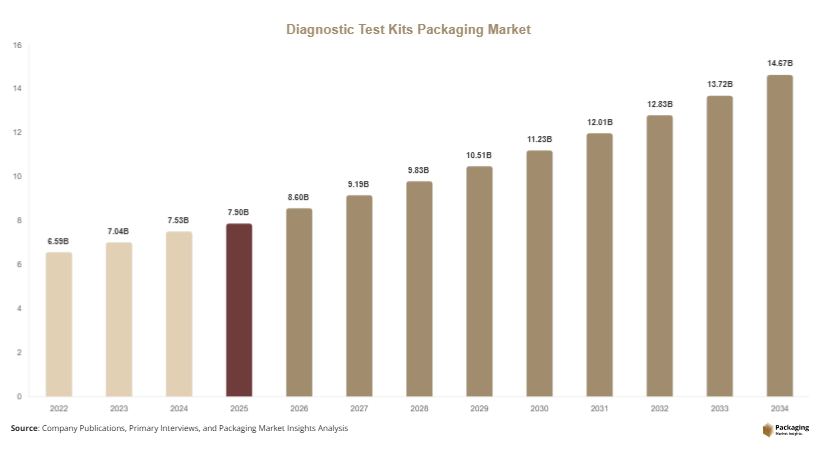
The global diagnostic test kits packaging market size was valued at USD 7.9 billion in 2025 and is projected to reach USD 8.6 billion in 2026, further expanding to approximately USD 15.8 billion by 2034, registering a CAGR of 6.9% during the forecast period (2025–2034). Packaging for diagnostic test kits plays a critical role in maintaining the integrity, sterility, and accuracy of testing components, including reagents, swabs, and cartridges. The diagnostic test kits packaging market is experiencing steady expansion due to the rising demand for diagnostic testing across healthcare systems, research laboratories, and home-based care settings.
One of the primary growth factors is the increasing prevalence of infectious diseases and chronic conditions, which has led to higher demand for diagnostic testing. This trend is driving the need for reliable and protective packaging solutions. Another key factor is the growing adoption of point-of-care and home-based diagnostic kits. These kits require compact, user-friendly, and durable packaging to ensure safe handling and accurate results. Additionally, the expansion of healthcare infrastructure, particularly in emerging economies, is boosting demand for diagnostic test kits and associated packaging.
Key Highlights:
- Asia Pacific dominated the market with a 38.1% share in 2025, while Latin America is projected to grow at the fastest CAGR of 7.3%.
- Flexible packaging led the type segment with a 41.7% share, while rigid packaging is expected to grow at a CAGR of 6.8%.
- Plastic packaging dominated with a 55.2% share, while paper-based packaging is forecasted to grow at a CAGR of 6.5%.
- Clinical diagnostics applications led the segment with 62.4% share, while home diagnostics is expected to grow at a CAGR of 7.5%.
- China remained the dominant country with a market size of USD 2.4 billion in 2025 and USD 2.6 billion in 2026.
Explore more data points, trends and opportunities Download Free Sample Report
Market Trends
Rising adoption of sustainable and recyclable packaging solutions
Sustainability is emerging as a significant trend in the diagnostic test kits packaging market. Manufacturers are increasingly adopting recyclable and biodegradable materials to reduce environmental impact. This shift is driven by regulatory pressure and growing awareness among healthcare providers and consumers. Companies are redesigning packaging formats to minimize material usage while maintaining product safety and functionality. Additionally, innovations in material science are enabling the development of eco-friendly packaging solutions with improved barrier properties. This trend is expected to continue as sustainability becomes a key focus area in the healthcare packaging industry.
Increasing demand for compact and user-friendly packaging designs
The demand for compact and user-friendly packaging designs is increasing in the diagnostic test kits packaging market. Packaging solutions that offer ease of use, portability, and clear instructions are gaining popularity, particularly for home-based diagnostic kits. Manufacturers are focusing on developing packaging formats that simplify the testing process and enhance user experience. Features such as pre-measured components, easy-open seals, and integrated instructions are becoming common. This trend is driven by the growing adoption of self-testing kits and the need for convenient diagnostic solutions.
Market Drivers
Growing demand for diagnostic testing due to rising disease prevalence
The increasing prevalence of infectious and chronic diseases is a major driver of the diagnostic test kits packaging market. Healthcare systems are focusing on early detection and monitoring, leading to higher demand for diagnostic testing. This trend is driving the need for packaging solutions that ensure the safety and accuracy of test kits. Additionally, government initiatives to improve healthcare access and disease surveillance are supporting market growth. As the demand for diagnostic testing continues to rise, the need for reliable packaging solutions is expected to increase.
Expansion of point-of-care and home-based diagnostic testing
The expansion of point-of-care and home-based diagnostic testing is significantly contributing to market growth. These testing methods require packaging solutions that are compact, durable, and easy to use. Packaging plays a crucial role in ensuring the integrity of test components and preventing contamination. The rise of telemedicine and remote healthcare services is further supporting this trend. As more consumers adopt home-based testing, the demand for innovative packaging solutions is expected to grow.
Market Restraint
Stringent regulatory requirements and complex compliance standards
The diagnostic test kits packaging market faces challenges related to stringent regulatory requirements and complex compliance standards. Packaging for diagnostic test kits must meet strict guidelines to ensure product safety, sterility, and accuracy. Compliance with these regulations requires significant investment in testing, certification, and quality assurance processes. Small and medium-sized manufacturers may find it difficult to meet these requirements, limiting market entry and competition. Additionally, frequent changes in regulations can create uncertainty and increase operational complexity. These factors can act as a barrier to market growth, particularly in developing regions where resources may be limited.
Market Opportunities
Increasing demand in emerging markets with expanding healthcare infrastructure
The expansion of healthcare infrastructure in emerging markets presents significant growth opportunities for the diagnostic test kits packaging market. Countries in Asia, Latin America, and Africa are investing in healthcare facilities and diagnostic services, increasing the demand for test kits and packaging solutions. Government initiatives to improve healthcare access and disease detection are supporting market growth. Local manufacturers are entering the market, improving product availability and affordability. This opportunity is expected to contribute significantly to market expansion during the forecast period.
Advancements in smart packaging and temperature-controlled solutions
Technological advancements in packaging are creating new opportunities in the diagnostic test kits packaging market. Smart packaging solutions, such as QR codes and RFID tags, are being integrated to improve product traceability and provide additional information to users. Temperature-controlled packaging solutions are also gaining importance, particularly for test kits that require specific storage conditions. These innovations are enhancing product safety and performance, helping manufacturers meet the evolving needs of the market. As technology adoption increases, the demand for advanced packaging solutions is expected to grow.
Report Scope
| Report Metric | Details |
|---|---|
| Market Size in 2025 | USD 7.9 Billion |
| Market Size in 2026 | USD 8.6 Billion |
| Market Size in 2034 | USD 15.8 Billion |
| CAGR | 6.9% (2026-2034) |
| Base Year for Estimation | 2025 |
| Historical Data | 2022-2024 |
| Forecast Period | 2026-2034 |
| Report Coverage | Revenue Forecast, Competitive Landscape, Supply Chain Disruption, Growth Factors, Environment & Regulatory Landscape and Trends |
| Geographies Covered | North America, Europe, APAC, Middle East and Africa, LATAM |
| Countries Covered | U.S., Canada, U.K., Germany, France, Spain, Italy, Russia, Nordic, Benelux, Rest of Europe, China, South Korea, Japan, India, Australia, Singapore, Taiwan, South East Asia, Rest of Asia-Pacific, UAE, Turky, Saudi Arabia, South Africa, Egypt, Nigeria, Rest of MEA, Brazil, Mexico, Argentina, Chile, Colombia, Rest of LATAM |
Explore more data points, trends and opportunities Download Free Sample Report
Segmental Analysis
By Packaging Type
Flexible packaging accounted for the largest share of approximately 41.7% in 2024. This segment dominates due to its lightweight nature, cost efficiency, and versatility. Flexible packaging formats such as pouches and films are widely used for diagnostic test kits. The segment is supported by advancements in material technology that enhance barrier properties and product safety.
Rigid packaging is expected to grow at the fastest CAGR of 6.8% during the forecast period. This segment includes containers, trays, and boxes that provide enhanced protection for test kits. The increasing demand for durable packaging solutions is driving growth in this segment.
By Material
Plastic materials accounted for the largest share of 55.2% in 2024. These materials are widely used due to their durability, flexibility, and cost efficiency. Plastic packaging provides excellent protection for diagnostic test kits, ensuring product stability and safety.
Paper-based materials are expected to grow at a CAGR of 6.5%. Increasing environmental concerns are driving the adoption of sustainable materials. Paper-based packaging offers environmental benefits while maintaining product functionality.
By Application
Clinical diagnostics accounted for the largest share of 62.4% in 2024. This segment includes laboratory and hospital-based diagnostic testing. The growth of this segment is driven by increasing demand for accurate and reliable diagnostic solutions.
Home diagnostics is expected to grow at a CAGR of 7.5%. The rising adoption of self-testing kits is driving demand in this segment. Packaging solutions for home diagnostics are focusing on convenience and ease of use.
Diagnostic Test Kits Packaging Market Segmentations
By Product Type
- Flexible Packaging
- Rigid Packaging
- Hybrid Packaging
By Application
- Clinical Diagnostics
- Home Diagnostics
- Research Laboratories
By Distribution Channel
- Hospitals & Clinics
- Diagnostic Laboratories
- E-commerce Platforms
Regional Analysis
North America
North America accounted for approximately 23.8% of the diagnostic test kits packaging market share in 2025 and is projected to grow at a CAGR of 6.2% during the forecast period. The region benefits from a well-established healthcare system and high demand for diagnostic testing. Increasing adoption of advanced packaging technologies is supporting market growth.
The United States dominates the regional market, driven by strong demand for diagnostic test kits and advanced healthcare infrastructure. A unique growth factor is the widespread adoption of home-based testing solutions, which is driving demand for user-friendly packaging.
Europe
Europe held a market share of 24.7% in 2025 and is expected to grow at a CAGR of 6.4%. The region is characterized by strict regulatory standards and a strong focus on sustainability. These factors are driving the adoption of eco-friendly packaging solutions.
Germany is the leading country in the European market, supported by advanced manufacturing capabilities. A unique growth factor is the region’s emphasis on reducing medical waste through sustainable packaging initiatives.
Asia Pacific
Asia Pacific dominated the market with a 38.1% share in 2025 and is projected to grow at a CAGR of 7.1%. Rapid population growth, increasing healthcare access, and rising disease prevalence are key drivers of market growth.
China leads the Asia Pacific market due to its large healthcare sector and growing demand for diagnostic testing. A unique growth factor is the increasing investment in healthcare infrastructure and diagnostic services.
Middle East & Africa
The Middle East & Africa region accounted for 6.5% of the market share in 2025 and is expected to grow at a CAGR of 6.6%. Growth is driven by improving healthcare infrastructure and increasing awareness of disease detection.
The United Arab Emirates is the dominant country in this region, supported by a growing healthcare sector. A unique growth factor is the expansion of diagnostic laboratories and testing facilities.
Latin America
Latin America held a 6.9% market share in 2025 and is projected to grow at the fastest CAGR of 7.3%. The region is witnessing increasing demand for diagnostic testing due to improving healthcare access.
Brazil dominates the market in this region, supported by a large population and expanding healthcare services. A unique growth factor is the increasing focus on disease prevention and early diagnosis.
Competitive Landscape
The diagnostic test kits packaging market is moderately competitive, with several global and regional players focusing on innovation and sustainability. Companies are investing in advanced packaging technologies to improve product safety and reduce environmental impact. Strategic collaborations and acquisitions are common strategies for expanding market presence.
Amcor plc is a leading player in the market, known for its innovative packaging solutions. The company recently introduced advanced packaging technologies for diagnostic applications. Other key players are also focusing on expanding their product portfolios and improving manufacturing capabilities to remain competitive.
Key Players List
- Amcor plc
- Berry Global Inc.
- Gerresheimer AG
- Constantia Flexibles
- WestRock Company
- Sonoco Products Company
- Sealed Air Corporation
- AptarGroup Inc.
- Tekni-Plex Inc.
- Winpak Ltd.
- UFlex Ltd.
- DS Smith Plc
- Huhtamaki Oyj
- Clondalkin Group
- Coveris Holdings S.A.