Cryogenic Labels Market Size and Growth
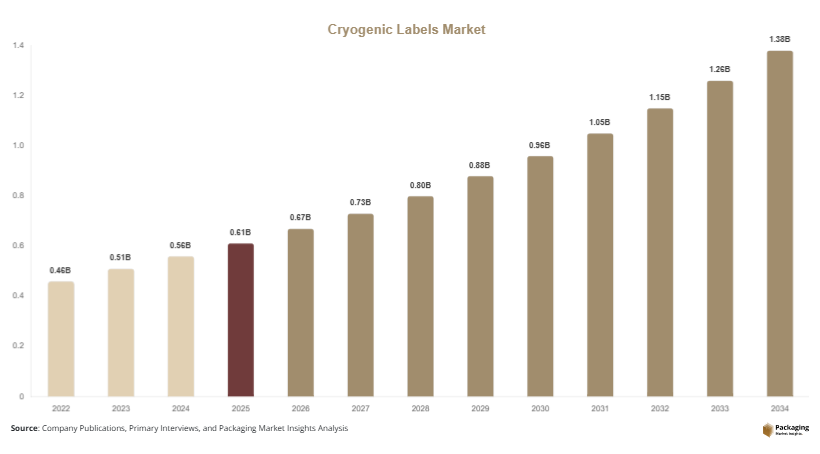
The global cryogenic labels market size is estimated at approximately USD 0.612 billion in 2025, while in 2026, it is projected to reach around USD 0.668 billion, driven by increasing adoption in biobanking and vaccine storage applications. By 2034, the market is expected to reach nearly USD 1.38 billion, expanding at a CAGR of 9.5% (2025–2034). The cryogenic labels market is witnessing steady expansion due to increasing demand for ultra-low temperature storage solutions in biotechnology, pharmaceuticals, blood banks, and clinical research laboratories. These labels are designed to withstand extreme freezing conditions, typically ranging from -80°C to -196°C, without losing adhesion, readability, or structural integrity.
Growth in this market is primarily driven by three key factors. First, the rapid expansion of biopharmaceutical research and development activities is increasing demand for reliable sample identification systems under extreme temperature conditions. Second, the rising number of biobanks and genomic research centers globally is significantly boosting consumption of cryogenic labeling solutions. Third, increasing vaccine development and cold-chain logistics requirements post-pandemic have strengthened demand for temperature-resistant labeling technologies.
Key Highlights:
- North America dominated the market with a 38.2% share in 2025.
- Europe held a 27.5% share in 2025.
- Asia Pacific is projected to grow at the fastest CAGR of 10.4%.
- Polyester-based labels led the material segment with a 46.8% share in 2024.
- Biobanking dominated the application segment with a 49.3% share in 2024.
- Pharmaceutical companies led the end-use segment with a 51.2% share in 2024.
- The US remained the dominant country with a market size of USD 612 million in 2025 and USD 668 million in 2026.
Explore more data points, trends and opportunities Download Free Sample Report
Market Trends
Adoption of Ultra-Durable Polymer-Based Cryogenic Labels
The cryogenic labels market is witnessing increasing adoption of advanced polymer-based materials such as polyester, polypropylene, and polyethylene blends designed to withstand extreme cryogenic conditions. These labels maintain adhesion even when exposed to liquid nitrogen and ultra-low freezer environments. Manufacturers are focusing on enhancing chemical resistance, moisture stability, and barcode readability under long-term storage conditions. The trend is particularly strong in pharmaceutical laboratories and biobanks, where sample integrity is critical. Additionally, demand for laser-printable and smudge-resistant cryogenic labels is rising, enabling improved tracking accuracy in automated laboratory systems. This shift toward durable material innovation is improving operational reliability in research and clinical environments.
Integration of Digital Tracking and Barcode Labeling Systems
Another key trend in the cryogenic labels market is the integration of digital identification technologies such as 2D barcodes, QR codes, and RFID-enabled labeling systems. Laboratories are increasingly adopting automated tracking systems to manage large-scale biological sample inventories. These smart labeling solutions enable real-time monitoring, reduce manual errors, and enhance traceability in biobanking operations. Pharmaceutical companies are also integrating cryogenic labels with laboratory information management systems (LIMS), improving data synchronization and compliance. This trend is expected to accelerate as laboratories shift toward fully digitized workflows.
Market Drivers
Expansion of Biobanking and Genomic Research
The rapid growth of biobanks and genomic research institutions is a major driver of the cryogenic labels market. These facilities store millions of biological samples under extremely low temperatures for long-term research and diagnostic applications. Accurate sample identification is essential to prevent data loss or contamination, increasing demand for high-performance cryogenic labeling systems. Governments and private organizations are investing heavily in genomics and precision medicine, further boosting demand for reliable labeling solutions. As a result, cryogenic labels are becoming essential components of modern biomedical research infrastructure.
Rising Demand for Cold Chain Pharmaceutical Storage
The increasing demand for cold-chain logistics in pharmaceutical distribution is another major driver of market growth. Vaccines, biologics, and cell-based therapies require strict temperature-controlled environments, necessitating durable labeling solutions that remain readable under freezing conditions. Pharmaceutical companies are expanding global cold-chain networks, increasing usage of cryogenic labels for tracking and identification. This is particularly important for vaccine distribution programs and advanced biologics that require long-term frozen storage and transportation.
Market Restraint
High Cost and Limited Standardization of Cryogenic Labeling Solutions
A major restraint in the cryogenic labels market is the relatively high cost of advanced labeling materials and printing technologies. Cryogenic labels require specialized adhesives, synthetic substrates, and temperature-resistant inks, which significantly increase production costs compared to conventional labels. Small laboratories and research facilities often face budget constraints, limiting adoption of premium labeling solutions.
Additionally, lack of global standardization in labeling formats and compliance requirements creates operational complexity. Different laboratories and pharmaceutical companies use varied labeling systems, which leads to inefficiencies in sample tracking and interoperability issues. In developing regions, limited awareness of advanced cryogenic labeling technologies further slows adoption. These cost and standardization challenges collectively restrict market penetration, particularly in price-sensitive economies.
Market Opportunities
Growth in Personalized Medicine and Cell Therapy
The increasing adoption of personalized medicine and cell-based therapies presents a significant opportunity for the cryogenic labels market. These therapies require long-term storage of patient-specific biological samples under cryogenic conditions. Accurate labeling is critical for ensuring sample integrity and traceability throughout treatment cycles. As pharmaceutical companies invest in precision medicine, demand for high-performance cryogenic labels is expected to increase significantly.
Expansion of Automated Laboratory Systems
The rising adoption of laboratory automation systems offers strong growth potential. Automated sample handling, storage, and retrieval systems require machine-readable labeling solutions such as barcode and RFID-enabled cryogenic labels. Integration with digital laboratory management platforms improves efficiency and reduces human error. As laboratories transition toward smart infrastructure, demand for compatible cryogenic labeling systems will continue to expand.
Report Scope
| Report Metric | Details |
|---|---|
| Market Size in 2025 | USD 0.612 Billion |
| Market Size in 2026 | USD 0.668 Billion |
| Market Size in 2034 | USD 1.38 Billion |
| CAGR | 9.5% (2026-2034) |
| Base Year for Estimation | 2025 |
| Historical Data | 2022-2024 |
| Forecast Period | 2026-2034 |
| Report Coverage | Revenue Forecast, Competitive Landscape, Supply Chain Disruption, Growth Factors, Environment & Regulatory Landscape and Trends |
| Geographies Covered | North America, Europe, APAC, Middle East and Africa, LATAM |
| Countries Covered | U.S., Canada, U.K., Germany, France, Spain, Italy, Russia, Nordic, Benelux, Rest of Europe, China, South Korea, Japan, India, Australia, Singapore, Taiwan, South East Asia, Rest of Asia-Pacific, UAE, Turky, Saudi Arabia, South Africa, Egypt, Nigeria, Rest of MEA, Brazil, Mexico, Argentina, Chile, Colombia, Rest of LATAM |
Explore more data points, trends and opportunities Download Free Sample Report
Segmental Analysis
By Material Type
The material type segment of the cryogenic labels market is dominated by polyester-based cryogenic labels, accounting for approximately 46.8% share in 2024. Polyester labels are widely preferred due to their high durability, chemical resistance, and ability to withstand extreme cryogenic temperatures without losing adhesion or readability. These labels are extensively used in biobanks, pharmaceutical laboratories, and clinical research facilities where long-term sample storage is required. Their resistance to moisture, solvents, and frost makes them ideal for liquid nitrogen environments and ultra-low freezer storage systems.
The fastest-growing subsegment is polypropylene-based cryogenic labels, projected to expand at a CAGR of 10.1% through 2034, driven by cost efficiency and flexibility. Polypropylene labels offer a balance between durability and affordability, making them suitable for small and mid-sized laboratories. Increasing adoption of automated labeling systems is further driving demand for polypropylene materials due to their compatibility with high-speed printing and scanning systems. Additionally, improvements in adhesive technology are enhancing their performance in extreme temperature conditions, expanding their usage across research and diagnostic applications.
By Application
The application segment is led by biobanking, accounting for approximately 49.3% share in 2024. Biobanks store large volumes of biological samples, including blood, tissues, and DNA, for long-term research and clinical applications. Accurate labeling is critical in these environments to ensure traceability and prevent sample mix-ups. Cryogenic labels are essential for maintaining sample identity under extreme storage conditions, making them a core component of biobanking operations worldwide.
The fastest-growing subsegment is clinical diagnostics, projected to grow at a CAGR of 10.6% through 2034, driven by increasing diagnostic testing volumes and expansion of laboratory networks. Clinical laboratories require reliable labeling systems to manage high sample throughput while maintaining accuracy and compliance. Rising prevalence of infectious diseases and chronic conditions is increasing demand for diagnostic testing, further boosting adoption of cryogenic labels. Integration of digital tracking systems and automated laboratory workflows is also enhancing efficiency and supporting strong growth in this segment.
By End Use
The end-use segment is dominated by pharmaceutical companies, accounting for approximately 51.2% share in 2024. Pharmaceutical companies extensively use cryogenic labels for storing biologics, vaccines, and clinical trial samples under controlled temperature conditions. The need for regulatory compliance and precise sample tracking makes high-performance labeling systems essential in pharmaceutical research and manufacturing processes.
The fastest-growing subsegment is research laboratories, projected to grow at a CAGR of 10.8% through 2034, driven by increasing investments in biotechnology and life sciences research. Research institutions require reliable labeling systems to manage complex sample inventories across multiple experiments and studies. Expansion of genomic research, cell therapy development, and precision medicine initiatives is significantly increasing demand for cryogenic labels. Additionally, growing adoption of automated laboratory systems and digital sample management platforms is further accelerating growth in this segment.
Cryogenic Labels Market Segmentations
By Material Type
- Polyester Cryogenic Labels
- Polypropylene Cryogenic Labels
- Polyethylene Cryogenic Labels
- Other Specialty Films
By Application
- Biobanking
- Clinical Diagnostics
- Pharmaceutical Storage
- Research Laboratories
By End User
- Pharmaceutical Companies
- Hospitals & Diagnostic Centers
- Research Institutes
- Biotechnology Companies
Regional Analysis
North America
North America dominates the cryogenic labels market, accounting for approximately 38.2% share in 2025, and is projected to grow at a CAGR of 9.3% during 2025–2034. The region’s strong position is supported by advanced biotechnology infrastructure, high R&D investment, and the presence of leading pharmaceutical and life sciences companies. The United States remains the largest contributor due to its extensive network of biobanks, clinical research organizations, and vaccine production facilities that require reliable cryogenic labeling systems for sample tracking and storage.
A key growth driver in North America is the increasing demand for precision medicine and personalized healthcare solutions. These applications require long-term storage of biological samples at ultra-low temperatures, making durable labeling essential for maintaining traceability. Laboratories are rapidly adopting cryogenic labels integrated with barcode and RFID systems to reduce human error and improve efficiency. Additionally, strong adoption of laboratory automation systems is accelerating demand for machine-readable and chemically resistant labels. Canada also contributes to market growth, supported by government funding in genomic research and expanding cold-chain pharmaceutical logistics.
Europe
Europe holds approximately 27.5% share in 2025, with a projected CAGR of 9.0% through 2034 in the cryogenic labels market. The region benefits from a well-established healthcare system, strong regulatory frameworks, and high investment in biomedical research. Countries such as Germany, the United Kingdom, France, Italy, and Switzerland are major contributors, with Germany leading due to its advanced pharmaceutical and laboratory infrastructure.
A major growth factor in Europe is the rapid expansion of genomic research and biobanking activities. European research institutions are increasingly focused on long-term storage of genetic material and biological samples, requiring highly durable cryogenic labeling solutions. Strict EU regulations regarding sample traceability and data integrity further drive adoption of standardized labeling systems. Additionally, increasing collaboration between pharmaceutical companies and research institutes is boosting demand for high-performance labeling solutions. The rise of automated laboratory systems and digital sample tracking platforms is further enhancing efficiency and adoption across the region.
Asia Pacific
Asia Pacific accounts for approximately 24.1% share in 2025, and is projected to grow at the fastest CAGR of 10.4% through 2034 in the cryogenic labels market. The region’s growth is driven by expanding biotechnology infrastructure, increasing government investment in healthcare, and rising awareness of advanced laboratory practices. China, India, Japan, and South Korea are key markets, with China holding the largest share due to its rapidly expanding pharmaceutical and life sciences sector.
A key growth factor in Asia Pacific is the rapid development of biobanking and clinical research facilities. Governments and private organizations are investing heavily in genomics, vaccine development, and precision medicine initiatives, which require advanced sample storage and tracking systems. India is emerging as a high-growth market due to increasing pharmaceutical manufacturing and expanding diagnostic laboratory networks. Japan also plays a significant role due to its aging population and strong focus on healthcare innovation. The adoption of automated labeling systems and digital laboratory infrastructure is further accelerating market growth across the region.
Middle East & Africa
The Middle East & Africa (MEA) region holds approximately 5.1% share in 2025, with a projected CAGR of 8.2% through 2034 in the cryogenic labels market. Growth in the region is supported by improving healthcare infrastructure, increasing investment in clinical research, and rising demand for advanced pharmaceutical storage solutions. Countries such as the United Arab Emirates, Saudi Arabia, South Africa, and Egypt are the primary contributors to regional demand.
A key growth factor in MEA is the expansion of healthcare modernization programs and laboratory infrastructure development. Governments in the region are investing in advanced medical research facilities, including biobanks and diagnostic centers that require reliable cryogenic labeling solutions. The UAE leads the region due to its strong focus on healthcare innovation and smart laboratory systems. South Africa is also witnessing steady growth driven by increasing clinical research activities and expanding diagnostic capabilities. However, limited access to advanced automation systems in smaller healthcare facilities continues to restrict faster adoption.
Latin America
Latin America accounts for approximately 5.1% share in 2025, with a projected CAGR of 8.5% through 2034 in the cryogenic labels market. The region is gradually expanding its presence in biomedical research and pharmaceutical manufacturing, supported by improving healthcare infrastructure. Brazil, Mexico, Argentina, and Chile are the key markets, with Brazil leading due to its strong pharmaceutical production base and growing clinical research ecosystem.
A major growth factor in Latin America is increasing investment in healthcare digitization and pharmaceutical cold-chain logistics. Research laboratories and diagnostic centers are adopting cryogenic labeling solutions to improve sample traceability and reduce operational errors. Mexico is emerging as a strong growth market due to expanding pharmaceutical distribution networks and rising healthcare expenditure. Additionally, government initiatives aimed at improving healthcare access and research capabilities are further supporting adoption of advanced labeling systems across the region.
Competitive Landscape
The cryogenic labels market is moderately fragmented with strong presence of global labeling and packaging companies. Key players include Brady Corporation, Zebra Technologies, 3M Company, Avantor Inc., and Thermo Fisher Scientific. These companies focus on developing high-durability labeling solutions with improved adhesive performance under extreme temperatures.
Brady Corporation is a leading player in the market, driven by its advanced industrial labeling technologies. Recently, the company expanded its cryogenic labeling product line with enhanced chemical-resistant adhesives designed for liquid nitrogen storage applications, improving sample traceability in biobanks.
Key Players List
- Brady Corporation
- 3M Company
- Zebra Technologies
- Thermo Fisher Scientific
- Avantor Inc.
- GA International
- LabTAG
- GA International Europe
- Brady Europe
- Fisher Scientific
- UPM Raflatac
- CCL Industries
- Dura-ID Solutions
- GA Labeling Systems
- BioLab Labels