Creating Good Packaging For Eco Friendly Packaging Market Size and Growth
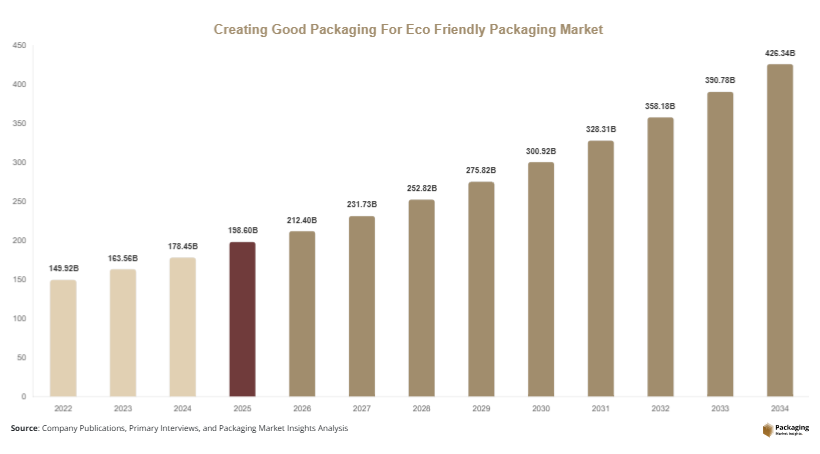
The global creating good packaging for eco friendly packaging market size is estimated at USD 198.6 billion in 2025. The market is projected to reach USD 212.4 billion in 2026 and expand steadily to USD 456.9 billion by 2034, registering a compound annual growth rate (CAGR) of 9.1% from 2025 to 2034. Growth is supported by the expansion of environmentally responsible packaging initiatives across both developed and emerging economies. Companies are redesigning packaging structures to minimize material use while improving product protection and logistics efficiency.
The global creating good packaging for eco friendly packaging market has gained significant attention as businesses, regulators, and consumers increasingly prioritize sustainability across supply chains. Eco-friendly packaging solutions focus on reducing environmental impact through recyclable materials, biodegradable components, minimal resource usage, and efficient design structures. These solutions are widely adopted across industries such as food and beverage, e-commerce, personal care, healthcare, and consumer electronics. The rising pressure on companies to reduce plastic waste and carbon emissions has accelerated investments in sustainable packaging design and manufacturing technologies.
Key Highlights
- Market size projected to reach USD 456.9 billion by 2034
- Expected CAGR of 9.1% between 2025 and 2034
- Growing consumer demand for environmentally responsible packaging
- Regulatory restrictions on plastic waste accelerating adoption
- E-commerce growth increasing demand for sustainable packaging solutions
Explore more data points, trends and opportunities Download Free Sample Report
Market Trends
Increasing Adoption of Biodegradable and Compostable Materials
One notable trend shaping the creating good packaging for eco friendly packaging market is the increasing adoption of biodegradable and compostable materials. Companies are shifting away from traditional petroleum-based plastics toward materials such as molded fiber, plant-based polymers, and compostable films. These materials naturally break down under environmental conditions, reducing long-term waste accumulation. Food service companies and consumer goods manufacturers are particularly active in adopting biodegradable packaging to meet sustainability commitments. Manufacturers are also improving material durability and barrier properties to ensure these eco-friendly solutions can match conventional packaging performance. This trend is expected to accelerate as innovation in material science continues to enhance the cost efficiency and functionality of biodegradable packaging products.
Integration of Smart and Minimalist Packaging Design
Another significant trend in the market is the integration of smart and minimalist packaging design approaches. Companies are increasingly focusing on reducing material usage while improving packaging efficiency. Minimalist packaging designs reduce unnecessary layers and utilize lightweight structures that maintain product protection during transportation. At the same time, smart packaging technologies such as QR codes and digital tracking features are being integrated into eco-friendly packaging to enhance supply chain transparency and consumer engagement. These innovations allow brands to provide product information, recycling instructions, and sustainability messaging through digital platforms instead of printed materials. The convergence of minimal design and digital communication helps reduce resource consumption while strengthening the environmental value of packaging solutions.
Market Drivers
Growing Consumer Awareness of Environmental Sustainability
The increasing awareness of environmental sustainability among consumers is a major driver of the creating good packaging for eco friendly packaging market. Consumers are becoming more conscious about the environmental impact of packaging waste, especially plastic pollution. As a result, many shoppers prefer products packaged in recyclable, biodegradable, or reusable materials. Retailers and consumer brands are responding to this shift by redesigning packaging to align with sustainability expectations. Eco-friendly packaging not only helps reduce environmental impact but also enhances brand credibility. Companies that adopt sustainable packaging strategies often experience stronger customer loyalty and improved market positioning, encouraging further investment in eco-friendly packaging innovation.
Expansion of Sustainability Regulations and Corporate Commitments
Government regulations and corporate sustainability commitments are another important driver supporting market growth. Several countries have introduced policies targeting plastic waste reduction, extended producer responsibility, and mandatory recycling targets. These regulations require manufacturers to reduce packaging waste and adopt recyclable materials. At the same time, large multinational companies have established sustainability goals focused on reducing packaging emissions and increasing recyclable content. These commitments are encouraging supply chain partners to develop eco-friendly packaging solutions that meet environmental targets. The combination of regulatory pressure and corporate sustainability strategies is creating consistent demand for environmentally responsible packaging across multiple industries.
Market Restraint
Higher Production Costs and Material Limitations
Despite strong demand growth, the creating good packaging for eco friendly packaging market faces challenges related to higher production costs and material limitations. Eco-friendly packaging materials such as biodegradable polymers, molded fiber, and recycled paper often require specialized manufacturing processes and supply chains. These materials can be more expensive than conventional plastic packaging, especially in large-scale production environments. For small and medium-sized manufacturers, the transition to sustainable packaging may increase operational costs and reduce profit margins.
In addition to cost challenges, certain eco-friendly materials may have performance limitations compared to traditional packaging solutions. For example, biodegradable materials may offer lower moisture resistance or reduced shelf life protection for certain food products. This can create difficulties for industries requiring strict packaging performance standards, such as pharmaceuticals or perishable food segments.
Another impact of this restraint is the limited availability of recycling infrastructure in some regions. Without efficient waste management systems, recyclable packaging materials may still end up in landfills. As a result, companies must balance environmental goals with practical considerations such as logistics efficiency and product safety.
Although technological innovation is gradually improving material performance and cost efficiency, the current price difference between conventional and eco-friendly packaging solutions remains a challenge for widespread adoption in cost-sensitive markets.
Market Opportunities
Expansion of Sustainable E-Commerce Packaging Solutions
The rapid growth of global e-commerce platforms presents a strong opportunity for the creating good packaging for eco friendly packaging market. Online retail operations require large volumes of shipping materials, including boxes, cushioning, and protective packaging. Many e-commerce companies are now redesigning packaging to reduce environmental impact while maintaining product safety during delivery. Eco-friendly packaging solutions such as recycled cardboard, molded pulp inserts, and paper-based cushioning are gaining traction. These materials reduce plastic usage and improve recyclability across logistics networks. As e-commerce shipments continue to expand globally, demand for sustainable packaging formats tailored to transportation efficiency is expected to increase significantly.
Technological Innovation in Bio-Based Packaging Materials
Technological advancements in bio-based materials represent another important opportunity for the market. Researchers and manufacturers are developing new packaging materials derived from renewable sources such as agricultural waste, seaweed, and plant-based polymers. These materials can reduce dependence on fossil-fuel-based plastics while offering improved biodegradability. Emerging technologies are also enhancing barrier properties and durability, making bio-based packaging suitable for food preservation and industrial applications. As research investment continues to expand, the commercialization of advanced bio-materials could transform the eco-friendly packaging industry and create new revenue streams for manufacturers.
Report Scope
| Report Metric | Details |
|---|---|
| Market Size in 2025 | USD 198.6 Billion |
| Market Size in 2026 | USD 212.4 Billion |
| Market Size in 2034 | USD 456.9 Billion |
| CAGR | 9.1% (2026-2034) |
| Base Year for Estimation | 2025 |
| Historical Data | 2022-2024 |
| Forecast Period | 2026-2034 |
| Report Coverage | Revenue Forecast, Competitive Landscape, Supply Chain Disruption, Growth Factors, Environment & Regulatory Landscape and Trends |
| Geographies Covered | North America, Europe, APAC, Middle East and Africa, LATAM |
| Countries Covered | U.S., Canada, U.K., Germany, France, Spain, Italy, Russia, Nordic, Benelux, Rest of Europe, China, South Korea, Japan, India, Australia, Singapore, Taiwan, South East Asia, Rest of Asia-Pacific, UAE, Turky, Saudi Arabia, South Africa, Egypt, Nigeria, Rest of MEA, Brazil, Mexico, Argentina, Chile, Colombia, Rest of LATAM |
Explore more data points, trends and opportunities Download Free Sample Report
Segmental Analysis
By Material Type
The paper and paperboard segment dominated the creating good packaging for eco friendly packaging market in 2024, accounting for approximately 41.3% of total market share. Paper-based materials are widely used due to their recyclability, cost efficiency, and strong consumer acceptance. These materials are commonly used in shipping boxes, food containers, and retail packaging. Paper packaging also offers customization advantages, allowing companies to incorporate branding elements while maintaining eco-friendly attributes. The growing demand for sustainable e-commerce packaging has further strengthened the dominance of paper-based materials across logistics operations.
The bioplastics segment is expected to be the fastest-growing material category, registering a CAGR of 10.8% during the forecast period. Bioplastics are derived from renewable resources such as corn starch, sugarcane, and plant oils. These materials can provide similar performance characteristics to conventional plastics while reducing environmental impact. Advances in polymer science are improving the durability, flexibility, and barrier properties of bioplastics. As technology evolves and production costs decline, the adoption of bio-based plastic packaging is expected to expand across industries such as food service and consumer goods.
By Packaging Type
The rigid packaging segment held the largest share of the market in 2024, accounting for 46.7% of total revenue. Rigid eco-friendly packaging includes containers made from recycled plastics, glass, and molded fiber. These packaging formats provide strong structural integrity and are widely used for beverages, personal care products, and healthcare items. Rigid packaging also offers improved product protection during transportation and storage. Companies are increasingly incorporating recycled materials into rigid packaging structures to enhance sustainability while maintaining product safety standards.
The flexible packaging segment is expected to register the fastest growth, with a CAGR of 9.9% through 2034. Flexible packaging solutions, such as compostable pouches and recyclable films, use less material compared to rigid formats. This lightweight structure helps reduce transportation emissions and packaging waste. Flexible eco-friendly packaging is particularly popular in the food and snack industry due to its convenience and cost efficiency. Ongoing research into recyclable multilayer films and biodegradable flexible materials is expected to support continued expansion of this segment.
By End-Use Industry
The food and beverage industry dominated the creating good packaging for eco friendly packaging market in 2024, representing 38.5% of total market share. This industry generates a high volume of packaging waste, making sustainability initiatives particularly important. Many food manufacturers are transitioning to recyclable containers, compostable trays, and paper-based wrapping solutions. Retailers and restaurant chains are also adopting eco-friendly packaging to comply with plastic reduction policies and improve brand perception among environmentally conscious consumers.
The e-commerce industry is projected to be the fastest-growing end-use segment, expanding at a CAGR of 11.2% during the forecast period. The rapid growth of online retail has created strong demand for sustainable shipping materials. Companies are investing in recyclable cardboard boxes, paper cushioning systems, and biodegradable protective packaging to reduce environmental impact during delivery operations. As e-commerce logistics continue to expand globally, eco-friendly packaging solutions tailored to shipping efficiency are expected to play a critical role in market growth.
Creating Good Packaging For Eco Friendly Packaging Market Segmentations
Material Type
- Paper & Paperboard
- Bioplastics
- Glass
- Metal
- Others
Packaging Type
- Rigid Packaging
- Flexible Packaging
End-Use Industry
- Food & Beverage
- Personal Care & Cosmetics
- Healthcare
- E-Commerce
- Consumer Electronics
Regional Analysis
North America
North America accounted for approximately 29.4% of the global creating good packaging for eco friendly packaging market share in 2025. The region is expected to grow at a CAGR of 8.6% through 2034. Strong environmental regulations, high consumer awareness, and corporate sustainability initiatives support the adoption of eco-friendly packaging across industries. Large retail chains and e-commerce platforms are prioritizing recyclable and compostable packaging formats to reduce waste generation across supply chains.
The United States remains the dominant market within North America. A key growth factor is the increasing number of corporate sustainability commitments among major consumer brands. Companies across the food, beverage, and personal care industries are investing in recyclable packaging solutions and waste reduction programs. These initiatives are encouraging packaging manufacturers to develop innovative eco-friendly materials that meet regulatory and consumer expectations.
Europe
Europe represents a major regional market and accounted for 27.8% of global market share in 2025. The region is expected to grow at a CAGR of 8.9% during the forecast period. Strict environmental regulations, including plastic reduction policies and recycling mandates, have accelerated the transition toward eco-friendly packaging solutions. The European packaging industry is actively developing recyclable materials and closed-loop packaging systems to support circular economy initiatives.
Germany dominates the European market due to its advanced recycling infrastructure and strong sustainability policies. One unique growth factor is the widespread adoption of deposit return schemes and extended producer responsibility regulations. These policies encourage companies to design packaging that can be easily recycled or reused. As a result, manufacturers are investing in innovative materials that align with circular economy objectives.
Asia Pacific
Asia Pacific held 24.6% of the global market share in 2025 and is projected to register the fastest CAGR of 10.4% through 2034. Rapid industrialization, expanding consumer markets, and rising environmental awareness are contributing to strong demand for eco-friendly packaging solutions. Governments across the region are implementing policies to reduce plastic waste and promote sustainable packaging alternatives.
China leads the Asia Pacific market due to its large manufacturing sector and growing environmental policies. A key growth factor is the expansion of sustainable packaging within the country's rapidly growing e-commerce sector. Major logistics and online retail companies are introducing recyclable shipping materials and biodegradable packaging solutions to reduce packaging waste generated by online deliveries.
Middle East & Africa
The Middle East & Africa accounted for 9.1% of the global market share in 2025 and is projected to grow at a CAGR of 7.4% through 2034. Although the market is still developing, increasing awareness of environmental sustainability and waste management is encouraging adoption of eco-friendly packaging materials across industries such as food service and retail.
The United Arab Emirates is emerging as a leading market in the region. One important growth factor is the government's commitment to sustainability initiatives and waste reduction programs. Retail companies and hospitality businesses are increasingly adopting recyclable and biodegradable packaging materials to support national environmental goals and reduce landfill waste.
Latin America
Latin America represented 9.1% of the global creating good packaging for eco friendly packaging market in 2025 and is expected to expand at a CAGR of 7.8% during the forecast period. The region is witnessing growing interest in sustainable packaging as environmental awareness increases among consumers and policymakers.
Brazil dominates the Latin American market due to its large consumer goods industry and growing environmental policies. A unique growth factor is the rising adoption of bio-based packaging materials derived from agricultural resources such as sugarcane and corn. These renewable materials are supporting the development of eco-friendly packaging solutions while promoting sustainable agricultural value chains.
Competitive Landscape
The creating good packaging for eco friendly packaging market is moderately competitive, with several global packaging companies investing in sustainable material innovation and circular economy initiatives. Major players focus on developing recyclable, biodegradable, and lightweight packaging solutions that reduce environmental impact while maintaining functional performance.
One of the leading companies in the market is Amcor plc, which has established a strong presence in sustainable packaging development. The company has introduced recyclable packaging formats and invests heavily in research focused on reducing plastic waste and improving material recyclability.
Other key players such as Mondi Group, Tetra Pak, Smurfit Kappa, and DS Smith are also expanding their eco-friendly packaging portfolios. These companies are investing in biodegradable materials, fiber-based packaging solutions, and recycling technologies to support global sustainability goals.
Recent developments in the competitive landscape include partnerships between packaging manufacturers and consumer brands to develop closed-loop recycling systems. Companies are also increasing investments in sustainable packaging research centers and production facilities. These initiatives aim to improve material performance, reduce production costs, and accelerate the adoption of environmentally responsible packaging solutions across multiple industries.
Key Players List
- Amcor plc
- Mondi Group
- Tetra Pak International
- Smurfit Kappa Group
- DS Smith Plc
- WestRock Company
- International Paper Company
- Stora Enso Oyj
- Sealed Air Corporation
- Berry Global Inc.
- Huhtamaki Oyj
- Sonoco Products Company
- Uflex Ltd.
- Coveris Holdings S.A.
- Graphic Packaging International