Covid Vaccine Packaging Market Size
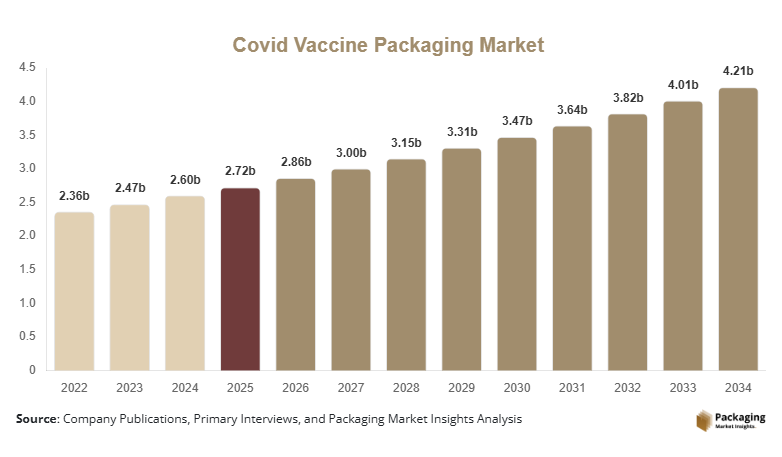
Covid Vaccine Packaging market size is projected at USD 2.86 billion in 2026 and is expected to hit USD 4.21 billion by 2034 with a CAGR of 4.95%. Continued immunization programs, booster dose requirements, and investments in pharmaceutical cold-chain infrastructure continue supporting packaging demand worldwide. The report provides detailed analysis of production capacity, market segmentation, technological advancements, and competitive landscape across the global vaccine packaging industry.
The Covid vaccine packaging market comprises primary and secondary packaging solutions including glass vials, prefilled syringes, labels, cartons, insulated shippers, and temperature-controlled transport systems used for vaccine storage and distribution. Global production exceeded 18.7 billion packaging components in 2025, while glass vial packaging represented nearly 56% of total demand. mRNA vaccine applications accounted for approximately 49% of packaging consumption, while automated pharmaceutical packaging penetration surpassed 72% across major manufacturing facilities. Investments exceeding USD 1.6 billion in pharmaceutical packaging modernization continue strengthening the Covid vaccine packaging market.
Explore more data points, trends and opportunities Download Free Sample Report
Covid Vaccine Packaging Trends
Increasing Adoption of Advanced Cold-Chain Packaging Technologies
Demand for ultra-low-temperature packaging systems increased by 16% during 2025 as pharmaceutical manufacturers enhanced global vaccine distribution capabilities. More than 3.8 billion insulated packaging units were utilized for temperature-sensitive vaccines, while digital temperature monitoring adoption exceeded 68% across international logistics networks. Smart packaging technologies continue improving traceability and product integrity throughout the Covid vaccine packaging market.
Pharmaceutical manufacturers increasingly deploy recyclable insulated containers and RFID-enabled labels to improve supply chain efficiency. Production of pharmaceutical glass vials exceeded 11 billion units, while prefilled syringe output surpassed 2.4 billion units. Approximately 58% of newly commissioned packaging lines incorporated automated inspection and serialization systems, reinforcing the Covid vaccine packaging market.
Covid Vaccine Packaging Drivers
Expansion of Booster Vaccination and Pandemic Preparedness Programs
Governments allocated more than USD 24 billion toward vaccine preparedness initiatives during 2025. Booster vaccination campaigns continued across multiple countries, supporting annual packaging demand exceeding 4.5 billion vaccine doses. More than 66% of pharmaceutical manufacturers expanded sterile packaging capacity, accelerating the Covid vaccine packaging market.
Covid Vaccine Packaging Restraints
Declining Emergency Vaccine Procurement Volumes
Global emergency procurement volumes declined by approximately 18% compared with peak pandemic levels, reducing short-term demand for specialized vaccine packaging. Excess manufacturing capacity affected nearly 29% of packaging suppliers, while pricing pressure increased by 9% across selected pharmaceutical packaging products. These factors continue influencing the Covid vaccine packaging market.
Covid Vaccine Packaging Opportunities
Growth of Next-Generation Vaccine Development
Development of updated mRNA formulations and combination respiratory vaccines increased pharmaceutical R&D investments by 14% during 2025. More than 57% of vaccine developers adopted advanced sterile packaging technologies supporting multi-dose and single-dose delivery systems. Investments exceeding USD 900 million in pharmaceutical packaging innovation present long-term opportunities for the Covid vaccine packaging market.
Challenges in Covid Vaccine Packaging
Maintaining Cold-Chain Integrity Across Global Distribution
Approximately 12% of temperature-sensitive pharmaceutical shipments experience cold-chain deviations during transportation. Maintaining storage temperatures between -70°C and 8°C requires specialized insulated packaging and continuous monitoring systems. Logistics costs account for nearly 21% of total vaccine distribution expenditure, presenting ongoing challenges for the Covid vaccine packaging market.
Report Scope
| Report Metric | Details |
|---|---|
| Market Size in 2025 | USD 2.72 billion |
| Market Size in 2026 | USD 2.86 billion |
| Market Size in 2034 | USD 4.21 billion |
| CAGR | 4.95% (2026-2034) |
| Base Year for Estimation | 2025 |
| Historical Data | 2022-2024 |
| Forecast Period | 2026-2034 |
| Report Coverage | Revenue Forecast, Competitive Landscape, Supply Chain Disruption, Growth Factors, Environment & Regulatory Landscape and Trends |
| Geographies Covered | North America, Europe, APAC, Middle East and Africa, LATAM |
| Countries Covered | U.S., Canada, U.K., Germany, France, Spain, Italy, Russia, Nordic, Benelux, Rest of Europe, China, South Korea, Japan, India, Australia, Singapore, Taiwan, South East Asia, Rest of Asia-Pacific, UAE, Turky, Saudi Arabia, South Africa, Egypt, Nigeria, Rest of MEA, Brazil, Mexico, Argentina, Chile, Colombia, Rest of LATAM |
Explore more data points, trends and opportunities Download Free Sample Report
Covid Vaccine Packaging Market Segmentation
Glass vials dominate with approximately 56% market share due to extensive multi-dose vaccine usage, while mRNA vaccine applications contribute nearly 49% of total packaging demand. Automation, traceability, and temperature-controlled logistics continue driving technological advancements across the market.
By Type
Glass Vials account for approximately 56% of total demand with annual production exceeding 11 billion units. Borosilicate glass provides high chemical resistance, sterility, and compatibility with multi-dose vaccine formulations while maintaining excellent storage performance.
Prefilled Syringes represent around 24% of market demand, with annual production exceeding 2.4 billion units. These systems improve dosing accuracy, reduce contamination risks, and support rapid vaccination campaigns through ready-to-use delivery.
Secondary Packaging contributes nearly 20% of global demand through cartons, labels, insulated containers, and transport packaging. Automated serialization and tamper-evident technologies improve traceability and regulatory compliance.
By Application
mRNA Vaccines hold approximately 49% of packaging demand owing to stringent cold-chain requirements and high production volumes. Specialized insulated packaging and pharmaceutical glass containers remain essential for maintaining vaccine stability.
Viral Vector Vaccines account for nearly 29% of market demand, utilizing sterile glass vials and secondary pharmaceutical packaging for global distribution and storage.
Protein Subunit Vaccines contribute approximately 22% of total demand, supported by increasing commercialization of next-generation vaccines and expanding immunization programs.
Covid Vaccine Packaging Market Segmentations
Product Type
- Glass Vials
- Prefilled Syringes
- Secondary Packaging
Application
- mRNA Vaccines
- Viral Vector Vaccines
- Protein Subunit Vaccines
Distribution Channel
- Direct Supply to Pharmaceutical Companies
- Medical & Pharmaceutical Distributors
- Government Procurement
- Hospital & Healthcare Networks
- Contract Packaging Organizations
Covid Vaccine Packaging Regional Outlook
North America
North America accounts for approximately 34% of global revenue. The United States contributes nearly 83% of regional demand through advanced pharmaceutical manufacturing, vaccine development, and cold-chain logistics infrastructure.
Europe
Europe represents around 28% of the market, led by Germany, Belgium, France, and Switzerland. Pharmaceutical manufacturing investments and vaccine exports continue supporting advanced packaging demand.
Asia-Pacific
Asia-Pacific holds approximately 29% of global demand. China, India, Japan, and South Korea continue expanding pharmaceutical packaging production while increasing vaccine manufacturing capacity for domestic and export markets.
Latin America
Latin America contributes around 5% of market demand. Brazil and Mexico lead regional pharmaceutical packaging investments supporting immunization and biologics manufacturing.
Middle East & Africa
The Middle East & Africa account for approximately 4% of global demand. Expanding pharmaceutical infrastructure and vaccine distribution programs continue increasing investments in temperature-controlled packaging.
Top players in Covid Vaccine Packaging
- Schott AG
- Gerresheimer AG
- SGD Pharma
- Corning Incorporated
- West Pharmaceutical Services, Inc.
- Stevanato Group
- Nipro Corporation
- Becton, Dickinson and Company (BD)
- DWK Life Sciences
- AptarGroup, Inc.
- Berry Global Inc.
- Amcor plc
- Catalent, Inc.
- PCI Pharma Services
- Sharp Services LLC
Schott AG
-
Estimated global market share of 16%–18%.
-
Leading supplier of pharmaceutical borosilicate glass vials used for vaccine packaging worldwide.
-
Operates advanced manufacturing facilities across Europe, North America, and Asia supporting billions of sterile containers annually.
-
Invests significantly in pharmaceutical glass innovation, sustainability, and high-capacity production technologies.
Gerresheimer AG
-
Estimated market share of 12%–14% globally.
-
Provides pharmaceutical packaging solutions including glass vials, syringes, and primary containment systems.
-
Strong partnerships with leading vaccine manufacturers and biologics producers worldwide.
-
Focuses on automation, quality assurance, sterile manufacturing, and next-generation pharmaceutical packaging technologies.