Cotton Bags Market Size
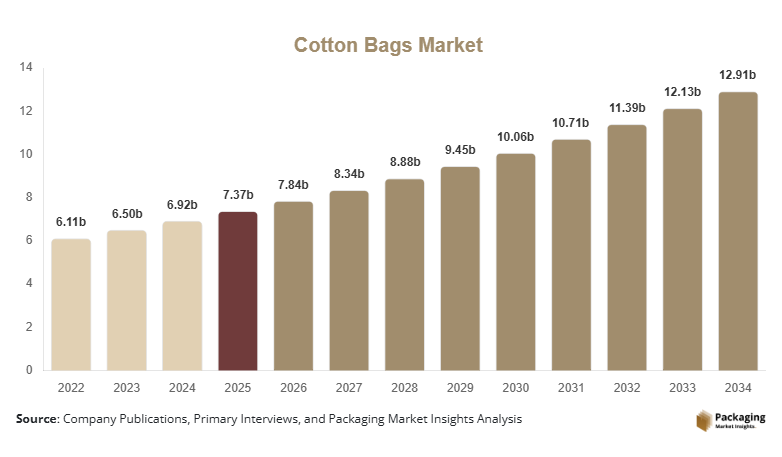
Cotton Bags market size is projected at USD 7.84 billion in 2026 and is expected to hit USD 12.91 billion by 2034 with a CAGR of 6.43%. The report provides a comprehensive assessment of production capacity, pricing trends, demand analysis, segmentation, and the competitive landscape across global markets. It evaluates historical performance from 2022–2024, the 2025 base year, and forecasts through 2034, covering more than 40 countries, 300 manufacturers, and over 16.5 billion cotton bags produced annually.
The Cotton Bags market comprises reusable bags manufactured using natural cotton fibers for shopping, packaging, retail, food service, and promotional applications. Global production exceeded 16.5 billion units in 2025, with reusable tote bags accounting for nearly 48% of total output, shopping bags contributing 34%, and drawstring bags representing 18%. Retail applications generated approximately 45% of total demand, while promotional usage contributed 30% and food & beverage applications accounted for 25%. Adoption of reusable cotton bags surpassed 59% among organized retailers, reinforcing the Cotton Bags market.
Explore more data points, trends and opportunities Download Free Sample Report
Cotton Bags Trends
Rising Adoption of Sustainable and Reusable Packaging
Global demand for reusable packaging continues to rise as governments introduce restrictions on single-use plastics. Production of organic cotton bags exceeded 4.8 billion units during 2025, representing an annual increase of 13.6%. More than 62% of large retail chains have adopted reusable cotton bag programs, while recycled cotton usage increased by 18% year over year. Digital printing and water-based inks are further enhancing product customization across the Cotton Bags market.
Manufacturers are investing in automated stitching, laser cutting, and digital printing technologies to improve efficiency and product quality. Automated production lines now manufacture over 32,000 bags per day, reducing production waste by nearly 15%. Demand from supermarkets, fashion retailers, and promotional campaigns increased by 9.4%, while premium cotton bag sales expanded by 11.2%, supporting the Cotton Bags market.
Cotton Bags Market Drivers
Increasing Restrictions on Single-Use Plastic Bags
More than 90 countries have implemented regulations limiting plastic bag usage, encouraging the adoption of reusable alternatives. Retail demand increased by 12.4% during 2025, while supermarket distribution exceeded 7.2 billion cotton bags globally. Government sustainability initiatives and rising consumer environmental awareness continue to accelerate Cotton Bags market growth.
Cotton Bags Market Restraints
Fluctuating Cotton Prices and Production Costs
Raw cotton prices increased by approximately 10% during 2025, while labor expenses rose by 8% in several manufacturing regions. Raw materials account for nearly 55% of production costs, creating pricing pressure for manufacturers. Seasonal cotton supply fluctuations and higher logistics costs remain significant constraints for the Cotton Bags market.
Cotton Bags Market Opportunities
Expansion of Organic and Recycled Cotton Products
Demand for certified organic cotton bags increased by 17%, while recycled cotton product shipments exceeded 1.6 billion units in 2025. Investments in sustainable textile manufacturing surpassed USD 1.9 billion, and more than 54% of global retailers announced reusable packaging initiatives, creating long-term opportunities within the Cotton Bags market.
Challenges in Cotton Bags Market
Maintaining Cost Competitiveness Against Synthetic Alternatives
Manufacturers face challenges balancing affordability with premium-quality cotton materials. Production costs for certified organic cotton bags are approximately 18–24% higher than conventional products, while manufacturing lead times increased by 7% due to stricter sustainability standards. Efficient sourcing and automation remain essential challenges affecting the Cotton Bags market.
Report Scope
| Report Metric | Details |
|---|---|
| Market Size in 2025 | USD 7.37 billion |
| Market Size in 2026 | USD 7.84 billion |
| Market Size in 2034 | USD 12.91 billion |
| CAGR | 6.43% (2026-2034) |
| Base Year for Estimation | 2025 |
| Historical Data | 2022-2024 |
| Forecast Period | 2026-2034 |
| Report Coverage | Revenue Forecast, Competitive Landscape, Supply Chain Disruption, Growth Factors, Environment & Regulatory Landscape and Trends |
| Geographies Covered | North America, Europe, APAC, Middle East and Africa, LATAM |
| Countries Covered | U.S., Canada, U.K., Germany, France, Spain, Italy, Russia, Nordic, Benelux, Rest of Europe, China, South Korea, Japan, India, Australia, Singapore, Taiwan, South East Asia, Rest of Asia-Pacific, UAE, Turky, Saudi Arabia, South Africa, Egypt, Nigeria, Rest of MEA, Brazil, Mexico, Argentina, Chile, Colombia, Rest of LATAM |
Explore more data points, trends and opportunities Download Free Sample Report
Cotton Bags Market Segmentation
The market is segmented by product type and end user. Tote cotton bags dominate with approximately 48% market share, followed by shopping cotton bags at 34% and drawstring cotton bags at 18%. Retail applications contribute nearly 45% of total demand, promotional applications 30%, and food & beverage applications 25%.
By Product Type
Drawstring bags account for nearly 18% of the market, with production exceeding 3.0 billion units annually. These lightweight bags are widely used for promotional kits, footwear packaging, and gift applications due to their durability and reusability.
Tote bags hold approximately 48% market share with annual production surpassing 7.9 billion units. Manufactured using cotton fabrics ranging from 120–350 GSM, they provide superior carrying capacity and are extensively adopted by retailers and supermarkets.
Shopping cotton bags represent approximately 34% of the market, with production exceeding 5.6 billion units annually. These bags feature reinforced handles, reusable designs, and customizable printing for retail and grocery applications.
By End User
Retail applications account for nearly 45% of global demand, consuming more than 7.4 billion bags annually. Large supermarket chains and fashion retailers increasingly replace plastic bags with reusable cotton alternatives to meet sustainability targets.
Food & beverage applications contribute approximately 25% of demand, utilizing over 4.1 billion bags annually for bakery products, takeaway services, and grocery packaging while supporting environmentally friendly packaging practices.
Promotional applications represent nearly 30% of the market, with production exceeding 5.0 billion units. Businesses increasingly use customized cotton bags for branding, exhibitions, and corporate events due to their high visibility and reusability.
Cotton Bags Market Segmentations
Product Type
- Drawstring Cotton Bags
- Tote Cotton Bags
- Shopping Cotton Bags
End User
- Retail
- Food & Beverage
- Promotional
Cotton Bags Regional Outlook
North America
North America accounted for approximately 27% of global revenue in 2025, producing over 4.2 billion units annually. The United States contributed nearly 79% of regional demand through retail, grocery, and promotional sectors.
Europe
Europe represented approximately 31% of the global market, with annual production exceeding 5.1 billion units. Germany, France, Italy, and the United Kingdom collectively generated over 70% of regional consumption due to strict environmental regulations.
Asia-Pacific
Asia-Pacific held the largest share at nearly 35%, producing more than 5.8 billion units annually. China and India contributed over 68% of regional production, supported by abundant cotton availability and large-scale textile manufacturing.
Latin America
Latin America accounted for approximately 4% of the global market. Brazil and Mexico generated nearly 71% of regional demand through retail modernization and increasing environmental awareness.
Middle East & Africa
The Middle East & Africa represented nearly 3% of the market, supported by expanding retail infrastructure and growing adoption of reusable packaging solutions across GCC countries and South Africa.
Top players in Cotton Bags Market
- Enviro-Tote Inc.
- Bullet Line LLC
- Cotton Bag Co.
- BAGGU Corporation
- Earthwise Bag Company Inc.
- Eco Bags Products Inc.
- Westford Mill
- Simple Ecology LLC
- Custom Earth Promos
- The Clever Baggers Ltd.
- ReBagCo
- Green Bag Company
Enviro-Tote Inc.
-
Estimated market share: 9–11%.
-
Strong presence in reusable cotton shopping bags for retail and promotional applications.
-
Operates with a broad product portfolio focused on organic cotton, recycled materials, and customized printing. The company supplies supermarkets, retailers, and corporate customers while emphasizing domestic manufacturing, sustainable sourcing, and environmentally responsible production processes.
Cotton Bag Co.
-
Estimated market share: 7–9%.
-
Well-established supplier of reusable cotton bags across Europe and international markets.
-
Specializes in premium tote bags, promotional bags, and customized packaging solutions. The company continues to invest in organic cotton sourcing, advanced printing technologies, and environmentally certified manufacturing to strengthen its competitive position.